
Best Portable Power Station 2026: 5 Picks for Camping & Outages
Table of Contents
The power goes out at 2 a.m., or you are three days into a camping trip with a dead phone and a cooler full of food that needs to stay cold. A portable power station is the box that solves both problems: a big rechargeable battery with AC outlets, USB ports, and a car socket, in a package you can carry with one hand.
This guide cuts through the noise. Every pick below uses a lithium iron phosphate (LiFePO4) battery, which is the chemistry that matters most in 2026: whether you need the best portable power station 2026 has to offer for camping, for home backup, or for a bit of both, one of these five will fit.
How to Choose a Portable Power Station: The 3 Numbers That Matter
Before the picks, a quick sizing lesson, because it saves more money than any discount. Three numbers decide whether a power station will run your gear: capacity, output, and battery chemistry.
Capacity, in watt-hours (Wh), is how much energy the battery holds — the size of the tank. A 1,000Wh station holds roughly ten times the energy of a 100Wh laptop power bank. To estimate runtime, multiply the capacity by 0.85 (to account for inverter losses) and divide by the watts your device draws.
Output, in watts (W), is how much power the station can deliver at once — the size of the pipe. A 1,500W inverter will run a coffee maker, a microwave, or a power tool; a 600W inverter will not. Check the running watts of the hungriest thing you plan to plug in, and add a margin for the startup surge, which can be two or three times the running watts for motors and compressors.
Battery chemistry is the long-term value question. LiFePO4 cells are rated for 3,000 to 4,000 charge cycles before dropping to 80% capacity — roughly ten years of regular use. Older NMC lithium-ion cells are typically rated for 500 to 800 cycles. Every pick in this guide is LiFePO4, and in 2026 there is no good reason to buy a new station that is not.
A quick sizing guide
For phones, laptops, lights, and a camera — a weekend of light use — 300 to 500Wh is enough. For a weekend of camping with a small fridge, lights, and device charging, aim for 1,000Wh. For keeping a full-size fridge, a few lights, and a phone charged through a 24-hour outage, you want 2,000Wh or more, or a 1,000Wh station you can recharge from solar panels during the day. If you are kitting out a home office for outages, our guide to the best budget soundbars of 2026 covers the other half of a comfortable backup setup.
| Use case | Capacity to buy | Output to buy |
|---|---|---|
| Phones, laptops, lights (weekend) | 300–500Wh | 600W |
| Camping with a small fridge | 1,000Wh | 1,500W |
| 24-hour home outage (fridge + lights) | 2,000Wh or 1,000Wh + solar | 1,800–2,400W |
| Power tools / high-draw appliances | 1,000Wh+ | 1,800W+ |
Best Portable Power Station 2026: The 5 Picks
1. Best Overall: Jackery Explorer 1000 v2 — around $519–$559
The Jackery Explorer 1000 v2 is the pick for most people, and the reason is balance. It packs 1,070Wh of LiFePO4 capacity and a 1,500W continuous inverter (3,000W surge) into a 23.8-pound box — the lightest unit in its class — It charges from a wall outlet to full in about an hour using its app-enabled emergency super-charging mode, accepts up to 400W of solar input, and is rated for 4,000 charge cycles. Jackery lists it at $519 on its own store (list price $589), and it has been seen at $559 on Amazon, where it holds a 4.7-star rating from more than 3,700 buyers.
What sets it apart is how little there is to think about. It is the station you buy when you want one box that handles a weekend of camping and a night without power, and you do not want to become a power-station hobbyist to use it. The trade-offs are real but narrow: it is not expandable, so if your needs grow you will need a second unit, and its 20-millisecond UPS switchover is slower than the sub-10-millisecond switching on some rivals, which matters if you are protecting a desktop computer rather than a fridge. For most buyers, neither is a dealbreaker. Check the current price on a recent independent roundup of 2026 power stations before buying — prices on these units move with sales.
2. Best Value: BLUETTI AC180 — around $499
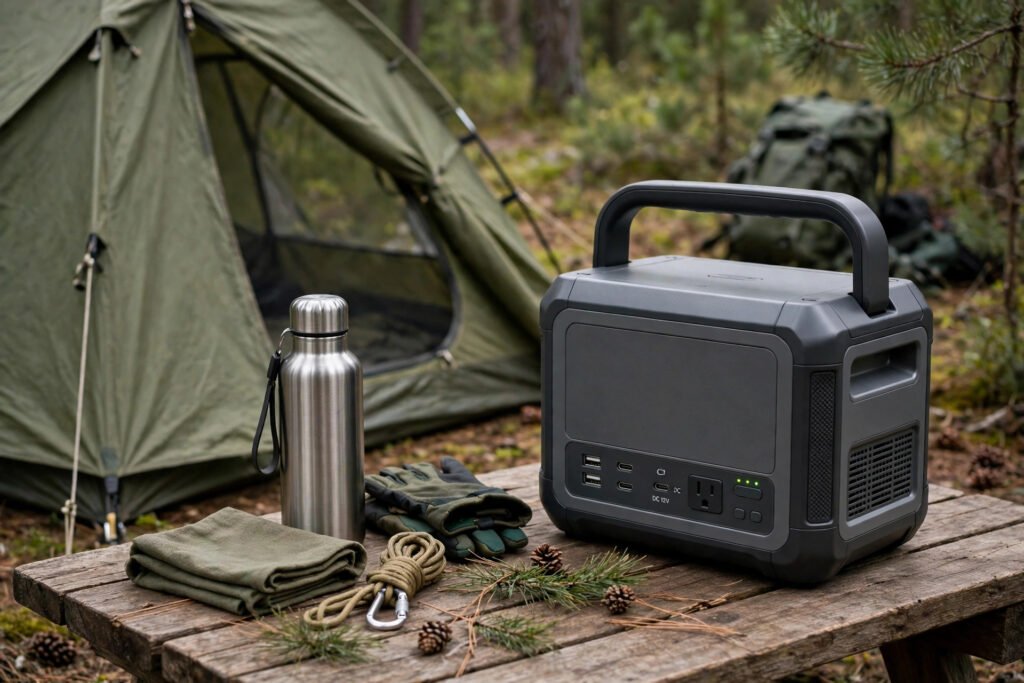
If the Jackery is the best all-rounder, the BLUETTI AC180 is the most power per dollar. For about $499 on BLUETTI’s US store, you get 1,152Wh of LiFePO4 capacity — more than the Jackery — and a stronger 1,800W continuous inverter with a 2,700W surge, plus a 20-millisecond UPS.
The catch is weight: at 35.3 pounds it is nearly 50% heavier than the Jackery, which you will notice carrying it from the car to the campsite. But if the station mostly lives in a garage or a closet and comes out for outages and car camping, the extra capacity and output for less money are hard to argue with. The AC180 is the pick for buyers who want the biggest numbers on the spec sheet for the smallest price — and at $499 it is, watt-hour for watt-hour, the best value in this guide. A detailed Jackery vs EcoFlow vs BLUETTI comparison reaches the same conclusion on value.
3. Best for Home Backup: EcoFlow DELTA 3 Max — around $879
When the job is keeping a house running through an outage, capacity is king, and the EcoFlow DELTA 3 Max is the pick. It holds 2,048Wh with a 2,400W continuous inverter, a 10-millisecond UPS switchover that will keep a desktop computer and a router alive through the flicker, It is rated 4.7 stars from more than 650 Amazon buyers, where it has been seen at $878.99.
Two thousand watt-hours is the threshold where a station stops being a camping accessory and starts being a genuine home backup device: it will run a full-size fridge for the better part of a day, keep the Wi-Fi and a few lights going, and charge every phone in the house, with room to spare. If outages are your main concern, our guide on how to boost your Wi-Fi signal at home pairs well with this pick, because a router on backup power is only useful if the signal reaches the rooms you are sitting in. But if your main fear is a winter storm knocking out power for a day, this is the unit to buy — and pairing it with a 200W solar panel turns a one-day box into a multi-day one.
4. Best Expandable: EcoFlow DELTA 3 Plus — around $719
The EcoFlow DELTA 3 Plus is the pick for buyers who want to start at 1,000Wh and grow. On its own it is a strong mid-size station: 1,024Wh of LiFePO4, a 1,800W continuous inverter with a 3,600W surge, up to 500W of solar input, a sub-10-millisecond UPS, 4,000 cycles to 80%, and a five-year warranty — all in a 27.6-pound box with an IP65-rated battery pack. The official US price is $719.
What makes it special is the expansion path: add extra batteries and the system grows to 5kWh, which is enough to run a home’s essentials for a day or more. It also works with EcoFlow’s 800W alternator charger, which refills about 1kWh in roughly 1.3 hours of driving — a genuinely useful feature for van life and overlanding, where solar alone is slow and shore power is scarce. For most people the DELTA 3 Plus is the “buy once, grow later” option: more expensive than the Jackery or BLUETTI at the same capacity, but the only pick here that can become a whole-home system without replacing the box. Full specs and current pricing are in this independent 2026 van-life power station guide.
5. Best Lightweight: EcoFlow RIVER 3 Plus — around $279
Not everyone needs a kilowatt-hour. The EcoFlow RIVER 3 Plus is the pick for day trips, short camping weekends, and keeping a laptop and phones alive during a brief outage. It holds 286Wh of LiFePO4 with a 600W continuous inverter (1,200W with X-Boost), accepts up to 220W of solar, charges from a wall outlet in about an hour, and is expandable to 858Wh with an extra battery. It weighs just 10.4 pounds — light enough to carry in one hand with a bag of groceries in the other — The official price is $279 for the station alone.
The limitation is obvious: 286Wh will not run a fridge overnight. But for its job — phones, laptops, lights, a camera battery, a small fan — it is the most portable station in this guide by a wide margin, and the five-year warranty is the longest here. For the small electronics that go with it, our roundup of the best cheap wireless earbuds of 2026 covers the earbuds most likely to be charging off a box like this.
Side-by-Side Comparison
| Model | Capacity | Output | Weight | Price (Nov 2026) | Best for |
|---|---|---|---|---|---|
| Jackery Explorer 1000 v2 | 1,070Wh | 1,500W | 23.8 lb | ~$519–$559 | Best overall |
| BLUETTI AC180 | 1,152Wh | 1,800W | 35.3 lb | ~$499 | Best value |
| EcoFlow DELTA 3 Max | 2,048Wh | 2,400W | 44.8 lb | ~$879 | Home backup |
| EcoFlow DELTA 3 Plus | 1,024Wh | 1,800W | 27.6 lb | ~$719 | Expandable |
| EcoFlow RIVER 3 Plus | 286Wh | 600W | 10.4 lb | ~$279 | Lightweight |
Prices checked against official US stores and Amazon listings in October–November 2026. The ThemisReviews ranking of smart power stations, updated November 6, 2026 with prices checked the same day, reaches similar conclusions on the same models, which is a useful cross-check.

Solar Panels: Worth It?
A power station is only as good as its ability to recharge, and for camping that usually means solar. A 200W panel in good sun produces roughly 800Wh to 1,000Wh per day — enough to refill a 1,000Wh station in a day and a half of decent weather. The Jackery Solar Generator 1000 v2 kit, which pairs the Explorer 1000 v2 with a 200W panel, runs about $719 on Jackery’s site,
Solar is worth it if you camp for more than two nights or if outages in your area last longer than a day. One practical tip: panels are rated in ideal laboratory conditions, so expect 70% to 80% of the rated watts in real sunlight, and less on a cloudy day. Buy the panel from the same brand as the station — connectors and charge controllers vary, and cross-brand compatibility is a headache you do not need in the field.
Mistakes to Avoid When Buying a Portable Power Station
The most common mistake is buying on capacity alone. A 2,000Wh station with a 600W inverter cannot run a 1,000W microwave, no matter how big the battery is. Check the inverter first, then the capacity. The second mistake is ignoring the surge rating: a fridge compressor can draw two to three times its running watts for a second at startup, and a station that cannot handle the surge will shut down even though its continuous rating looks fine.
The third mistake is buying a non-LiFePO4 battery to save money. Older NMC cells are rated for 500 to 800 cycles, while LiFePO4’s 3,000 to 4,000 cycles are worth the small premium. And the fifth is skipping the warranty check — five years is the standard for the best brands in 2026, and a one- or two-year warranty on a $500 box is a warning sign.
Frequently Asked Questions
What size portable power station do I need?
For phones, laptops, and lights, 300–500Wh is enough. For a weekend of camping with a small fridge, buy 1,000Wh — that is the sweet spot most best portable power station 2026 roundups converge on. For a 24-hour home outage with a full-size fridge, you need 2,000Wh or a 1,000Wh station plus a solar panel. Add up the watts of everything you will run at once, and buy an inverter rated above that total.
How long does a 1,000Wh power station last?
It depends on the load. A 60W laptop runs for about 14 hours, a 150W mini-fridge for about 5 to 6 hours of continuous running (longer in practice, since fridges cycle on and off), and a phone charges dozens of times. Multiply the capacity by 0.85 for inverter losses, then divide by the device’s watts.
Are LiFePO4 power stations better?
Yes. LiFePO4 batteries last 3,000 to 4,000 charge cycles versus 500 to 800 for older NMC lithium-ion cells, handle heat better, and are more stable. Every pick in this guide uses LiFePO4, and it is the chemistry to insist on in 2026.
Can a portable power station run a fridge?
Yes, if the inverter is big enough. A full-size fridge draws about 100–200W while running but needs a surge of 600W or more at startup, so you need at least a 1,000W inverter — all five picks here qualify except the small RIVER 3 Plus, which is not a fridge box. A 1,000Wh station will run a fridge for roughly 8 to 12 hours in practice.
How long do portable power stations last?
A LiFePO4 station rated for 4,000 cycles will last a decade or more of regular use before its capacity drops to 80%. The electronics — inverter, ports, display — usually outlast the battery. Store the station at 50% to 80% charge if you will not use it for months, and top it up every three to six months.
Is it cheaper to buy a power station or a gas generator?
A gas generator is cheaper per watt and runs indefinitely on fuel, but it is loud, needs maintenance, produces exhaust, and cannot be used indoors. A power station is silent, maintenance-free, and safe indoors, but costs more per watt-hour and needs recharging. For short outages and camping, a power station wins; for multi-day outages with no sun, a generator still has a role.
Conclusion
The best portable power station 2026 buyers can choose depends on the job, but the shortlist is simple. The Jackery Explorer 1000 v2 is the best all-rounder for most people at around $519 to $559. The BLUETTI AC180 is the best value at around $499, with more capacity and output for less money. The EcoFlow DELTA 3 Max is the home-backup pick at around $879, and the DELTA 3 Plus is the expandable option at around $719. If you want something light, the EcoFlow RIVER 3 Plus at around $279 does the job.
Whatever you buy, insist on LiFePO4, size the inverter before the battery, and check the current price before checkout — these units go on sale often, . Buy the station before you need it, charge it to 80%, and put it somewhere you can find in the dark. The night the power goes out is a bad time to start shopping.