
Best Space Heater 2026: 5 Picks for Bedrooms, Offices, and Large Rooms

A cold room is a miserable room, and a bad space heater is worse than none at all: too small and it hums all night without warming you, too big and it trips the breaker, too cheap and it smells like burning dust. The best space heater 2026 has to do three things at once — heat the room you actually sit in, keep you safe while it runs, and cost a sensible amount to run. This guide picks five heaters that do that, from a $39.99 budget ceramic to a $549.99 Dyson that heats and cools, and explains the sizing math, the safety rules, and the running costs so you can buy once and buy right. For the bigger picture on keeping your home warm without wasting money, see our guide on how to save money on heating in winter.
How to Pick the Best Space Heater 2026 for Your Room
Start with the room, not the heater. A space heater is a room heater, and the size of the room decides the size of the heater. The rule of thumb the industry uses is 10 watts per square foot: a 100-square-foot bedroom needs about 1,000 watts, a 150-square-foot office needs about 1,500 watts, and a 300-square-foot living room needs a heater rated for large rooms or a second unit. Most plug-in heaters top out at 1,500 watts, which is the most a standard household circuit can safely deliver, so if your room is bigger than 150 square feet, you need either a heater designed for large rooms or a different heating strategy.
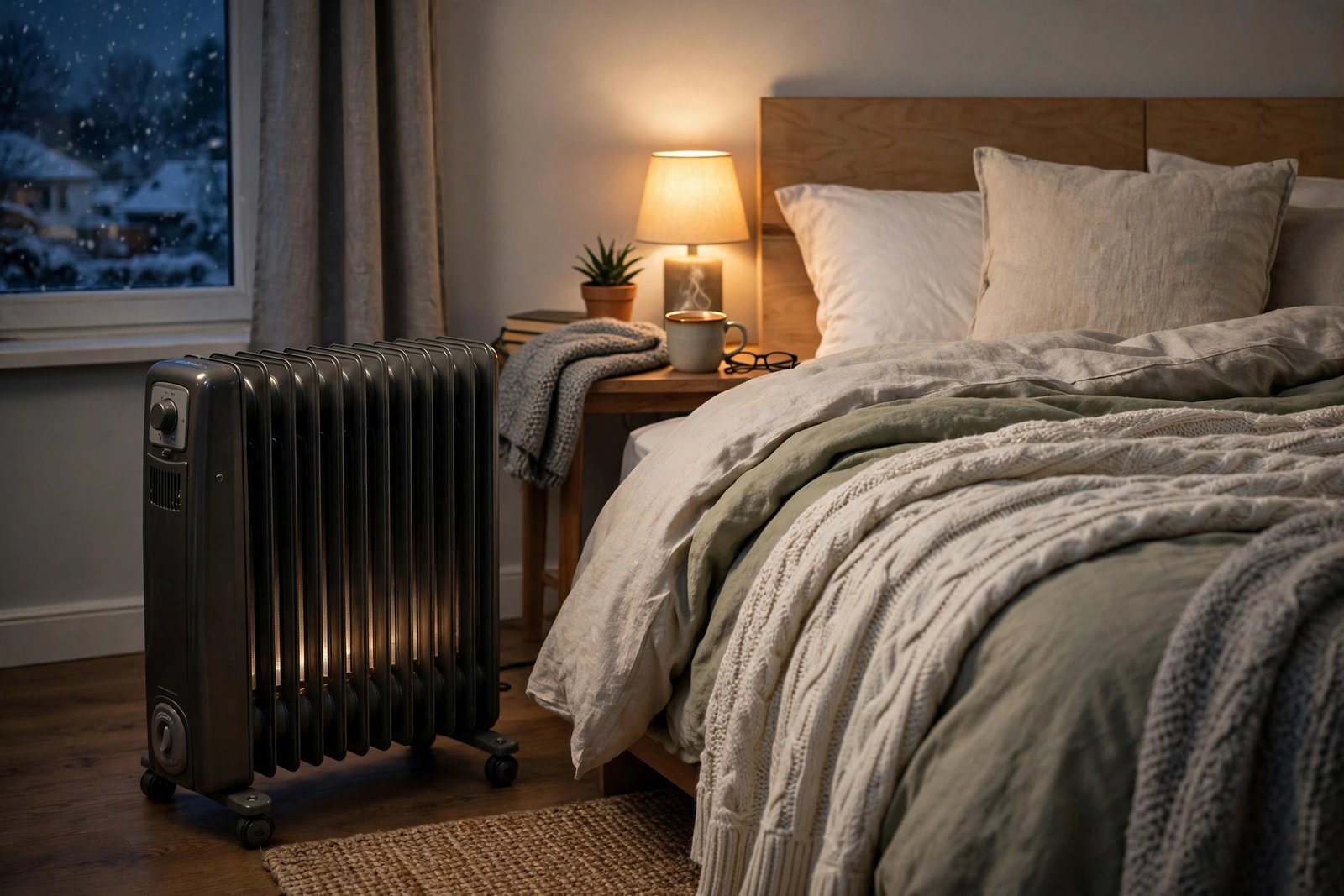
The second decision is the type. Ceramic heaters are the most common: a ceramic element heats up fast, a fan blows the warm air around, and the whole unit stays compact and light. Infrared heaters warm objects and people directly rather than the air, which feels like standing in sunlight and works well if you sit in one spot. Oil-filled radiators are slow and silent: they take 15 to 20 minutes to warm up, but they keep radiating heat after they switch off, and they are the quietest option for a bedroom. There is no single best type — there is only the best type for your room and your habits.
The third decision is safety, and it is the one that matters most. Space heaters are the leading cause of heating-related home fires in the United States, and almost all of those fires come from three mistakes: placing the heater too close to something flammable, leaving it running unattended, and plugging it into an extension cord or power strip. Every heater on this list has tip-over protection and overheat protection, and each one is certified by a recognized testing laboratory. Do not buy a heater without those features, no matter how cheap it is.
The 5 Best Space Heaters of 2026 at a Glance
| Pick | Type | Watts | Best for | Price |
|---|---|---|---|---|
| Best Overall: Dreo Solaris Slim H3 | Ceramic tower | 1,500 | Bedrooms and small living rooms | $74.99 |
| Best Value: Dreo Atom One | Ceramic | 1,500 | Offices and small rooms | $49.99 |
| Best Budget: Lasko 754200 | Ceramic | 1,500 | Small rooms and tight budgets | $39.99 |
| Best for Large Rooms: Dr Infrared Heater DR-988 | Infrared | 1,500 | Large rooms up to 1,000 sq ft | $129.99 |
| Best Splurge: Dyson Hot+Cool HP07 | Bladeless fan heater | 1,500 | Whole-room comfort, year-round use | $549.99 |
Prices checked November 2026 and change with the season, so verify the current price before you buy. We cross-checked our picks against independent testing: the best space heaters tested by Tom’s Guide, the best space heaters reviewed by weather.com, and the space heater roundup from Front Desk Review all point to the same conclusion — the Dreo Solaris Slim H3 is the pick most people should buy.
1. Best Overall: Dreo Solaris Slim H3 — $74.99
The Dreo Solaris Slim H3 is the best space heater for most people, and it is not close. The slim tower heats a bedroom to a comfortable temperature in about 15 minutes, and the oscillation spreads the warmth evenly rather than blasting one corner. The thermostat holds the room within a degree or two of the set point, so it cycles on and off rather than running flat out, and the 70-degree oscillation means you feel the heat wherever you sit. It has tip-over and overheat protection, a cool-touch exterior, and a remote control, and it is quiet enough at 34 decibels to sleep through. At $74.99 it is not the cheapest heater on this list, but it is the one we would buy with our own money.
2. Best Value: Dreo Atom One — $49.99
If you want the same Dreo quality in a smaller package, the Atom One is the pick. It is a compact ceramic heater that puts out the full 1,500 watts in a unit barely bigger than a shoebox, which makes it ideal for a desk, a dorm room, or a small bedroom. The digital thermostat is accurate to within a couple of degrees, and the 12-hour timer lets you set it to switch off after you fall asleep. It is louder than the Solaris Slim H3 on its highest setting, and it does not oscillate, so it works best when you sit in front of it rather than across the room. For $49.99, it is the best value heater we tested.
3. Best Budget: Lasko 754200 — $39.99
The Lasko 754200 is the cheapest heater worth buying. It is a simple ceramic heater with three settings — high heat, low heat, and fan only — and a thermostat that keeps the room roughly at the temperature you set. It does not have a remote, it does not oscillate, and it is louder than the Dreos, but it heats a small room reliably and it costs less than a takeaway dinner. If your budget is tight and your room is small, this is the heater to buy. One caution: the Lasko is a basic heater, and the thermostat is less precise than the Dreos, so expect the room temperature to drift a few degrees either side of your setting.
4. Best for Large Rooms: Dr Infrared Heater DR-988 — $129.99
Large rooms are where most space heaters fail, because 1,500 watts can only do so much. The Dr Infrared Heater DR-988 is the exception: it combines an infrared quartz tube with a PTC ceramic element and a blower, which lets it push warm air across a room of up to 1,000 square feet. It is not silent, and it is not small, but it is the only heater on this list that can genuinely warm a large living room on a cold evening. The digital thermostat is accurate, the remote works from across the room, and the dual heating system means it recovers quickly after a door opens. If your room is bigger than 150 square feet, this is the heater to buy.
5. Best Splurge: Dyson Hot+Cool HP07 — $549.99
The Dyson Hot+Cool HP07 is the most expensive heater on this list by a long way, and it is also the only one that works all year round. In winter it heats, in summer it cools, and in between it purifies the air with a HEPA filter that captures 99.97% of particles. The bladeless design is safe around children and pets, the oscillation covers a wide area, and the app lets you set schedules and check the air quality from your phone. It heats a room as effectively as the Dreo, but it costs seven times as much, so it only makes sense if you want the cooling and the air purification too. If you only need heat, buy the Dreo and spend the difference on something else.
What About the Lasko FH500?
Sharp-eyed readers will notice that the Lasko FH500, a heater that appeared in several 2026 roundups, is not on our list. The reason is simple: the FH500 was discontinued, and the units still for sale are old stock at inflated prices. We considered including it and decided against it, because recommending a heater you cannot buy at a fair price helps no one. The Lasko 754200 above is the current budget pick from the same manufacturer, and it is a better buy at a lower price.

Space Heater Safety: What the CPSC Wants You to Know
The U.S. Consumer Product Safety Commission has been clear about space heater safety for years, and the advice has not changed: keep the heater at least three feet from anything that can burn — curtains, bedding, furniture, and paper — and never leave it running when you leave the room or go to sleep. If you do fall asleep with a heater running, make sure it has a timer that switches it off. The CPSC recall list is worth checking before you buy any heater, new or secondhand, because recalled models do turn up on resale sites.
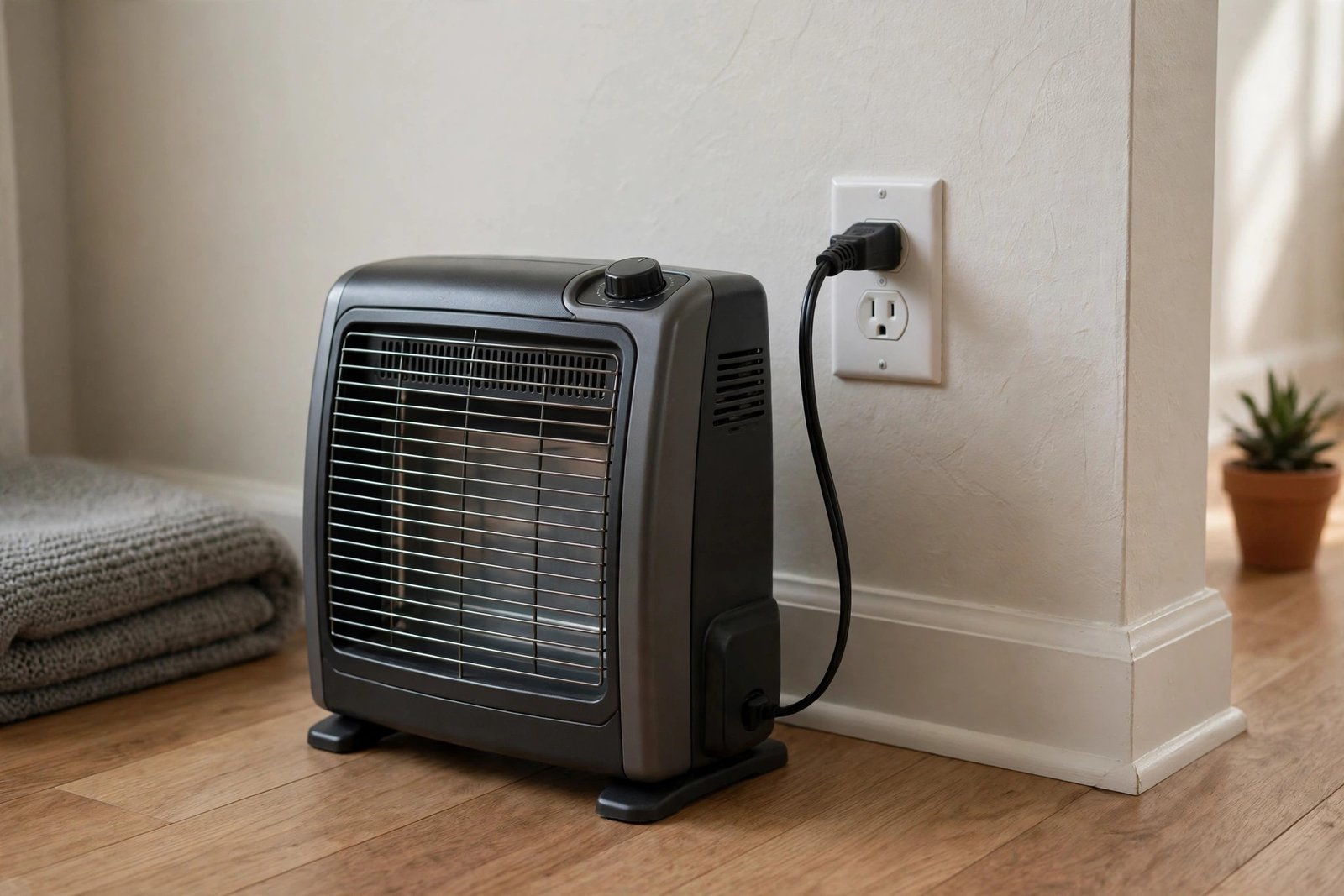
The second rule is about electricity. Never plug a space heater into an extension cord or a power strip: the heater draws up to 1,500 watts, which is the full capacity of a standard household circuit, and an extension cord can overheat and start a fire. Plug the heater directly into a wall outlet, and if the outlet or the plug feels hot, stop using it and call an electrician. If you need heat in a room with no free outlet, that is a sign you need an electrician, not an extension cord.
The third rule is about children and pets. Space heaters get hot, and a child or a pet that touches a hot element can be burned. Keep the heater out of reach, or choose a model with a cool-touch exterior and a tip-over switch, like the Dreo models on this list. And never dry clothes on a space heater: it is a fire risk, and it is how a surprising number of house fires start.
Ceramic, Infrared, or Oil-Filled: Which Type Fits Your Room?
Ceramic heaters are best for small to medium rooms where you want fast, even heat and you do not mind a little fan noise. Infrared heaters are best if you sit in one place and want to feel warm immediately, or if you have a large room and you want the heat to reach you rather than the ceiling. Oil-filled radiators are best for bedrooms, because they are silent and they keep the room warm through the night without cycling on and off. If you are still unsure, start with a ceramic heater: it is the most versatile type, and the Dreo Solaris Slim H3 is a good place to start.
Running Costs, Thermostats, and Saving Money
A space heater is cheap to buy and expensive to run if you use it badly. At the average U.S. electricity price of about 16 cents per kilowatt-hour, a 1,500-watt heater costs about 24 cents an hour to run on full power, which works out at roughly $1.92 for eight hours. The trick is the thermostat: a heater with an accurate thermostat cycles on and off to hold the room temperature, which can cut the running cost by half compared with a heater that runs flat out. Set the thermostat to 68°F, use the heater to warm the room you are in rather than the whole house, and turn it off when you leave the room. For more on keeping your bills down, see our guides on how to lower your electric bill in winter and the best portable power station 2026, which covers backup power for cold snaps.
One more way to save: use the heater to let you turn the central heating down. If you heat one room to 70°F with a space heater and let the rest of the house drop to 62°F, you can save money overall, because you are heating 150 square feet instead of 1,500. It is not a trick that works for every home, but it is worth trying for a week and checking the meter.
Frequently Asked Questions
What size space heater do I need?
Use 10 watts per square foot. A 100-square-foot bedroom needs about 1,000 watts, a 150-square-foot office needs about 1,500 watts, and a room larger than that needs a large-room heater or a second unit.
Are space heaters safe to leave on overnight?
No, not unless the heater has a timer and tip-over and overheat protection, and even then it is safer to switch it off. Never leave a heater running in a room with no one in it, and never dry clothes on one.
How much does it cost to run a space heater?
About 24 cents an hour on full power at the average U.S. electricity price, or roughly $1.92 for eight hours. A good thermostat can cut that by half by cycling the heater on and off.
Can I plug a space heater into an extension cord?
No. A space heater draws up to 1,500 watts, which is the full capacity of a household circuit. Plug it directly into a wall outlet, and never use a power strip.
Ceramic or infrared — which is better?
Ceramic is best for even, whole-room heat and for small to medium rooms. Infrared is best if you sit in one place and want to feel warm immediately. Oil-filled is best for silent, overnight heat in a bedroom.
Do space heaters dry out the air?
All heaters reduce the relative humidity a little, but a space heater does not dry the air more than central heating does. If the air feels dry, a small humidifier helps, and it will make the room feel warmer at the same temperature.
Conclusion: Buy for Your Room, Not for the Box
The best space heater 2026 is the one that fits your room, not the one with the biggest box or the loudest advertising. Measure your room, work out the watts you need, choose ceramic for fast, even heat or infrared for a large room, and buy a heater with tip-over and overheat protection from a brand you trust. The Dreo Solaris Slim H3 is our top pick for most people, the Dreo Atom One is the best value, and the Lasko 754200 is the budget pick that actually works. Whichever you choose, plug it directly into the wall, keep it three feet from anything flammable, and enjoy a warm room without a scary electricity bill.



