

Every successful business you’ve ever admired — from the corner bakery that always has a line out the door to the tech startup that just raised millions — started the same way: with a plan on paper. If you’re wondering how to write a business plan that actually works, you’re already ahead of most aspiring founders. Most people skip this step entirely, jumping straight to logos and websites, and then wonder why they run out of money six months in.
A business plan isn’t just paperwork for banks. It’s the document that forces you to answer the hard questions before your money is on the line: Who exactly will buy this? What will it cost to reach them? When does the business start paying for itself? In this guide, I’ll walk you through how to write a business plan step by step — the same structure lenders and investors expect — plus the common mistakes that get plans rejected and free resources that make the whole process easier.
Why Learning How to Write a Business Plan Actually Matters
Let’s address the elephant in the room: plenty of successful businesses started without a formal plan. So is this just busywork? The research says no — and the numbers are striking.
A study by Francis J. Greene and Christian Hopp, published in the Harvard Business Review, tracked more than 1,000 would-be entrepreneurs over six years and found that entrepreneurs who write formal plans are 16% more likely to achieve business viability than otherwise identical founders who don’t. Separately, research cited by Palo Alto Software found that businesses that plan and track their progress grow up to 30% faster than those that don’t.
Beyond the statistics, a plan does three practical things for you:
- It forces clarity. Vague ideas sound great in your head. Writing them down exposes the gaps — the missing costs, the fuzzy target customer, the optimistic revenue assumptions.
- It unlocks money. Banks, the SBA, and investors almost universally require a written plan before they’ll discuss funding. No plan, no loan — it’s that simple.
- It becomes your compass. Six months in, when you’re drowning in decisions, your plan reminds you what you actually set out to do and whether you’re on track.

Traditional vs. Lean: Pick the Right Format First
Before you write a single word, decide which format fits your situation. The U.S. Small Business Administration’s business plan guide recognizes two standard formats, and choosing the wrong one wastes weeks of effort.
| Feature | Traditional Business Plan | Lean Startup Plan |
|---|---|---|
| Length | 20–40+ pages, highly detailed | 1 page, high-level summary |
| Best for | Bank loans, SBA loans, investors | Early-stage validation, internal planning |
| Time to write | Several weeks | A few hours |
| Financial detail | Full projections, 3–5 years | Key metrics and cost structure only |
| Downside | Can become outdated quickly | Not enough detail for lenders |
If you’re seeking any kind of financing, write the traditional plan — lenders expect it. If you’re still testing whether your idea has legs, start with a lean one-pager; you can expand it later. Many founders do both: the lean plan to think, the traditional plan to fundraise.
How to Write a Business Plan in 9 Steps
Here’s the standard structure, in the order it appears in a finished plan. One important tip from experienced founders: write the executive summary last, even though it appears first. You can’t summarize a plan you haven’t written yet.
Step 1: Executive Summary
This is the one page most readers will actually read — sometimes the only page. In two to four short paragraphs, cover what your business does, the problem it solves, your target market, and your financial highlights. If you’re seeking funding, state exactly how much you need and what you’ll use it for. Write it crisply; every sentence should earn its place.
Step 2: Company Description
Introduce your business: its legal name, structure (LLC, sole proprietorship, corporation), location, and mission. Explain what makes you different — your unfair advantage. A mobile dog-grooming service isn’t just “dog grooming”; it’s “grooming for busy professionals who can’t visit a salon during work hours.” That specificity is what makes a company description memorable. If you’re still choosing a direction, browsing small business ideas can spark a concept worth building a plan around.
Step 3: Market Analysis
This is where most weak plans fall apart. You need to demonstrate that you understand your industry, your target customers, and your competitors — with evidence, not vibes.
Cover three things: industry outlook (is the market growing? cite industry reports or trade associations), target customer (be specific — “women aged 28–45 who buy organic groceries” beats “everyone”), and competitive landscape (who else serves these customers, what they charge, and where they’re weak). Never write “we have no competition.” Every business has competition, even if it’s just customers doing nothing. Lenders see that line as a red flag that you haven’t done the research.

Step 4: Organization and Management
Describe your business’s structure with a simple org chart, even if it’s just you. List the owners, key team members, and advisors, with a line or two about each person’s relevant experience. If you’re a solo founder, say so — and name the gaps you’ll fill with contractors, a bookkeeper, or a mentor. Lenders want to see that the people behind the plan can execute it.
Step 5: Products or Services
Describe what you sell and — more importantly — the benefit to the customer. Focus on outcomes, not features. A landscaping company doesn’t sell “weekly lawn mowing”; it sells “a yard you’re proud of without spending your Saturday on it.” Include pricing, and if you’re in research and development, note where you are in the product lifecycle. This section pairs naturally with thinking about starting an online store if your products will sell through e-commerce.
Step 6: Marketing and Sales Strategy
How will customers find you, and how will you convince them to buy? Break this into two parts. Marketing: your channels (local SEO, social media, referrals, partnerships), your positioning, and your budget. Sales: your actual process — how a stranger becomes a paying customer, your pricing strategy, and your sales targets. Be concrete: “We will acquire 40 customers per month through Google Ads at an estimated $35 cost per acquisition” is a plan; “we will market on social media” is a wish.
Step 7: Funding Request
If you’re seeking financing, this section is non-negotiable. State the exact amount you need, how you’ll use it (break it into categories: equipment, inventory, working capital, marketing), and what terms you’re looking for. Also explain your future funding plans — will you need a second round in 18 months? Lenders and investors want to know you’ve thought beyond the first check.
Step 8: Financial Projections
This is the section that makes most founders sweat, but it’s also the section lenders scrutinize most. You don’t need to be an accountant — you need to be realistic and thorough. Include:
- Startup costs: every dollar you’ll spend before opening day, itemized.
- Profit and loss projection: monthly for year one, then annually for years two through five.
- Cash flow projection: when money actually enters and leaves — this is different from profit, and it’s what keeps businesses alive.
- Break-even analysis: the month your revenue covers your costs. Know this number cold.
Base every number on research: supplier quotes, competitor pricing, commercial rent listings. Round numbers like “$10,000/month in marketing” with no sourcing destroy credibility. And run a conservative case alongside your expected case — lenders trust founders who’ve stress-tested their own optimism.

Step 9: Appendix
Park your supporting documents here: résumés, permits, lease agreements, detailed market data, product photos, and letters of intent from potential customers. The appendix keeps the main plan readable while proving you’ve done the homework.
The Numbers Behind the Plan
The chart below summarizes two of the most-cited research findings on business planning — and they both point the same direction:
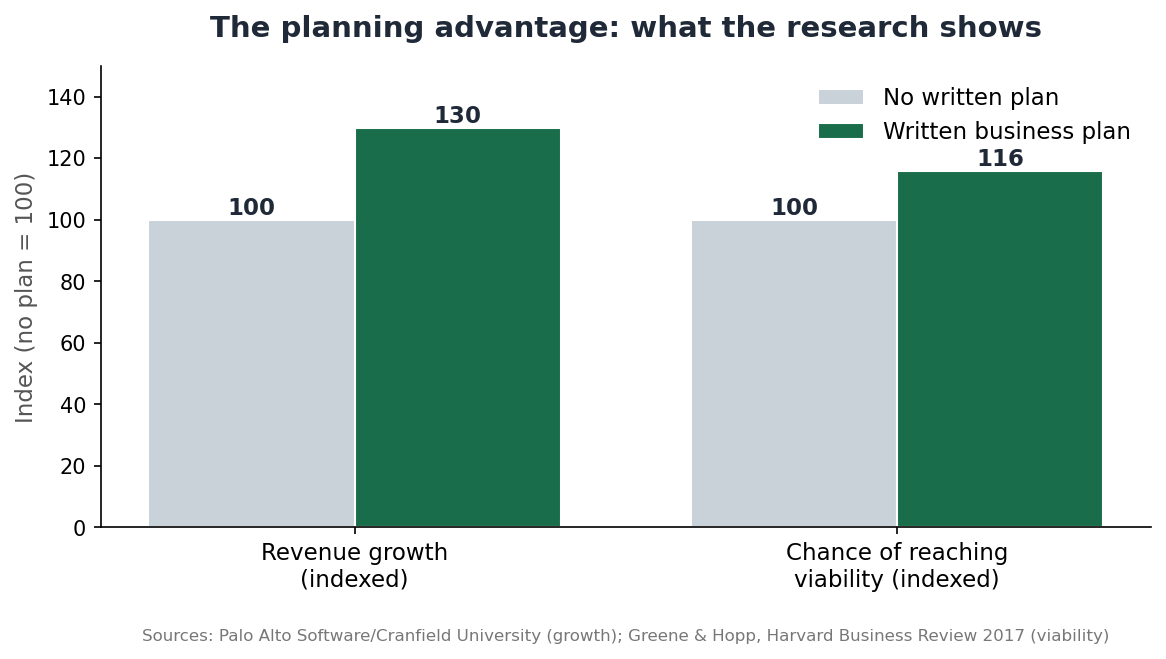
Planning doesn’t guarantee success — nothing does — but it measurably shifts the odds. The mechanism isn’t mysterious: founders who plan understand their numbers, spot problems earlier, and make decisions against a baseline instead of improvising.
5 Business Plan Mistakes That Turn Off Lenders
Loan officers and investors read hundreds of plans. These are the mistakes that get yours tossed aside:
- Claiming no competition. As noted above, this signals you haven’t researched the market. Name your competitors and explain your edge.
- Hockey-stick revenue with no justification. Projecting 500% growth in year two without explaining the engine behind it reads as fantasy. Tie every growth assumption to a specific action and cost.
- Ignoring cash flow. Profitable on paper but broke in month four is the classic startup killer. Your cash flow projection matters more than your profit projection in year one.
- A 40-page plan nobody will read. Detail is good; bloat is not. Cut anything that doesn’t help a reader decide to fund you. Appendices exist for a reason.
- Writing it once and shelving it. The SBA’s five reasons you need a business plan include using it as a living management tool. Review and update your plan quarterly — that’s when it actually starts paying for itself.
If the blank page is intimidating, don’t start from zero. There are free templates from SCORE, the SBA’s nonprofit mentoring partner, that walk you through each section with prompts and examples.
Frequently Asked Questions
How long should a business plan be?
A traditional business plan typically runs 20–40 pages, though length matters less than completeness. A lean startup plan fits on one page. The right length is whatever it takes to convincingly cover all nine sections without filler. If you’re still validating a concept, many founders pair a lean plan with side hustles to test demand before committing to a full plan.
How long does it take to write a business plan?
Expect two to four weeks for a solid traditional plan if you’re researching as you go. The financial projections take the longest — gathering real quotes and building the spreadsheet is where the time goes. A lean one-page plan can be drafted in an afternoon.
Do I need a business plan to get a loan?
In most cases, yes. Banks and SBA lenders require a written plan as part of the loan application — it’s how they evaluate whether your business can repay. Even for a service business started with no money, having a lean plan dramatically improves your credibility with lenders.
Can I write a business plan myself, or should I hire someone?
Write it yourself. Nobody understands your business idea better than you do, and the process of writing is where the real value lies — it forces you to think through the details. Templates and mentors (like free SCORE mentors) can guide you, but avoid paying someone to write it for you; you’ll end up with a document you can’t defend in front of a lender.
What’s the difference between a business plan and a business model?
A business model describes how your company creates and captures value — who pays, for what, and at what margin. A business plan is the broader document that includes the business model plus market analysis, operations, team, and financial projections. Think of the model as one chapter of the plan.
How often should I update my business plan?
Review it quarterly and update it annually at minimum — or whenever something fundamental changes (a new competitor, a pricing shift, a funding round). A business plan is a living document; the founders who revisit it regularly are the ones who get the “grow 30% faster” benefit the research describes.
Conclusion
Learning how to write a business plan isn’t about producing a perfect document — it’s about doing the thinking that separates viable businesses from expensive hobbies. Work through the nine sections honestly, ground your numbers in real research, and treat the finished plan as a living tool rather than a one-time homework assignment.
Start today with the section that feels easiest — often the company description or products section — and build momentum from there. Use the SBA’s free guide and templates, find a SCORE mentor to review your draft, and write that executive summary last. Your future self, sitting across from a loan officer or investor, will thank you for every hour you put in now.



