

Pick up your phone “for a second” and look up forty minutes later — if that sentence made you flinch with recognition, you’re not alone. The average person now spends about 4 hours and 37 minutes on their smartphone every single day, checking it roughly 58 times, according to current data compiled by smartphone usage researchers at Exploding Topics. For Americans it’s even higher: 5 hours and 16 minutes daily. That’s more than a full day per week, or about 70 days a year, gone to a glass rectangle.
So no wonder “how to do a digital detox” is one of the most-searched wellness questions right now — but the version that actually works, one that survives past Monday morning, isn’t the dramatic cabin-in-the-woods weekend. It’s a series of small, deliberate changes to how you handle your devices. This guide walks you through a practical, step-by-step approach: audit your usage, pick your detox style, change your environment, and plan a reentry so the gains stick.

Why a Digital Detox Is Worth Doing
Before the how, a quick look at the why — because a detox without a personal reason is the first thing you abandon.
Start with the numbers. Globally, the average person spends 2 hours and 21 minutes a day on social media alone, per DataReportal figures reported by ShortsIntel’s 2026 screen-time roundup — and TikTok users average 1 hour 37 minutes a day in that one app. Almost half of all phone sessions begin within three minutes of the last one. Most of that time isn’t deliberate; it’s reflex. Half of all screen-time sessions are just habit loops: reach, unlock, scroll, lock, repeat.
Then there’s sleep. A 2025 study in Frontiers in Psychiatry of more than 45,000 university students linked each additional hour of screen use in bed to 24 minutes less sleep and 59% higher odds of insomnia symptoms, as summarized by screen-time researchers at ScreenBuddy. And the effect compounds: tired brains reach for the phone more, not less.
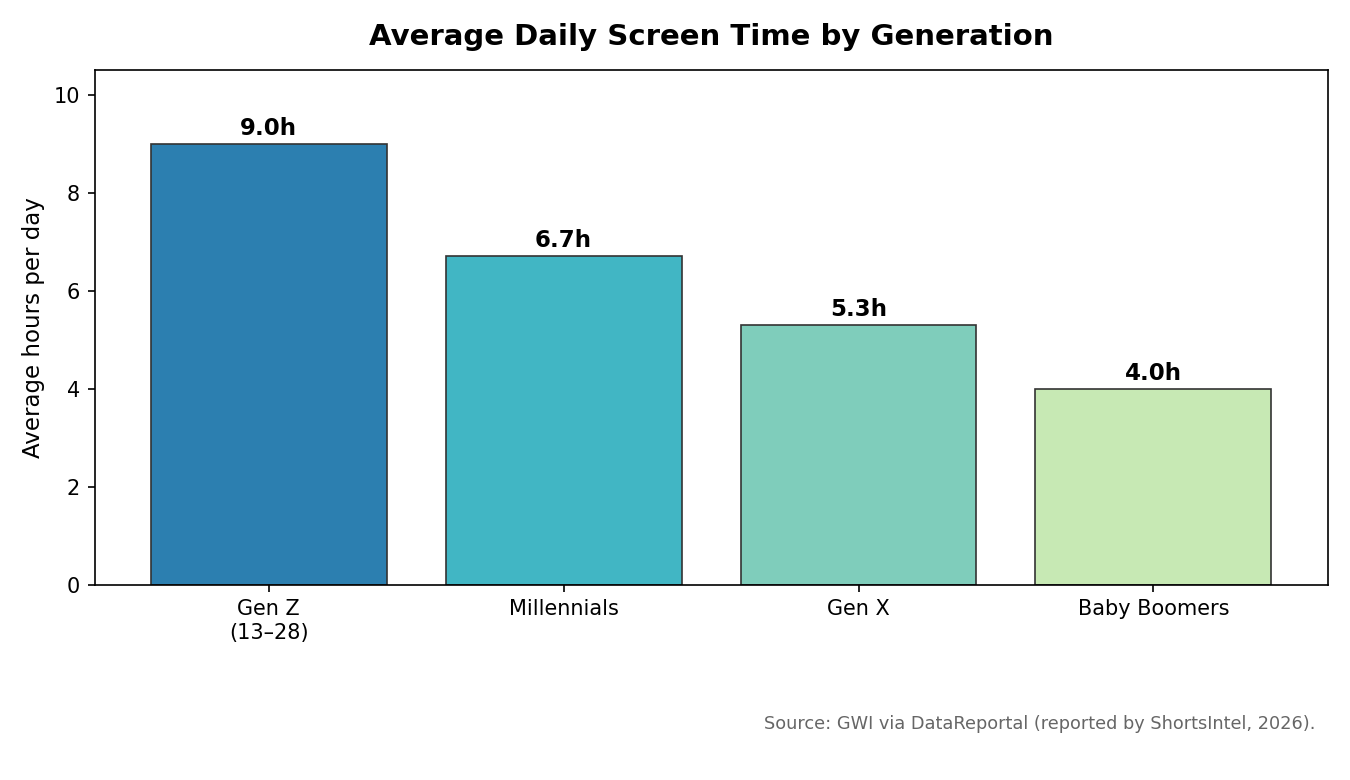
The generational picture is even starker. Look at the chart below: Gen Z (ages 13–28) averages over 9 hours of daily screen time — more than double what Baby Boomers log. If you’re in your twenties and feel like your attention span has thinned, the data says you’re not imagining it.
How to Do a Digital Detox: The 6-Step Framework
These six steps work in order — each one makes the next easier. Skip the audit and you’re guessing; skip the environment setup and you’re relying on willpower; skip the reentry and you’re back where you started within a week.
Step 1: Audit Your Actual Usage
You can’t change what you don’t measure, and your guess about your screen time is almost certainly low. Start here:
- Open your phone’s built-in report — Screen Time on iOS, Digital Wellbeing on Android — and write down your daily average for the past week.
- Identify your top two time-draining apps. For most people, it’s two of the same handful: a short-video app, a social feed, or a game.
- Note when the usage spikes: waking up, avoiding work, waiting in line, bedtime, the post-dinner slump. These are your trigger moments — the places where the detox actually happens.
This audit is the foundation of everything else. As the team at BreakAway puts it in their practical digital detox guide, don’t start by deleting everything — start by writing down the three moments where useful checking turns into lost time.
Step 2: Pick Your Detox Style
Not every detox means going off the grid. Choose the scope that matches your life — the best detox is the one you’ll finish.
The daily mini-detox
No screens for the last 1–2 hours before bed, or a phone-free first hour of the morning. Smallest commitment, outsized payoff for sleep and mornings. Ideal if you need your phone for work all day.
The weekend detox
One tech-free day per week — typically Saturday or Sunday. Social and messaging apps go off; phone stays for calls and emergencies only. This is the version that produces the biggest “I got my weekend back” feeling.
The app-specific detox
Keep the phone, delete (or block) your single most problematic app for a set period — usually one to two weeks. You stay reachable; the doomscrolling feed disappears. This is the most sustainable option for people whose problem is one app, not the whole device.
The full detox
Several days with no non-essential device use — a weekend trip, a camping weekend, a deliberate “I’m unavailable” window. Powerful as a reset, but it only works as a detox if you plan the reentry (see step 6). Otherwise it’s just a pause button.
Step 3: Set Up Your Environment Before You Start
Willpower is the weakest tool in this guide. Environment design is the strongest. Before day one, do the following:
- Silence the sirens. Turn off push notifications for every social media app — not “deliver quietly,” actually off. Every alert you silence is one less reason to pick up the phone. Keep calls and messages from real people; kill everything else.
- Add friction. Move your most distracting apps into a folder on the last home-screen page, or delete them and reinstall only when you need them. Each extra tap is a decision point where the autopilot loop can break. Try grayscale mode for a week to make the screen less visually rewarding.
- Create phone-free zones. Pick two: the bedroom and the dining table are the highest-impact pair. Buy a cheap alarm clock so the phone can charge outside the bedroom — removing it from the bedroom at night is the single most consistent sleep intervention the research supports.
- Tell people. Let friends, family, and colleagues know you’ll be less reachable and when. Managing expectations up front prevents the “is everything okay?” spiral that sends people back online by day two.
If you work from home, this step pairs well with broader focus systems — the same boundary-setting that makes working from home more productive applies to your personal screen habits too: physical separation of the distraction beats self-control every time.
Step 4: Follow a 7-Day Plan
One concrete day at a time. This plan assumes an app-specific or general detox; adjust for a full unplug.
| Day | Action | Why It Works |
|---|---|---|
| 1 — Measure | Record your screen-time average and top apps; set your detox goal (better sleep? more focus? less anxiety?) | Baseline data plus a clear “why” — the motivator when temptation hits |
| 2 — Silence | Turn off all non-essential notifications; set up Do Not Disturb schedules for evenings | Removes external triggers, which drive most pickup behavior |
| 3 — Friction | Reorganize the home screen; bury or delete the top two time-drain apps; enable app timers | Every extra step between you and the feed weakens the habit loop |
| 4 — Zones | Establish bedroom and mealtime phone-free zones; alarm clock goes on the nightstand | Protects sleep and real-life connection — the two biggest detox payoffs |
| 5 — Replace | Choose a replacement for each trigger moment: book by the bed, walk at lunch, hobby after dinner | Habits are replaced, not deleted — an empty gap gets refilled by the phone |
| 6 — Accountability | Ask one person to check in; or use a blocking app with a friend-locked password | Social commitment beats private promises on hard days |
| 7 — Review | Compare screen time to day 1; note mood, sleep, focus changes; decide what stays permanent | Turns the detox from a one-off reset into lasting boundaries |

Step 5: Fill the Gap With Something Better
This is where most detoxes quietly die. Removing the phone without replacing the habit leaves an empty slot in your routine, and the phone refills it within days. The fix: decide in advance what goes in each trigger slot.
- Bedtime scroll → a physical book or magazine on the nightstand.
- Morning phone-check → stretch, water, journal — a screen-free first 30 minutes. If your mornings are chaotic for other reasons (shift work especially), a structured routine helps; see our best morning routine for night-shift workers for adapting routines to irregular schedules.
- Boredom scroll → a walk, a puzzle, a page of writing, calling a friend — anything with a defined end.
- Work-break scroll → five minutes of stretching with the phone left at the desk. Once you get distracted, refocusing takes real effort; the break should restore focus, not fragment it.
The science of habit change backs this up: “implementation intentions” — deciding exactly what you’ll do when a specific situation appears — are among the most reliable behavior-change tools in the research literature, as noted in the BreakAway guide’s discussion of planning psychology.
Step 6: Plan the Reentry
The detox is the easy part. The reentry is the whole point. Before your detox ends, decide:
- Which apps come back, and with what daily time limits — set the limits now, in the settings, not “later.”
- Which notification changes stay permanent. (Almost all of them should.)
- Which phone-free zones remain. The bedroom one is the keeper.
- What your new weekly check looks like — a quick glance at Screen Time every Sunday keeps drift visible before it becomes relapse.
As the Science of People’s digital detox guide frames it: the device is fine; the way most of us use it is the part worth changing. The goal was never to live without the phone. It was to use it on purpose instead of by reflex.
Common Mistakes That Sabotage a Digital Detox
- Trying to quit everything at once. One or two boundaries first. A total overhaul collapses under its own weight by Wednesday.
- Treating one slip as total failure. Missing a phone-free zone once doesn’t undo the routine. It’s the pattern that matters, not a single day.
- Removing the phone without replacing the habit. Covered above, but it bears repeating — it’s the number-one detox killer.
- Ignoring the why. A detox without a clear personal reason — better sleep, more presence, less anxiety — is much easier to abandon when it’s inconvenient.
- Making it all restriction, no reward. Pair boundaries with something genuinely enjoyable so the routine feels like a trade-up, not a punishment. A phone-free Saturday is a lot easier when it’s also a hiking Saturday.
Positive Psychology’s guide to digitally detoxing adds a useful framing: the detox is most effective as the starting point of a longer-term strategy for healthier digital boundaries, not as a quick reset before resuming old habits.
FAQ
How long should a digital detox last?
Start with one week focused on your most problematic apps — that’s enough to break the automatic checking loop. Many people find a repeating rhythm works better than one big effort: a phone-free day each week, or a longer app-specific break every few months. The research suggests even short structured breaks produce measurable focus gains, but the lasting benefits come from the boundaries you keep afterward.
Do I have to delete all my apps for a digital detox?
No — and you probably shouldn’t. The approach that lasts is selective: remove or block the apps you mostly scroll, keep the ones you use to talk to people. Protecting communication while cutting feeds, reels, and games keeps you reachable without the autopilot time loss.
What should I do instead of scrolling on my phone?
Decide this before you start, per trigger moment: reading, walking, cooking, journaling, exercise, a hobby, time outdoors. The key is having the replacement ready at the moment the urge hits — a book on the nightstand beats a vague intention to “read more.”
Will a digital detox actually improve my sleep?
Removing the phone from the bedroom is the most consistently supported intervention in the research. A 2025 study of 45,000+ university students linked each additional hour of screen use in bed to 24 minutes less sleep and much higher insomnia odds. Keeping the phone out of the bedroom and adding a screen-free wind-down hour is the highest-leverage move you can make.
How do I do a digital detox if I need my phone for work?
Then don’t detox the whole device — detox the feeds. Keep email, messaging, maps, and work tools; block or time-limit social media, short-video apps, and games. Use focus modes during deep-work blocks, and physically put the phone in a drawer rather than face-down on the desk — visibility alone is a distraction.
What if I relapse halfway through?
Then you’re normal. Check what triggered it — boredom, stress, a specific time of day — and adjust the environment around that trigger rather than relying on more willpower. Extend the detox a few days or narrow its scope. One slip is data, not failure.
Conclusion
A digital detox isn’t about going off the grid or proving you don’t need your phone. It’s about noticing that 4 hours and 37 minutes a day — 58 checks, session after session starting within three minutes of the last — and deciding how much of it you actually chose. Audit your usage, pick a detox style that fits your life, redesign the environment instead of white-knuckling it, replace the habit rather than just deleting it, and plan the reentry before you start. Do that, and the week after the detox looks different from the week before it — not because the phone changed, but because you did.



