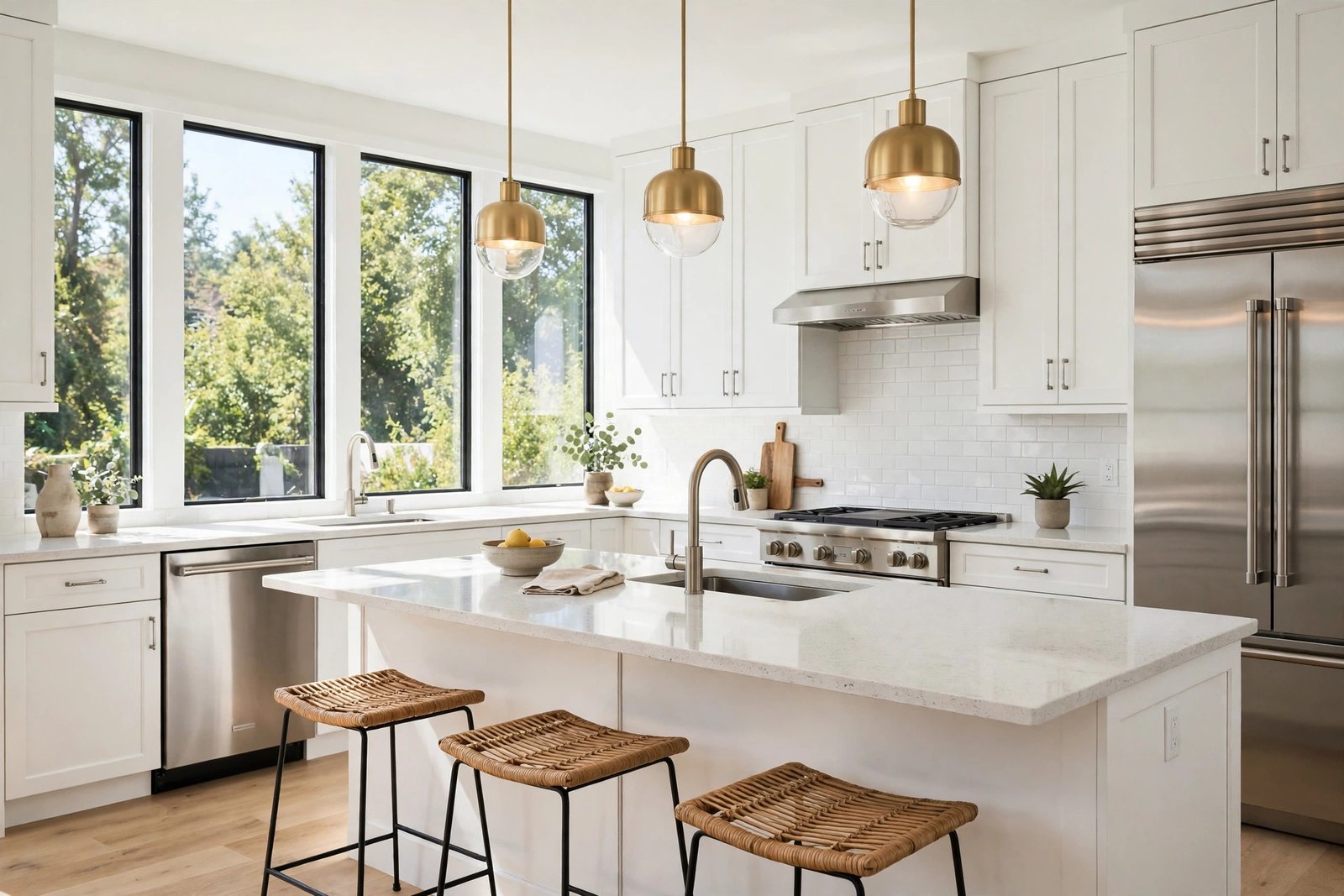

If you are standing in a tired kitchen wondering how much does a kitchen remodel cost, you are asking the right question at the wrong level of detail. There is no single price for a kitchen remodel, because “remodel” can mean anything from a weekend of new paint and hardware to gutting the room down to the studs and moving the plumbing. The honest answer is a range — and where you land in that range depends on the size of your kitchen, the scope of the work, and the finishes you choose. This guide breaks the project into four clear tiers, shows where the money actually goes, flags the hidden costs that catch homeowners off guard, and explains what you can realistically expect to get back when you sell.
Start with the benchmarks. According to Houzz, the median spend on a minor kitchen remodel in 2026 is around $20,000, while a major remodel has a median of roughly $55,000, rising to about $75,000 for kitchens of 250 square feet or more — figures reported in Houzz kitchen remodel cost research. Angi puts the national average for a kitchen remodel at about $27,000, as shown in its kitchen remodeling cost guide. Those two numbers are not in conflict: the Houzz figures are medians for two different scopes, and the Angi figure is an average across all scopes. Together they tell you that most real projects land somewhere between $20,000 and $55,000, with smaller refreshes far below and full gut jobs far above.
How Much Does a Kitchen Remodel Cost by Tier?
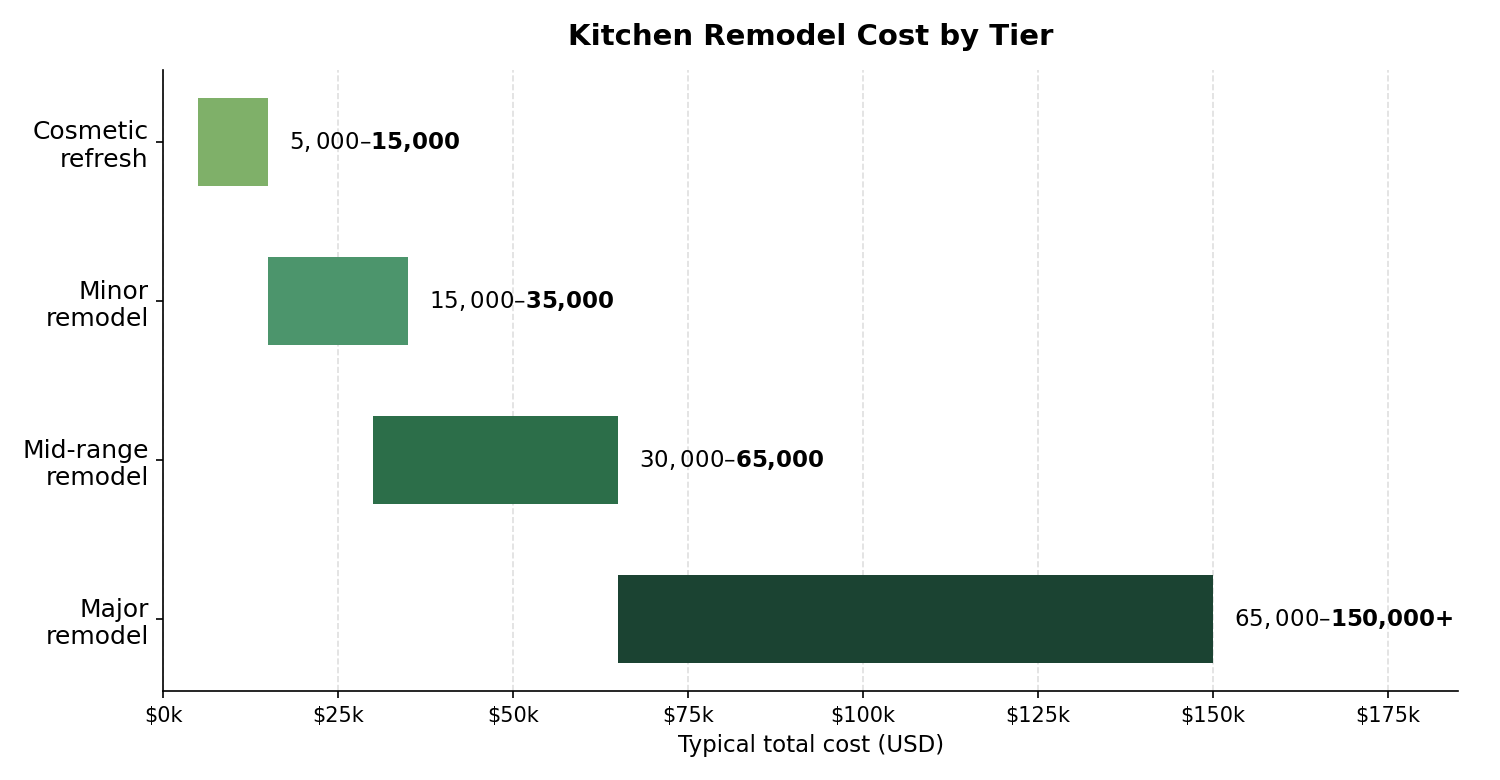
The simplest way to budget is to pick your tier first, then price within it. Here are the four tiers most contractors and designers use, with the broad planning ranges that cover the majority of projects.
| Remodel tier | Typical cost range | What it usually includes | Best for |
|---|---|---|---|
| Cosmetic refresh | $5,000–$15,000 | Paint, new hardware, faucet, lighting, backsplash, minor repairs | A kitchen with good bones that just looks dated |
| Minor remodel | $15,000–$35,000 | Refaced or stock cabinets, new countertops, new sink, updated appliances | Improving function and looks without moving walls or plumbing |
| Mid-range remodel | $30,000–$65,000 | Semi-custom cabinets, stone countertops, new flooring, better appliances | A long-term home where you cook daily and want quality finishes |
| Major remodel | $65,000–$150,000+ | Custom cabinets, layout changes, moved plumbing and wiring, structural work | A forever home, a badly laid-out kitchen, or a luxury finish level |
Tier 1: Cosmetic refresh ($5,000–$15,000)
A cosmetic refresh is the best value in remodeling, full stop. If your cabinets are solid, your layout works, and your appliances still run, you do not need to tear anything out. A professional paint job on cabinets, new pulls and knobs, a modern faucet, updated pendant lights, and a fresh backsplash can make a 1990s kitchen read as current for a fraction of a full remodel. This is also the tier where do-it-yourself effort pays off most: painting and hardware are genuinely learnable skills, and the labor you save goes straight to your bottom line.
Tier 2: Minor remodel ($15,000–$35,000)
A minor remodel is where most homeowners land, and it matches the Houzz minor-remodel median of around $20,000 nicely. The usual recipe: keep the layout and the plumbing where they are, reface or replace cabinets with stock units, install new laminate or butcher-block countertops (or entry-level stone if the kitchen is small), and swap in a new sink, faucet, and perhaps one or two appliances. Nothing moves, so you avoid the expensive trades — no plumber relocating drains, no electrician rewiring circuits, no structural engineer.
Keeping the footprint is the single biggest cost control in remodeling. The moment a wall moves or a sink crosses the room, labor costs jump and permits enter the picture. If your kitchen’s layout genuinely frustrates you — a fridge that blocks a doorway, a stove with no counter space beside it — that frustration is worth solving. But if the layout is merely boring, spend the money on finishes instead.
Tier 3: Mid-range remodel ($30,000–$65,000)
The mid-range remodel is the sweet spot for a home you plan to stay in for a decade or more. Semi-custom cabinets give you better drawers, soft-close hardware, and storage that fits your actual pots and pans. Stone countertops — granite or quartz — handle heat and stains in a way laminate never will. Flooring gets replaced properly rather than patched, lighting gets layered (task, ambient, and under-cabinet), and appliances move from builder-grade to reliable mid-range brands.
At this tier, design help starts paying for itself. A kitchen designer will catch the mistakes that are expensive to fix later: a dishwasher door that hits the oven handle, a cabinet that blocks a light switch, a walkway too narrow for two cooks. Many cabinet suppliers include basic design service with an order, and an independent designer typically charges a fee that is small relative to a $50,000 project — and small compared with the cost of reordering a wrong cabinet run.
Tier 4: Major remodel ($65,000–$150,000+)
A major remodel is a different animal. Walls come down, the kitchen may absorb a dining room or push into an addition, plumbing and gas lines move, and everything is custom or near-custom. The Houzz major-remodel median of roughly $55,000 sits below this tier’s range because many “major” Houzz projects keep the existing footprint; once you add structural changes and a large footprint — kitchens over 250 square feet can reach around $75,000 at the median — the total climbs fast. This is also the tier where a general contractor, permits, and inspections become non-negotiable, and where the timeline stretches from weeks to months.
Major remodels make sense in three situations: the layout is genuinely broken, the house is a long-term home where you will enjoy the result for years, or the neighborhood supports the investment at resale. They rarely make sense as a quick pre-sale flip — buyers will not pay dollar for dollar for your custom choices, a point the resale section below covers honestly.
Kitchen Remodel Cost Per Square Foot
Contractors often quote kitchen work by the square foot, and it is a useful sanity check — but only a rough one. Small kitchens cost more per square foot than large ones, because the expensive parts (cabinets, appliances, plumbing, electrical) do not shrink proportionally. A 70-square-foot galley kitchen can easily run $300 or more per square foot, while a sprawling 300-square-foot kitchen might average less per square foot even though its total is far higher.
Use per-square-foot figures to compare quotes, not to set your budget. If two contractors quote wildly different per-square-foot rates for the same scope, ask what is included: one may include appliances, flooring, and permits while the other prices the cabinets alone. Apples-to-apples scope matters far more than the headline rate. For a fuller sense of how remodeling budgets compare across rooms, see our guide to small bathroom remodel cost, where the same footprint logic applies on a smaller scale.
Where the Money Goes: Kitchen Remodel Budget Breakdown
Cabinets are the biggest single line item in most kitchen remodels, typically accounting for 25–35% of the total budget, according to industry budget breakdowns published by This Old House kitchen remodeling guides. That share is why cabinet choices move the total more than almost any other decision: stock cabinets, semi-custom, and fully custom units can differ in price by a factor of three or more for the same kitchen.
After cabinets, the next-biggest shares usually go to labor (installation, plumbing, and electrical work), countertops, and appliances, with flooring, backsplash, lighting, and fixtures making up the remainder. The practical takeaway: if you need to cut $5,000 from a budget, downgrading the countertop stone or choosing stock cabinets will get you there; downgrading the faucet will not. Spend where your hands and eyes go every day — cabinet function, countertop durability, and lighting — and save on the things you barely notice after week two.

Hidden Kitchen Remodel Costs Most Budgets Miss
Almost every remodel runs over its first estimate, and the overruns usually come from the same handful of surprises. Build a contingency of 10–20% into your budget before you sign anything, and treat this checklist as your pre-project audit.
Outdated wiring and plumbing. Once walls open up, contractors often find wiring or pipes that no longer meet code. Bringing them up to standard is not optional, and it is not something a quote can predict without opening the wall. Older homes are especially prone to this — budget extra if your house predates the 1980s.
Permits and inspections. Electrical, plumbing, and structural changes usually require permits, and permit fees plus inspection delays belong in the budget and the timeline. Skipping permits to save money is a false economy: unpermitted work can stall a future home sale and complicate insurance claims.
Temporary kitchen costs. A full remodel can leave you without a kitchen for weeks. Eating out, buying disposable supplies, and setting up a makeshift cooking station add up faster than most people expect. Factor in a realistic food budget for the construction period.
Delivery, disposal, and the small stuff. Dumpster rental, haul-away of old cabinets and appliances, delivery surcharges, and the last 5% of items — trim pieces, outlet covers, caulk, touch-up paint — are easy to forget and annoying to fund mid-project. Ask your contractor explicitly what is included and what is billed separately.
Changes mid-project. The most expensive words in remodeling are “while you’re here.” Every change order costs more than the same work priced into the original contract, because it disrupts the schedule. Finalize your selections — cabinets, counters, fixtures, paint colors — before demolition starts.
The same discipline applies to outdoor projects: clearing the space before work starts is one of the cheapest ways to keep a remodel on schedule. And if you are weighing several big home projects at once, compare the kitchen against our breakdown of roof replacement cost — structural necessities should usually come before cosmetic upgrades.
Kitchen Remodel ROI: What You Get Back at Resale
Here is the honest version: a kitchen remodel rarely returns 100% of its cost at resale. Industry cost-versus-value reporting, such as the long-running Remodeling Magazine Cost vs. Value report, consistently shows mid-range kitchen remodels recouping a solid but partial share of their cost, with minor remodels typically recouping better than major ones. The reason is simple: buyers value a clean, functional, modern kitchen, but they do not pay extra for your specific taste in custom cabinetry.
That does not make remodeling a bad investment — it makes it a lifestyle investment with a partial payback, not a financial instrument. If you remodel a kitchen you will cook in daily for ten years, the enjoyment is the return, and the resale recoup is a bonus. If you are remodeling purely to sell, stay in the cosmetic-to-minor tiers, choose neutral finishes, and spend on the things buyers notice first: clean cabinets, decent counters, working appliances, and good light. A $15,000 refresh on a dated kitchen usually does more for a sale price than a $60,000 custom job that reflects one person’s taste.
How to Keep Your Kitchen Remodel on Budget
Seven habits separate on-budget remodels from runaway ones. First, lock your scope in writing before demolition, with a line-item contract rather than a single lump sum. Second, keep the layout — moving plumbing is the fastest way to add five figures. Third, choose stock or semi-custom cabinets unless you have a genuinely unusual space. Fourth, finalize every selection before work starts, so nothing is ordered mid-project at rush prices. Fifth, hold a 10–20% contingency and do not spend it on upgrades; it exists for surprises. Sixth, visit the site regularly and catch mistakes early, when fixes are cheap. Seventh, pay in milestones tied to completed work, never in full up front.
Paying cash is cheapest; a home equity loan or line of credit is the usual middle path for mid-range projects. However you pay, the monthly payment should still leave room for the rest of your life — a beautiful kitchen is not worth financial strain. For a broader view of how home projects stack up, see our guide to the cost to build a deck, which follows the same tier logic on a smaller budget.
Frequently Asked Questions
How much does a kitchen remodel cost on average?
Angi reports a national average of about $27,000, while Houzz reports a median of around $20,000 for a minor remodel and roughly $55,000 for a major one. Your actual cost depends on your kitchen’s size, whether the layout changes, and the finish level you choose — most projects fall between $15,000 and $65,000.
What is the most expensive part of a kitchen remodel?
Cabinets, typically 25–35% of the total budget. After cabinets, labor, countertops, and appliances are usually the next-largest costs. Choosing stock or semi-custom cabinets instead of fully custom units is the single biggest lever for controlling the total.
Can I remodel a kitchen for $10,000?
Yes, at the cosmetic-refresh tier: cabinet painting, new hardware, a new faucet, lighting, and a backsplash can transform a kitchen with good bones for $5,000–$15,000. A full cabinet-and-countertop replacement for $10,000 is unrealistic in most markets unless the kitchen is very small and you do much of the labor yourself.
Does a kitchen remodel increase home value?
Usually yes, but rarely by the full cost of the work. Minor and mid-range remodels with neutral, durable finishes tend to recoup the best share at resale, while highly customized major remodels recoup less. Treat a remodel primarily as a lifestyle upgrade with a partial financial payback.
How long does a kitchen remodel take?
A cosmetic refresh can take a few days to two weeks. A minor remodel typically takes three to six weeks, a mid-range remodel six to ten weeks, and a major remodel with structural changes can take three months or more. Permit approvals and custom cabinet lead times are the most common sources of delay.
Should I hire a contractor or manage the remodel myself?
Hire a licensed general contractor for anything involving plumbing, electrical, gas, or structural changes — and for any project where coordinating multiple trades matters. You can act as your own project manager for a cosmetic refresh, but for mid-range and major work, a contractor’s scheduling and trade relationships usually save more than they cost.

Conclusion: Pick Your Tier, Then Protect Your Budget
So, how much does a kitchen remodel cost? For most homeowners, the useful answer is one of four numbers: $5,000–$15,000 for a refresh, $15,000–$35,000 for a minor remodel, $30,000–$65,000 for a mid-range job, or $65,000–$150,000+ for a major overhaul — checked against the Houzz medians of about $20,000 and $55,000 and the Angi average of about $27,000. Pick your tier honestly, keep the layout if you can, spend on cabinets and countertops, and hold a contingency for the surprises behind your walls.



