

A week in one small bag sounds like a magic trick until you have done it once. Then it feels obvious, and going back to a checked bag feels like paying money to wait at a carousel. This guide explains how to pack a carry-on for a week using a 15-item capsule, the airline size limits that decide whether your bag flies free, and the laundry plan that makes four days of clothes stretch to seven. It is not about suffering, or wearing the same shirt every day. It is about choosing clothes that work together, rolling instead of folding, wearing your bulkiest layers on the plane, and leaving the “just in case” items at home.
Do that, and a carry-on stops being a constraint and starts being a freedom: no checked-bag fee, no lost luggage, and no waiting at the carousel.
Start With the Size That Actually Fits
Before you pack anything, check your bag. The standard carry-on size for the big US airlines is 22 x 14 x 9 inches, wheels and handles included, and that size fits American, Delta, and United overhead bins. A bag that measures 22 inches before you add the wheels does not count — airlines measure the whole thing, and the sizer at the gate does not forgive an extra inch.
That 22 x 14 x 9 inch bag holds roughly 40–45 litres. That sounds small, until you realise how much of a checked bag is air, spare shoes, and clothes you never wear. Forty litres is enough for a week if every item earns its place. Measure your bag with a tape measure before you travel — do not trust the label. A soft-sided bag that squashes into the sizer is more forgiving than a hard shell that does not give at all.
The cost of getting this wrong is real. Checked bag fees now run $35–$40 each way on most US airlines, so a return trip can add $70–$80. Worse, if your bag does not fit the sizer at the gate, gate-check fees can hit $60–$100. Check the airline’s own baggage page before you fly. American Airlines sets out its carry-on baggage rules, Delta publishes its carry-on baggage policy, and United lists its carry-on bag requirements.
One warning matters more than the rest. United Basic Economy allows only a personal item on most domestic routes — no full-size carry-on in the overhead bin. If you booked Basic Economy on United, your week has to fit in a bag that goes under the seat, or you will pay at the gate. Check your fare class, not just your bag size, before you start packing.

How to Pack a Carry-On for a Week: The 15-Item Capsule
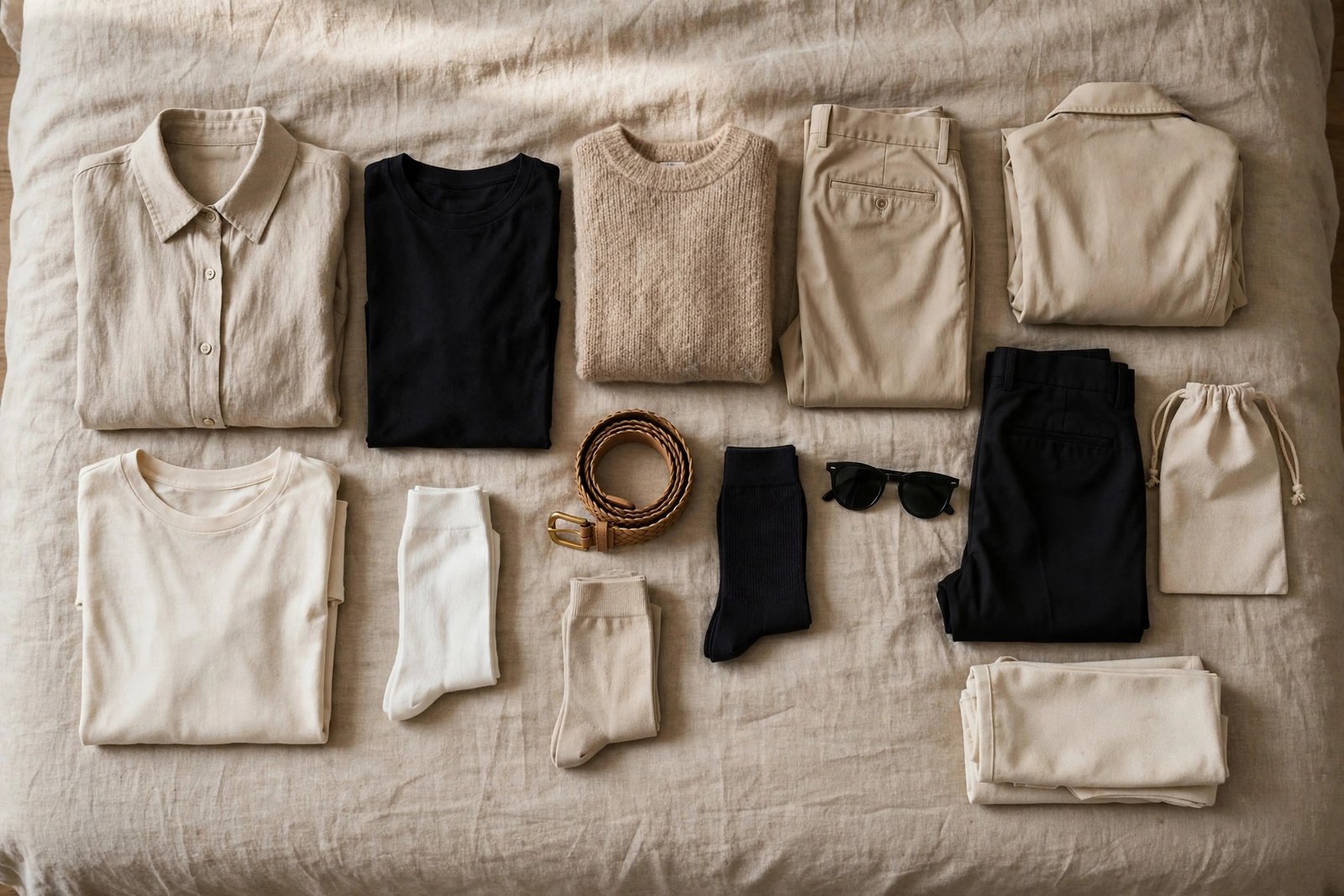
The heart of this system is the 5-4-3-2-1 formula: 5 tops, 4 bottoms, 3 layers or accessories, 2 pairs of shoes, 1 dressy piece. That is 15 items, plus underwear, socks, sleepwear, and toiletries. It sounds minimal, and it is — that is the point. Fifteen pieces that all work together give you far more outfits than twenty pieces that do not.
Start with a colour palette, not a pile of favourites. Pick two neutrals — black and white, navy and grey, or whatever you actually wear — and one accent colour. Every top should go with every bottom. If a shirt only works with one pair of trousers, it does not make the cut.
Here is how the formula breaks down in practice. The five tops should include a mix of short and long sleeves, and at least one that can be dressed up. The four bottoms should include trousers or jeans you can wear for days, plus a skirt or shorts if the weather calls for it. The three layers or accessories might be a light jacket, a scarf, and a cardigan. The two pairs of shoes are the pair on your feet and one packed pair, covering walking and one smarter occasion. The one dressy piece is a dress, a blazer, or a smart shirt for a nice dinner.
Underwear and socks follow the same logic: pack for four days, not seven, and plan to wash once mid-trip. Pack four sets, wash on day four, and you have fresh underwear for the rest of the trip with half the bulk. The same applies to sleepwear — one set is enough if you can wash it.
For a fuller look at the suitcase itself, our guide to packing a suitcase efficiently covers the rolling and folding techniques that make the capsule fit without wrinkles.
Rolling vs. Folding: What Actually Saves Space
Rolling saves roughly 15–20% of space compared with flat folding, and rolled clothes wrinkle less in a tightly packed bag, because there are no sharp creases pressed in by the weight of everything on top. That does not mean you should roll everything. Roll soft, casual clothes — T-shirts, knit tops, casual trousers, underwear, and socks — and fold structured pieces such as blazers and dress shirts.
Packing cubes are the other half of the system. They compress soft clothes, keep categories separate, and let you pull out one cube without unpacking the whole bag. Use one cube for tops, one for bottoms, and a small one for underwear and socks.
Pack in layers, heaviest at the bottom. Shoes go at the bottom of the bag, near the wheels, where their weight keeps the bag stable. Fill shoes with socks or small rolled items — that dead space inside a shoe is free storage. Next come the packing cubes, then the folded dressy piece on top, where it stays flat. Toiletries go in an outer pocket or on top, where you can reach them at security without digging.
Wear the bulkiest shoes and jacket on the plane. That one decision frees more space than any packing trick. A pair of boots takes up a third of a carry-on; on your feet, they take up none of it. The same goes for a heavy jacket or a chunky jumper. Wear it through the airport and take it off on the plane.
The 3-1-1 Liquids Rule, in Plain English
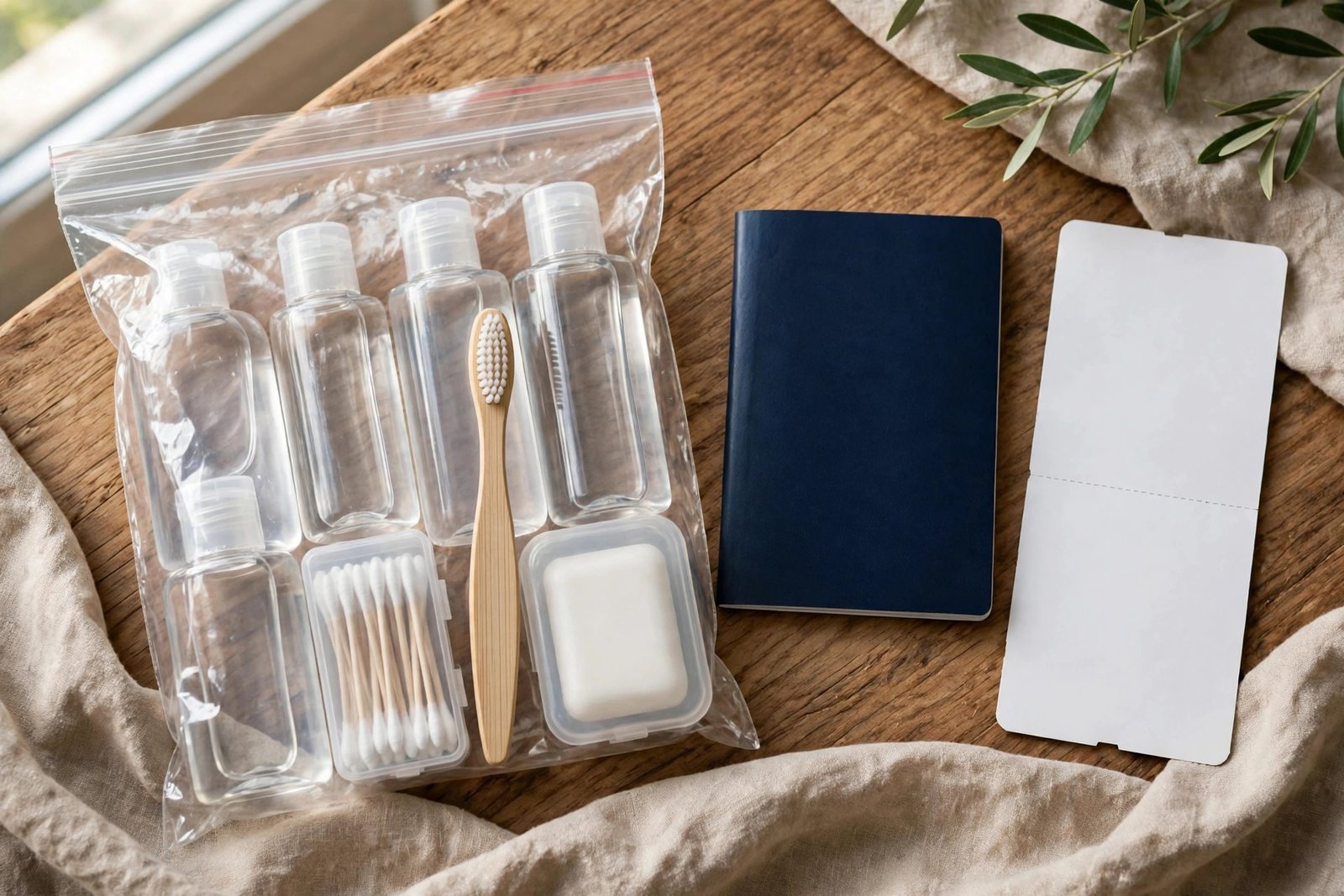
Toiletries are where most carry-on packers lose space and time. The TSA 3-1-1 rule is simple once you say it plainly: liquids, gels, and creams must be in containers of 3.4 oz (100 ml) or less, all of those containers must fit in one quart-size clear bag, and each passenger gets one bag. That is the whole rule. The TSA liquids, aerosols, and gels rule states it the same way, and the TSA 3-1-1 travel tips page walks through what counts.
The mistake people make is packing full-size bottles “because there is room.” A 6 oz bottle of shampoo is not allowed even if it is half empty — the TSA measures the container, not what is left inside it. Decant what you need into travel-size bottles, or buy travel sizes and refill them at home. Toothpaste, shampoo, conditioner, mouthwash, lotion, sunscreen, and contact-lens solution all count as liquids, gels, or creams, so they all go in the bag.
What does not count matters too. Solid toiletries — a bar of shampoo, a solid deodorant stick, a bar of soap — do not need to go in the quart bag, and they save space and weight. Medications are a separate case: keep them accessible, in their original packaging where possible. The same goes for lithium batteries — power banks and spare camera batteries must stay in your carry-on, never in checked luggage, and should be easy to reach.
Pack the quart bag last, on top, in an outer pocket or in the lid of the suitcase. At security you will need to take it out, and the person behind you will thank you if that takes five seconds instead of five minutes. If you are travelling with a partner, each of you gets your own quart bag.
Pack for Four Days, Wash Once
The laundry plan is what makes a week possible. Pack for four days and wash once mid-trip, on day three or four, and you never need to carry seven days of clothes. That single wash is the difference between a bag that closes easily and a bag you have to sit on. Learning how to pack a carry-on for a week is really learning this rhythm: pack light, wash once, wear everything twice.
You do not need a laundromat or a hotel laundry service, though both work fine. A hotel sink, a small packet of travel detergent, and a little patience will wash a set of underwear, socks, and a T-shirt in ten minutes. Rinse, squeeze gently without wringing, roll the clothes in a towel to press out water, and hang them to dry overnight. In a warm room, most lightweight clothes dry by morning.
Choose fabrics that help you here. Merino wool, lightweight synthetics, and linen blends dry faster and resist odour better than heavy cotton. A merino T-shirt can be worn for two days, washed in a sink, and dry by morning. Heavy cotton jeans, by contrast, take a day to dry and weigh a lot. One pair of jeans is enough; make the other bottoms lighter.
What to Pack — and What to Leave Behind
Start with the essentials that are hard to replace: passport or ID, phone and charger, medications, glasses or contact lenses, and payment cards. Those go in your personal item — the small bag under the seat — not in the overhead carry-on. If your carry-on gets gate-checked on a full flight, you still have the things you cannot travel without.
Then pack the capsule: five tops, four bottoms, three layers or accessories, two pairs of shoes, one dressy piece, four sets of underwear and socks, one set of sleepwear, and toiletries in the quart bag. Add a light rain layer if the forecast calls for it, and a swimsuit if there is any chance of a pool or a beach.
Leave behind the “just in case” pile. The extra pair of shoes, the third jacket, the book you might read, the full-size hair dryer the hotel already provides — all of it stays home. If you need something on the trip, you can buy it there. The test for every item is simple: can you name the specific day and situation you will use it? If not, it does not go in.
Tech deserves the same discipline. One charger with a multi-port adapter beats three separate chargers. Download films, maps, and boarding passes before you leave, so you are not dependent on airport Wi-Fi. Keep cables in a small pouch, not loose in the bag. If you are still choosing the bag itself, our best travel backpack guide for 2026 compares the carry-on backpacks that work best for a week-long trip, and our cheap flights guide can help you put the money you save on bag fees towards the trip itself.
Packing Day: A Step-by-Step Checklist
Pack the night before, not the morning of the flight. Lay out the capsule on the bed first, before anything goes in the bag. Count the pieces — five tops, four bottoms, three layers, two pairs of shoes, one dressy piece — and remove anything extra.
Roll the soft clothes and place them in packing cubes. Fold the dressy piece and lay it on top. Put shoes at the bottom, stuffed with socks. Place the quart bag of toiletries in an outer pocket or on top. Put medications, lithium batteries, and chargers in your personal item, along with your passport, phone, and a snack. Then close the bag and lift it. If it feels heavy or will not close without a fight, take something out.
Do a final check at the door: passport, phone, charger, wallet, keys, medications, boarding pass. Those seven things are the ones that ruin a trip if you forget them. Everything else can be bought, borrowed, or done without.
Frequently Asked Questions
Can you really pack for a week in a carry-on?
Yes, with the 5-4-3-2-1 capsule — five tops, four bottoms, three layers or accessories, two pairs of shoes, and one dressy piece — plus four sets of underwear and socks and one wash mid-trip. The system works because every piece matches every other piece, and because you pack for four days and wash once, not for seven days at once.
What size carry-on is allowed on American, Delta, and United?
The standard is 22 x 14 x 9 inches, wheels and handles included, and that size fits American, Delta, and United overhead bins. Measure your bag fully packed, including wheels and handles, and check the airline’s baggage page before you fly. United Basic Economy is the exception: on most domestic routes it allows only a personal item, not a full-size carry-on.
What is the TSA 3-1-1 liquids rule?
Liquids, gels, and creams must be in containers of 3.4 oz (100 ml) or less, all in one quart-size clear bag, with one bag per passenger. The limit applies to the container size, not how much is left inside, so a half-empty 6 oz bottle is still not allowed in a carry-on.
Should I roll or fold my clothes?
Roll soft, casual clothes — T-shirts, knit tops, and casual trousers — because rolling saves about 15–20% of space and reduces wrinkles. Fold structured pieces such as blazers and dress shirts so they keep their shape, and lay the folded dressy piece on top of the packing cubes.
How do I do laundry mid-trip?
Wash on day three or four in a hotel sink with travel detergent, or use a laundromat or hotel laundry service. Rinse, squeeze gently, roll clothes in a towel to remove water, and hang them to dry overnight. Lightweight, quick-dry fabrics such as merino wool dry fastest.
What should go in my personal item instead of my carry-on?
Passport or ID, phone and charger, medications, glasses, payment cards, and lithium batteries such as power banks. Keep those in the bag under your seat, so you still have them if your carry-on is gate-checked on a full flight.
Conclusion
A week in a carry-on is not a test of endurance; it is a system, and once you have used it, it becomes the default. Measure the bag, build the 15-item capsule around one colour palette, roll the soft clothes, wear the bulky layers, pack the quart bag on top, and wash once mid-trip. The reward is simple and immediate: no $35–$40 checked-bag fee each way, no wait at the carousel, no worry about lost luggage, and a bag that goes from the plane to the street in minutes. Now you know how to pack a carry-on for a week — lay out the capsule tonight, count the pieces, and leave the “just in case” pile at home.



