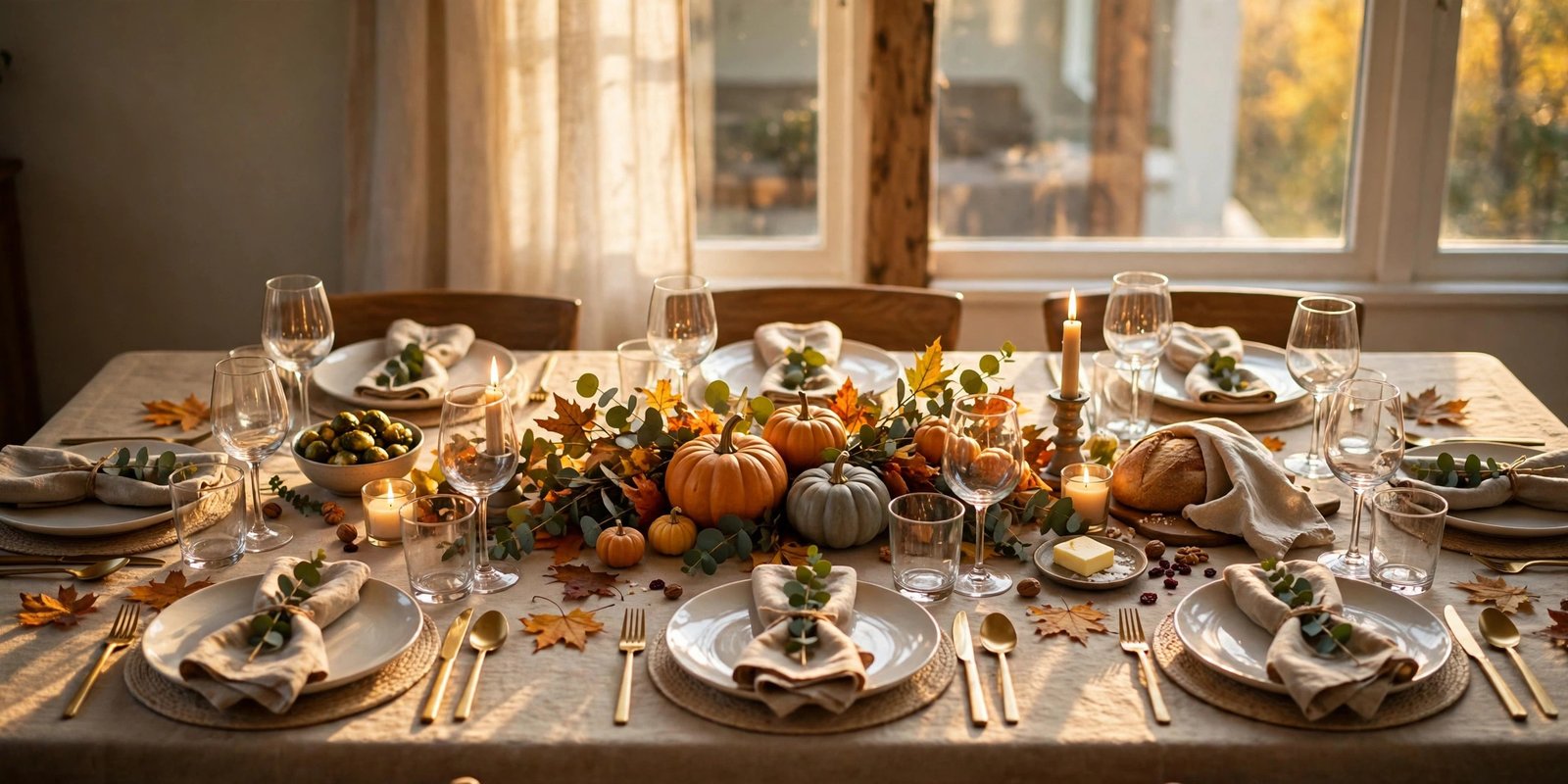

How to Set a Thanksgiving Table: A Step-by-Step Guide for Any Crowd
The turkey is brined, the pies are cooling, and the guests arrive in two hours — and the dining table is still bare. This is the moment every Thanksgiving host dreads, and it is entirely avoidable. Learning how to set a Thanksgiving table is not about memorizing etiquette rules from a 1920s handbook. It is a simple order of operations: work from the middle out, give every guest enough elbow room, and keep the centerpiece low enough that people can see each other.
This guide gives you that order, step by step, for any crowd — a formal dinner for twelve, a casual family table for six, a kids’ table, or a Friendsgiving buffet. You will learn the place setting piece by piece, how much space each guest needs, and how to make a table look expensive on a small budget. Thanksgiving is Thursday, November 26, 2026, and the best tables are set the night before, not in a panic while the turkey rests.
Before you touch a plate, make three decisions: how many people are coming, whether dinner is served at the table or buffet-style, and how formal you want it to feel. Everything else — the number of forks, the centerpiece size, the need for a kids’ table — flows from those answers. If you are hosting on a budget, our guide to hosting a dinner party on a budget has money-saving ideas that apply to Thanksgiving too. Those three answers are the whole plan for how to set a Thanksgiving table that fits your crowd.
Before You Touch a Plate: Count, Measure, Decide
Start with the guest count, then measure the table. A dining table seats one person per 24 inches of length on each side, plus one at each end — the number that matters most in this guide, measured from the center of one plate to the center of the next. Less than that, and elbows collide, wine glasses get knocked over, and nobody enjoys the meal.
If the math does not work — twelve guests and a table built for eight — do not force it. Borrow a folding table, set up a second table in the living room, or run a kids’ table so the adults fit. A cramped table ruins the meal faster than a burnt roll. Check the chairs too: every seat needs one that fits under the table.
Next, decide the serving style. Family-style — dishes passed around the table — needs space in the middle for serving bowls, so the centerpiece must be small or movable. Plated service frees the middle for decoration. A buffet frees the table entirely for eating — the best choice for a big crowd in a small room.
How to Set a Thanksgiving Table in This Order
Here is the order event planners use — each layer goes down before the next can get in the way: runner, placemats, plates, flatware, glasses, then the centerpiece last.
Step 1: The tablecloth or runner. A tablecloth should hang 10 to 12 inches over the edge for an informal meal, and to the floor for a formal one. A runner is the easier choice for Thanksgiving — it adds color down the middle without hiding a beautiful wooden table, and it leaves room for placemats. Lay it straight, centered, with equal overhang at both ends.
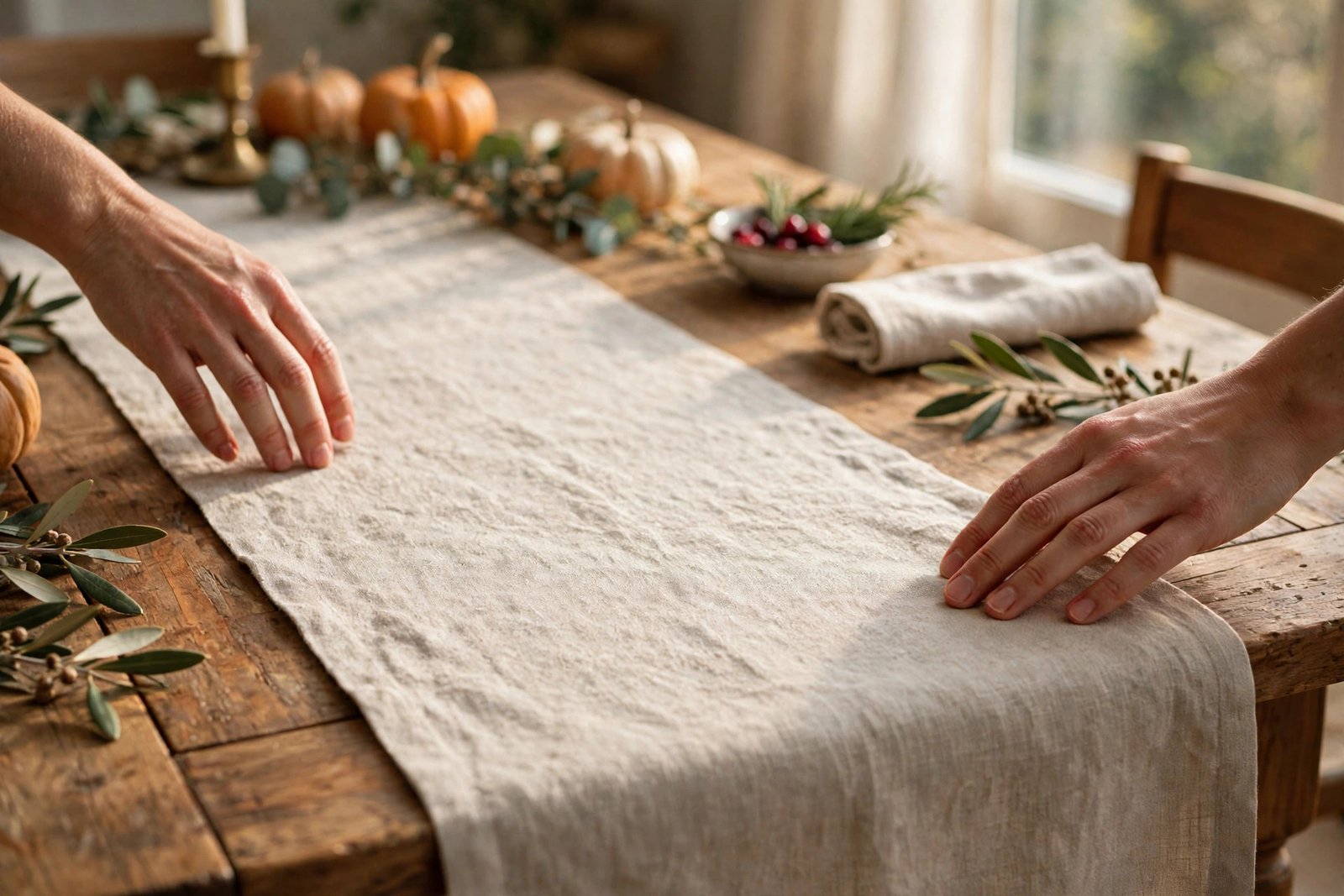
Step 2: Placemats or chargers. Placemats mark each guest’s territory and protect the table from hot dishes. Chargers — large decorative plates under the dinner plate — do the same job with more drama, and make even plain white plates look intentional. You do not need both. Pick one, and space them 24 inches apart, about an inch from the table’s edge.
Step 3: Plates. Set the dinner plate in the center of each placemat or charger. If you are serving soup or salad first, put that bowl or plate on top of the dinner plate — it gets cleared before the main course. The charger comes off the table before the turkey is served.
Step 4: Flatware. Forks go on the left, knives and spoons on the right — “fork” has four letters, like “left”; “knife” and “spoon” have five, like “right.” Work from the outside in: the first course’s utensils sit farthest from the plate. For most Thanksgiving dinners, that means a salad fork on the far left, the dinner fork next to the plate, the dinner knife on the right, blade in, and a soup spoon outside the knife if you are serving soup. Dessert forks and spoons go above the plate, or come out with dessert.
Step 5: Glasses. The water glass goes directly above the tip of the dinner knife; the wine glass sits just to its right. If you are serving both red and white wine, the red glass goes closer to the water glass. One wine glass is plenty for a casual table — it leaves more room for the food.
Step 6: The centerpiece — last. Decorate last, after every place is set, so you can see what space is left. A centerpiece that goes in first always ends up too big.
The Place Setting, Piece by Piece
If you remember nothing else, remember the shape of one correct place setting. It is the same at a diner and at a state dinner, just with more or fewer pieces.
The plate sits in the middle, about an inch from the table’s edge. The napkin goes to the left of the forks, under the forks, or folded on the plate — all three are correct. The dinner fork sits to the left of the plate; the salad fork, if you are using one, sits to the left of that. The knife sits to the right with the blade facing in. The spoon, if you need one, sits to the right of the knife. The bread plate goes above the forks; the butter knife lies across it. Glasses cluster at the upper right, above the knife: water first, then wine.
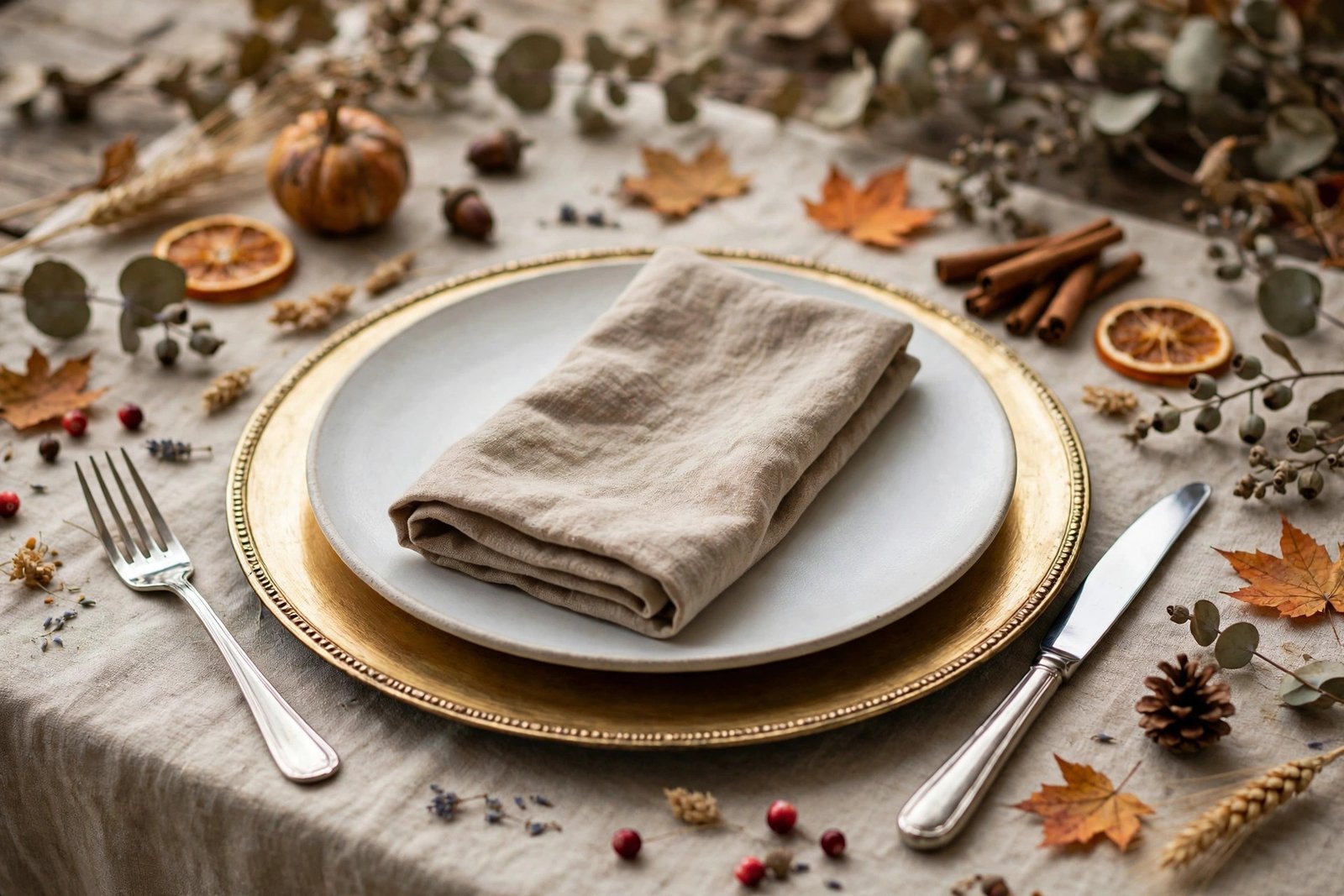
Check your work with the BMW rule: left to right across the top — Bread, Meal, Water. Bread plate on the left, the meal in the middle, water glass on the right. If those three are right, the rest falls into line. The Spruce’s table-setting guides use the same framework.
A word about napkins: cloth napkins make a table feel like an occasion, and they cost less than you think — a set of twelve basic linen napkins lasts for years. Fold them simply: a rectangle, a triangle, or a loose roll tied with twine and a sprig of rosemary. Skip the elaborate swan folds — nobody has time for swans on Thanksgiving morning, and a simple fold looks better next to a turkey anyway.
How Much Space Each Guest Needs
Twenty-four inches per guest is the rule, and it is not just about elbows — it is about the plate, the glass, the shared dishes passing by, and the fact that people lean, gesture, and reach. At 18 inches, guests bump shoulders. At 24, they can eat comfortably and pass the mashed potatoes without a negotiation.
Depth matters too: each setting needs about 15 inches. If your table is narrow, skip the runner and keep the centerpiece to one low row, and leave 12 inches behind each chair so guests can push back.
The Centerpiece Rule: Low, Movable, Unscented
A Thanksgiving centerpiece has one job: make the table beautiful without getting in the way. Three rules: low — nothing taller than about 12 inches; sit in a chair and check the sightline. Movable — build it in pieces (small pumpkins, votives, a short garland) so you can lift one away when the turkey needs a landing spot. Unscented — skip scented candles and fragrant flowers; the turkey, stuffing, and pies are the fragrance. Unscented votives or battery candles give the glow without competing with dinner.
The cheapest good-looking centerpiece is a grocery-store run: three small pumpkins, a bunch of eucalyptus, and a handful of votive candles down the middle of the runner — usually under twenty dollars, and it looks like you planned it for weeks. Add what you already have: a wooden board, a linen napkin under the pumpkins, a few pinecones from the yard. Martha Stewart’s Thanksgiving table ideas lean on the same principle: natural materials, one color story, nothing fussy.
The Kids’ Table: How to Make It the Best Seat in the House
The kids’ table works when it feels like a treat, not an exile. Set it with the same care as the adult table, then add the things kids actually care about.
Use paper plates and cups — the fun kind, in autumn colors, not the flimsy white ones — so nobody worries about breakage. Give each child a small pumpkin to take home, and put crayons and a paper turkey craft or coloring placemat at each place. A roll of kraft paper doubles as a drawing surface, and cleanup is rolling the mess up and throwing it away.
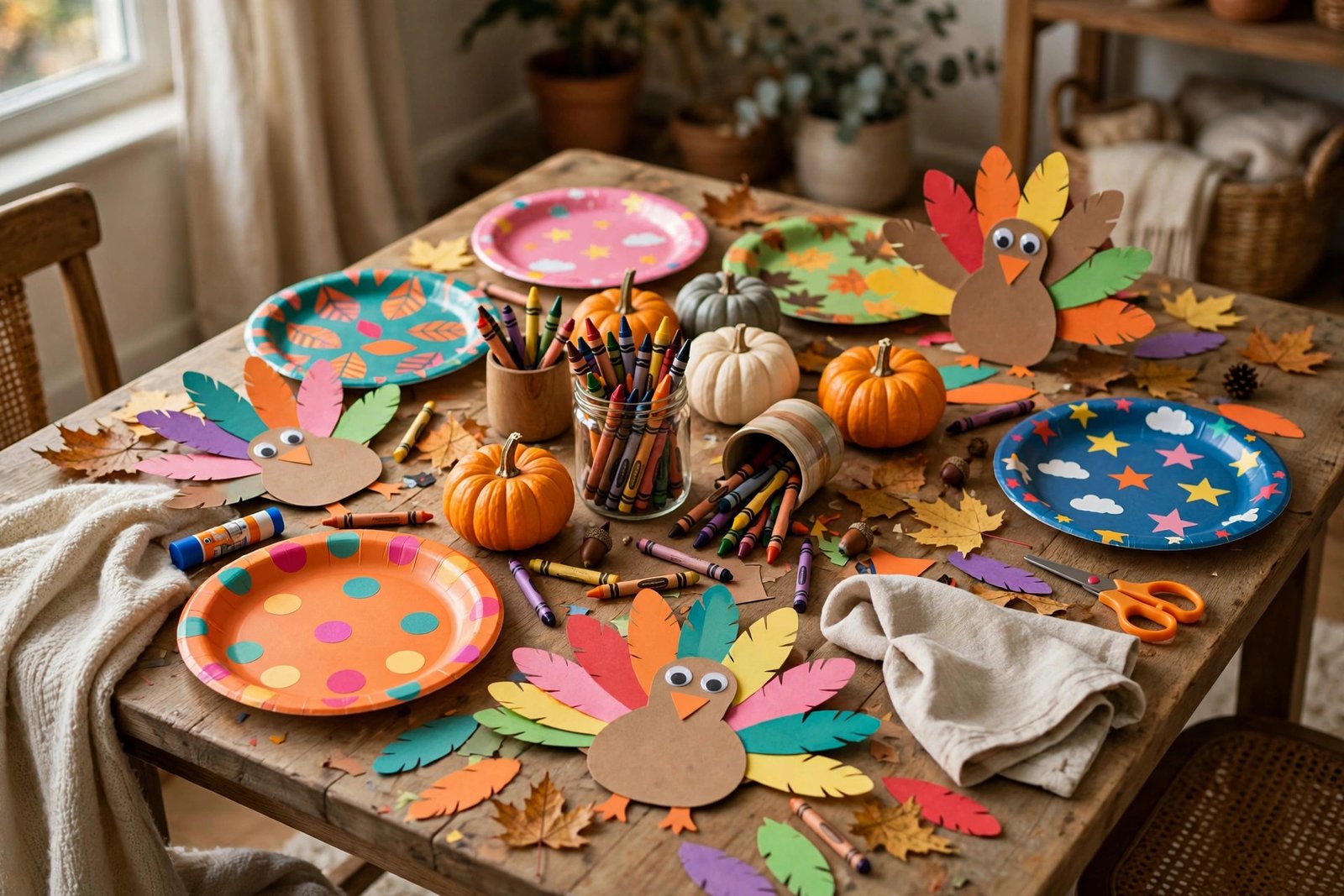
Seat the oldest child at the head as the “host,” pouring water and passing dishes — it gives them a role, and keeps the adults from refereeing. Keep the kids’ table close to the adults, in the same room, and check the chair height: a child perched on books at a full-size table is not comfortable, and a booster seat or lower table fixes it. The goal is a table kids want to sit at.
Friendsgiving and Buffet Variations
Friendsgiving — Thanksgiving with friends, usually the weekend before or after the holiday — follows the same rules with a looser hand. The table can be simpler: placemats instead of chargers, one fork each, mismatched glasses. What matters is the same order and the same 24 inches per guest. The menu is usually potluck, so leave the middle open until the dishes arrive, and let the food become the decoration.
A buffet changes the table entirely: it becomes a pure eating surface — plates, flatware, napkins, and glasses at each place, nothing in the middle. The food goes on a sideboard, kitchen island, or separate table, in serving order: plates first, then the main dish, the sides, the bread, with cutlery rolled in napkins at the end so guests are not juggling a fork while they serve themselves. Put drinks on a separate station with glasses, ice, and a pitcher of water, so the food line never jams behind someone pouring a drink. BHG’s buffet and holiday table guides lay out the same flow — a buffet that runs in the wrong order is a traffic jam with gravy. Food Network’s Thanksgiving turkey timeline is a useful check for the cooking side of the day.
Budget vs Formal: Two Looks, Same Rules
A Thanksgiving table does not need to be expensive to look good, and an expensive table is not automatically a good one. Both follow the same rules; they just spend money in different places.
The budget table (under $50 for decor): kraft paper runner or a plain linen runner you already own, white plates from the everyday set, cloth napkins in one autumn color, grocery-store pumpkins and eucalyptus down the middle, dollar-store votives, and card-stock place cards. The money goes to one thing: the food. This table looks warm, honest, and inviting — and nobody will know what it cost.
The formal table: a full tablecloth, chargers, your best plates, cloth napkins with rings, a low floral arrangement or greenery garland, taper candles in holders, and proper wine glasses. The money goes to layers: cloth, charger, plate, napkin ring, candlelight. It looks like a magazine spread, and takes about twice as long to set.
Here is the secret: the budget table and the formal table are the same table with different layers. The place setting is identical, the spacing is identical, and the centerpiece follows the same low, movable, unscented rule. If you buy one thing this year, buy cloth napkins — the single cheapest upgrade that makes a table feel like Thanksgiving instead of Tuesday.
Frequently Asked Questions
How do I set a Thanksgiving table for a large crowd?
Count first, then add space. Give every guest 24 inches, and if the main table cannot fit everyone, add a second table or a kids’ table rather than squeezing people in. A buffet beats family-style for groups over twelve — the table holds only place settings, and the food lives on a sideboard.
What is the correct order for setting a table?
Runner or tablecloth first, then placemats or chargers, plates, flatware, glasses, and the centerpiece last. Each layer goes down before the next can get in the way, and decorating last lets you see exactly how much space is left.
Do I need a charger plate for Thanksgiving?
No — chargers are optional. They add drama and protect the tablecloth, but a placemat does the same job. If you do not own chargers, do not buy them for one meal — a clean placemat and a good dinner plate look just as intentional.
How do I keep the centerpiece from blocking conversation?
Keep it under 12 inches tall, built in pieces you can move. Sit in a chair and check you can see the person across — if not, take a piece away. Small pumpkins and votives beat one tall arrangement every time.
What should I put on a kids’ Thanksgiving table?
Paper plates in autumn colors, a small pumpkin per child, crayons and a coloring placemat, and cups that will not shatter. Cover the table with kraft paper so kids can draw on it, and seat the oldest child as host. Keep the kids’ table in the same room.
Can I set the table the night before Thanksgiving?
Yes — and you should. Set everything except the food and water pitcher on Wednesday evening, then cover the table with a clean sheet if you have pets or small children. On Thursday, all that is left is the candles and the glasses.
Conclusion
Knowing how to set a Thanksgiving table comes down to three things: an order, a measurement, and a rule. The order is runner, placemats, plates, flatware, glasses, centerpiece. The measurement is 24 inches per guest. The centerpiece stays low, movable, and unscented. Get those three right and the rest is decoration, not stress.
Thanksgiving is Thursday, November 26, 2026. Set the table on Wednesday night, while the kitchen is quiet. Then, when dinner hits the table, sit down while it is hot, and enjoy it. For the rest of the meal, our gravy from scratch and cranberry sauce from scratch guides cover the two dishes that make the turkey taste like Thanksgiving — and if the pantry is in chaos after the shopping trip, how to organize a pantry will help you put it back together.



