
LED Christmas Lights vs Incandescent: Which Should You Buy in 2026?
Somewhere in your attic, there is a box of old Christmas lights. The bulbs are the warm, familiar kind — they glow amber, run hot enough to warm your fingers, and die one strand at a time every December. Next to them, maybe, is a newer box: LEDs, cooler, brighter, and somehow less romantic. Every year, the same question comes up as you drag the boxes down: is it finally time to switch?
The short answer is yes, for most people, most of the time — but not in every case. This comparison of LED christmas lights vs incandescent runs the real numbers: the running cost for a full season, the lifespan, the heat, the colour, and the one honest case where the old bulbs still win.
LED Christmas Lights vs Incandescent: The Short Answer
If you want the verdict up front, here it is. LED Christmas lights use 80 to 90 percent less electricity than incandescent lights, last ten to twenty times longer, stay cool to the touch, and let you connect far more strands end to end. For a big display or a tree lit for weeks, that is a decisive win.
Incandescent lights still have one real advantage: their light. An old-fashioned bulb glows at around 2,400 to 2,700 Kelvin, a warm amber that LEDs took years to imitate well. Modern warm-white LEDs have mostly closed that gap — more on that below — but if you are chasing a very specific vintage glow, the old bulbs are still the reference point.
The Running-Cost Math: What a Season Actually Costs
This is where the comparison stops being taste and becomes arithmetic. A standard string of 100 incandescent mini lights draws about 40 watts. The equivalent LED string draws about 4 to 6 watts for the same brightness — roughly a tenth of the power, for the same light.
Scale it up to a real display and the gap gets dramatic. Take 1,000 mini lights, lit six hours a night for forty nights — a typical season. The incandescent set uses about 96 kilowatt-hours; the LED set uses about 12. At 17 cents per kilowatt-hour, that is roughly $16 for the old bulbs and about $2 for the LEDs. The U.S. Department of Energy makes the same point at national scale: if every American household replaced just one string of incandescent holiday lights with LEDs, the energy saved could power nearly 200,000 homes for a year.
Now, $14 a season is not a fortune. But the saving repeats every year, it grows with the size of your display, and it is only the first of three ways LEDs save you money — the other two are replacement bulbs and replacement strands.
| Incandescent | LED | |
|---|---|---|
| Power per 100 mini lights | About 40 W | About 4–6 W |
| Power per 25 C9 bulbs | About 175 W (7 W each) | Under 25 W |
| Season cost, 1,000 minis (6 h/night, 40 nights) | ~96 kWh, about $16 | ~12 kWh, about $2 |
| Typical lifespan | 1,000–3,000 hours | 20,000–50,000 hours |
| Heat | Hot to the touch | Cool to the touch |
| Strands connectable end to end | About 3 | 20 or more |
| Colour | Warm amber, 2,400–2,700 K | Warm white available at 2,700 K |
| Best for | Vintage glow, small displays | Most trees and rooflines |
One more cost worth counting: your time. An incandescent strand that loses a bulb can take out a whole section, and finding the dead bulb in a hundred is a December ritual nobody enjoys. LEDs fail far less often, and when one does go, the rest of the strand usually keeps shining. Our guide on how to lower your electric bill in winter runs the same kilowatt-hour math for the whole house.
Brightness and Colour: Fixing the Cold White Problem
The most common complaint about LEDs is also the oldest one: they look cold. The first generations were a harsh, bluish white that made a living room feel like a hospital corridor, and a lot of people who tried them once never went back. That complaint was fair in 2015. In 2026, it is mostly out of date.
The fix is a single number on the box: the colour temperature, measured in Kelvin. Incandescent bulbs glow at roughly 2,400 to 2,700 Kelvin, and a warm-white LED rated at 2,700 Kelvin produces essentially the same colour — a soft, golden light that flatters wood, greenery, and wrapping paper. The mistake is buying LEDs labelled “cool white” or “daylight,” which run at 4,000 Kelvin and above and look blue by comparison.
Brightness is a different question, and here LEDs have a genuine edge. An LED string delivers the same brightness as an incandescent string on a tenth of the power, and manufacturers use that headroom to make denser strands — more bulbs per foot, which is what makes a tree look full rather than sparse. Check the bulb count on the box, not just the wattage. The U.S. Department of Energy’s guide to LED lighting explains colour temperature and brightness in more detail.

Lifespan: Buy Once vs Buy Every Few Years
The lifespan gap in the LED christmas lights vs incandescent debate is the biggest single difference between the two. A typical incandescent Christmas bulb lasts 1,000 to 3,000 hours. A typical LED is rated for 20,000 to 50,000 hours. At six hours a night for forty nights — 240 hours a season — an incandescent strand is on borrowed time after four or five seasons, while an LED strand could last for decades.
In practice, LED strands do not last forever. Wires fray, sockets corrode, and a strand left in a damp attic will fail for reasons that have nothing to do with the bulbs. But the failure mode is gentler: instead of a whole section going dark because one filament broke, an LED strand usually loses a single bulb and keeps going. Over ten years, most households will buy one set of LEDs and three or four sets of incandescent replacements — and the replacements are where the supposed price advantage of incandescent quietly disappears.
Upfront, LEDs still cost more per strand — a 100-bulb LED string typically runs a few dollars more than its incandescent equivalent. On a small tree with two strands, that difference is trivial; on a large outdoor display with twenty strands, it is real money. But the payback comes fast: a 1,000-bulb display saves about $14 a year on electricity alone, and most displays break even in the first or second season.
Heat and Safety: The Difference You Can Feel
Hold an incandescent Christmas bulb that has been on for an hour and you will feel the difference immediately: it is hot. That heat is wasted energy — up to 90 percent of the electricity an incandescent bulb uses becomes heat rather than light — and it is also a safety issue. Hot bulbs can scorch dry needles and burn small fingers. LED bulbs stay cool to the touch even after hours.
There are two practical safety rules worth knowing. First, buy lights listed by a recognised testing laboratory — look for the UL mark and the UL 588 standard for seasonal lighting, which covers the wiring, the plugs, and the fusing. UL’s safety listings are the reason a strand from a reputable brand is a safer bet than a no-name bargain. Second, respect the connection limit: never string together more than three sets of incandescent lights. LED strands, drawing a tenth of the power, can typically be connected twenty or more end to end — check the manufacturer’s limit on the box.
That connection limit is also why LEDs win outdoors. A roofline needing fifteen strands of C9 bulbs would need five separate circuits with incandescent; with LED, one circuit does the whole job. Our guide on how to hang Christmas lights safely covers the ladder, clip, and circuit side of the job in detail.
C7 and C9 Bulbs: The Roofline Question
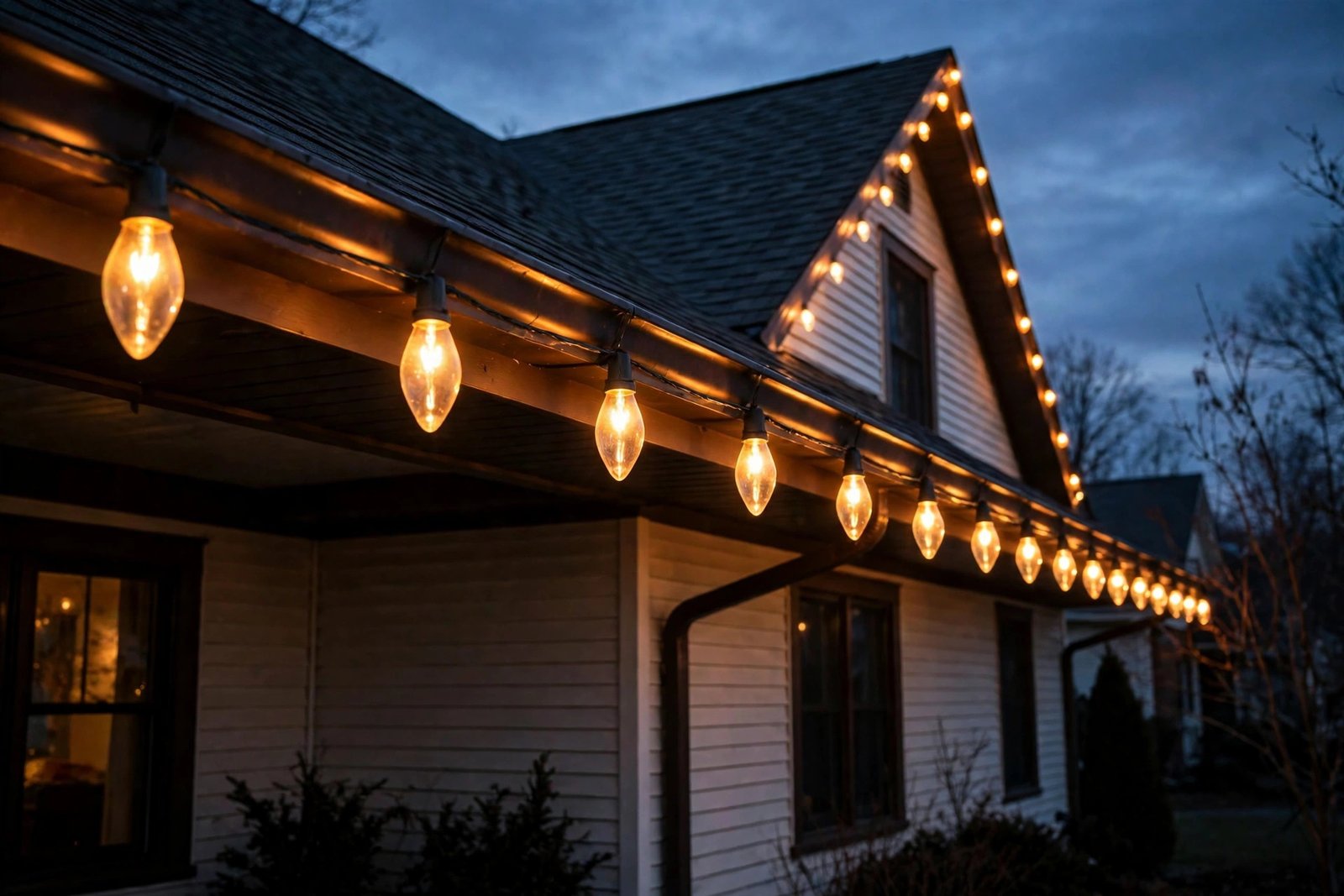
For the roofline, the LED christmas lights vs incandescent gap is widest, because the bulbs are bigger. A single incandescent C9 bulb draws about 7 watts, so a 25-bulb strand pulls about 175 watts; the LED equivalent draws under 25 watts for the whole strand. On a house with 200 C9 bulbs along the gutters, that is roughly 1,400 watts of incandescent against under 200 watts of LED — the difference between a dedicated circuit and a spare outlet.
C7 bulbs are the smaller sibling, about half the size of a C9, and they suit smaller homes, porch railings, and window frames. The same math applies: incandescent C7s run about 5 watts each, LED C7s about half a watt. The look is nearly identical from the street — the shape of the bulb matters more than what is inside it. If you are buying new roofline lights this year, our roundup of the best Christmas lights for 2026 compares C7 and C9 sets by brightness, spacing, and price.
The One Case Where Incandescent Still Wins
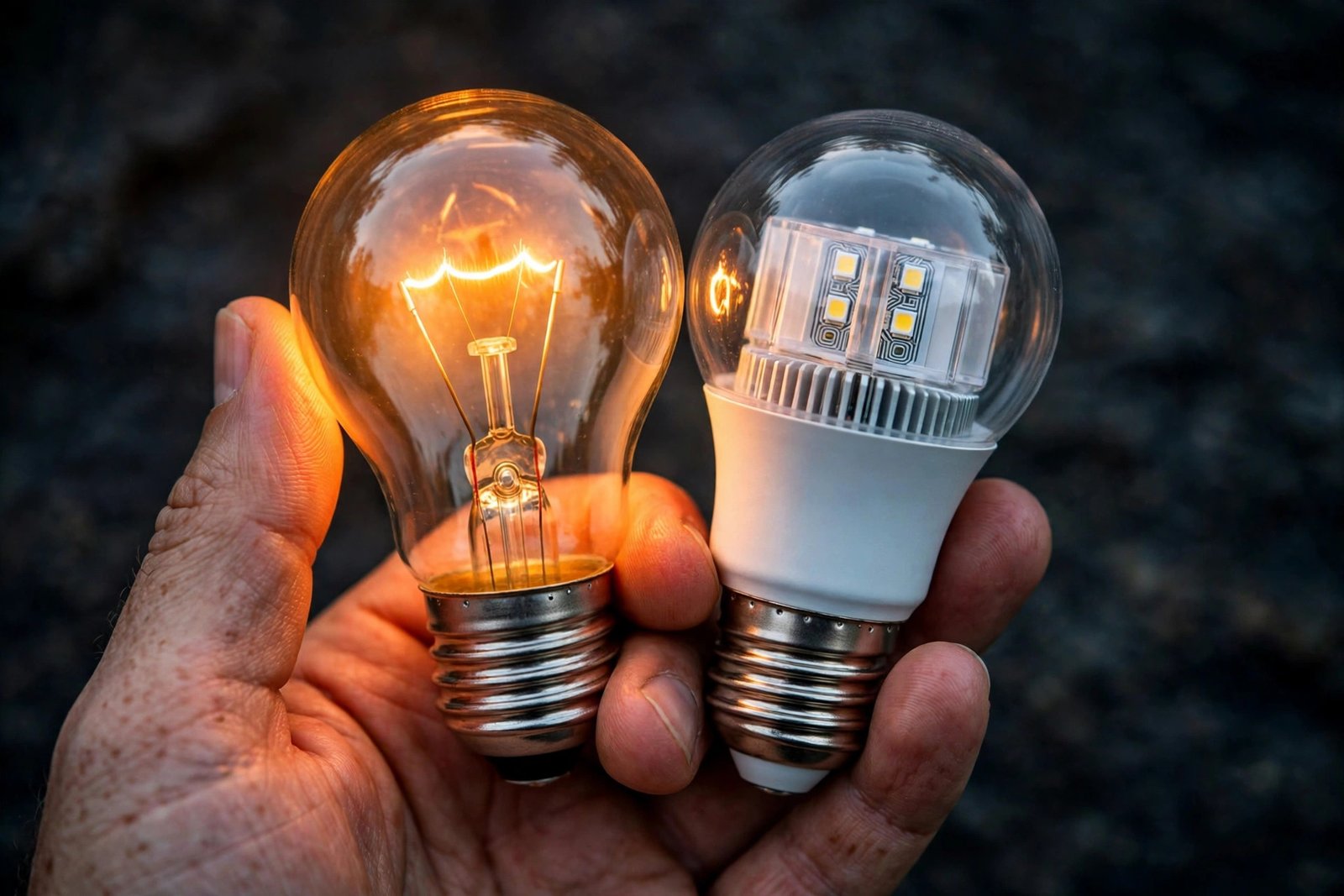
For all of that, there is one honest case for keeping the old bulbs. Incandescent light has a quality that is hard to measure and easy to recognise: a deep, amber warmth that comes from a filament actually glowing. Warm-white LEDs at 2,700 Kelvin get very close, but on a dark tree in a dark room, side by side, a careful eye can still tell them apart.
That matters most in two situations: a small, traditional tree where the lights are the main decoration, and a vintage-style display where the bulbs themselves are meant to be seen — old-fashioned C7s on a porch, or a mantelpiece garland. If your display is small, the electricity saving is pennies, the heat is manageable, and the glow is the whole point.
There is also a second, smaller case: dimming. Old incandescent strands dim smoothly on a standard dimmer, warming as they dim. Many LED strands do not dim well — they flicker, or drop out below a certain level — unless they are specifically rated as dimmable. If you run your tree lights on a dimmer, check the box before you buy. Consumer Reports’ lighting guides are a useful check for dimmable ratings before you commit to a brand.
What to Buy in 2026: A Quick Checklist
If you are switching to LED this year, a little care at the shop saves a disappointing December. First, buy warm white at 2,700 Kelvin — not cool white, not daylight. Second, count the bulbs, not just the watts: 100 bulbs on a short wire looks fuller than 100 bulbs stretched thin. Third, check the UL 588 listing and the manufacturer’s end-to-end connection limit, and buy outdoor-rated sets for anything outside. Fourth, buy one spare strand in the same brand and colour temperature, because matching a strand mid-season is harder than it sounds.
And keep your old incandescent strands if they still work. There is no rule that says the whole house has to switch at once. Many households run LED on the roofline and the big tree, where the savings are largest, and keep a strand or two of incandescent on the mantelpiece, where the glow matters most. That split is not indecision — it is the sensible answer to the LED christmas lights vs incandescent question for a real home. If you are weighing the switch as part of a wider winter budget, our guide on how to save money on heating in winter covers the bigger savings around the house.
Frequently Asked Questions
Do LED Christmas lights really use 80 percent less electricity?
Yes — typically 80 to 90 percent less, and it is the headline number in the whole LED christmas lights vs incandescent comparison. A 100-bulb incandescent mini string draws about 40 watts; the LED equivalent draws about 4 to 6 watts for the same brightness. The U.S. Department of Energy cites the same range, and it is easy to verify with a plug-in power meter on your own strands.
Can you mix LED and incandescent Christmas lights?
You can use them on the same tree or in the same display, but never on the same strand or the same series circuit — the two types have different electrical requirements and should not be wired together. Keep them on separate strands and separate plugs. Be aware that warm-white LEDs and incandescent bulbs are close in colour but not identical, so a mixed tree can look slightly uneven if the strands sit side by side.
Why do my LED Christmas lights look blue?
You probably bought cool-white or daylight LEDs, which run at 4,000 Kelvin or higher. Incandescent bulbs glow at roughly 2,400 to 2,700 Kelvin. Buy warm-white LEDs rated at 2,700 Kelvin and the colour will match the old bulbs closely. Check the Kelvin number on the box before you buy — the words “warm white” alone are not always reliable.
How many LED strands can you connect end to end?
It depends on the manufacturer, but LED strands can typically be connected twenty or more end to end, because each strand draws so little power. Incandescent mini-light strands are limited to about three. Always check the limit printed on the box or the tag — never assume, and never exceed it.
Are LED Christmas lights worth the higher price?
For most displays, yes. LEDs cost more per strand upfront, but they use about a tenth of the electricity, last ten to twenty times longer, and rarely need replacing. A 1,000-bulb display saves roughly $14 a season on electricity alone at 17 cents per kilowatt-hour, and most displays break even within the first or second season. The exception is a very small display where the saving is pennies — there, buy whichever light you like looking at.
Conclusion
So, LED christmas lights vs incandescent — which should you buy in 2026? For most homes, the answer is LED: a tenth of the power, a fraction of the running cost, ten to twenty times the lifespan, cool to the touch, and twenty strands on one circuit instead of three. Buy warm white at 2,700 Kelvin, check the UL 588 listing, and you will get the glow you remember at a tenth of the cost.
But keep the old bulbs where they earn their keep. A small traditional tree, a vintage porch display, a mantelpiece garland — those are places where the amber glow of a filament is the decoration, and the electricity saving is too small to matter. The best answer is rarely all of one and none of the other. Put LEDs where the numbers are big and the lights stay on for weeks, keep incandescent where the glow is the point, and enjoy a December that costs less and looks exactly the way you want it to. For a wider look at this year’s options, Home Depot’s Christmas lights range is a useful place to compare C7, C9, and mini sets side by side.



