
How to Start a Cleaning Business With No Money: The $300 First-Month Plan
Learning how to start a cleaning business with no money is simpler than most people think. You do not need a franchise, a van full of equipment, or a business loan. You need a short list of affordable supplies, a clear offer, and a plan to get your first five paying clients within 30 days. This guide gives you exactly that: a realistic first-month budget, a buy/skip list, and a week-by-week client-getting plan you can start this weekend.
Cleaning is one of the most forgiving businesses to start from zero. There is no degree required and no expensive certification standing between you and your first paying job. If you are looking for practical side hustles you can start with no money, cleaning sits near the top because customers pay you the same day you do the work — no waiting for invoices, no inventory to sell first.
Why a Cleaning Business Works When You’re Starting From Zero
Most businesses fail before they start because the founder spends money before making any. A cleaning business flips that around: your main “equipment” is your time and effort, which you already own. The supplies are cheap and available at any grocery or dollar store, and you can genuinely begin with products you already have under your sink.
There are three reasons this model is so beginner-friendly:
- Same-day cash flow. Residential clients typically pay on the spot — cash, check, or a payment app. You are not waiting 30 days for an invoice to clear.
- No special skills to learn first. You already know how to clean. The business part is learning how to price, schedule, and keep clients — all of which you pick up by doing.
- Built-in repeat revenue. A one-time deep clean often turns into a weekly or biweekly recurring booking. Five recurring clients can form the entire foundation of your income.
Learning how to start a cleaning business with no money is not effortless — cleaning is physical work, and the first month is mostly about getting clients, not cleaning. But the barrier to entry is genuinely low, which is why the plan below front-loads client-getting instead of spending.
The $300 First-Month Plan for How to Start a Cleaning Business With No Money
The biggest mistake new cleaners make is buying like a franchise on day one: a $400 vacuum, a caddy full of specialty products, printed uniforms. You do not need any of that yet. The goal of month one is to turn a small supply budget into paying clients, then reinvest. Here is a sample budget that keeps your total startup spend around $300.
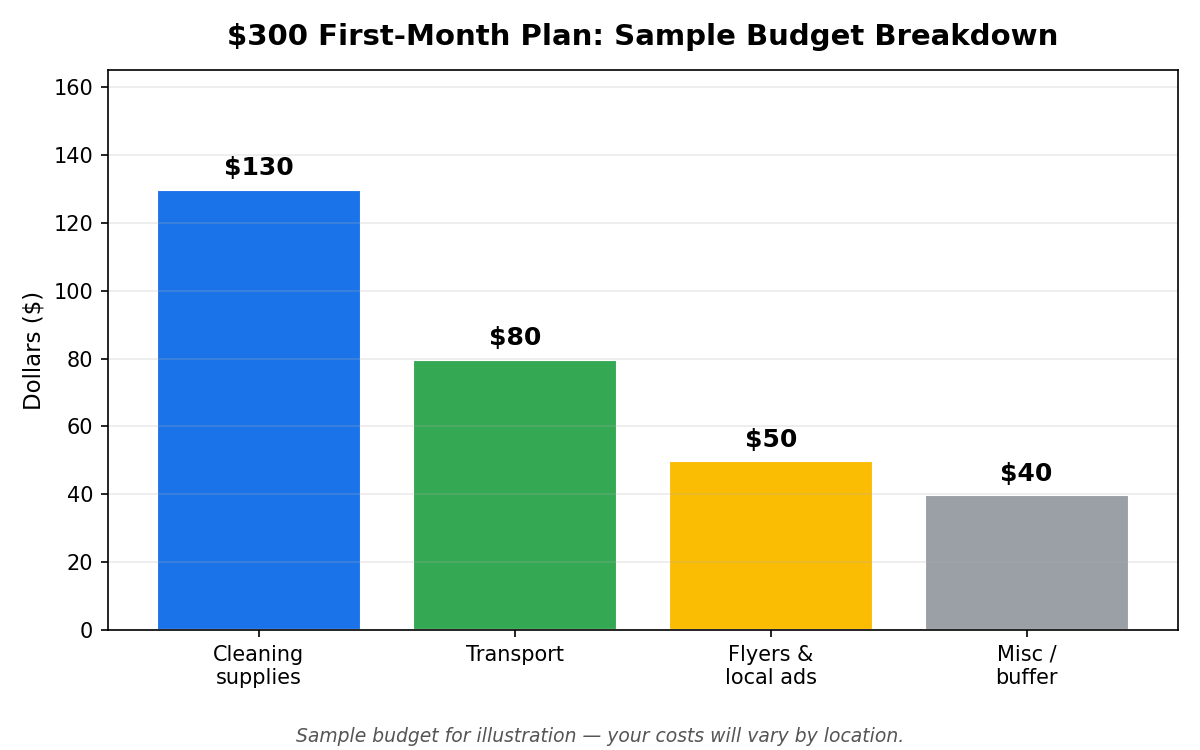
Here is the breakdown behind the chart:
- Cleaning supplies — about $130. An all-purpose cleaner, bathroom cleaner, glass cleaner, floor cleaner, a pack of microfiber cloths, sponges, a scrub brush, rubber gloves, trash bags, and a sturdy tote or caddy to carry it all. Buy store brands. They work fine.
- Transport — about $80. Bus fare, gas money, or rideshare credit to get to your first jobs. If you already have reliable transport, move this money into flyers.
- Flyers and local ads — about $50. A stack of simple printed flyers and a few boosted posts in local community groups. More on exactly what to print below.
- Maintenance buffer — about $40. Tape, a cheap door-hanger bag supply, or replacing anything that runs out mid-month.
What to Buy This Week
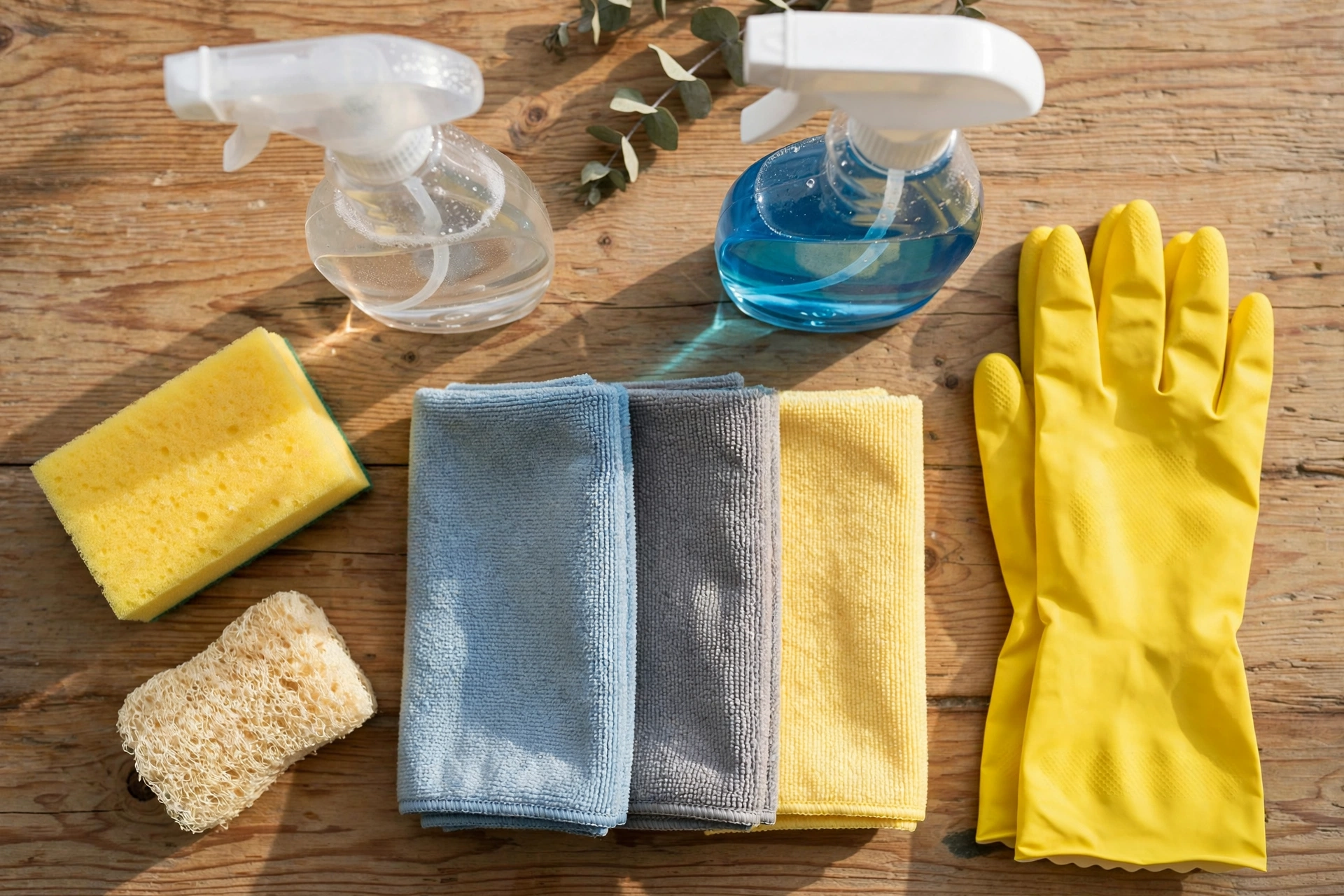
Keep the list short and practical. You need to clean kitchens, bathrooms, floors, and glass — four surfaces cover almost every residential job:
- All-purpose cleaner (1 large bottle)
- Bathroom cleaner or disinfecting spray (1 bottle)
- Glass cleaner (1 bottle)
- Floor cleaner suitable for the floors you will meet most (1 bottle)
- Microfiber cloths (pack of 12 or more — these are your workhorses)
- Sponges and one stiff scrub brush
- Rubber gloves (a multi-pack)
- Trash bags (one box)
- A tote bag or small caddy to carry everything between rooms
If money is extremely tight, start with what you already own and buy the rest after your first paid job. Many cleaners land client number one using products from home and restock from that first payment. If you are budgeting on a low income, treat this list as a priority order, not an all-or-nothing shopping trip.
What to Skip (For Now)
- An expensive vacuum. Ask clients if you can use theirs for the first month — most will say yes. Buy your own only after you have steady bookings.
- Specialty products. Granite polish, wood oil, grout pens — wait until a client actually asks for them, then buy per job.
- A website and logo. A free Google Business Profile and a Facebook page cost nothing and matter far more at this stage.
- Uniforms. Clean, plain clothes and an apron look professional enough for month one.
- Business registration and insurance. Yes, you will need these — but read the section below on timing. Spending your whole budget on paperwork before you have a single client is backwards.
Residential vs. Commercial Cleaning: Which Should You Start With?
When you are figuring out how to start a cleaning business with no money, the residential-vs-commercial question comes up fast. Both are valid, but they are very different businesses in month one:
| Factor | Residential (Homes) | Commercial (Offices) |
|---|---|---|
| First client difficulty | Easier — neighbors, friends, and local groups convert fast | Harder — usually requires quotes, references, and insurance upfront |
| Startup cost | Very low — basic supplies suffice | Higher — may need commercial-grade equipment |
| Pay per job | Lower per visit, but jobs are quick to book | Higher contracts, but slower to win |
| Schedule | Daytime, flexible — you set the hours | Often evenings/weekends when offices are empty |
| Insurance expectations | Often not asked for at first (get it as you grow) | Frequently required before you start |
| Best for month one? | Yes — fastest path to paying clients | Better as a month-three expansion goal |
The recommendation is simple: start residential. Land five happy home clients, build a small base of recurring bookings, and then use that track record — plus real revenue — to pitch offices and retail spaces later. If you live somewhere with fewer households nearby, check out these small business ideas for small towns for complementary services you can bundle with cleaning.
How to Land Your First Five Paying Clients in 30 Days
Supplies do not matter if nobody hires you. This is the part most guides skip, so here is a concrete week-by-week plan. The target: five paying clients by day 30.

Week 1: Tell Everyone You Know (Goal: Client #1)
Your first client almost always comes from your existing network. Post on your personal social media accounts: what you are offering, which neighborhoods you serve, and a simple starting price for a standard home clean. Text friends, family, former coworkers, and neighbors directly — not a mass blast, but individual messages. People hire people they know first.
Also set up your free online presence this week: a Google Business Profile (it is free and puts you on the map when locals search), a simple Facebook page with your service area and phone number, and listings on free local classifieds. These take an afternoon and keep working for you around the clock.
Week 2: Flyers and Community Groups (Goal: Clients #2 and #3)
Print 200 simple flyers: your service, your area, your phone number, and one line about a first-clean offer. Skip fancy design — clear and readable beats pretty. Put them on community bulletin boards (laundromats, grocery stores, libraries, places of worship), and do one afternoon of door hangers in a neighborhood with lots of busy-looking homes.
At the same time, join every local Facebook and neighborhood group that allows service posts, and post once with a friendly introduction. Homeowner and “moms of [your town]” style groups are especially effective — cleaning is one of the most requested services in them. Follow each group’s promo rules so your post stays up.
Week 3: Ask for Referrals (Goal: Client #4)
By now you have cleaned two or three homes. This is the moment most beginners waste: they finish the job, take payment, and leave. Instead, before you leave, say this: “If you’re happy with the work, I’d really appreciate it if you’d tell a friend or neighbor — I’m building my client list right now.” Then text them the next day with a thank-you and a gentle reminder that referrals are how you grow.
Offer a small thank-you incentive, like a discount on their next clean for every referred client who books. Referrals from happy clients convert better than any advertising you can buy, and they cost you nothing upfront.
Week 4: Follow Up and Fill Gaps (Goal: Client #5)
Go back through everyone who showed interest but did not book — the neighbor who said “maybe next month,” the group commenter who asked for prices. A short, friendly follow-up message (“Just checking in — I have two slots open next week if you’d like that clean”) converts a surprising number of maybes. Re-post in your community groups with a short testimonial from a happy client (ask permission first).
End the month by converting one-time cleans into recurring bookings: offer clients a slightly better rate for a biweekly schedule. One client on a recurring plan is worth more than three one-time jobs, and five recurring clients is a genuine business.
Pricing Your First Jobs (Without Guessing)
Once you learn how to start a cleaning business with no money, pricing is the next skill: new cleaners either price too low from panic or too high from optimism. Use this simple approach for month one:
- Price by the job, not the hour, when you can. Flat rates (for example, one price for a standard 2-bedroom home clean) are easier for clients to say yes to than an open-ended hourly meter.
- Research three local competitors. Check their Facebook pages or ask in a local group what people pay. Price yourself slightly below the established cleaners while you are new — not half price, just enough to make trying you an easy decision.
- Charge extra for first-time deep cleans. A home that has not been professionally cleaned needs more work. Quote the first visit higher, then offer the lower recurring rate going forward.
- Raise prices after ten happy clients. Once you have reviews and a waitlist, your prices go up. Early low pricing is a launch strategy, not a permanent business model.
Take payment on the day of the job. Cash, bank transfer, or a payment app — whatever is normal in your area. Do not leave without being paid for a first-time client, and do not offer credit terms in month one.
Licenses, Insurance, and the Boring (Important) Stuff
When you learn how to start a cleaning business with no money, here is the honest, non-legal-advice version: requirements for cleaning businesses vary a lot by city, county, and state or country. Some places want a general business license before you take a dollar; others are relaxed for tiny sole proprietorships. Some clients will ask if you are insured; most residential clients in month one will not.
The practical sequence that works for most beginners:
- Start taking clients now as a sole proprietor, keeping simple records of every payment.
- After your first few paid jobs, check your local government’s small business requirements — the U.S. Small Business Administration is a solid starting point, and its 10 steps to start your business guide walks through licenses and permits in plain language.
- Get liability insurance as soon as you can afford it — it protects you if something gets damaged, and it becomes a selling point when pitching bigger clients. Industry groups like ISSA, the worldwide cleaning industry association, publish beginner-friendly resources on professional standards.
- Set aside part of every payment for taxes. Self-employment income is taxable, and a simple spreadsheet beats a surprise later. The IRS self-employed tax center explains the basics.
This is general information, not legal advice — rules really do differ by location, so verify yours with your local business office before you scale up.
Frequently Asked Questions
Can I really start a cleaning business with no money at all?
Essentially yes. The realistic version is “almost no money”: you need basic supplies, and you may already own most of them. Many cleaners land their first paying client using products from home and restock from that first payment.
Do I need a license to start a cleaning business?
It depends on where you live. Licensing rules for small service businesses vary by city, county, and state or country — some require a general business license before you begin, others do not for small sole proprietorships. Check your local government’s small business office (the SBA’s startup guide is a good starting point in the US) rather than guessing.
How much should I charge for house cleaning when starting out?
Research what established cleaners charge in your area and price slightly below them while you are new — not half price, just enough to make choosing you easy. Flat per-job rates convert better than hourly for residential clients, and you should quote first-time deep cleans higher than recurring visits.
Should I start with residential or commercial cleaning?
Start residential. Home clients are faster to win, require cheaper supplies, and rarely demand insurance upfront. Commercial contracts pay more but usually require quotes, references, and insurance before you begin — save offices for month three, after you have revenue and a track record.
What supplies do I actually need on day one?
An all-purpose cleaner, bathroom cleaner, glass cleaner, floor cleaner, microfiber cloths, sponges, a scrub brush, rubber gloves, trash bags, and something to carry it all in. That is the whole list. Skip the expensive vacuum at first — most clients will let you use theirs.
How do I get clients without spending money on ads?
Your personal network first, then free community channels: local Facebook and neighborhood groups, a free Google Business Profile, flyers on community bulletin boards, and door hangers in target neighborhoods. Referrals from your first happy clients are the highest-converting channel of all — always ask for them.
Conclusion: Your First 30 Days Start This Weekend
Starting a cleaning business with no money is not a theory — it is a sequence: buy the short supply list (or use what you have), skip everything that does not get you clients, and spend your first month telling everyone you know, posting in local groups, hanging flyers, and asking every happy client for a referral. Five paying clients in 30 days is ambitious but genuinely achievable if you work the plan week by week.
Once those five clients are booked, the business changes shape: you formalize the paperwork, get insured, raise your prices, and start turning one-time cleans into recurring revenue. But none of that comes first. Clients come first — everything else is funded by them. Pick up the supplies this weekend, send the first messages tonight, and give yourself 30 days to prove the model works.




[…] or biweekly clients create predictable income fast. Here is a practical walkthrough of how to start a cleaning business with no money if your budget is near […]
[…] the campus computer lab for the occasional heavy task, which is a perfectly valid strategy. Others earn money between classes with a small service business to fund a more powerful machine later — the laptop decision doesn’t have to be […]
[…] All three share the same economics: your costs are per-sale fees taken out of revenue you’ve already earned. If you sell nothing, you spend nothing. That makes them the only honest answer to starting with no money — and it’s the same “start with what you have” logic behind our guide to starting a cleaning business with no money. […]