
You have probably heard a dozen different answers to the question of how much water you should drink a day. Eight glasses. A gallon. “Just drink when you’re thirsty.” Half your body weight in ounces. Some of these are folk wisdom, some are oversimplifications of real science, and one of them actually matches what researchers found. This guide sorts it out: the real numbers from the most-cited research on the planet, why your personal target differs from your neighbor’s, and a practical routine that makes hitting it automatic.

The official answer: how much water should you drink a day
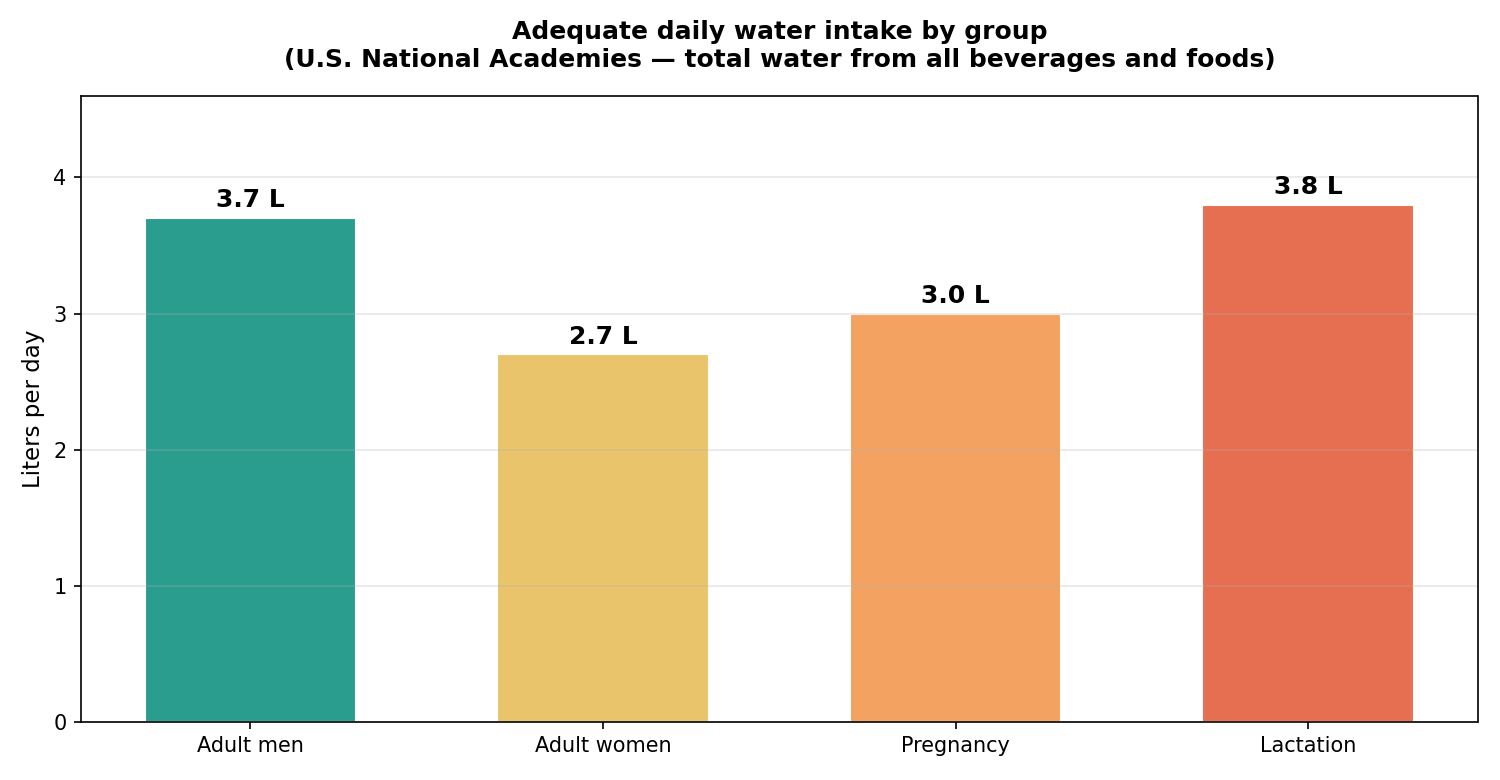
The most widely cited figures come from the U.S. National Academies of Sciences, Engineering, and Medicine, which reviewed intake data and set “adequate intake” levels for total daily water — everything you drink plus the water in your food. As summarized in Mayo Clinic’s guide to adequate daily water intake, the numbers are:
- About 15.5 cups (3.7 liters) of fluids a day for men
- About 11.5 cups (2.7 liters) of fluids a day for women
Two important details hide inside those figures. First, they are not minimums you must hit or suffer the consequences — they describe the observed intakes of healthy, well-hydrated populations, a description rather than a prescription. Second, about 20 percent of that total typically comes from food — a figure Healthline’s evidence review of daily water needs also confirms — so the beverage portion works out to roughly 13 cups a day for men and 9 cups for women.
Other respected bodies land in the same neighborhood with simpler framing. Cleveland Clinic’s breakdown of how much water you need daily notes the Academy of Nutrition and Dietetics suggests roughly 13 cups for men and 9 cups for women as a starting point — and stresses that size, metabolism, location, diet, activity, and health all move the number. Harvard Health’s take is refreshingly honest: for healthy individuals, men average about 15.5 cups and women about 11.5 cups of total water, which might mean you only need four to six cups of plain water depending on other fluid sources like coffee, tea, juice, fruits, and vegetables.
Where the “8 glasses a day” rule came from
The famous 8×8 rule — eight 8-ounce glasses, about 2 liters — is easy to remember, and that is precisely its problem. It is a mnemonic, not a medical finding. For a small, sedentary woman in a cool climate it may be plenty; for a large man doing physical labor in August heat, it is nowhere near enough.
Here is a useful way to think about it: the 8×8 rule roughly matches the beverage-only portion of the National Academies’ figures for an average woman (9 cups from beverages), once you account for the ~20 percent that comes from food. So the old rule is not nonsense — it is just the floor for a small person, presented as if it applied to everyone.
What actually changes your number
Knowing how much water you should drink a day in the abstract is only half the battle. Your real target shifts with at least five factors.
1. Exercise
This is the biggest day-to-day variable. A hard workout can cost you a liter or more of sweat per hour, and you have to replace it. If you start running out of shape, expect your fluid needs to jump noticeably on training days — that is one reason new runners feel wiped out. A practical rule used by exercise physiologists: drink before, during, and after exercise, and for sessions longer than an hour, replace electrolytes too, not just water.
2. Heat, humidity, and altitude
Hot, humid weather and high altitude both increase fluid loss — heat through sweat, altitude through faster breathing and drier air. If you live somewhere with real summers, your “enough” in July is genuinely different from your “enough” in January.
3. Pregnancy and breastfeeding
Fluid needs rise here: the National Academies set adequate intake at about 3.0 liters (12.5 cups) of total water during pregnancy and 3.8 liters (16 cups) while breastfeeding. If this applies to you, treat hydration as part of the plan, not an afterthought.
4. Age and medications
Older adults sense thirst less keenly than younger people, which is one reason dehydration sends so many seniors to the emergency room. Certain medications — diuretics, some blood pressure drugs — also increase fluid loss. If you are working on your cardiovascular health, note that steady hydration supports the whole system; a sensible plan to lower blood pressure naturally pairs well with consistent fluid intake.
5. Illness
Fever, vomiting, and diarrhea drain fluids fast. When you are sick, water, oral rehydration solutions, and brothy soups matter more than they do on any normal day.

Water from food counts more than you think
About one-fifth of your daily water typically arrives on a fork. Fruits and vegetables are the heavy hitters. Here is roughly how much water common foods contain:
| Food | Approximate water content | What it means in practice |
|---|---|---|
| Cucumber, lettuce | ~95% | A big salad is genuinely hydrating |
| Watermelon, strawberries | ~90–92% | A summer snack that doubles as a drink |
| Oranges, apples | ~84–87% | Whole fruit beats juice for hydration plus fiber |
| Cooked rice, pasta | ~65–70% | Staple meals quietly add up |
| Yogurt | ~85% | Breakfast can cover a cup or more |
This is also why “drink X liters of plain water” advice often overshoots. If your diet is rich in produce, soups, and cooked grains, you are already banking a meaningful share of your target before you lift a glass. Coffee and tea count too, by the way — their mild diuretic effect does not cancel out their fluid content, a point MD Anderson’s dietitian advice on daily water intake confirms: total fluids include water, teas, and even juice.
Signs you are not drinking enough
Your body telegraphs under-hydration well before it becomes dangerous. Watch for:
- Dark yellow urine. Pale straw is the target; consistently dark means drink more.
- Fatigue and brain fog. Even mild dehydration can drain energy and make you tired.
- Headaches that arrive in the afternoon and fade after a big glass of water.
- Dry mouth, dry skin, and dizziness when standing up.
- Constipation — water keeps things moving through the digestive tract.
Thirst itself is a decent guide for most healthy adults, though it lags slightly behind actual need — by the time you feel thirsty you are already mildly dehydrated. The CDC notably sets no fixed daily amount of plain water at all, advising people to let thirst lead and choose water over sugary drinks.
Can you drink too much water?
Yes, though it is uncommon outside of endurance sports and certain medical conditions. Drinking extreme amounts in a short time can dilute blood sodium — a condition called hyponatremia — causing confusion, headache, nausea, and in severe cases seizures. People with thyroid disease or kidney, liver, or heart problems, and those on medications that cause water retention, should ask their doctor about the right amount rather than chasing a high target. More is not always better; the goal is enough.
A simple daily routine that hits the target without thinking
Forget carrying a gallon jug. Anchor water to habits you already have:
- Morning: a full glass right after waking — you lose water overnight through breathing alone.
- Meals: a glass with each meal. Three meals, three glasses, zero effort.
- Work blocks: keep a bottle on your desk and sip between tasks, not in heroic chugs.
- Exercise: drink before, during, and after; add electrolytes for sessions over an hour.
- Evening: a smaller glass with dinner, then taper off so you are not up all night.
That routine alone lands most people in the 8–12 cup range from beverages, which — plus food — puts you squarely inside the National Academies’ adequate intake zone. Adjust upward on hot days, hard training days, and during illness, and you are done.
Frequently asked questions
How much water should you drink a day if you exercise a lot?
Start from the standard adequate intake (about 3.7 liters total for men, 2.7 for women) and add roughly 1.5–2.5 cups per hour of moderate-to-intense exercise, more in heat. For sessions over an hour, include electrolytes — replacing water without sodium can be counterproductive.
Does coffee count toward daily water intake?
Yes. Coffee, tea, milk, and juice all contribute to total fluid intake. Caffeine has a mild diuretic effect, but it does not cancel out the water in the cup. If coffee is your main beverage, it counts — just do not let it be your only one.
Is the 8-glasses-a-day rule true?
It is a reasonable floor, not a law. Eight 8-ounce glasses (about 2 liters) roughly matches the beverage portion of the National Academies’ adequate intake for an average woman, but men, athletes, and anyone in heat need more. Treat it as a starting line, not the finish.
How much water should you drink a day to lose weight?
Water supports weight loss indirectly — it can modestly reduce appetite when drunk before meals and replaces calorie-containing drinks — but there is no special “weight loss water target.” Staying consistently in the adequate intake range while swapping sugary drinks for water is the evidence-backed move.
What are the first signs of dehydration?
Dark yellow urine, fatigue, headache, dry mouth, and dizziness. In older adults, confusion can be an early sign. If symptoms include very dark urine, rapid heartbeat, or fainting, seek medical care rather than just drinking more.
Should you drink water before bed?
A small glass is fine and can help if you wake up thirsty, but large amounts close to bedtime often mean interrupted sleep. Front-load your intake earlier in the day and taper in the evening.
The bottom line
So, how much water should you drink a day? For most healthy adults: about 3.7 liters of total fluids if you are a man, about 2.7 liters if you are a woman — with roughly 20 percent coming from food, and the rest from drinks of all kinds. Then adjust for your life: more when you train, sweat, travel to altitude, or run a fever; a steady, moderate amount when you are at a desk in air conditioning. Let pale-yellow urine be your dashboard, thirst your backup sensor, and your doctor the final authority if you have a health condition. Hydration is not complicated — it just needs to be consistent.