

If you’ve ever watched a flight price jump $120 overnight, you know the frustration: figuring out how to find cheap flights feels less like shopping and more like gambling. The good news? Airfare isn’t random. Every year, researchers crunch hundreds of millions of fares and the same patterns keep showing up — book in the right window, fly on the right days, and let fare-tracking tools do the stalking for you. Below are 14 tricks that genuinely work in 2026, backed by published airfare studies, not travel-forum folklore.

1. Book Inside the “Prime Booking Window”
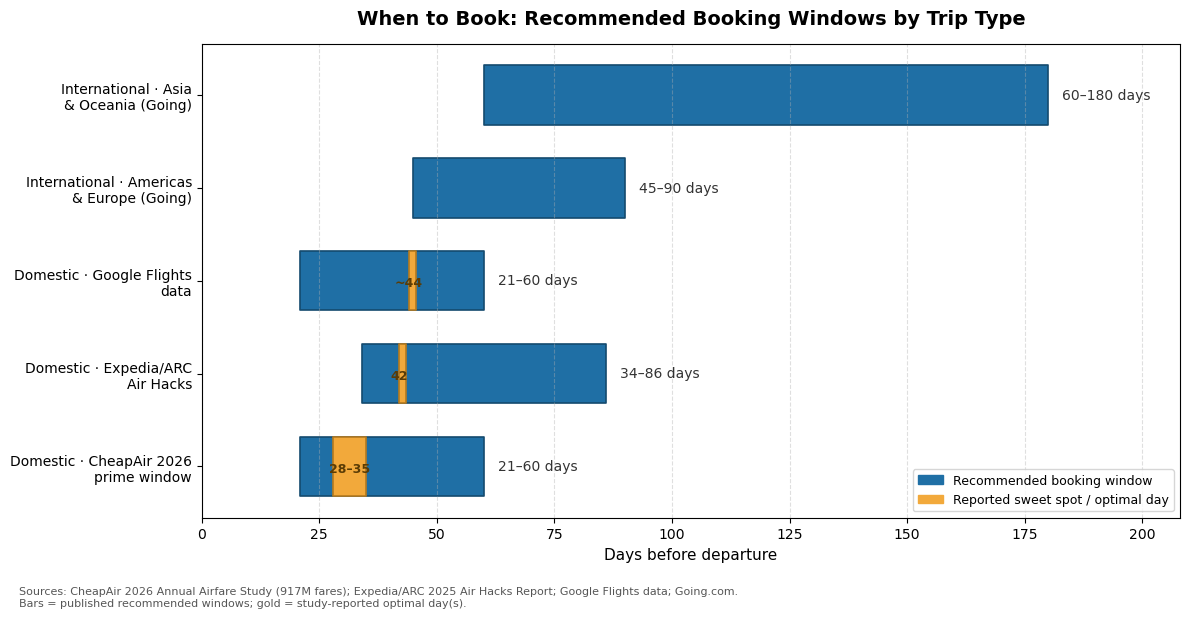
The single biggest lever on price is when you click “buy.” CheapAir’s 2026 Annual Airfare Study, which analyzed 917 million domestic fares, found that the cheapest fares cluster in a “prime booking window” of roughly 21 to 60 days before departure, with a sweet spot around 28 to 35 days out. Book much earlier and you pay a “first dibs” premium; book inside two weeks and prices climb steeply as airlines target last-minute business travelers.
Other datasets agree. Expedia and ARC’s Air Hacks report puts the domestic savings window at 34 to 86 days out (with day 42 statistically optimal), and estimates that booking inside that window saves about 25% compared to booking outside it. The takeaway is simple: start watching prices three to four months ahead, but plan to actually buy in the 1-to-3-month zone.
2. Fly on Tuesdays and Wednesdays
The day you buy matters far less than the day you fly. Midweek departures — especially Tuesday and Wednesday — are consistently the cheapest days to be in the air, while Sundays are the most expensive. One CheapAir analysis measured the average gap between the cheapest and priciest travel days at around $76 on domestic routes. If your schedule has any give, shifting a trip from Sunday to Wednesday can quietly erase the cost of a checked bag, an airport meal, and then some.
3. Search With Flexible Dates
Fixed dates are a luxury tax. Google Flights’ own guide highlights its calendar view, which shows the lowest fare for every day of the month at a glance. When I priced a spring trip to Chicago recently, moving the outbound by a single day dropped the fare by nearly a third — same route, same airline, 24 hours apart. Always scan the whole-month grid before committing to dates, and if you can, let the cheapest days pick your itinerary instead of the other way around.
4. Search “Everywhere” When You’re Flexible
If your goal is simply to go somewhere great without overpaying, destination flexibility is a superpower. The flight search engine Skyscanner lets you type “Everywhere” as the destination and returns countries ranked by cheapest fare from your home airport. Google Flights has a similar Explore map. This is how people end up with $380 round trips to Lisbon instead of $700 to the place they “always” go. Browse the map, filter by month, and let the deals choose the destination.
5. Set Price Alerts and Stop Guessing
You cannot watch fares manually — algorithms reprice constantly, and human willpower is finite. Set alerts on Google Flights, Skyscanner, and Kayak for every route you might take, and let them ping you when prices drop. The smart move is to track a route for a few weeks before your prime booking window opens, so you learn what “normal” looks like. Then, when a fare dips below that baseline inside your window, book it immediately. As CheapAir CEO Jeff Klee has put it: when you see a good deal pop up, grab it, because it likely won’t last long.
6. Compare Everywhere, Then Book Direct
Use metasearch engines (Google Flights, Skyscanner, Kayak) to find the cheapest itinerary, then check the airline’s own website before paying. Airlines frequently match the metasearch price — and booking direct buys you far better customer service when things go sideways: rebooking a delayed flight through a third-party site is a special kind of misery. One caveat: always use the “bags” filter when comparing. A fare that looks $40 cheaper can become $20 more expensive once you add a checked suitcase.
7. Check Budget Airlines and Alternate Airports
Legacy carriers dominate the big search results, but low-cost airlines sometimes undercut them dramatically — especially in Europe and Southeast Asia. Also try nearby airports: flying into Fort Lauderdale instead of Miami, or Oakland instead of San Francisco, can shave real money off, and the train or rideshare between them is often cheap. Search the city rather than a single airport code so results include every option, then do the 30-second math on ground transport.
8. Try Two One-Way Tickets Instead of a Round Trip
Round trips aren’t always cheaper. Sometimes airline A wins your outbound and airline B wins your return, and booking two separate one-ways beats any single round-trip fare. This also unlocks mixed strategies: fly a budget carrier out, fly a legacy carrier home with your miles. It takes five extra minutes of searching and regularly saves 10 to 20 percent on competitive routes.
9. Forget Incognito Mode — Track Prices Instead
You’ve heard it: “airlines raise prices when they see you searching, so use incognito mode.” There’s no credible evidence that airlines meaningfully personalize fares based on your cookies. Prices move because seats sell and algorithms reprice — sometimes hundreds of times per day. Incognito mode won’t hurt, but it won’t help either. The mechanism that actually works is the one from trick #5: set a price alert and let data, not paranoia, decide when you buy.
10. Travel in Shoulder Season
Timing your trip matters as much as timing your purchase. Flying to Europe in October instead of July, or the Caribbean in early December instead of late December, can cut fares nearly in half on the same route. Shoulder season also means thinner crowds and cheaper hotels — the savings compound. If your dates are flexible, aim for the weeks right before or after peak season; you often get 80% of the weather for 60% of the price.
11. Watch for Mistake Fares (and Act Fast)
Every so often an airline publishes a fare with a missing zero — $180 business class to Tokyo, that kind of thing. These “mistake fares” get honored more often than you’d think, provided you don’t call the airline to ask about them. Follow deal accounts and set up alerts on sites that track error fares; when one appears, book immediately and don’t make non-refundable plans for 48 hours. Most airlines will honor or cancel within a day or two, so treat it as a lottery ticket, not a plan.
12. Use Points for the Expensive Legs
You don’t need to be a miles guru to benefit. Even a single sign-up bonus on a travel rewards card can cover one international leg, and the highest-value move is spending points on the flights that are expensive in cash — long-haul and last-minute — while paying cash for cheap short hops. If you’re building a travel budget on a low income, treat points as a separate savings account: earn on everyday spending you’d do anyway, redeem only where the cash price hurts.
13. Price the Trip as a Whole
A $250 flight with a $60 bag fee, $40 seat selection, and a 6 a.m. departure that forces a $90 airport hotel isn’t cheaper than the $330 flight. Add up the true door-to-door cost — bags, seats, meals, ground transport, and your time — before declaring a winner. Budget airlines win on base fare and lose on everything else; run the full math and you’ll often find the “expensive” airline was cheaper all along.
14. Rebook When Prices Drop
Here’s the trick almost nobody uses: many airlines now let you rebook the same flight at a lower price and keep the difference as credit, with no change fees on main-cabin fares and above. After you book, keep your price alert running. If the fare drops $80 two weeks later, rebook and pocket the credit toward your next trip. It takes three minutes on the airline’s app and turns post-purchase price drops from a frustration into a discount.

What the Data Says About Booking Windows
The chart above pulls together the major published studies on how to find cheap flights through timing alone. Notice the pattern: domestic sweet spots cluster between three weeks and three months out, while international trips need a longer runway — 45 to 90 days for the Americas and Europe, and 60 to 180 days for Asia and Oceania. Day of the week you purchase barely registers (one study measured under a 0.6% difference between purchase days), so ignore the old “buy on Tuesday at 3 p.m.” advice and focus on your booking window and your fly day instead.
One more practical note: airfare is only one line in the vacation budget. Travelers who cut their grocery bill for a few months before a big trip, or declutter and sell what they don’t need, often fund the entire flight from savings most people leave on the table. The cheapest flight is the one your everyday budget already paid for.

Frequently Asked Questions
What day of the week is cheapest to fly?
Tuesday and Wednesday are consistently the cheapest days to fly domestically, while Sunday is the most expensive — one CheapAir analysis put the average gap at about $76. Flying midweek instead of weekends is one of the most reliable discounts in airfare, and it holds across most seasons.
Is it cheaper to book flights in incognito mode?
No. There is no credible evidence that airlines raise prices based on your browsing cookies; fares change because seats sell and pricing algorithms update constantly. Incognito mode doesn’t hurt, but setting a price alert on Google Flights or Skyscanner is the strategy that actually catches drops.
How far in advance should I book international flights?
Give yourself more lead time than domestic trips: roughly 45 to 90 days ahead for the Americas and Europe, and 60 to 180 days for Asia and Oceania, based on Going.com’s booking data. Start tracking prices even earlier so you recognize a genuine deal when it appears inside your window.
Do flight prices really drop on Tuesdays?
Not anymore. Hopper’s economists have confirmed that modern pricing algorithms update fares around the clock — sometimes hundreds of times per day — which erased the old “Tuesday afternoon” pattern. Studies now find under a 3% difference between purchase days of the week.
Should I book directly with the airline or through a third-party site?
Compare on metasearch engines, then book directly with the airline whenever the price matches. Direct bookings get you better rebooking help during delays and cancellations, and you can still rebook for credit if the price drops later. Use third parties mainly when their fare is clearly lower and the savings justify the worse customer service.
Conclusion
Learning how to find cheap flights comes down to a handful of repeatable habits: buy inside the prime booking window, fly midweek, search with flexible dates, set price alerts, compare broadly but book direct, and keep tracking after you buy so you can rebook drops. None of these require luck or insider access — just a little patience and the right tools. Pick three tricks from this list, apply them to your next trip, and you’ll likely save enough to fund the one after that.