

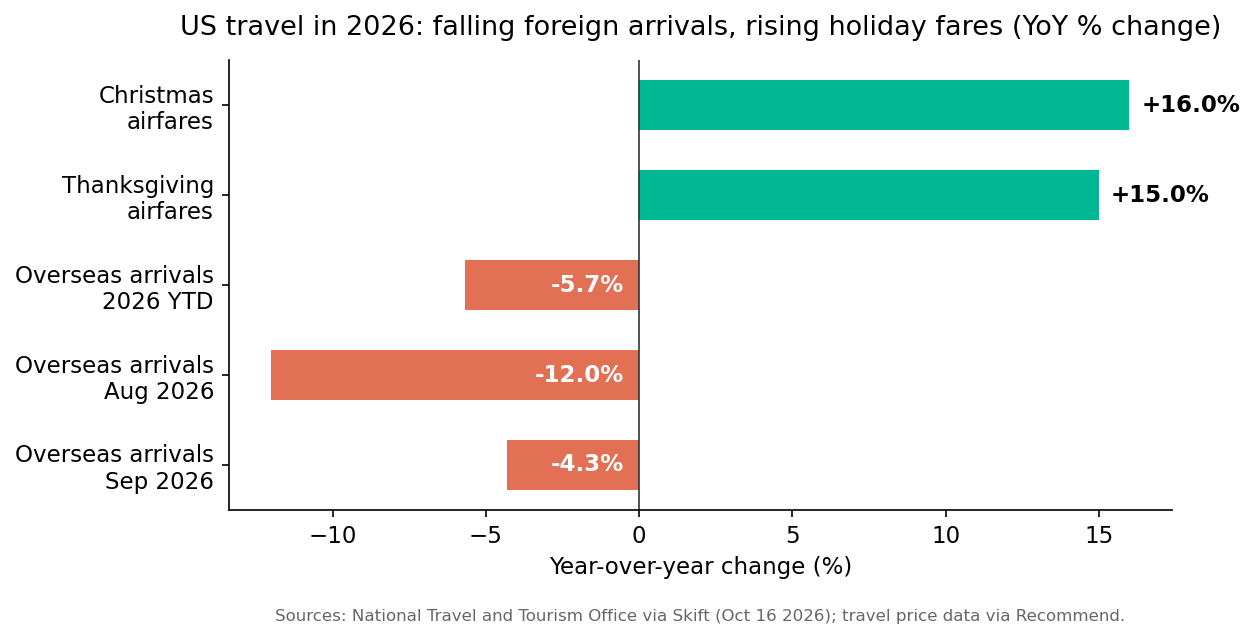
America’s welcome mat is getting less use. Preliminary government data released this week shows overseas arrivals to the United States fell 4.3% year over year in September, to 2.7 million visitors — the latest leg of a slide that has now run through most of 2026. Western Europe, historically the backbone of US inbound tourism, is driving the decline. At the same time, Americans planning their own trips face a different squeeze: holiday airfares are climbing 15–16% above last year. Here is what the US tourism decline looks like in the numbers, why it is happening, and what it means whether you are visiting America or leaving it.
The Numbers: A Slide That Keeps Sliding
The National Travel and Tourism Office’s preliminary September figures, reported by Skift on October 16, put overseas arrivals at 2.7 million — down 4.3% from September 2025. That follows a nearly 12% year-over-year plunge in August and soft inbound figures through June and July. For the year to date, arrivals are down 5.7%.
The composition of the decline is as telling as the size. Gains from China and South America have not been enough to offset falling visitation from Western Europe — traditionally the highest-spending source markets for US tourism. When Europeans stop coming, the impact lands disproportionately on gateway cities, national parks, and the hospitality workers who depend on them.
Why Fewer Visitors Are Coming
No single cause explains the drop, but several forces are converging. A strong dollar makes the US expensive for foreign visitors at exactly the moment travel prices are climbing broadly — the U.S. Travel Association’s Travel Price Index rose 8.7% year to date, more than twice the pace of overall inflation, driven by rising fuel costs. Geopolitical tensions and stricter border rhetoric have also weighed on sentiment in key European markets, where travel media has spent the year debating whether the US still feels welcoming.
There is also a quieter structural factor: competition. Other long-haul destinations have spent 2026 aggressively courting the same travelers, and when a trip to the US costs more and feels more complicated, alternatives in Asia, the Middle East, and within Europe itself start looking attractive. Tourism is a choice, and choices respond to price and perception. Add in the practical frictions — lengthy visa interview waits in some markets and the sheer cost of transatlantic airfare on strong-dollar pricing — and the cumulative drag on European travel intent becomes easier to understand.
Meanwhile, Americans Pay More to Fly for the Holidays
Here is the irony: while fewer foreigners visit the US, Americans are paying record prices to travel themselves. Domestic Thanksgiving airfares are up 15% year over year, with Christmas fares climbing 16%, even as international fares hold relatively steady. If you are flying home for the holidays, the data argues for booking sooner rather than later — and for knowing how to find cheap flights, from prime booking windows to fare alerts, because this is not a year to wing it.
The industry is adjusting in real time. Southwest Airlines is overhauling its Rapid Rewards program with new elite status tiers, more milestone perks, and expanded Companion Pass benefits — a bid to lock in loyal flyers as competition for domestic travelers intensifies. Delta, citing regional developments, postponed its planned nonstop between Atlanta and Riyadh until March 2027. And with disruptions always possible in a volatile year, having solid travel insurance for international trips is less of a luxury and more of a baseline.
What the US Tourism Decline Means for the Travel Industry
International visitors spend far more per trip than domestic travelers, so a 5.7% year-to-date decline in arrivals punches above its weight in economic terms. Hotels in gateway markets, tour operators, national park gateway towns, and luxury retail all feel it first. The September data, covered alongside the week’s other top travel stories, suggests the weakness is broadening rather than bottoming — August’s near-12% drop was not a one-off.
There is a potential silver lining for domestic travelers: softer inbound demand can mean better availability and occasional deals at hotels and attractions that usually cater to foreign visitors. If you have been priced out of peak-season destinations, late 2026 into 2027 may offer unusual value — provided you book strategically.
The Regional Picture: Where the Drop Hits Hardest
Not every corner of the US feels this equally. The pain concentrates in gateway markets — New York, Los Angeles, Miami, San Francisco, Orlando — where international visitors make up an outsized share of hotel nights and retail spending. National park gateway towns, from Moab to Jackson Hole, are similarly exposed: European travelers are classic long-stay park visitors, renting cars for two-week loops through the Southwest. When that segment pulls back, small towns with little economic diversity feel it immediately.
There is an interesting asymmetry in the data worth noting. While inbound travel softens, outbound American travel remains robust — US travelers are still flying abroad in large numbers, which is partly why international airfares are holding steady even as domestic holiday fares spike. In other words, the world has not stopped traveling; it has, for now, tilted its itineraries slightly away from the United States. That distinction matters because it suggests the problem is specific and fixable, not a global travel downturn.
Practical Tips for Travelers Right Now
Whether you are an American flying home for the holidays or a foreign visitor weighing a US trip, the current data points to a few clear moves. First, book holiday flights early — with Thanksgiving fares up 15% and Christmas up 16% year over year, waiting is a bet against the trend. Second, compare international routings: with overseas fares steadier than domestic ones, positioning flights and open-jaw tickets can sometimes beat a straight domestic round trip.
Third, consider the shoulder windows. The weeks just before Thanksgiving and just after New Year’s historically offer the year’s best value, and with inbound demand soft, hotels in gateway cities may be more negotiable than usual. Finally, protect the trip you book: in a year of schedule changes and route postponements, decent travel insurance is worth its modest cost.
What to Watch in the Months Ahead
Three things will determine whether this is a blip or a trend. First, the dollar: any sustained weakening would quickly make the US cheaper for foreign visitors. Second, the winter holiday season: if inbound numbers stabilize in December and January, the industry can breathe; another leg down would confirm a structural shift. Third, policy signals: visa processing times, border rhetoric, and aviation agreements all shape how welcoming — and how convenient — a US trip feels from abroad.
For now, the data tells a clear story as of October 2026: the world is traveling, just somewhat less to America. Whether that reverses depends on prices, politics, and perception — three things that can change faster than most forecasts assume. Industry watchers will be parsing the October and November arrival figures closely; a stabilization would suggest the worst is passing, while another soft month would force a harder conversation about what it takes to make the United States a must-visit destination again rather than a maybe-next-year one.
Frequently Asked Questions
How much did US inbound travel fall in September 2026?
Overseas arrivals fell 4.3% year over year to 2.7 million, according to preliminary National Travel and Tourism Office data. August was worse at nearly -12%, and arrivals are down 5.7% year to date.
Which countries are driving the decline?
Western Europe. Gains from China and South America have not been enough to offset falling European visitation — a particular problem since European travelers are among the highest spenders.
Why are fewer foreigners visiting the US?
A strong dollar, travel prices up 8.7% year to date on rising fuel costs, geopolitical tensions, and competition from other destinations are all contributing. No single factor explains the full drop.
Are holiday airfares really up that much?
For domestic US travel, yes: Thanksgiving fares are up 15% and Christmas fares up 16% year over year. International fares are holding steadier, which is one reason booking early and using fare alerts matters more than ever this year.
Is this bad for the US economy?
It is a headwind for tourism-dependent businesses — hotels, tour operators, gateway-city retail — because international visitors spend significantly more per trip than domestic travelers. The broader economic impact depends on whether the slide continues into 2027.
Could the trend reverse?
Yes. A weaker dollar, stabilized fuel prices, or improved sentiment could bring visitors back quickly — tourism demand is famously elastic. Watch the December–January inbound figures for the first real signal.
Conclusion
September’s 4.3% drop in overseas arrivals extends a year-long slide in US inbound tourism, led by fading Western European demand even as Americans face 15–16% higher holiday fares at home. The causes — a strong dollar, rising travel costs, and geopolitical headwinds — are real but reversible. As of October 2026, the question is not whether the world still wants to travel; it is whether America can win those travelers back.



