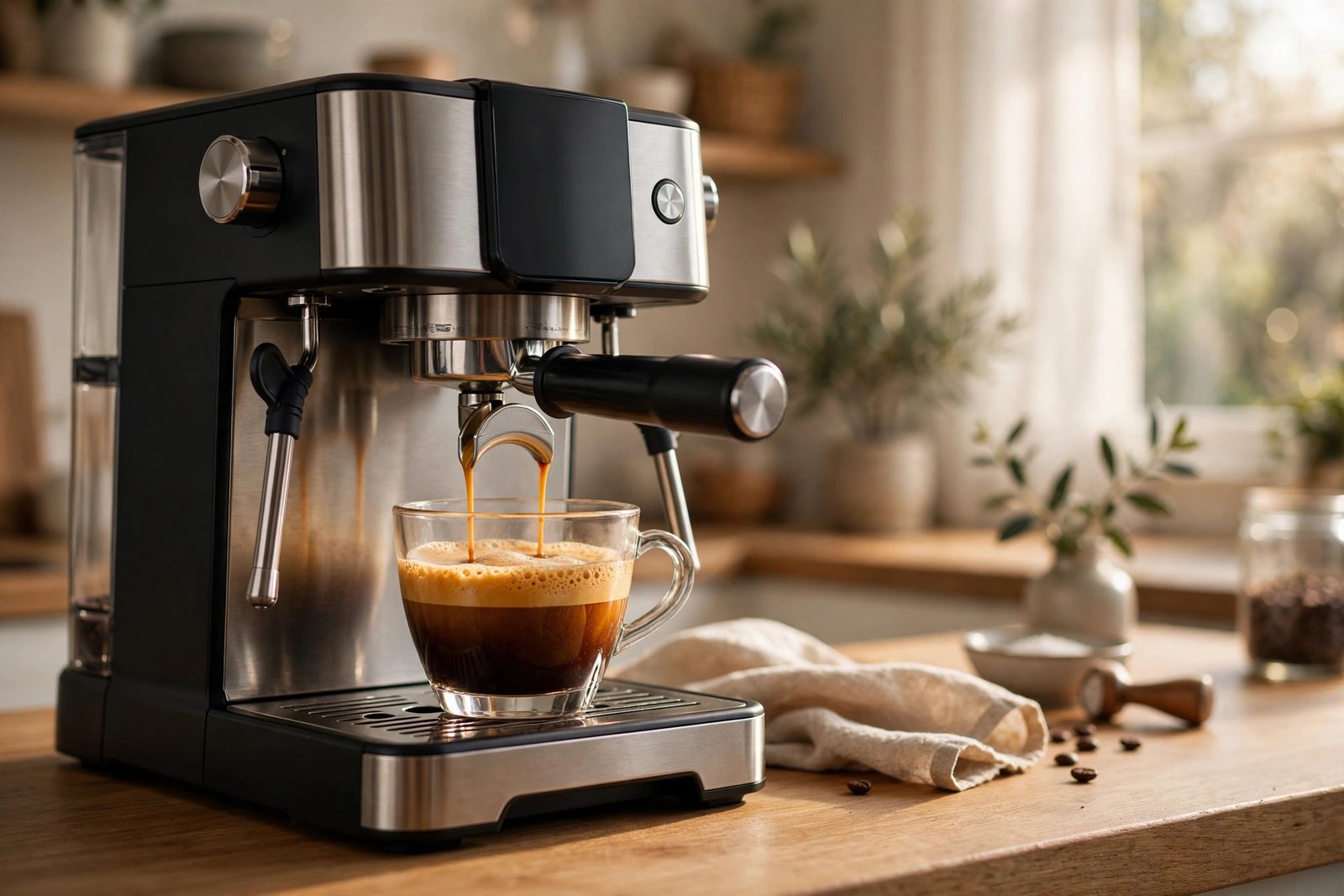

Here’s the sentence most buying guides won’t give you: the best espresso machine under $200 will not make you a barista. It will do something far more useful — put a genuinely good shot of espresso on your kitchen counter every morning for less than a month of café visits. The catch is that the sub-$200 shelf is crowded with lookalikes, and the specs that matter (basket type, boiler, steam power) are the ones the box never brags about. Below are five machines that earn their money — every price checked October 2026.
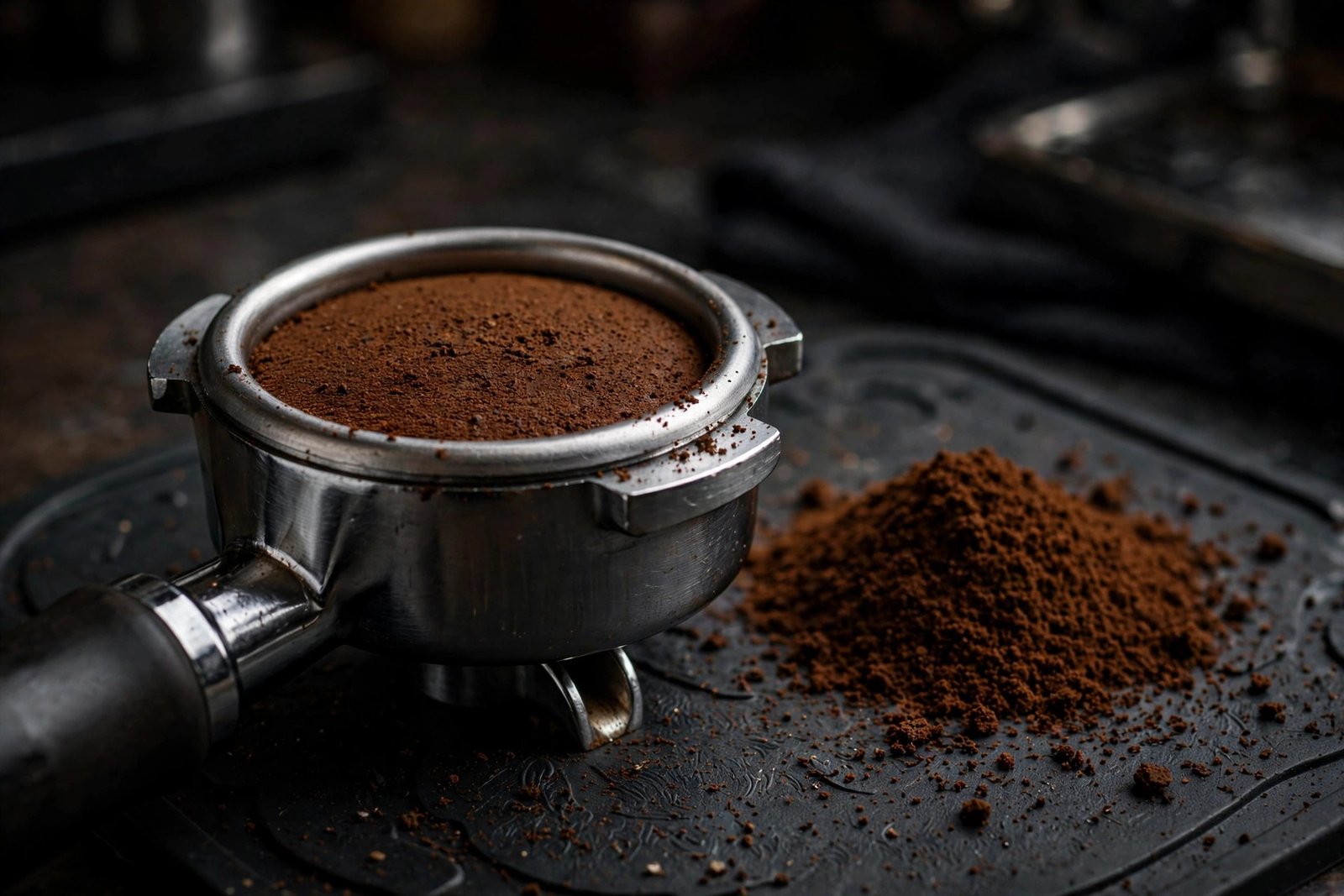
What the Best Espresso Machine Under $200 Actually Gets You
Start with the ceiling, because it explains everything else. Step one tier up and you hit machines like the De’Longhi Dedica EC680M, which lists around $279.95 — slim, 15-bar, well-reviewed, and firmly out of this budget. Under $200, you’re buying the tier below that, and honesty about it saves disappointment:
- Pressurized (dual-wall) baskets, not pro baskets. The CASABREWS CM5418 ships with dual-wall filters and the Gevi uses pressurized baskets — both fake good crema from pre-ground coffee. Forgiving for beginners; a ceiling for perfectionists.
- One heating system, not two. Budget machines run a single boiler or thermoblock, so you brew first, then steam — never both at once. Fine for two lattes; slow for a crowd.
- Real pumps, real pressure. Every pump pick here runs 15–20 bar, which is plenty — true espresso extracts at around 9 bars, so the extra number on the box is mostly marketing headroom.
- Plastic bodies, honest trade-offs. Nobody is selling a chrome dual boiler for $120. You’re buying solid internals in a light chassis.
Who should skip this price range? If you dream of dialing in single-origin light roasts like a competition barista, save up — you’ll outgrow a pressurized basket in months. But if you want better-than-café-chain espresso and real steamed milk, this is the right budget. For a second opinion on the category, this best espresso machine under $200 roundup lands in the same place on value.
Quick Picks: The 5 Best Espresso Machines Under $200 at a Glance
- Best overall: CASABREWS CM5418 (~$119) — most features per dollar: 20-bar pump, PID, pressure gauge.
- Best budget: De’Longhi Stilosa EC260 (~$120–150) — the cheapest credible entry into real pump espresso.
- Best for small kitchens: Gevi 20-Bar Compact (~$100–140) — slim, with a gauge and pre-infusion.
- Best capsule espresso: Nespresso Essenza Mini (~$150–180) — 19-bar pump, tiny footprint, zero learning curve.
- Best espresso + coffee versatility: Nespresso Vertuo Plus (~$125–200) — one machine, five cup sizes, from espresso to full mugs.
Compared: The 5 Machines Side by Side
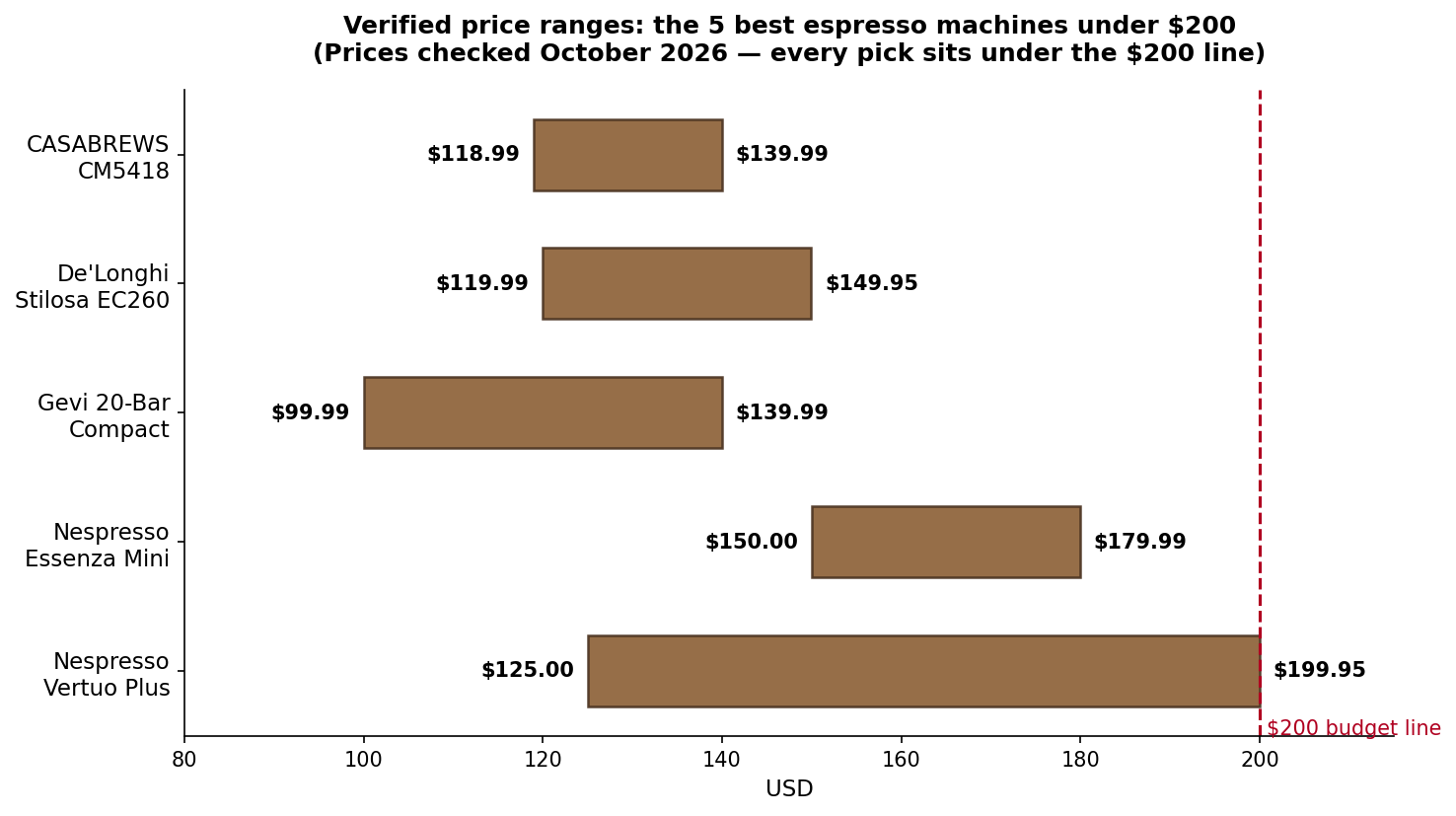
| Machine | Best for | Type | Pressure | Price* | Standout |
|---|---|---|---|---|---|
| CASABREWS CM5418 | Best overall | Pump | 20 bar | $118.99–139.99 | PID + pressure gauge; 4.6/5 (Target, 407 ratings) |
| De’Longhi Stilosa EC260 | Best budget | Pump | 15 bar | $119.99–149.95 | 4.4/5 from 1,228 Best Buy reviews; ESE-pod compatible |
| Gevi 20-Bar Compact | Small kitchens | Pump | 20 bar | $99.99–139.99 | Pre-infusion + gauge; compact 1350W thermoblock |
| Nespresso Essenza Mini | Capsule convenience | Capsule | 19 bar | $150–179.99 | Heats in ~25 sec; barely wider than a coffee mug |
| Nespresso Vertuo Plus | Versatility | Capsule | Centrifusion | $125–199.95 | 5 cup sizes with automatic barcode brewing |
*Verified price ranges from major retailers, checked October 2026. Prices move with sales — always confirm before buying.
1. CASABREWS CM5418 — Best Overall Espresso Machine Under $200
If there’s a “how is this only $119?” machine in this roundup, it’s the CM5418. CASABREWS sells it direct for $118.99, and Target lists it at the same price with a 4.6-out-of-5 rating across 407 ratings — the strongest owner verdict of any pump machine here. You get a 20-bar Italian pump, PID temperature control, low-pressure pre-infusion, a real-time pressure gauge, a 51mm portafilter with dual-wall filters, and a 34oz removable tank. Reviewers keep landing on the same conclusion: the best combination of quality, features, and value among the budget options.
Who it’s for: beginners who want to actually learn espresso — the gauge and pre-infusion teach you what a good shot looks like — plus anyone making milk drinks, since the steam wand can produce genuine microfoam with a little technique.
Pros: unmatched feature set at the price; pressure gauge for learning; PID keeps shots consistent; compact and good-looking on the counter.
Cons: the 51mm aluminum portafilter and small aftermarket ecosystem; the small boiler means short pauses between long steaming sessions; dual-wall baskets cap how far your skills can grow.
Price: $118.99 direct from CASABREWS or the official CASABREWS CM5418 product listing (seen around $139.99 on Amazon during sales). Prices checked October 2026.
2. De’Longhi Stilosa EC260 — Best Budget Pick
The Stilosa is the old reliable of budget espresso — a 15-bar pump machine that has been pulling shots in home kitchens for years, and the cheapest credible way into real espresso. Best Buy lists it at $119.99 on clearance (compared at $149.95); Target’s current price is $149.95.
What you get is refreshingly simple: a 15-bar pump, stainless steel boiler, 1-liter tank, single and double baskets, a manual Cappuccino System frother, and even ESE pod compatibility. Owners rate it 4.4 out of 5 across 1,228 Best Buy reviews, with 87% recommending it — and several reviewers mention buying their second or third Stilosa after a decade of daily use, which says a lot about longevity at this price.
Who it’s for: anyone whose budget is the boss. If $120 is the ceiling and you want real pump espresso — not a steam toy — this is the pick.
Pros: lowest real-espresso price here; dead simple to use; proven long-term reliability; ESE pod compatibility.
Cons: basic plastic build; the manual frother is entry-level for latte art; warmup is slower than thermoblock rivals; no pressure gauge.
Price: $119.99 (Best Buy clearance) to $149.95 (Target). Prices checked October 2026.
3. Gevi 20-Bar Compact — Best for Small Kitchens
Counter space is the silent budget-killer — a great machine you can’t fit is a machine you won’t use. The Gevi compact (ECMG0/ECMA0) is built for exactly that: a slim 20-bar machine with a pressure gauge and pre-infusion, a rare combination under $140.
Gevi’s store lists it at $139.99, and deal trackers have caught it as low as $99.99 on Amazon. You get a 20-bar pump tuned for proper extraction, a 51mm portafilter with pressurized baskets, a 1.2-liter tank, a fast 1350W thermoblock, and low-water and descale warning lights. Owners rate it 4.85 out of 5 on Gevi’s site. The most common gripe is a spout prone to dripping.
Who it’s for: apartment dwellers, dorm rooms, and crowded counters. If every inch matters, this is your machine.
Pros: smallest footprint of the pump picks; gauge + pre-infusion for learning; fast thermoblock heat-up; helpful maintenance alerts.
Cons: pressurized baskets only, so there’s a skill ceiling; single-boiler design means brew-then-steam sequencing; some owners report spout dripping.
Price: $139.99 at Gevi (frequently discounted to ~$99.99). Prices checked October 2026.
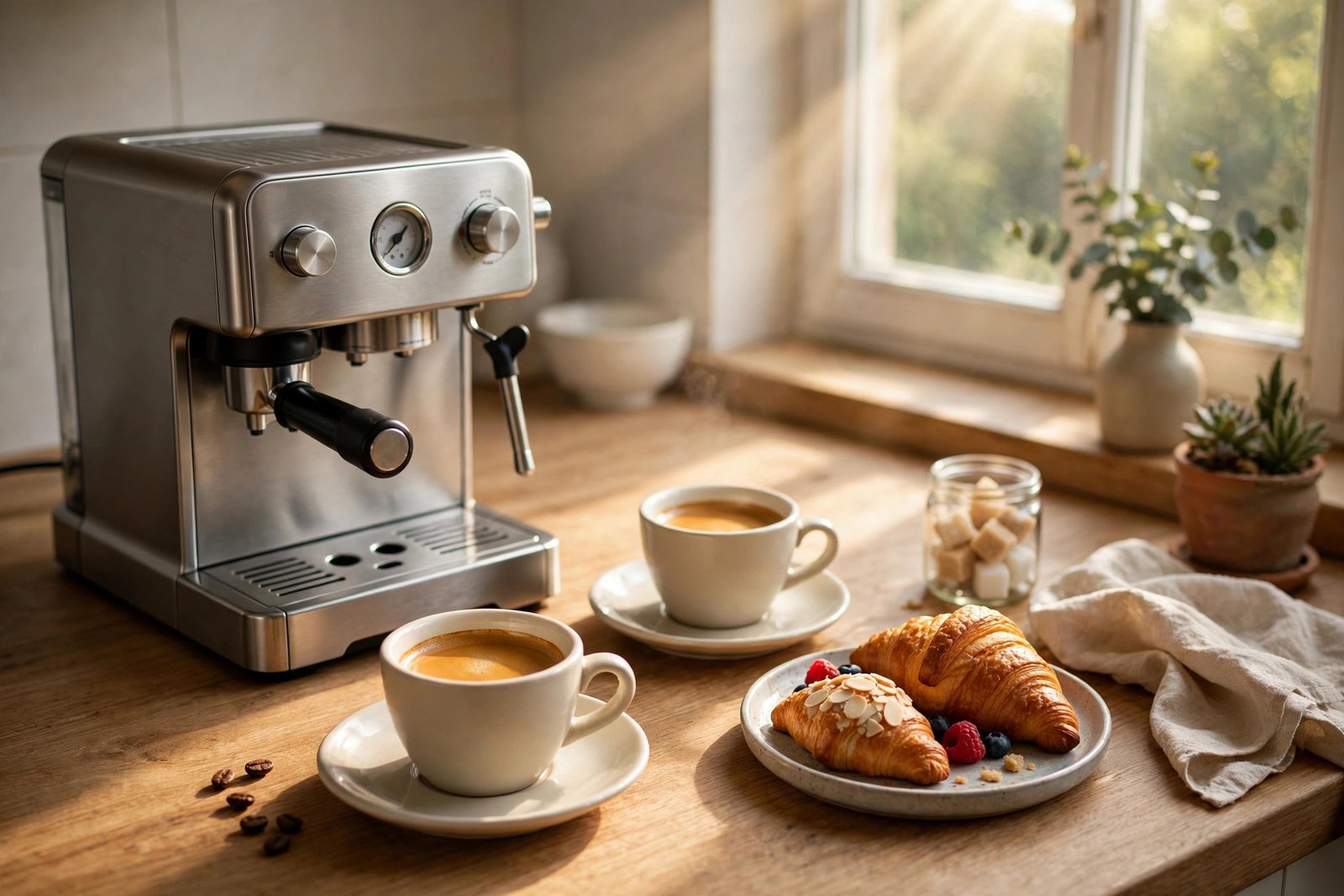
4. Nespresso Essenza Mini — Best Capsule Espresso Machine Under $200
Not everyone wants a hobby. The Essenza Mini is for people who want real espresso — 19-bar pump, genuine crema — with a learning curve of zero: insert capsule, press button, drink. It’s the smallest Nespresso ever made (about 110mm wide), heats in roughly 25 seconds, and offers two programmable cup sizes.
Pricing sits around $150–170, with Target listing the Breville version at $179.99 — still under the $200 line. The trade-off is the capsule economy: the machine is cheap, the pods are the ongoing cost, and milk frothing needs a separate frother.
Who it’s for: convenience-first drinkers, offices, and anyone who tried a pump machine and bounced off the ritual. Also the best pick if your kitchen is truly tiny.
Pros: foolproof; fastest from off to espresso here; enormous capsule variety; whisper-small footprint.
Cons: ongoing pod cost adds up; no milk system included; you’re locked into Nespresso Original capsules.
Price: ~$150–180 depending on retailer and bundle (Target: $179.99). Prices checked October 2026.
5. Nespresso Vertuo Plus — Best for Espresso AND Regular Coffee
The Vertuo Plus is the odd one out, and that’s the point. It doesn’t just make espresso — it brews five cup sizes, from a 40ml espresso to a full mug, reading the barcode on each capsule to set volume, temperature, and brew parameters automatically. If your household can’t agree on “espresso person” vs “coffee person,” this ends the argument.
Walmart has listed the Vertuo Plus Deluxe at $167.89 (down from $198.95); the Deluxe retails at $199.95 — right at the budget ceiling. You get a movable 60oz tank, 1350W heating, 15–20 second heat-up, and automatic capsule ejection.
Who it’s for: households that want both espresso-style drinks and full cups of coffee from one machine, with zero technique required.
Pros: unmatched cup-size versatility; fully automatic brewing; big water tank; consistent results every time.
Cons: Vertuo capsules only — no third-party pods, and they’re pricier than Original-line capsules; the Centrifusion crema (see below) isn’t traditional espresso crema; larger footprint than the Essenza Mini.
Price: $125–200 depending on model and sale (Vertuo Plus Deluxe: $199.95). See a Nespresso Vertuo line comparison to pick the right variant. Prices checked October 2026.
Pod vs Pump: Which Type Should You Choose?
Pump machines (CASABREWS, Stilosa, Gevi — and the Essenza Mini, a 19-bar pump machine in capsule form) push hot water through ground coffee at high pressure. That’s traditional espresso: a syrupy shot topped with a hazelnut-colored emulsion of coffee oils and CO2. You control grind, dose, and tamp — better coffee when you get it right, sink shots while you learn.
The Vertuo system is not a pump machine. Nespresso’s Centrifusion technology spins each capsule at up to 7,000 RPM while injecting water, whipping the coffee into a thick, generous foam. It looks spectacular and tastes rich and smooth — but strictly speaking, that airy crown is foam, not the emulsified crema of a pressure-pulled shot. Purists notice; most casual drinkers just enjoy it.
The honest trade: pump machines give you cheaper per-cup costs and a higher flavor ceiling in exchange for effort. Pod machines give you perfect consistency and zero mess in exchange for higher capsule costs.
How to Choose: Match the Machine to Your Life
- Skill level: Want to learn? CM5418 — the gauge teaches you. Zero learning curve? Essenza Mini or Vertuo Plus. Tight budget, don’t mind fiddling? Stilosa.
- Space: Measure your counter. The Essenza Mini and Gevi compact disappear into small kitchens; the Vertuo Plus needs real estate.
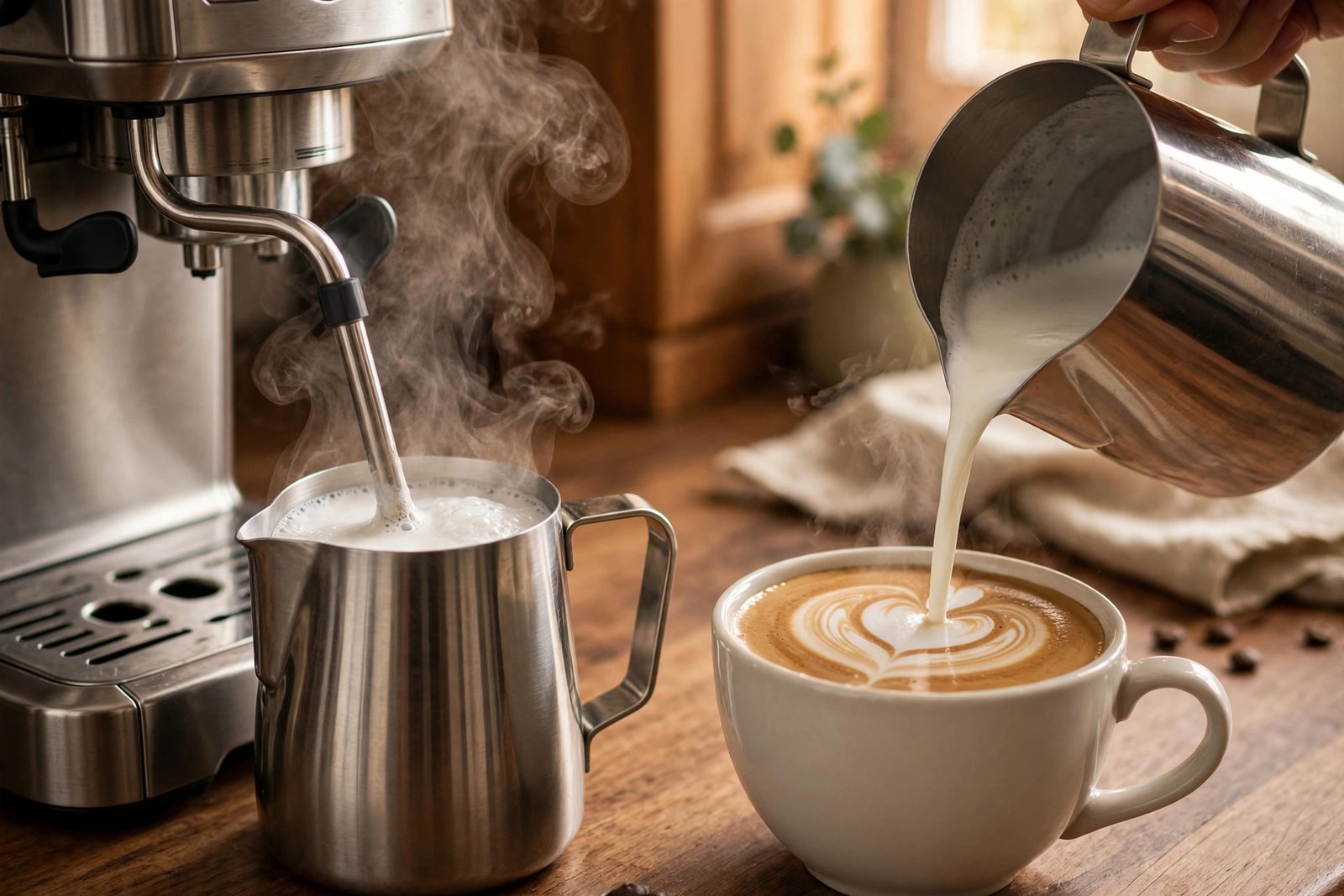
- Milk drinks: All three pump picks have steam wands in one box; the Nespresso picks need a separate frother.
- Household: One espresso drinker? Any pick works. A house split between espresso and drip-style coffee? Vertuo Plus ends the debate.
And if you’re still deciding whether hot espresso is even your thing, there’s no shame in starting cold — learning how to make cold brew coffee costs almost nothing and tells you a lot about your taste.
Don’t Forget the Grinder
The least glamorous advice in espresso is also the most true: the grinder matters more than the machine. A $120 machine with fresh-ground coffee will out-pull a $300 machine fed stale pre-ground — and with pressurized baskets that forgive grind imperfections, even a modest burr grinder transforms your shots. Budget for one alongside whichever machine you pick. Think of the machine as the engine and the grinder as the fuel: premium fuel in a modest engine still runs well.
Care and Maintenance: Keep It Alive for Years
Budget machines die from neglect, not from being cheap. The routine is simple: descale every 2–3 months with hard tap water (every 4–6 with soft or filtered); purge and wipe the steam wand after every use — dried milk inside a wand is the #1 killer of milk-drink machines; rinse the portafilter, baskets, and drip tray daily and clean the group head weekly; and don’t leave water sitting in the tank for weeks.
Do that, and there’s no reason a $120 machine can’t serve you for years — Stilosa owners report daily use stretching past a decade. And when those years of good espresso pay off in dinner-party bragging rights, here’s how to host a dinner party on a budget — nothing ends one like a round of home-pulled espressos.
Frequently Asked Questions
Is a $200 espresso machine worth it?
Yes — if you buy a real pump machine or a Nespresso rather than a steam toy. At roughly $5 a pop for café lattes, a $120 machine pays for itself in about a month of daily use. Every pick on this list has a real pump (15 bar or more).
Can you make real espresso with a $200 machine?
Real enough to be delicious, with an asterisk. Under $200 you get pressurized baskets and single boilers, so you won’t match a $1,000 prosumer setup — but you’ll pull sweet, crema-topped shots that beat most coffee chains. The Essenza Mini makes genuine 19-bar pump espresso; the Vertuo Plus makes excellent coffee via Centrifusion, though its crema is foam rather than traditional emulsion.
Does 15 bar vs 20 bar matter?
Not really. True espresso extracts at around 9 bars; the number on the box is the pump’s maximum, not what hits the coffee. A well-built 15-bar machine outperforms a sloppy 20-bar one. Judge machines on reviews and features instead.
Do I need a grinder with a budget espresso machine?
Not on day one — pressurized baskets are designed to work with pre-ground coffee. But a burr grinder is the single biggest upgrade you can make later; fresh-ground coffee improves every machine on this list more than any accessory.
Should I get a Nespresso or a pump machine under $200?
Choose Nespresso (Essenza Mini or Vertuo Plus) for zero-effort consistency, accepting higher capsule costs. Choose a pump machine (CM5418, Stilosa, or Gevi) for cheaper per-cup costs, real steamed milk in one box, and room to grow your skills. For a second take on the category, this under-$200 espresso machine guide weighs the same trade-offs.
How long do budget espresso machines last?
Almost entirely a maintenance question. Descale on schedule, purge the steam wand after every use, and use filtered water, and a well-reviewed budget machine can serve daily for years — multiple Stilosa owners report a decade-plus across replacements. Skip descaling and any machine, cheap or expensive, will clog and die early.
The Verdict: Our Clear Winner
Five good machines, one obvious champion: the CASABREWS CM5418 is the best espresso machine under $200. Nothing else at $119 gives you a 20-bar pump, PID temperature control, pre-infusion, and a pressure gauge — a machine that teaches you espresso while making genuinely good coffee from day one.
The right pick still depends on your life: the De’Longhi Stilosa EC260 if every dollar counts, the Gevi 20-Bar Compact for tiny counters, the Nespresso Essenza Mini for zero-effort espresso, and the Vertuo Plus for espresso plus full-size coffee at one button. Any of the five beats another year of $5 lattes — and your kitchen is about to smell fantastic.



