

You did it. The final interview went well, the recruiter called with congratulations, and then came the moment most people dread: “We’re putting together your offer.” What happens in the next few days can be worth thousands of dollars a year — and it compounds for years. Yet learning how to negotiate a salary offer isn’t about being pushy or greedy. It’s about having one confident, well-prepared conversation at the exact moment you have the most leverage.
Most candidates leave money on the table simply because they never ask. In Pew Research Center’s 2023 survey of U.S. workers, fewer than a third of workers said they asked for higher pay than what was initially offered the last time they were hired. The kicker? Two-thirds of those who did ask ended up with more than the original offer. This guide walks you through the entire salary negotiation process — research, timing, exact scripts, counteroffers, and the final handshake — so you can negotiate with data instead of nerves.

Before You Negotiate a Salary Offer: Do Your Research
Walking into a salary negotiation without data is like haggling at a market without knowing what anything costs. The single most important step happens before you ever say a number: research what the role actually pays.
Build your market-rate range
Use several data points, not one. Check salary benchmarking sites, recent job postings for the same title in your city (many now list pay bands due to transparency laws), and your own network. Recruiters and hiring managers trust candidates who cite specific ranges: “Based on roles at this level in Chicago with my background, I’m seeing $95,000 to $110,000” carries far more weight than “I’d like more money.”
Be careful about anchoring to a single site. Aggregate at least three sources and note how factors like company size, industry, and remote-versus-onsite expectations move the number. And remember the goal is a defensible range, not a wish list — a salary that lands above your walk-away number but below an absurd one you can’t defend.

Know your walk-away number
Before the conversation, define three numbers privately: your ideal (the number that would make you thrilled), your target (the number you’d genuinely accept and feel good about), and your walk-away (the number below which you’d decline). This discipline prevents the classic mistake of celebrating an offer verbally and then discovering, three months later, that the number barely covers your bills. Knowing what your money is doing once it arrives matters too — many people put a new higher salary to work by building an emergency fund before lifestyle inflation sets in.
How to Negotiate a Salary Offer: The Process, Step by Step
Step 1: Wait for the written offer
Never negotiate against a number you only heard verbally in an interview. Thank the employer, express genuine enthusiasm for the role, and ask for the formal offer letter. Then request 24 to 48 hours to review it. This isn’t stalling — it’s professionalism. It buys you time to research, run the numbers, and respond with a composed counteroffer instead of a flustered on-the-spot answer. As the USC career center’s guide to negotiating a job offer puts it, only negotiate when you’re seriously considering accepting — and take the time to evaluate the offer thoroughly first.
Step 2: Evaluate the entire offer, not just the salary
Your offer letter is a package: base salary, bonus target, equity or stock options, signing bonus, health benefits, retirement match, paid time off, remote flexibility, and start date. Two offers with the same base salary can differ wildly in real value. A 5% higher base with a weak retirement match can be worth less over time than a slightly lower base with a strong 401(k) match. If you’re early in your career, consider whether the role helps you start a Roth IRA or otherwise build long-term wealth — the trajectory matters as much as the number.
Step 3: Express enthusiasm first, then make your ask
The counteroffer should always open with genuine excitement about the role and the team. Then state one specific number (or tight range) backed by a reason. The reason should be about market data and the value you bring — never personal financial pressure. Compare these:
- Weak: “That’s a bit lower than I hoped. Can you do better?”
- Strong: “I’m really excited about this role and the team. Based on my research for this level in this market, I was expecting something closer to $108,000. Is there flexibility to get closer to that number?”
The strong version gives the employer a specific target and a rationale. It also opens the door to creative solutions if base salary is truly fixed — which leads to the next step.

Step 4: Negotiate the whole package
If the hiring manager says the base salary can’t move, don’t stop — pivot. Signing bonuses, extra paid time off, a higher bonus target, remote-work flexibility, tuition reimbursement, and an accelerated salary review (at 6 months instead of 12) are often easier for a manager to approve than a base-salary exception. A signing bonus can be a smart lever when the base is capped; just know where it should land — some people use it to pay off debt fast before the higher salary kicks in, which multiplies its value.
Step 5: Use silence and stay collaborative
After you make your counteroffer, stop talking. Silence feels awkward, but it lets the other side think — rushing to fill it often leads to negotiating against yourself. Throughout, frame the conversation as a collaboration: “What flexibility is there in the range?” or “What would it take to get to $X?” These are open questions that keep the discussion moving, a core piece of advice in how to negotiate salary when you get a job offer from Fast Company’s career column.
Step 6: Get the final terms in writing
Once you reach an agreement verbally, ask for an updated offer letter reflecting the new terms before you resign from your current role. An email summary of the agreed terms is the minimum. This protects both sides and eliminates the most common source of disputes: “I thought we agreed on…” Remember, the deal isn’t done until the paperwork matches the conversation.
What the Data Says About Asking
If you’re still hesitant, look at what actually happens when people negotiate. Pew Research Center surveyed 5,188 employed U.S. adults in 2023, and the results reveal a striking asymmetry between the risk and the reward:
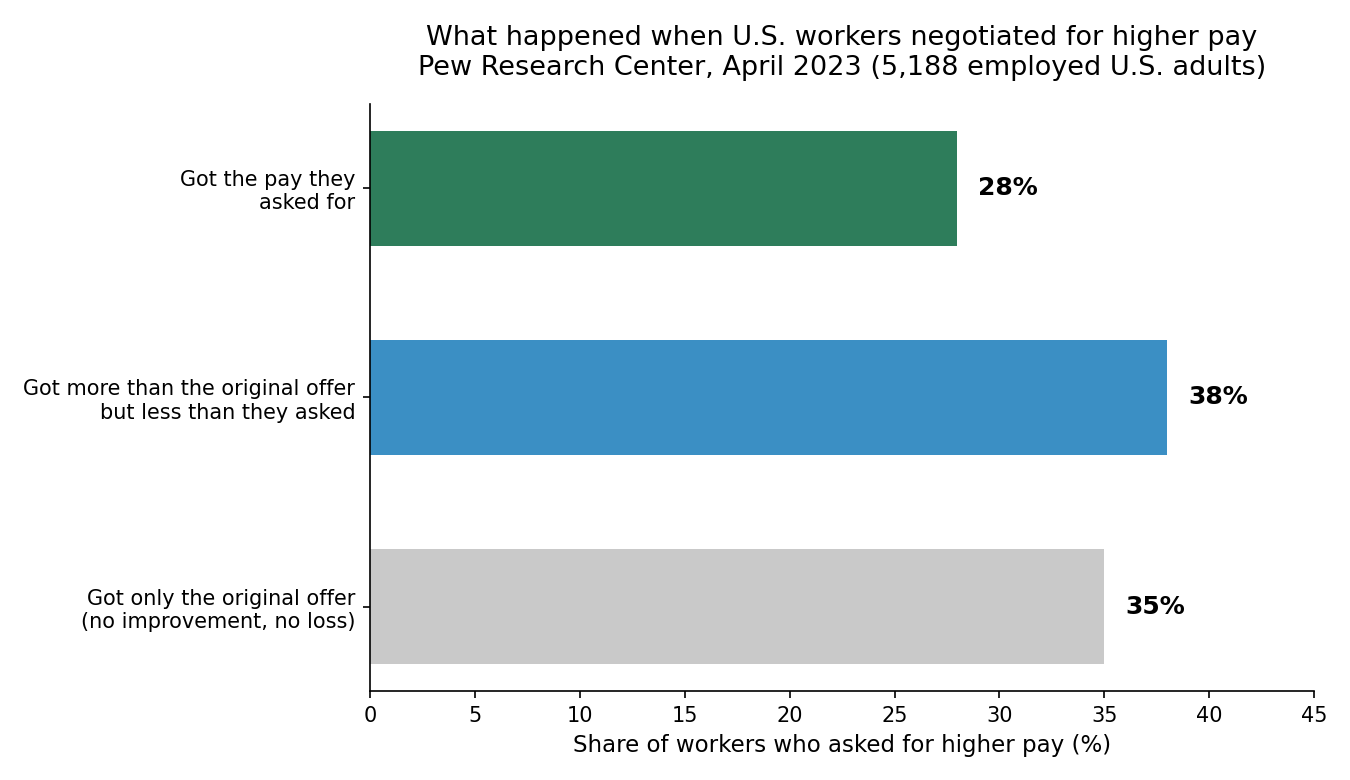
The chart tells the whole story. Of workers who asked for higher pay, 28% got exactly what they asked for, 38% got more than the original offer (just less than their ask), and 35% ended up with the original offer — which is exactly where they’d have been without asking. Two-thirds came out ahead; the rest simply kept the original deal. The downside is one slightly awkward conversation. The upside compounds every year, because raises, bonuses, and even future job offers are typically pegged to your current base salary.
Salary Negotiation Scripts That Actually Work
Having exact words ready removes most of the fear. Here are scripts for the moments that matter, adapted from proven salary negotiation strategies used by career coaches:
When you get the offer call
“Thank you so much — I’m really excited about the team and the role. I’d love to review the written offer and get back to you by Thursday. Would that work?”
When you make the counteroffer (phone call)
“I appreciate the offer and I’m enthusiastic about joining. Based on my research for this role and level in this market, I was expecting something closer to [your number]. Is there flexibility to get closer to that figure?”
When they say the base is fixed
“I understand. If the base can’t move, could we look at a signing bonus, or an early performance review at six months with a salary adjustment tied to it?”
When they ask your current salary
“I’m focusing on the market rate for this role. Based on my research, the range for this position is [range]. Does that align with your budget for it?”
Notice a pattern: every script opens warm, states something specific, and ends with a question. Questions hand control back to the employer while keeping you anchored to your number.
Mistakes That Cost People Thousands
- Accepting on the spot. Even a great offer deserves 24 hours of thought. Accepting instantly signals the number was higher than your expectation — which can actually make a hiring manager question their own offer.
- Negotiating by email when you could call. Tone gets lost in email. A five-minute phone call conveys enthusiasm and collaboration that paragraphs of text can’t.
- Citing personal expenses. “My rent went up” or “I have student loans” doesn’t move employers. Market data and your value move employers.
- Negotiating without a walk-away number. If you don’t know your floor, you’ll accept anything that feels like an improvement — even a bad deal.
- Failing to practice. Rehearse your scripts out loud, ideally with a friend who can push back. The first time you say the number should never be the first time you hear yourself say it.
- Forgetting the written confirmation. Verbal agreements evaporate. The updated offer letter is the deal.
Salary Negotiation FAQ
Can negotiating a salary offer cost me the job?
In the vast majority of cases, no. Once a company has extended an offer, it has already decided it wants you — pulling the offer over a polite counteroffer is extremely rare and would be a red flag about the employer. What does get offers rescinded is behavior: being rude, making ultimatums, or disappearing. A respectful, data-backed ask is expected; surveys of employers consistently show a large majority expect candidates to negotiate.
How much should I counter for?
Aim for a number at or slightly above the top of your researched market range for your experience level, so there’s room to land in your target zone. A common approach: ask for 5–15% above the offer if your research supports it, and in hot fields like technology and finance, gaps of up to 20% are not unusual. Always be able to defend the number with data.
Should I negotiate by phone or email?
Phone is better for the main counteroffer — it’s collaborative, lets you read the room, and conveys enthusiasm. Use email for follow-ups, summaries, and the final confirmation of terms. If you’re asked to put your counteroffer in writing, keep it warm and brief: thank them, state the number and one reason, and restate your excitement.
What if the employer won’t budge on salary at all?
Shift to the rest of the package: signing bonus, bonus target, extra PTO, remote flexibility, tuition reimbursement, an earlier performance review with a raise tied to it, or a better title. Sometimes the total value of these moves exceeds what a modest base increase would have been.
Is it okay to negotiate for an entry-level job?
Yes. Entry-level offers have less room, but the principle is the same: research the range, ask politely, and be open to non-salary terms like start date, relocation help, or a signing bonus. The habit of negotiating early pays off for every future job change.
How long should I wait before responding to an offer?
Ask for 24 to 48 hours. Most employers expect this and will tell you the deadline. If you need more time because you’re waiting on another offer, be honest and ask — many employers will extend the window rather than lose a candidate.
Conclusion: One Conversation, Years of Compound Returns
Learning how to negotiate a salary offer comes down to a simple sequence: research the market, wait for the written offer, express enthusiasm, state one specific number with a reason, negotiate the whole package if the base is fixed, and get it all in writing. The data says two-thirds of people who ask come out ahead and the rest lose nothing. The next time a recruiter says “we’re putting together your offer,” you won’t feel dread — you’ll feel ready. That single conversation could be the highest-paid hour of your career.