

Learning how to pay off debt fast is less about finding a secret trick and more about running a simple plan with total commitment. Minimum payments are designed to keep you in debt for years — sometimes decades — while interest quietly doubles what you owe. The good news: with a clear list of your debts, a method for attacking them, and a few hundred extra dollars a month (found or earned), most people can become debt-free years earlier and save thousands in interest.
This guide walks you through the exact process: facing your numbers honestly, stopping new borrowing, building a small safety buffer, freeing up cash, choosing between the debt snowball and debt avalanche methods, negotiating with creditors, and avoiding the traps that keep people stuck. No gimmicks — just a plan that works if you work it.
Step 1: Face the Full Picture — List Every Debt
You cannot beat what you will not look at. Before anything else, make a complete list of every debt you owe: credit cards, personal loans, car loans, student loans, medical bills, buy-now-pay-later balances, money owed to family — all of it. For each one, write down four numbers:
- Current balance — what you owe right now
- Interest rate (APR) — check your statement or account page
- Minimum monthly payment
- Due date
Yes, this part stings. Do it anyway, in one sitting. Most people discover the total is either smaller than the vague dread in their head, or one forgotten balance has been quietly gathering interest. Either way, you now have a map instead of a fog.

Keep this list somewhere visible — a notebook, a spreadsheet, your phone’s notes app. You will update it monthly as balances fall, and watching numbers shrink is one of the most motivating parts of the whole process. If budgeting on a low income is already part of your routine, fold this debt list right into that budget so the payoff amounts are planned, not improvised.
Step 2: Stop the Bleeding — No New Debt
The fastest way to pay off debt is to stop adding to it. This is the rule people resist most and need most. While you are in payoff mode:
- Take credit cards out of your wallet (and delete saved card numbers from shopping apps and browsers).
- Pause buy-now-pay-later purchases — they are debt wearing a friendlier name.
- Do not take out a new loan to “simplify” things unless you have run the numbers and the new rate is genuinely lower with no hidden fees.
This is temporary, not forever. Think of it like a cast on a broken bone: uncomfortable, but it is what lets the healing happen. If an emergency forces you to borrow, that is what Step 3 exists for.
Step 3: Build a Small Buffer Before You Attack
This sounds backwards, but hear it out: before throwing every spare dollar at debt, save a small emergency buffer — even $500 to $1,000 in a separate savings account. Why? Because without a buffer, the first surprise car repair or medical bill goes straight onto a credit card, and you are back where you started.
A mini buffer breaks the borrow-for-emergencies cycle. It will not cover a catastrophe, but it covers the ordinary surprises that derail payoff plans. Once your debts are gone, you will grow this into a full emergency fund — but for now, small and separate is enough.
Step 4: Free Up Cash — Cut Spending and Add Income
Debt payoff speed comes from one thing: the gap between your income and your expenses. Widen it from both sides.
Find money in your current budget
Go through the last two months of bank and card statements line by line. Almost everyone finds forgotten subscriptions, duplicate services, and spending that does not match their priorities. Common quick wins:
- Cancel subscriptions you barely use (streaming, apps, boxes, memberships).
- Renegotiate recurring bills — call your internet, phone, and insurance providers and ask for a lower rate or a retention deal.
- Cook more and cut food delivery; the markup plus fees plus tip often doubles the cost of a meal.
- Set a 48-hour rule for non-essential purchases: if you still want it in two days, reconsider then.
Our guide on how to save money on groceries is a natural companion here — food is one of the biggest flexible expenses in most households, and trimming it feeds your debt payoff directly.
Add income with a temporary side push
Cutting has limits; earning does not. A short-term income push aimed entirely at debt can collapse your timeline. Ideas that need little or no startup money:
- Sell things you no longer use — electronics, furniture, clothes, hobby gear.
- Pick up gig work: food delivery, rideshare, pet sitting, task apps, or freelance work in a skill you already have.
- Overtime or extra shifts at your current job, if available.
You do not need to hustle forever. Frame it as a sprint: “I am doing this for six months to kill this debt.” Temporary intensity beats permanent stress.
Step 5: Choose Your Weapon — Debt Snowball vs. Debt Avalanche
With your list made and extra cash freed up, pick one of the two proven payoff methods. Both work the same way mechanically: pay minimums on every debt, then throw all your extra money at one target debt until it is gone, then roll that whole payment into the next target.

The debt snowball: smallest balance first
List your debts from smallest balance to largest. Attack the smallest first, regardless of interest rate. When it is gone, add its payment to the next-smallest debt’s payment — like a snowball rolling downhill, your payment grows with each debt you clear.
The snowball wins on psychology: clearing whole accounts quickly gives you visible wins early, and visible wins keep you going.
The debt avalanche: highest interest rate first
List your debts from highest APR to lowest. Attack the highest-rate debt first. This method wins on pure math — you pay less total interest and get out of debt slightly faster, because expensive debt dies first.
The avalanche is the rational choice; its only weakness is patience — if your highest-rate debt is also your biggest balance, months can pass before you clear a single account.
How big is the difference? An example
To show what the choice costs, here is a worked example — just arithmetic, not a statistic. Take three debts totaling $6,000: $1,500 at 29% APR, $2,500 at 22% APR, $2,000 at 15% APR. Assume minimums cover each month’s interest plus $15 (with a $25 floor):
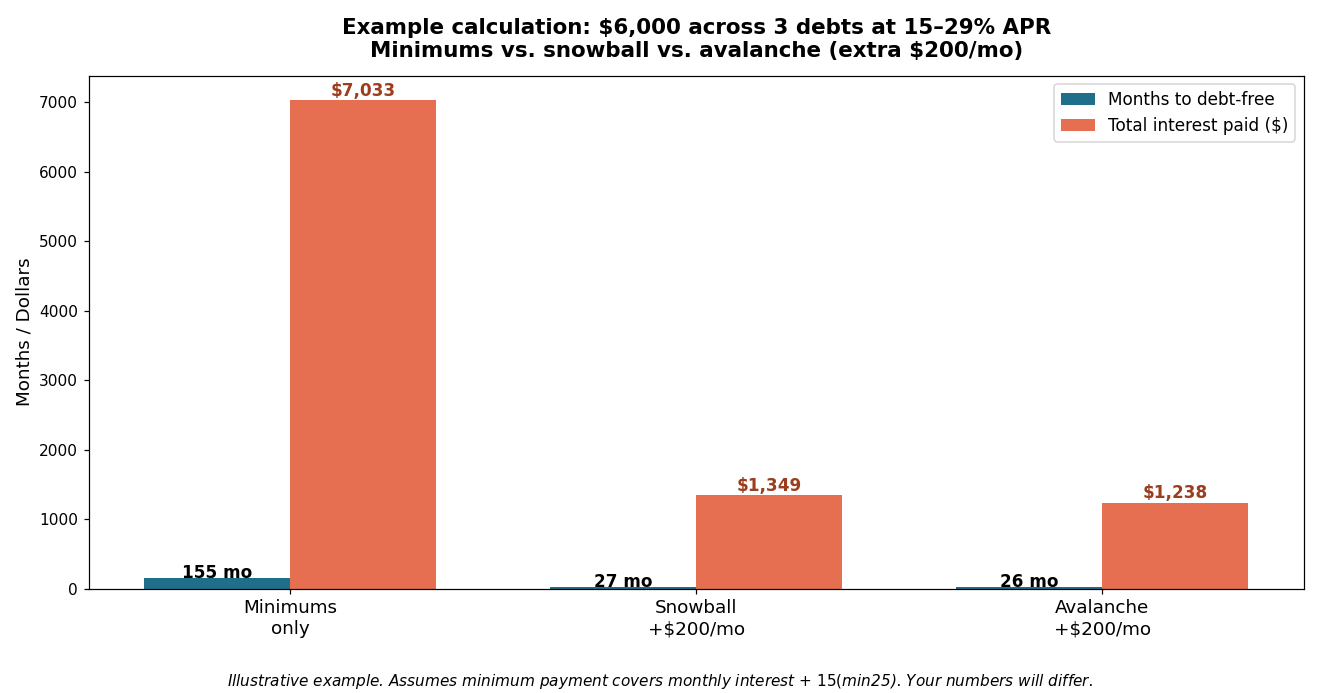
- Minimums only: about 155 months (nearly 13 years) and roughly $7,033 in total interest — more interest than the original debt.
- Snowball with an extra $200/month: debt-free in about 27 months, with roughly $1,349 in interest.
- Avalanche with an extra $200/month: debt-free in about 26 months, with roughly $1,238 in interest.
Two takeaways: the method matters far less than the extra payment — both aggressive strategies beat minimums-only by more than a decade and save over $5,600 in interest. And while avalanche saves a little more here, snowball clears a debt first for a faster psychological win. Pick the one you will stick with — consistency beats optimization.
The math is simple amortization: each month, interest accrues on every balance at APR/12, minimums are paid everywhere, and the extra $200 attacks the target debt. Your numbers will differ, but the shape holds — aggressive payoff saves years and thousands.
How to Pay Off Debt Fast on a Low Income
Everything above applies on a tight income; the levers just get smaller:
- Start with the list anyway. Knowing your exact debts costs nothing and often reveals one small balance you can kill.
- Attack expenses first. On a low income, the biggest wins are usually housing, transport, and food — a cheaper phone plan, a roommate, or meal planning can free up real money.
- Grow income in small increments. Even $100 extra a month changes the math over two years.
- Get free help. A nonprofit credit counselor (more on this below) can often negotiate lower rates and a structured plan at low or no cost — this is one of the highest-leverage moves available when money is tight.
- Prioritize ruthlessly. Keep current on secured debts (things a lender can repossess, like a car) and essentials first, then aim extra cash at the highest-rate unsecured debt.
Step 6: Negotiate With Your Creditors
Your creditors would rather get paid less than get paid nothing, and many will deal if you ask. It costs nothing to try:
- Ask for a lower interest rate. Call the number on the back of the card, mention your payment history, and ask directly. Even a few percentage points off a large balance saves real money.
- Ask about hardship programs. If you have had an income drop, illness, or other hardship, many lenders have temporary programs with reduced rates or payments.
- Negotiate old collection debts. Debts already in collections can often be settled for less than the full balance — but get any agreement in writing before paying, and understand the tax and credit implications first.
If negotiating feels daunting, consider a session with a nonprofit credit counselor through the NFCC — their certified counselors review your full financial picture and can set up a debt management plan that consolidates payments and often reduces interest rates. The Consumer Financial Protection Bureau also publishes free guides on dealing with debt collectors and understanding your rights.
Step 7: Balance Transfers — Handle With Care
A balance transfer card with a 0% introductory APR can be a powerful accelerator: every dollar of your payment attacks principal instead of interest during the promo period. But the fine print decides whether it helps or hurts:
- Transfer fees (often 3–5%) get added to the balance — factor them in.
- The promo period ends. Know the exact date and the rate it jumps to, and have a plan to be paid off (or moved) before then.
- New purchases usually are not at 0%. Do not add new spending to the card.
- It only works if you stop borrowing. A transfer that frees up old cards you then refill is worse than doing nothing.
Used strictly as a refinancing tool inside a real payoff plan, a balance transfer can save hundreds. Used as breathing room to keep spending, it is a trap.
Step 8: Avoid the Traps That Keep People in Debt
When money is tight, expensive shortcuts look tempting. Two to refuse outright:
- Payday loans and cash advances. Their fees translate into extremely high effective APRs, and most borrowers end up rolling them over — paying fee after fee without shrinking the balance. The Consumer Financial Protection Bureau warns consumers about these products for good reason.
- “Debt relief” companies that charge big upfront fees. For-profit settlement firms often take hefty fees while telling you to stop paying creditors — which damages your credit and can invite lawsuits. Nonprofit counseling (see above) is the safer first call.
Beware lifestyle creep: when a debt dies, redirect its payment to the next debt before you get used to the money. Automate it on payday so willpower isn’t involved.
Step 9: Stay Debt-Free Once You Get There
Getting out of debt is an event; staying out is a system. Lock in the win:

- Grow that buffer into a full emergency fund — three to six months of essential expenses, in a separate savings account.
- Keep budgeting. The budget that killed your debt is the budget that keeps you free — our low-income budgeting guide scales to any income, and the federal government’s MyMoney.gov resources offer free worksheets and calculators.
- Use credit as a tool, not a crutch. Paying a card in full every month builds history without interest — our guide to building credit from scratch covers the mechanics.
- Redirect freed payments to wealth. The monthly amount that used to service debt can now fund retirement or investing — see how to start investing with little money to put it to work.
Celebrate milestones along the way — each paid-off account deserves acknowledgment. Just celebrate cheaply. The best reward is the next zero balance.
Frequently Asked Questions
What is the fastest way to pay off debt?
Pay more than the minimums, consistently, aimed at one debt at a time — the snowball (smallest balance first, for motivation) or the avalanche (highest rate first, for minimum interest). In our example, an extra $200/month cut a 13-year slog to just over two years either way.
Should I pay off debt or save money first?
Do both in sequence: first build a small $500–$1,000 buffer so emergencies do not force new borrowing, then attack debt aggressively, then grow the buffer into a full emergency fund. Skipping the buffer is the most common reason payoff plans collapse at the first surprise expense.
Is it better to pay off the smallest debt or the highest interest rate first?
Mathematically, highest rate first (avalanche) costs less. Psychologically, smallest balance first (snowball) keeps more people going. The difference is usually modest — in our example, about $111 and one month on $6,000 of debt. Choose the method you will stick with; quitting costs far more than either choice.
Will paying off debt fast hurt my credit score?
Usually the opposite. Paying down revolving balances lowers your credit utilization ratio, one of the biggest score factors, which typically lifts your score. You might see a small temporary dip when an old account closes, but the long-term effect of being debt-free with on-time history is strongly positive.
Can I negotiate my debt down myself?
Yes. Call each creditor and ask for a lower rate or a hardship arrangement — many say yes, especially if you have a decent payment history. For debts in collections, you can often settle for less than the balance; always get the agreement in writing before paying. If you want help, a nonprofit credit counselor through the NFCC can negotiate and structure a plan for you.
How do I stay motivated while paying off debt?
Track balances visually (a chart on the fridge works), celebrate each paid-off account, and remember your “why” — the life the payments are currently blocking. Shortening the timeline with extra income, even temporarily, also helps enormously: a finish line two years away motivates more than one thirteen years away.
The Bottom Line
There is no mystery to how to pay off debt fast: list everything, stop borrowing, keep a small buffer, widen the income-spending gap, and aim every extra dollar at one debt at a time with the snowball or avalanche method. Negotiate where you can, refuse the expensive traps, and automate the plan. Start today with the list — future you is already grateful.



