

Your car dies on a Tuesday. The mechanic quotes $1,100. In that single moment, your next year either gets easier or more expensive — and the deciding factor isn’t your salary, your credit score, or your luck. It’s whether you have an emergency fund. Yet according to Bankrate’s 2026 Emergency Savings Report, only 47% of Americans have enough liquidity to cover a $1,000 emergency expense. Fewer than one in three would pay it from savings; the rest would borrow, charge it, or go without.
So how much emergency fund do I need, really? The classic answer — three to six months of expenses — is a fine starting point, but it’s not your answer. Your number depends on your job stability, your dependents, your insurance deductibles, and how quickly you could replace your income. This guide will help you calculate your real number, build it step by step even on a tight budget, and keep it somewhere it actually earns something.
Why the Standard Advice Exists (and Where It Falls Short)
The three-to-six-month rule has survived for decades because it works for the middle of the bell curve: it covers the most common financial shocks (job loss, medical bills, major car repairs) without asking people to hoard cash that could be invested. The Federal Reserve’s 2025 Survey of Household Economics and Decisionmaking found that 55% of adults have emergency savings covering three months of expenses — meaning 45% don’t even clear the lower bar.
But “three to six months of what?” is the question most advice glosses over. Months of essential expenses — housing, food, utilities, insurance, transportation, minimum debt payments — not months of your full lifestyle spending. Your emergency fund doesn’t need to cover restaurant dinners and streaming subscriptions. It needs to keep a roof over your head and the lights on while you recover.
The trend data tells a sobering story about how fragile household buffers have become:
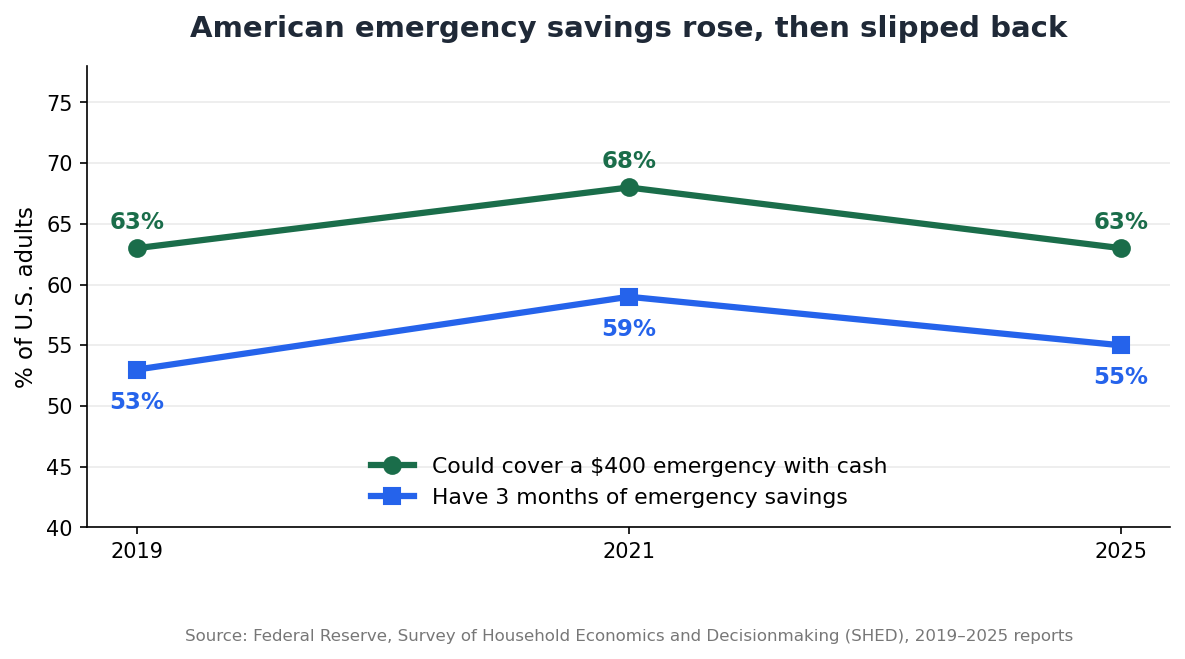
Emergency readiness improved through 2021, then slid back. The takeaway isn’t to panic — it’s that building your fund is a defensive move most households still haven’t made, which means doing it puts you ahead of the curve.

Calculate Your Number in 10 Minutes
Forget rules of thumb for a moment and do the actual math. Grab your last two or three months of bank and credit card statements and add up spending in these categories:
- Housing: rent or mortgage, property tax, homeowner’s/renter’s insurance
- Utilities: electric, gas, water, trash, phone, internet
- Food: groceries and true essentials — be honest, but use a realistic baseline
- Transportation: car payment, insurance, gas or transit passes
- Insurance: health, life, disability premiums
- Debt minimums: the minimum payments on every debt
- Non-negotiables: childcare, medications, pet essentials
Exclude everything discretionary: dining out, subscriptions, shopping, travel, hobbies. Take the monthly total of essentials and multiply by your target number of months (we’ll pick that next). If your essentials run $2,800/month and you land on four months, your target is $11,200.
That number might feel enormous. That’s normal — and it’s exactly why the next section matters more than this one.
How Much Emergency Fund Do I Need? A Personal Decision Framework
The right number of months depends on your personal risk profile. Use this table as a starting point, then adjust:
| Your Situation | Suggested Target | Why |
|---|---|---|
| Stable job, dual income, no dependents | 3 months | Low risk of simultaneous income loss; backup earner exists |
| Stable job, single income | 4–6 months | No backup income if your paycheck stops |
| Kids or other dependents | 6 months | Higher fixed costs; less flexibility to cut spending |
| Freelancer / variable income | 6–9 months | Income already fluctuates; dry spells compound emergencies |
| High-deductible health plan or old car | Add your deductible + $1,500 | Your most likely emergencies have known price tags — cover them explicitly |
Two factors push the number up more than anything else: income volatility and how long it would take to replace your income. A tenured teacher can reasonably hold less than a commission-only salesperson. A specialist in a niche field needs more than someone who could find comparable work in weeks.
On the flip side, don’t inflate the target out of anxiety. Money sitting in emergency savings earns modest interest; money you don’t need as a buffer could be invested for long-term growth or used to pay off high-interest debt fast. The fund is insurance, not an investment — size it like insurance.
Start With $1,000: The Starter Fund Strategy
If a full multi-month fund feels impossible, shrink the goal. Financial educators have long recommended a $1,000 starter emergency fund as step one — enough to absorb the most common shocks (a car repair, an appliance failure, an urgent vet bill) without reaching for a credit card.
Bankrate’s data shows why this matters: only 30% of Americans would cover a $1,000 emergency from savings, while 33% would go into debt to handle it. A $1,000 buffer moves you out of the most vulnerable group. Build it fast — sell things you don’t need, pause discretionary spending for a month, pick up extra shifts — then automate the refill toward your full target.
Where you are financially determines the order of operations. If you’re budgeting on a low income, the starter fund comes before everything except keeping current on bills. If you’re carrying credit card debt at 20%+ APR, build the $1,000 starter fund first (so the next emergency doesn’t go on the card), then attack the debt, then build the full fund. Skipping the starter fund is how people end up paying off a card and immediately charging it back up.
Where to Keep Your Emergency Fund
Your emergency fund has two jobs: be there when you need it, and don’t lose value while you wait. That rules out both extremes — not under the mattress (losing to inflation), and not in stocks (could drop 30% the month you need it).
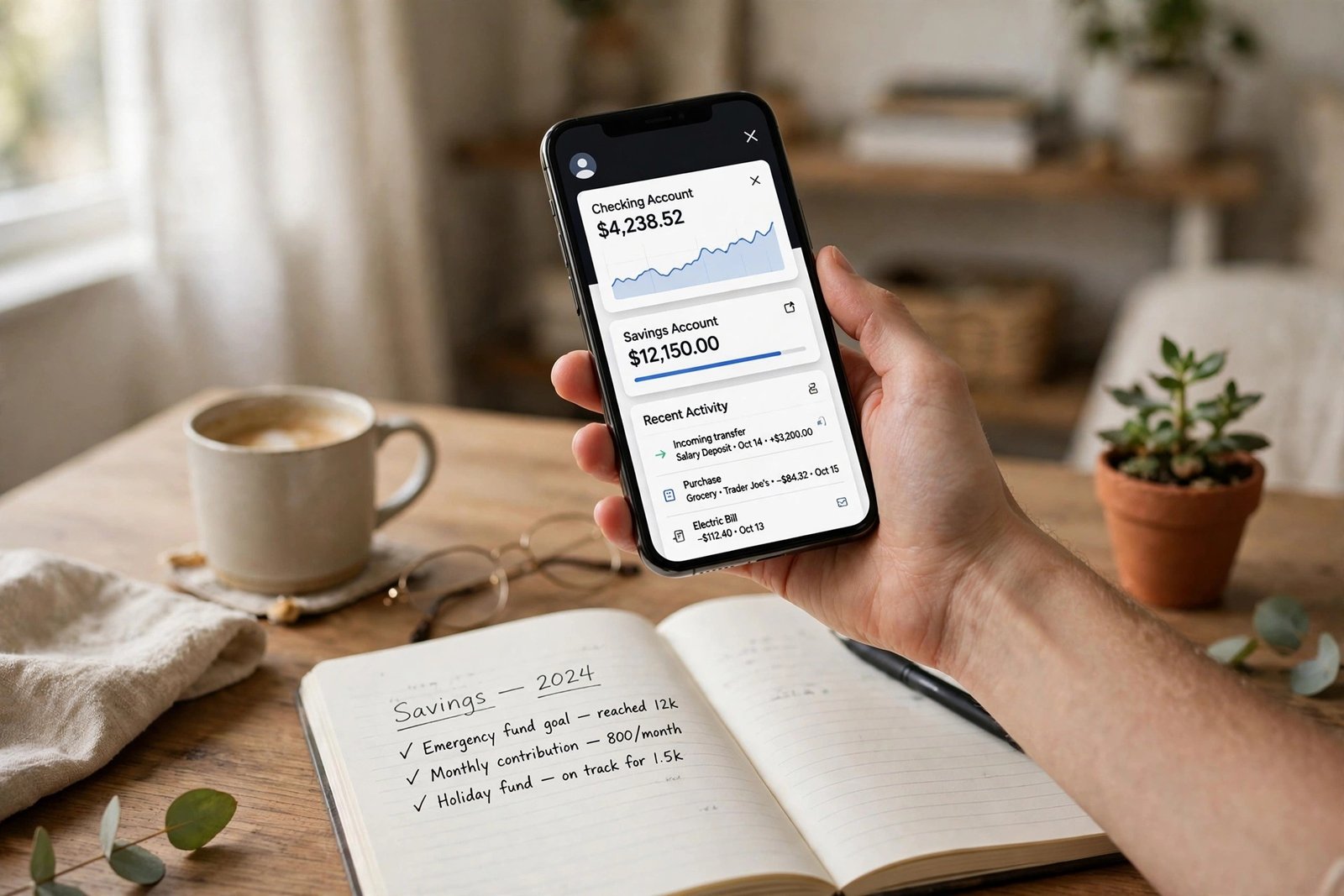
The sweet spot is a high-yield savings account (HYSA) at an FDIC-insured bank or credit union. HYSAs pay dramatically more than traditional savings accounts while keeping your money liquid and insured up to $250,000 per depositor. Keep the fund in a separate account from your daily spending money — ideally at a different bank. That small friction is a feature: it stops impulse raids while keeping the money reachable within a day or two when a real emergency hits.
What counts as an emergency? Use the urgent-unexpected-necessary test: it must be all three. A blown transmission qualifies. A holiday sale doesn’t. Write your personal definition down when you open the account — future you, tempted at 11pm, will appreciate the clarity.
How to Build It on a Tight Budget
The math of building a fund is simple; the execution is where people stall. These tactics actually work:
- Automate a fixed transfer on payday — even $50 per paycheck. Money you never see doesn’t get spent. Increase it with every raise before lifestyle creep absorbs the difference.
- Bank the windfalls. Tax refunds, bonuses, cash gifts, and side income go straight to the fund until it’s full. This is the fastest accelerator most people have.
- Cut one subscription tier permanently and redirect it. Small recurring amounts compound surprisingly fast when they’re automatic.
- Trim the biggest flexible expense first. For most households that’s food — our guide to saving money on groceries can free up $100–200 a month without much pain.
- Set a “full” date and track it visibly. A progress bar on the fridge beats a vague intention. Celebrate the starter $1,000, then each additional month of expenses.
If your income is genuinely too tight to save after essentials, that’s a signal to work the income side — even temporarily — rather than to skip the fund. An emergency will come; the only question is whether you meet it with savings or with debt.

The Refill Rule (What Nobody Tells You)
Here’s the part most guides skip: you will use this fund. That’s its job. The mistake isn’t spending it — it’s not rebuilding it afterward. Adopt a refill rule now: after any withdrawal, automatic contributions resume immediately at the same (or higher) amount until the fund is whole again. Treat the refill like a bill you owe yourself.
Also revisit your target annually. A new baby, a move to a higher-cost city, a switch to freelance work, or a paid-off car all change your number. An emergency fund set in 2022 and never updated is a guess, not a plan.
Frequently Asked Questions
Is $5,000 enough for an emergency fund?
It depends on your monthly essential expenses. If your essentials run $1,600/month, $5,000 covers about three months — solid. If they run $4,000, it’s barely five weeks. Don’t judge the fund by the dollar amount; judge it by months of essential expenses covered.
Should I invest my emergency fund?
No. Emergency money must be stable and liquid — available within days without risk of loss. Stocks, crypto, and even bonds can drop exactly when you need the cash. Keep it in a high-yield savings account; the modest interest is the price of certainty.
Can I use my emergency fund to pay off debt?
Keep at least the $1,000 starter fund intact while paying down debt. Draining your savings to zero to kill a balance leaves you exposed — the next surprise goes right back on the card, often at a higher balance than before. Build the full fund after high-interest debt is gone.
How is an emergency fund different from regular savings?
Purpose and accessibility. Regular savings has a job — a vacation, a down payment, holiday gifts. An emergency fund has one job: absorbing shocks. Keep them in separate accounts so a “great deal” never quietly eats your safety net.
What if I have irregular income — how do I build a fund?
Save a percentage of every payment received (say 10–15%) rather than a fixed dollar amount. In flush months you’ll build fast; in lean months you won’t break the habit. Freelancers should also target the higher end of the months range, since income dips and emergencies love arriving together.
Does my emergency fund need to beat inflation?
Ideally it roughly keeps pace, which is another argument for a high-yield account over a traditional savings account paying near zero. But don’t chase yield with risk — the fund’s job is availability, not growth. Long-term wealth building happens in your investment accounts, not your safety net.
Conclusion
So, how much emergency fund do you need? Start with $1,000 as fast as you can, then build toward three to six months of essential expenses — adjusted up for volatile income, dependents, or big deductibles, and kept in a separate high-yield savings account where it earns something while it waits.
The households that weather financial storms aren’t the ones with the highest incomes. They’re the ones with a buffer between life happening and debt happening. Calculate your number today, automate your first transfer on your next payday, and give yourself the one financial upgrade that protects every other goal you have.




[…] you put down, keep a separate emergency fund intact. Draining every dollar for the down payment and then facing a $9,000 roof repair in year one […]