

SpaceX Wants 80,000 Cell Towers. Your Phone Bill May Never Be the Same.
On the evening of October 22, 2026, Bloomberg dropped a story that sent a shiver through every telecom boardroom in America: SpaceX is in private talks with at least one major cell-tower company — Crown Castle among them — to secure access to more than 80,000 cell sites across the United States. Talk of a spacex fourth wireless carrier october 2026 moment is no longer armchair speculation. If a deal lands, Elon Musk’s company would hold the physical skeleton of a fourth nationwide wireless carrier, standing alongside AT&T, Verizon and T-Mobile. Markets didn’t wait for confirmation. On October 23, carrier stocks fell hard while tower stocks soared. Here’s what actually happened, why it’s happening now, what it could mean for your phone bill — and the very real obstacles still standing in the way.
What Actually Happened on October 22
The Bloomberg report, published the evening of October 22, 2026, described private discussions — attributed to people familiar with the matter — in which SpaceX is negotiating with major cellular infrastructure owners, including Crown Castle, for access to at least 80,000 US cell sites. To put that number in perspective, it’s roughly half of the 158,500 purpose-built cell towers operating in the United States last year, according to the Wireless Infrastructure Association. An agreement on that scale would, as the report put it, solidify SpaceX’s path toward building a fourth nationwide wireless carrier.
Two things worth stressing before the excitement runs away with you. First, these are talks, not a signed deal. Second, neither SpaceX nor any of the carriers have commented on the record. Everything below is built on verified reporting — and where the reporting ends, I’ll say so.
Why Now: Three Moves That Set the Table
This story didn’t come out of nowhere. October 2026 has been a drumbeat of SpaceX telecom moves, which is why chatter about a spacex fourth wireless carrier october 2026 push suddenly has real substance behind it.
Move one: spectrum. On October 8, 2026, SpaceX agreed to buy a nationwide portfolio of up to 14 MHz of paired 800 MHz low-band spectrum. Low-band spectrum is the good stuff for coverage — it travels far and penetrates buildings — and it’s exactly what a new carrier needs to cover a continent. The deal is expected to close in the first half of 2027, pending regulatory approval.
Move two: satellites. A day earlier, the FCC approved 15,000 next-generation direct-to-cell satellites for Starlink Mobile. Direct-to-cell means satellites designed to talk to ordinary mobile phones, not special satellite handsets — a space-based layer that could fill coverage gaps where towers can’t reach.
Move three: the towers themselves. On October 21, Crown Castle CEO Christian Hillabrant said on the company’s earnings call that it was talking to “all parties” — while declining to discuss specific customers. Twenty-four hours later, Bloomberg named Crown Castle as one of the infrastructure companies in discussions with SpaceX. Coincidence? Markets didn’t think so.
Add in Elon Musk’s long-stated, vocal desire to build a standalone wireless carrier from scratch, and the pattern is hard to miss: spectrum, satellites, and now towers — the three legs a new national carrier stands on. Meanwhile, the wireless tech around you keeps evolving too — if you’re curious how the next generation of home connectivity compares, see what Wi-Fi 7 is and whether you need it.
spacex fourth wireless carrier october 2026: what markets are saying
Wall Street rendered its verdict within hours. In premarket trading on October 23, AT&T fell 4.3% to $21.76, Verizon declined 4.3% to $43.25, and T-Mobile sank 5% to $150.82, as Dow Jones Newswires reported. Reuters’ coverage noted the big three had already fallen 4.2–5% in extended trading the night the Bloomberg story broke.
The other side of the trade was just as violent. Crown Castle jumped 12% to $88.56, American Tower added roughly 5%, and SBA Communications rose about 4.6%. The logic is simple: if SpaceX needs tens of thousands of tower leases, tower owners are the landlords of the next decade. Here’s the full picture:
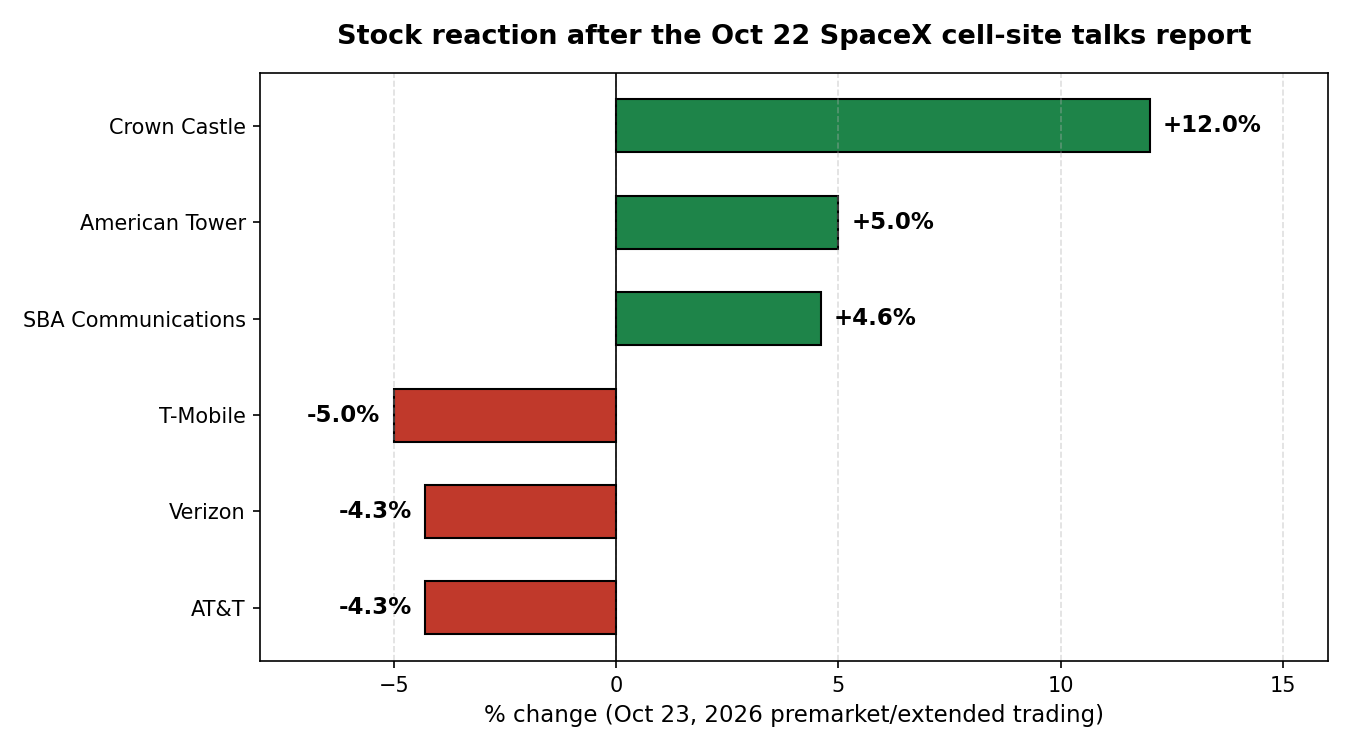
A one-day market move isn’t proof of anything — traders overreact for a living. But the direction of the money tells you what the smart money fears and what it wants to own: cheaper wireless for consumers, fatter lease books for tower owners.

What a Fourth Carrier Would Mean for Consumers
In a spacex fourth wireless carrier october 2026 world, the most likely consumer win is simple: price pressure. The US wireless market has been a comfortable three-player oligopoly since the T-Mobile–Sprint merger. A fourth national carrier — especially one run by Elon Musk, who has never met a market he didn’t try to undercut — would change the math on every pricing meeting in the industry.
What could that look like in practice?
- Lower plan prices, or at least an end to the creep. New entrants buy market share with aggressive pricing. Expect introductory unlimited plans designed to make AT&T and Verizon match or bleed subscribers.
- Bundling with Starlink. SpaceX already sells home internet via Starlink. A mobile arm opens the door to true bundles — home + mobile on one bill — the kind of packaging that has historically forced incumbents to discount.
- Rural coverage as a weapon. Between low-band 800 MHz spectrum and direct-to-cell satellites, a SpaceX carrier could credibly claim coverage where the big three still show dead zones — and market it relentlessly.
- Faster innovation cycles. Musk-run companies ship quickly and break things. Whether that’s eSIM-first onboarding, satellite messaging as standard, or pricing that changes monthly, the incumbents would have to respond.
One caveat for your household budget: if the weak link in your connectivity is the last few feet inside your own home rather than the carrier, that’s a different fix — here’s how to boost your WiFi signal at home without spending a fortune.
What Could Still Stop It
Before you cancel your Verizon contract, remember: none of this exists yet. Here’s the honest list of what stands between today’s headlines and a working fourth carrier.
Nothing is signed
The reporting describes private discussions with people familiar with the matter. Deals at this scale fall apart all the time — over price, over control, over timing. Until there’s a signed agreement or an 8-K filing, this is a negotiation, not a network.
The $80 billion price tag
TD Cowen estimates that building a nationwide terrestrial network would cost more than $80 billion. Leasing 80,000 existing sites is cheaper than building them, but it’s still an enormous capital commitment — radios, fiber backhaul, core network, billing systems, retail, support. That gap between ambition and checkbook is the biggest hole in the spacex fourth wireless carrier october 2026 thesis, and it’s why SpaceX would likely build in phases rather than all at once.
Spectrum and regulatory runway
The 800 MHz spectrum purchase still needs regulatory approval and isn’t expected to close until the first half of 2027. Regulators will look hard at a deal that hands more airwaves to one of the world’s most valuable private companies. And even with spectrum in hand, lighting up tens of thousands of sites takes years, not quarters.
The incumbents won’t sit still
AT&T, Verizon and T-Mobile have something SpaceX doesn’t: 300+ million existing subscribers, deep enterprise contracts, and retail stores on every main street. Their likely response to a fourth carrier is a price war — which is great for consumers in the short term, but price wars also squeeze the new entrant’s margins before it reaches scale.

What to Watch Next
If the spacex fourth wireless carrier october 2026 story keeps developing, these are the milestones that will tell you it’s real — long before any “sign up now” page appears:
- A signed tower agreement. Watch Crown Castle’s and American Tower’s earnings calls and SEC filings. A master lease agreement with SpaceX would be disclosed.
- The 800 MHz deal’s regulatory path. Any FCC or DOJ review of the spectrum purchase, and whether it stays on track for a first-half 2027 close.
- Starlink Mobile satellite deployments. The 15,000 approved direct-to-cell satellites need to actually launch. Launch cadence is the tell.
- FCC filings for terrestrial service. A real carrier needs licenses, certifications and numbering resources. Paperwork precedes towers.
- Musk himself. He has been vocal about wanting to build a carrier from scratch. If he starts talking timelines and pricing, take it seriously — and verify it independently.
Frequently Asked Questions
Is SpaceX actually building a fourth wireless carrier?
Not yet — at least, nothing has been confirmed. What we know is that Bloomberg reported on October 22, 2026 that SpaceX is in talks to access at least 80,000 US cell sites, which would be a foundational step toward a fourth nationwide carrier alongside AT&T, Verizon and T-Mobile. Neither SpaceX nor the carriers have commented on the record.
How many cell sites is SpaceX negotiating for?
At least 80,000, according to the Bloomberg reporting. For context, the Wireless Infrastructure Association counts roughly 158,500 purpose-built cell towers operating in the US — so SpaceX is reportedly discussing access to about half the country’s tower footprint.
When could a SpaceX phone service actually launch?
There is no announced timeline, and it would be years, not months. The 800 MHz spectrum deal alone isn’t expected to close until the first half of 2027 pending regulatory approval, and building out — or even leasing and equipping — tens of thousands of sites is a multi-year project. TD Cowen’s $80 billion-plus estimate for a full nationwide build gives a sense of the scale.
Would it work with my current phone?
The satellite component — Starlink Mobile’s direct-to-cell satellites — is designed around connecting standard mobile phones rather than specialized satellite hardware. The terrestrial tower network would use standard cellular technology. But until SpaceX announces actual service details, device compatibility is speculation.
What does “spacex fourth wireless carrier october 2026” actually mean?
It’s shorthand for the October 2026 news cycle around SpaceX’s reported push into the US wireless market: the October 22 Bloomberg report on the 80,000 cell-site talks, the October 23 stock market reaction, and the broader context of SpaceX’s October spectrum purchase and FCC satellite approvals. Think of it as the month the fourth-carrier story went from rumor to reported negotiation.
Should I switch carriers or wait?
Don’t change anything based on this story. No SpaceX wireless service exists, none has been announced, and the earliest realistic timeline is years away. If your current bill bothers you, the best move today is the boring one: call your carrier, ask for retention pricing, or compare MVNO deals. A future fourth carrier is a reason for optimism, not a reason to act now.
The Bottom Line
The evening of October 22, 2026 may be remembered as the night the US wireless market stopped being a three-player game — or as the night of a very expensive rumor. The facts we have: SpaceX is reportedly negotiating for 80,000 cell sites; it agreed to buy low-band spectrum on October 8; the FCC approved 15,000 direct-to-cell satellites; Crown Castle’s CEO said it’s talking to “all parties”; and markets moved violently on the news. The facts we don’t have: a signed deal, a launch date, a price, or a single on-the-record comment.
What makes this story worth watching isn’t any single headline — it’s the pattern. Spectrum, satellites, towers: the three legs of a national carrier are all moving in the same month, at the same company, under a CEO who has said he wants to build exactly this. Keep an eye on the milestones above. The next headline could be the one that matters.
Disclosure: this is a developing story. Details in this post come from reporting by Bloomberg, Dow Jones Newswires and Reuters; neither SpaceX nor the wireless carriers have commented on the record. Figures cited (stock moves, site counts, cost estimates) are as reported on October 22–23, 2026. This post will be updated as confirmed developments emerge. Nothing here is investment advice.