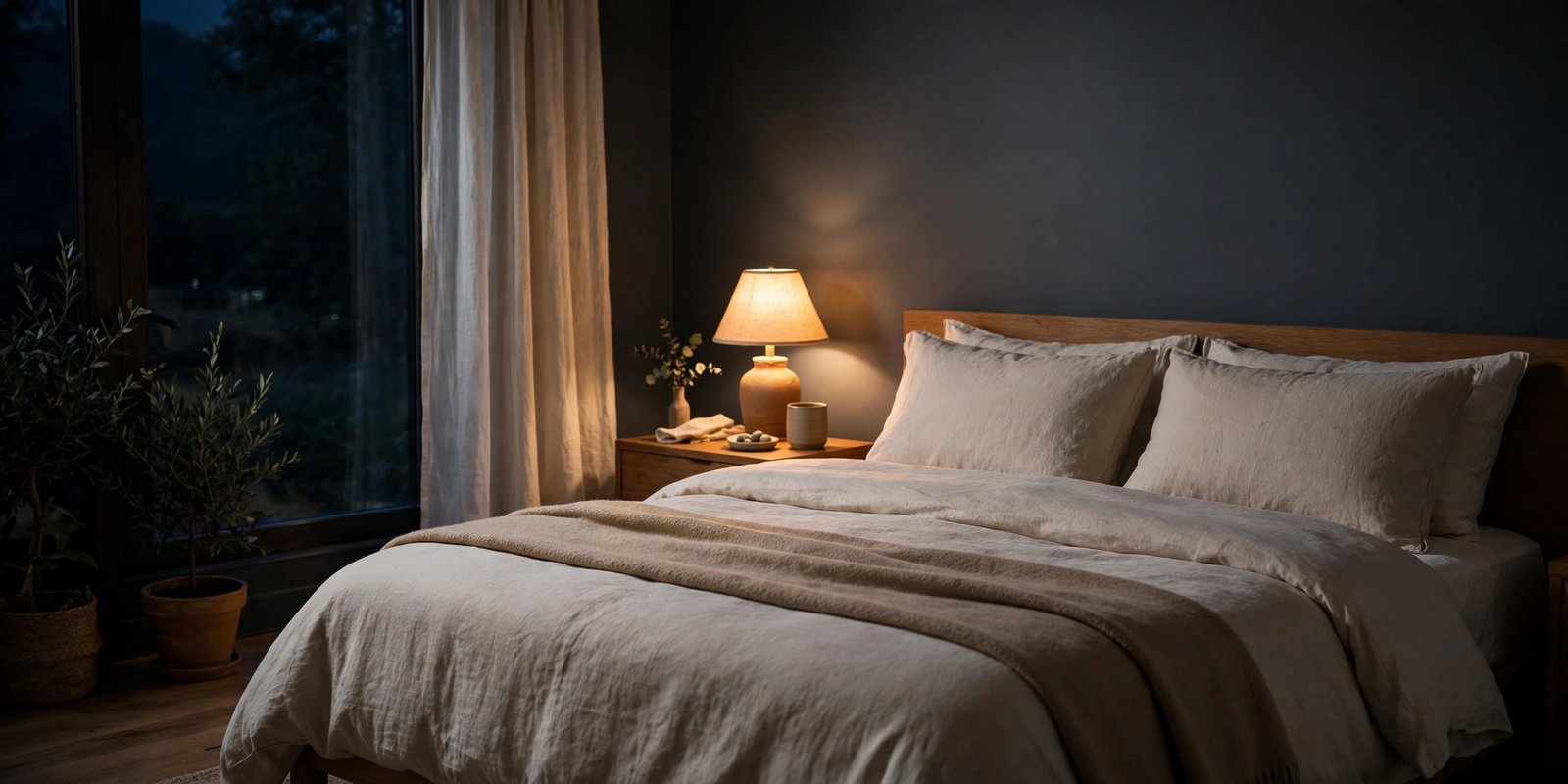

It is 1:47 a.m. You have tried counting sheep, scrolling until your eyes hurt, and bargaining with yourself that if you fall asleep right now you will still get five hours. Learning how to fall asleep without melatonin is less about one clever trick and more about giving your body the signals it already knows: light in the morning, less stimulation at night, a cool dark room, and a calm way to let go of the day. Melatonin is a timing signal, not a sleeping pill, and once you understand what actually makes you sleepy, you can build a routine that works most nights — without a supplement.
Melatonin is not a sedative. It is a timing hormone, produced by the pineal gland in the brain, that tells the body when night is coming. In the evening, as light fades, melatonin levels rise and the body starts preparing for sleep: temperature falls, alertness drops, and sleep pressure builds. Taking a melatonin pill does not create sleepiness out of nothing. It nudges the clock, and it works best for jet lag or a shifted schedule, not for a racing mind at 1:47 a.m.
Why Melatonin Is Not the Answer You Think It Is
Many people take melatonin expecting it to knock them out. When it does not, they take more, earlier, or every night — and then wonder why sleep still feels fragile. Part of the problem is dose: many over-the-counter tablets contain far more melatonin than the body makes, and the extra does not help you fall asleep faster. It can leave you groggy, vividly dreaming, or waking at 3 a.m. The research on melatonin for ordinary insomnia is modest at best: it may shorten the time to fall asleep by a few minutes, and for many people it does nothing measurable at all.
There is also a newer reason to pause before making melatonin a nightly habit. A preliminary study presented at a cardiology meeting linked long-term, high-dose melatonin use with a higher risk of heart failure, and the news travelled fast. A report on the melatonin heart study makes the same point: association, not proof that melatonin causes heart failure. The study was preliminary and the details matter.
If you currently take melatonin on a doctor’s advice, do not stop suddenly without talking to that doctor. For everyone else, the practical conclusion is simple: melatonin is a weak tool for a strong problem, and the stronger tools are light, temperature, timing, and relaxation. Those are the tools in the plan below, and they work tonight.
How to Fall Asleep Without Melatonin Tonight: The 9-Step Plan
Start with tonight. You do not need to fix everything at once. Work through the steps in order, and keep the ones that help. The plan is built on four ideas: light sets the clock, temperature opens the door to sleep, a wind-down routine tells the brain the day is over, and the 20-minute rule stops a bad night from becoming a worse one. If you follow most of the steps, most nights will improve within a week.
1. Get bright light in the morning
Your body clock is set by light, and the strongest signal comes in the morning. Get outside for 10 to 30 minutes within an hour of waking, even on a cloudy day. Outdoor light is far brighter than indoor light, and it anchors your rhythm so that melatonin rises at the right time in the evening. If you cannot get outside, sit near a bright window while you have breakfast. The habit is simple, free, and it is the single most powerful lever in this whole plan.

2. Cut caffeine at least 6 hours before bed
Caffeine blocks the sleep pressure that builds up during the day, and it lingers far longer than most people realise. Its half-life is about five to six hours, which means a coffee at 4 p.m. is still half there at 10 p.m. If your bedtime is 10:30, make 4:30 your last coffee, and remember that tea, cola, energy drinks, and some painkillers also contain caffeine. Switching the afternoon coffee to decaf or herbal tea is a small change with a large effect on the first hour of sleep.
3. Keep the bedroom cool, dark, and quiet
Your core temperature needs to fall before you can sleep well, and a cool room helps it do that. Clear the bedroom of glowing chargers and standby lights, and use earplugs or a white-noise machine if street noise wakes you. The Cleveland Clinic guide to the best temperature for sleep sets out the 60 to 67 degree range in detail. Darkness matters too: blackout curtains or an eye mask stop early light from waking you, and a cool room makes the fall in temperature easier.
4. Dim lights and screens 1 hour before bed
Bright light in the evening tells your brain it is still daytime, which delays the natural rise in melatonin and pushes sleep later. Dim the main lights an hour before bed, switch lamps to warm bulbs, and turn screens to their dimmest, warmest setting. Better still, put the phone on charge in another room and read a paper book instead. If you must use a screen, keep it brief and dim. The hour before bed is for winding down, not for news, work email, or arguments.
5. Build a wind-down routine
Sleep does not arrive on command. It arrives when the body feels safe and unhurried. Pick two or three calming activities and do them in the same order every night: a warm shower, a paper book, gentle stretching, or writing tomorrow’s list on paper so it stops circling in your head. The routine itself matters less than the repetition. After a week or two, the sequence becomes a cue, and the body starts to slow down as soon as the first step begins.

6. Try slow breathing
When the mind races, the breath is the fastest way to slow it down. Diaphragmatic breathing — slow breaths that expand the belly rather than the chest — lowers heart rate and signals safety to the nervous system. Try breathing in for four counts, holding for four, and breathing out for six, for five minutes. If counting feels like work, simply make the out-breath longer than the in-breath. The Sleep Foundation’s relaxation exercises for sleep describe diaphragmatic breathing alongside body scan meditation and progressive muscle relaxation.
7. Relax the muscles, one group at a time
Progressive muscle relaxation works by tensing and then releasing each muscle group in turn, from your toes to your face. Tense each group for five seconds, then let go completely and notice the difference. The contrast teaches the body what relaxation feels like, and it gives a busy mind something simple to focus on. It is a good technique to pair with slow breathing, and it works well in bed when sleep feels far away.
8. Keep a regular wake time
Going to bed at the same time helps, but waking at the same time matters more. A regular wake time anchors the body clock, which makes it easier to fall asleep the next night. Choose a wake time you can keep seven days a week, even on weekends, and get bright light soon after you wake. The first few mornings feel hard, and then the rhythm takes hold. A stable wake time is the foundation that makes the other steps work.
9. Use the 20-minute rule
This is the step most people resist, and the one that helps most on a bad night. If you are not asleep after about 20 minutes, get up. Go to another room, keep the lights dim, and do something quiet — read, stretch, or listen to calm music — until you feel sleepy, then go back to bed. Lying awake teaches the brain that the bed is a place for worrying, and that association makes the next night harder. That is a core part of how to fall asleep without melatonin: protect the bed as a place for sleep. The Sleep Foundation’s guide to what to do when you can’t sleep gives the same guidance: after 20 minutes, get out of bed, do a quiet activity, and return when sleepy.

What to Do When the Problem Lasts Weeks
A few bad nights are normal. Weeks of poor sleep are a different matter, and that is where cognitive behavioural therapy for insomnia, or CBT-I, helps. It is the treatment with the strongest evidence for lasting insomnia, and it works by retraining the habits and thoughts that keep sleep away. The Mayo Clinic guide to insomnia treatment explains how CBT-I combines stimulus control, sleep restriction, and cognitive work to retrain the sleep system.
CBT-I usually takes six to eight sessions, often with a trained therapist or through a structured online programme. It is more effective in the long term than sleeping pills, and the gains last after treatment ends. If poor sleep has lasted more than three weeks, if it affects your daytime mood or safety, or if you snore loudly, gasp, or stop breathing in your sleep, see a doctor. Sleep apnoea and other medical causes need treatment, not just a better routine.
It is also worth checking the basics. Alcohol may help you fall asleep faster, but it fragments sleep and causes early waking. Regular exercise helps, but vigorous exercise late in the evening can keep you wired. A heavy meal close to bedtime can cause discomfort, and a bedroom that is too warm, too bright, or too noisy will undo the rest of the plan. Fix the obvious things first, and then judge whether the routine is working.
A Sample Evening, Hour by Hour
Here is what a good evening looks like in practice, for a 10:30 p.m. bedtime. At 9:30, dim the lights and stop work. At 9:45, have a warm shower and change into sleep clothes. At 10:00, read a paper book or stretch gently. At 10:20, do five minutes of slow breathing. At 10:30, lights out. If you are still awake at 10:50, get up, read in dim light, and return when sleepy. The exact times matter less than the shape: light fades, activity slows, and the body gets the same message every night.
Morning matters just as much. Get up at the same time, get outside into bright light, and avoid the temptation to lie in after a bad night — a lie-in shifts the clock later and makes the next night worse. For more ideas on the basics, see our guide on how to sleep better naturally, and if poor posture is adding aches that keep you awake, our guide on how to fix bad posture may help. Shift workers face a harder version of the same problem, and our morning routine for night shift workers is built around the same light-and-timing principles.
Frequently Asked Questions
Can I fall asleep naturally without melatonin?
Yes. Most people can, because sleep is driven by light, temperature, sleep pressure, and relaxation, not by a supplement. A cool dark room, morning light, a regular wake time, and a wind-down routine are enough for most people. Melatonin may help with jet lag or a shifted schedule, but for ordinary sleepless nights the behavioural steps in this guide are the stronger tools.
How long does it take for these methods to work?
Some steps help tonight — a cool room, dim lights, and slow breathing can make a difference on the first night. Others, like a regular wake time and morning light, take a week or two to reset the clock. Give the plan at least two weeks before judging it, and keep the steps that help.
Is melatonin dangerous?
Melatonin is not proven dangerous, and it is not proven to cause heart failure. A preliminary study presented at a cardiology meeting found an association between long-term, high-dose use and heart failure, but the study was observational and the findings need confirmation. Talk to a doctor if you take melatonin regularly, especially in high doses.
What if I wake up at 3 a.m. and cannot get back to sleep?
Do not watch the clock or reach for your phone. Try slow breathing or a body scan for a few minutes. If you are still awake after 20 minutes, get up, go to another room, and do something quiet in dim light until you feel sleepy. Keep the lights low and avoid screens, and return to bed only when you feel drowsy.
Does reading in bed help or hurt sleep?
A paper book in dim light is one of the best wind-down activities, and it is a good choice for the 20-minute rule. A phone or tablet is different: the light and the content keep the brain alert, and the habit of scrolling in bed teaches the brain that the bed is a place for stimulation, not sleep.
When should I see a doctor about sleep?
See a doctor if poor sleep lasts more than a few weeks, if you snore loudly or gasp during sleep, if you feel sleepy during the day despite a full night in bed, or if sleep problems affect your work, mood, or safety. A doctor can check for sleep apnoea, restless legs, and other causes that a routine alone cannot fix.
Conclusion
Sleep is not something you can force, but it is something you can invite. Bright light in the morning, a cool dark room, a short wind-down, and the 20-minute rule are small levers with a large effect. Learning how to fall asleep without melatonin is really learning how your body already knows how to sleep, and then getting out of its way. Pick two or three steps from the plan, start tonight, and give it two weeks. Most people find the nights get easier — and the mornings feel like a different day.



