

You’ve probably been told to “sit up straight” a thousand times. And you’ve probably tried it a thousand times — shoulders yanked back, spine rammed into a ruler, chin tucked so hard you could barely breathe — only to melt back into the slump five minutes later. Here’s the truth about how to fix bad posture: it’s not about sitting up straight. It’s about a short daily routine that loosens what’s tight, strengthens what’s weak, and a desk setup that stops fighting your spine. Ten minutes a day is enough to start reversing years of slouching — and this guide gives you the exact exercises, with sets and reps, to do it.
The stakes are bigger than looking slouchy in photos. Back pain statistics from the WHO show lower back pain affected about 619 million people globally in 2020, with that number expected to hit 843 million by 2050. In the US, a National Institutes of Health analysis of 2019 survey data found 8.2% of adults live with chronic severe back pain — and three-quarters of them struggle with everyday activities like mobility, self-care, or work. Posture won’t cure every back problem, but for most desk workers, it’s the constant low-level strain that matters. And the good news, as Harvard Health’s posture guide puts it: it’s usually not too late to correct it, at almost any age.
The 30-Second Wall Test: Find Out What’s Actually Wrong
Before you start exercising, figure out which pattern you’re dealing with. Different slumps need different fixes, and this test takes half a minute. Stand with your heels a few inches from a wall and let the back of your head, your shoulder blades, and your buttocks touch it. Then slide one hand behind your lower back.
You should fit roughly one flat hand in the gap — not a fist, and not zero. Now read the results:
- If your head won’t reach the wall without tilting your chin up, you’ve got forward head posture — classic screen-neck.
- If your shoulder blades only touch when you force them back, your shoulders are rounded and your chest is tight.
- If you can fit a fist behind your lower back, it’s over-arched (tight hip flexors, weak glutes). If there’s no gap at all, it’s flattened (you’ve been slumping on your tailbone).
- If one shoulder or hip sits visibly higher, you’ve got a lopsided lean — worth getting assessed if it won’t level out.
Repeat the wall test once a week. It’s the simplest way to see whether the routine below is actually working, instead of just hoping.

The 7-Exercise, 10-Minute Daily Routine That Fixes Bad Posture
The logic behind fixing bad posture is simple, and it’s the same one a practical guide to fixing bad posture lays out clearly: loosen the muscles pulling you forward (chest, front of the neck, hip flexors) and strengthen the ones that hold you upright (upper back, deep neck muscles, glutes, core). Do these seven moves daily for the first six weeks — about ten minutes total — then drop to three or four times a week. Nothing here should hurt. A stretch should feel like a stretch; a strengthening move should feel like work.
1. Chin Tucks (10 reps, 5-second holds)
The single best fix for forward head posture. Sitting or standing tall, draw your chin straight back — like you’re making a double chin — without tilting your head up or down. Hold five seconds, release, and repeat ten times. It looks ridiculous. It wakes up the deep neck flexors that have been asleep since you started staring at screens, and it pulls a jutting head back over the shoulders.
2. Wall Angels (10 slow reps)
Stand against a wall with your lower back, shoulder blades, and head touching it. Raise your arms to a goalpost position, then slowly slide them up and down the wall, keeping your wrists and elbows in contact with it as far as you can. Ten slow reps. This opens the chest and teaches your shoulder blades to sit down and back where they belong.
3. Doorway Chest Stretch (30 seconds, twice)
Tight chest muscles are what drag rounded shoulders forward in the first place. Place your forearms on either side of a door frame with your elbows at shoulder height, step one foot through the doorway, and lean in until you feel a stretch across your chest. Hold 30 seconds, rest, repeat once. If you’ve been hunched at a keyboard for years, this one will feel dramatic.

4. Thoracic Extension Over a Rolled Towel (5 breaths per position)
Your mid-back has forgotten how to bend backward after years of sitting. Lie on your back with a rolled-up towel (or foam roller) across your mid-back, hands behind your head, and gently arch backward over it for five slow breaths. Move the roll up a few inches and repeat. Harvard Health recommends this same kind of upper-back mobility work as a core part of any posture routine.
5. Hip Flexor Stretch (30 seconds each side)
Tight hip flexors from sitting tilt the pelvis forward and over-arch the lower back. Half-kneel with one knee on a cushion, tuck your tailbone under slightly, and shift your hips forward until you feel the stretch in the front of the back hip. Hold 30 seconds per side. You’ll wonder why your lower back has been so angry — this is usually why.
6. Glute Bridges (2 sets of 12)
Lie on your back, knees bent, feet flat on the floor. Squeeze your glutes and lift your hips until your body forms a straight line from shoulders to knees. Hold two seconds at the top, lower slowly. Two sets of twelve. Strong glutes hold the pelvis level, and the pelvis is the platform everything above it sits on.
7. Scapula Squeezes (5 reps of 30-second holds)
Simply squeeze your shoulder blades together and hold for 30 seconds, breathing normally, then release. Repeat five times. Harvard Health highlights these alongside rows with a resistance band as the key upper-back strengtheners for posture. Do them at your desk between meetings — nobody can even tell.
On timeline: expect to feel a difference in two to three weeks and see one in six to twelve weeks of daily practice. The people who fail at this usually quit at week three, right when upright still feels like effort. It stops feeling like effort once the muscles doing the work are strong enough to hold you there without being told. If you catch the movement bug and want to build general fitness next, here’s how to start running out of shape safely.
Which Posture Problem Do You Have? Diagnose It Here
Match what you noticed in the wall test to the pattern below, and start with the fix listed. You don’t need to do everything at once — attack your worst pattern first.
| What you notice | Likely pattern | First fix |
|---|---|---|
| Chin juts forward, frequent headaches, tight neck | Forward head position — usually from screens set too low | Chin tucks daily; raise your screen to eye level |
| Shoulders roll forward, upper back rounds | Tight chest, weak upper back | Doorway stretch + wall angels; check desk height so shoulders aren’t hunched |
| Lower back arches, stomach pushes forward | Tilted pelvis from tight hip flexors and weak glutes | Hip flexor stretch + glute bridges; stop sitting for hours without breaks |
| Lower back flat, slumped deep in the chair | Flattened lower back from sitting on your tailbone | Sit back with a lumbar roll; get up every 30–45 minutes |
| One shoulder or hip sits higher | Habitual one-sided lean or carrying load on one side | Swap sides, center screen and chair; get assessed if it won’t level out |
Fix Your Desk, Fix Half the Problem
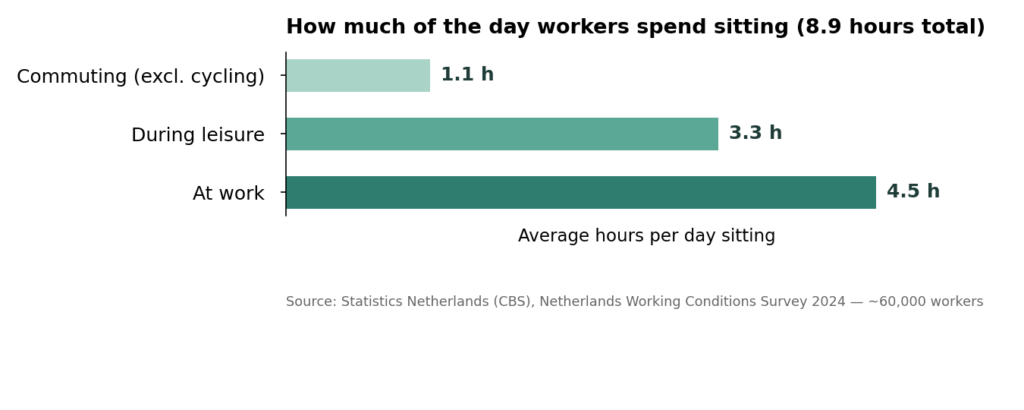
Here’s the uncomfortable math. In a 2024 survey of around 60,000 workers, Dutch workers spent an average of 8.9 hours a day sitting — 4.5 of those at work, 3.3 during leisure, and 1.1 commuting. Your exercises take ten minutes; your chair owns the other nine hours. That’s why the desk setup matters as much as the routine. Good posture should be the easy position, not the heroic one.
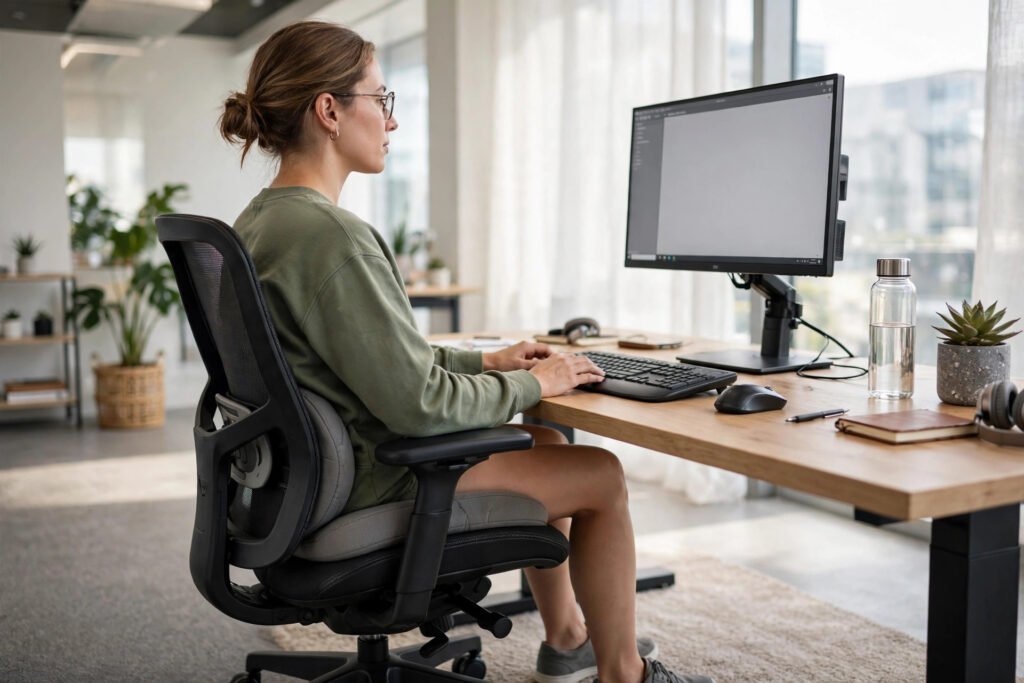
Set your workspace up like this: sit right back in the chair so your lower back is supported in its natural curve — a lumbar roll or small cushion in the small of your back does this for a few dollars if your chair doesn’t. Feet flat on the floor (or a footrest), knees level with or slightly below your hips, elbows at about 90 degrees with shoulders relaxed. Raise your screen so the top third is at eye level; a laptop sitting flat on a desk guarantees a forward head, so use a stand plus a separate keyboard. A well-set-up desk is also the foundation of being more productive working from home — comfort and output are the same project.
Then set a timer. Standing up for a minute every 30 to 45 minutes does more for your posture than any single piece of equipment, because no chair on earth can hold you in a good position for four hours straight. As physiotherapists like to say: the best posture is the next one.
5 Mistakes That Undo Your Posture Progress
1. Wearing a posture brace all day. A brace is a reminder, not a fix — it pulls your shoulders back and makes slumping uncomfortable, which is genuinely useful while you’re learning what upright feels like. But it strengthens nothing, and worn for hours daily it can do the opposite, since the muscles it replaces stop working. Twenty to thirty minutes during the part of the day you slump most, for the first few weeks, is the right dose. Then it comes off.
2. “Sitting up straight” by bracing. Forcing your shoulders back, locking your core, and holding your breath is bracing, not posture. Real posture is relaxed upright — muscles engaged enough to hold the position, not strained into a statue. If you’re exhausted after five minutes of “good posture,” you’re bracing.
3. Sleeping on your stomach. It cranks your neck to one side for hours and flattens the lower back’s natural curve. Back sleeping (with a pillow under your knees) or side sleeping (with a pillow between your knees) is far kinder to your spine. If your nights are working against your days, here’s how to sleep better naturally.
4. Sinking into the couch with your phone. Harvard Health flags two of the biggest modern culprits: slouching on the couch watching TV and looking down at a smartphone for long stretches. If you must scroll in bed or on the sofa, prop the phone up at eye level and sit back on your sit bones instead of melting into a C-shape.
5. Doing the exercises but skipping the strength progression. Stretching alone won’t fix bad posture — you need the muscles that hold you upright to actually get stronger over time. After a few weeks, add a second set, use a resistance band for the wall angels or rows, or lengthen your hold times. Maintenance is forever; the daily dose just gets smaller.
When to See a Professional Instead of Training Through It
A routine and a better setup sort out most posture problems. But see a doctor or physiotherapist if your posture changed suddenly, if it’s painful rather than just stiff, if it keeps getting worse despite the exercises, or if it comes with numbness, weakness, pins and needles, or pain traveling down an arm or leg. A visible curve in a child or teenager, and a new rounding of the upper back in an older adult, should both be assessed rather than trained through. And if you already have a diagnosed back condition, run the exercise list past your physiotherapist before starting.
Frequently Asked Questions
Can you fix bad posture after years of slouching?
For most people, yes. Posture is held in place by soft tissue, and soft tissue adapts in both directions: muscles kept short lengthen with regular stretching, and muscles that switched off come back when asked to work. Long-standing rounding of the upper back may not straighten completely, and some changes are structural, but the pain, stiffness, and slumped look usually improve a great deal with daily practice and a better setup.
How long does it take to fix bad posture?
Most people feel a difference within two to three weeks of daily practice and see a visible change in six to twelve weeks. Think in months, not days — habits built over years don’t switch off in a weekend. Keep the exercises going at a lower dose once your posture improves so the gains stay.
How do I stop slouching at my desk?
Attack it from both sides. Strengthen the muscles that hold you upright with a few minutes of daily exercise, and stop asking them to do all the work: sit back in a chair with lumbar support, put the top third of your screen at eye level, keep your feet flat, and stand up for a minute every 30 to 45 minutes. The break timer matters more than any equipment.
Are posture correctors worth it?
As a short-term training aid, yes — 20 to 30 minutes a day while the exercises take hold. As an all-day fix, no. Braces don’t strengthen anything, and wearing one for hours teaches your muscles to rely on it. Physiotherapists don’t recommend them as a stand-alone solution.
Does bad posture actually cause back pain?
The old idea that poor posture directly “causes” back pain is weaker than it sounds — plenty of people slouch without pain. What poor posture reliably does is load the same tissues the same way for hours, so the neck and shoulders tire, the mid-back stiffens, and a sore lower back gets less recovery time. Fixing it takes a constant, low-level strain off the spine, which for most desk workers is the strain that matters.
The Bottom Line
Fixing bad posture isn’t a posture — it’s a practice. Loosen the front, strengthen the back, set up your desk so upright is effortless, and move every half hour. Give it ten minutes a day for six to twelve weeks and check the wall test weekly; the change sneaks up on you, one painless evening at a time. Your future spine is built by the small things you do between the big workouts.