
How to Clean a Humidifier (and Keep It From Making You Sick)

That little machine puffing cool mist beside your bed is supposed to help you breathe easier. Left uncleaned, it can do the opposite. A humidifier tank is warm, dark, and wet — the perfect home for mould and bacteria — and the unit sprays whatever is growing in the tank straight into the air you breathe. Knowing how to clean a humidifier properly is not fussy housekeeping. It is the difference between relief and a cough that will not quit.
The good news is that cleaning a humidifier takes about fifteen minutes every three days, plus a one-minute daily rinse. This guide follows the schedule from the U.S. Environmental Protection Agency (EPA) and the Mayo Clinic, covers every type of humidifier and explains the safety rules that matter.
Why a Dirty Humidifier Is a Real Health Problem
Humidifiers add moisture to dry winter air, which helps with dry skin, irritated sinuses, and sore throats. But the same tank also grows things: mould, bacteria, and a pink slime called Serratia marcescens all thrive in standing water, and a running humidifier turns them into a fine mist you inhale for hours.
The U.S. Consumer Product Safety Commission (CPSC) has warned about this for years, noting that unclean units can breed microorganisms that cause flu-like symptoms, coughing, and respiratory irritation — sometimes called “humidifier fever.” People with asthma, allergies, or weakened immune systems are the most vulnerable.
There is also the mineral problem: tap water contains calcium and magnesium, and ultrasonic humidifiers break those minerals into a fine white dust that settles on furniture — and into your lungs. The EPA recommends distilled water to reduce that mineral release.
What You Need to Clean a Humidifier
You need almost nothing special: white vinegar, 3% hydrogen peroxide (the standard pharmacy bottle), a soft brush or old toothbrush, a clean cloth, and rubber gloves if your skin is sensitive. Distilled water for refilling is ideal, though tap water is fine for cleaning.
What you do not need: bleach, unless your owner’s manual specifically names it. Some manuals do — Vicks and Honeywell specify one teaspoon per gallon for twenty minutes. If your manual does not mention bleach, do not use it. The EPA’s default is 3% hydrogen peroxide.
Most important of all: your owner’s manual. It outranks any general guide — it tells you which parts can be soaked, which must stay dry, and which cleaners your model allows. If your manual and this guide disagree, follow the manual.
How to Clean a Humidifier: The EPA Schedule
The EPA’s guidance for portable humidifiers is simple: empty the tank, wipe it dry, and refill it every day — and clean the unit every third day. The Mayo Clinic gives the same three-day interval.
| When | What to do | What to use | Time |
|---|---|---|---|
| Every day | Unplug, empty tank and base, wipe dry, refill | Fresh water, clean cloth | 1–2 minutes |
| Every 3rd day | Scrub, descale, disinfect, rinse well | White vinegar, then 3% hydrogen peroxide | 15–20 minutes |
| Weekly | Full vinegar descale of tank and base, check filter | White vinegar, soft brush | 20–30 minutes |
| End of season | Full clean and disinfect, dry completely, store tank open | Vinegar, peroxide, towel | 30 minutes |
Some manufacturers are more relaxed — Vicks recommends weekly cleaning for its own models — and Consumer Reports is stricter, recommending daily cleaning. Treat your manual’s interval as the minimum and the EPA’s every-third-day routine as the target.
Step 1: The Daily Rinse (1–2 Minutes)
Unplug the humidifier first — always. Lift off the tank, pour out the remaining water, and wipe the tank and base dry. Refill with fresh water, distilled if you have it, and put the tank back on.
That is the whole daily routine, and it matters more than it sounds: stagnant water is where growth starts, and a tank emptied and refilled daily never gives mould and bacteria a chance to establish themselves. The CDC also recommends changing the water daily, and this one habit prevents most of the problems the three-day clean has to fix.
Do it at the same time every day — with your morning coffee, or when you brush your teeth at night.
Step 2: The Every-Third-Day Deep Clean
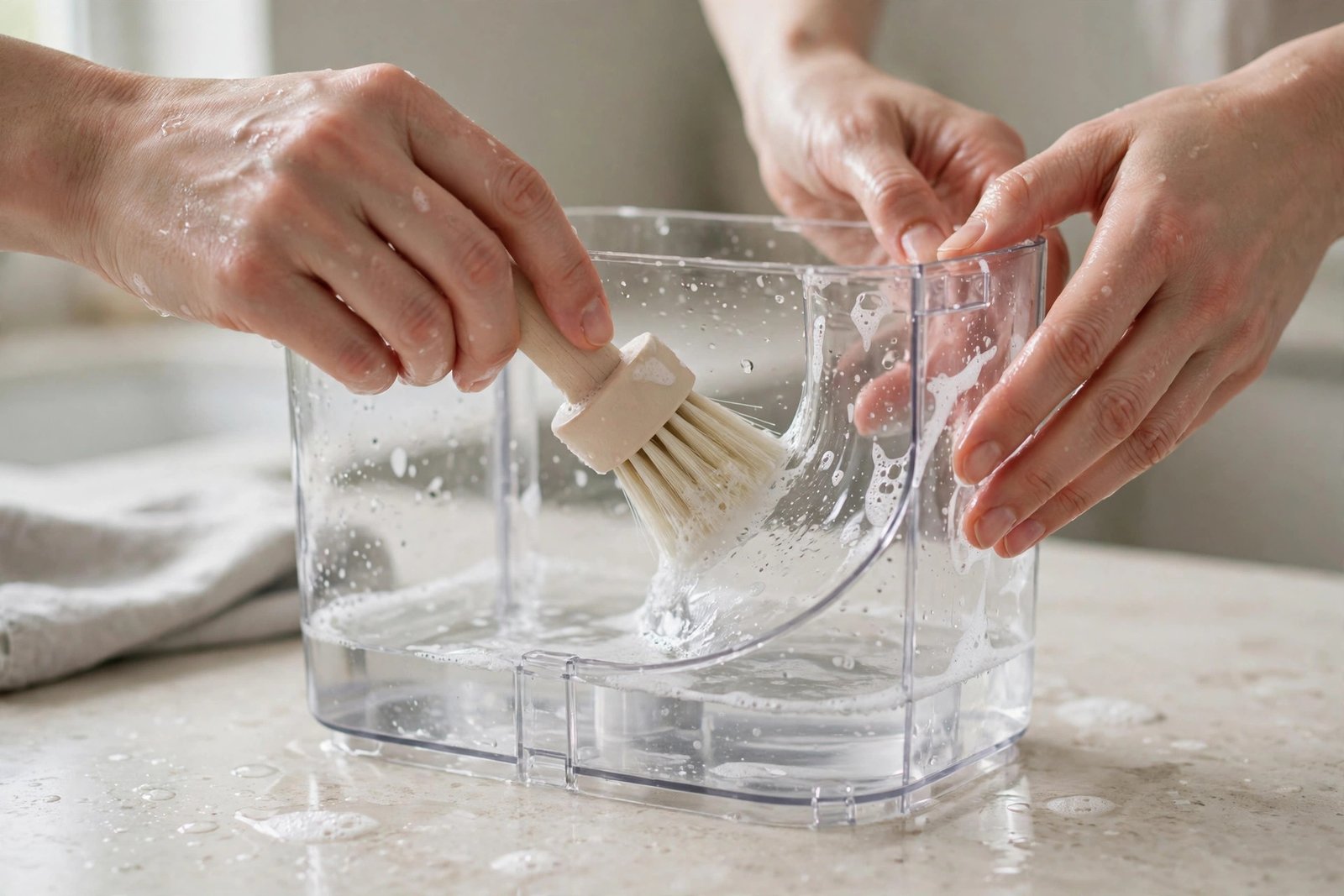
Every third day, the humidifier gets the full treatment — the heart of how to clean a humidifier properly: descale, then disinfect, as two separate steps, with a rinse in between. Descaling and disinfecting are different jobs: vinegar dissolves the mineral scale; the disinfectant kills what grows.
Descale with vinegar
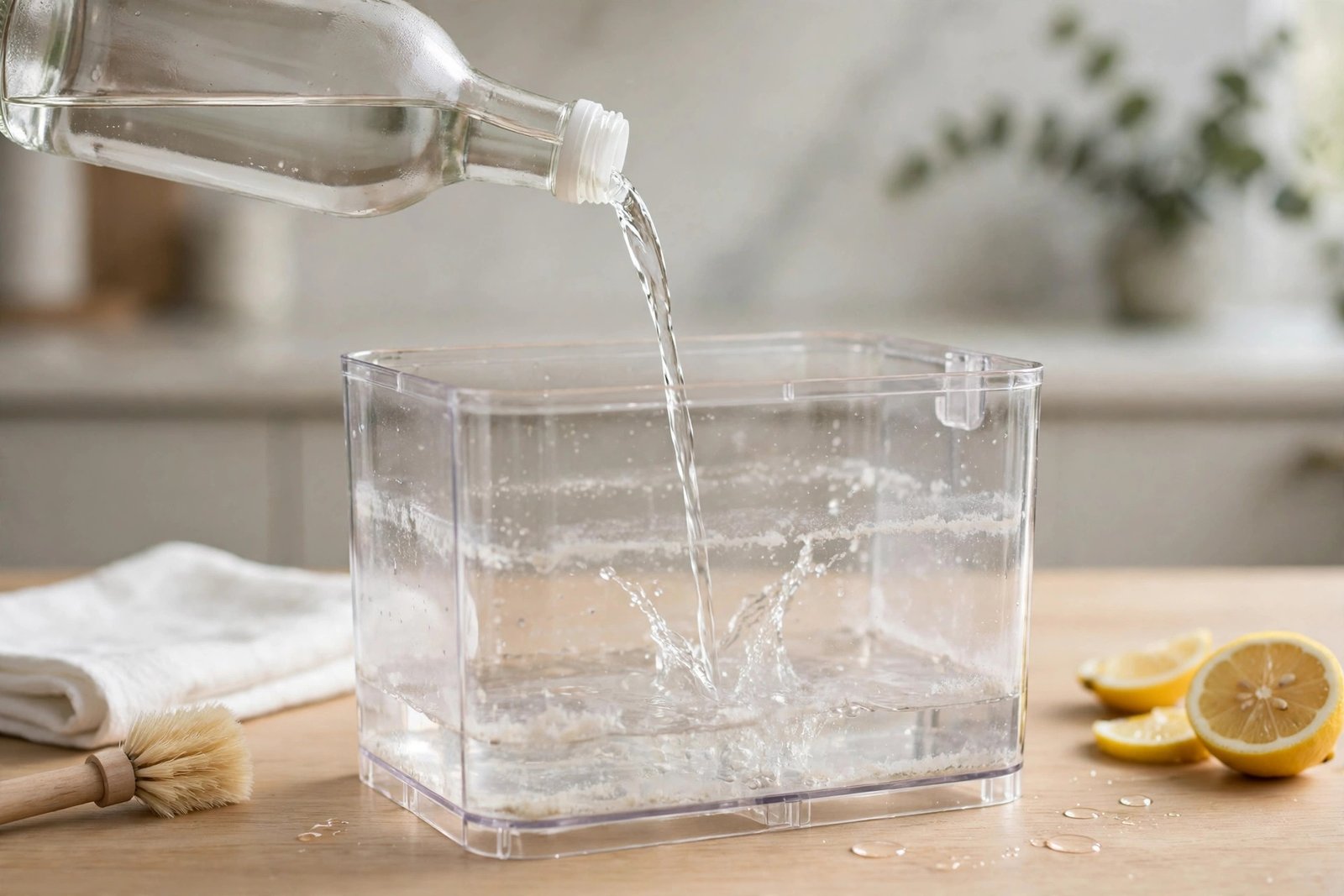
Unplug the unit, empty the tank and base, and pour undiluted white vinegar into the base so it covers any white crust. Swish some around the tank, too. Let it stand for 15 to 30 minutes, then scrub with a soft brush — pay attention to corners, seams, and the water channel, where deposits hide.
Rinse with several changes of tap water until the vinegar smell is gone. The EPA advises this after any cleaning or disinfecting product, so chemicals are not dispersed into the air when the unit runs.
Disinfect — a separate step
After the vinegar step and a rinse, disinfect every surface that touches water. If your manual names a disinfectant, use that; if it names none, the EPA’s default is 3% hydrogen peroxide: pour it in, swish it over the surfaces, let it sit for a few minutes, and pour it out.
If your manual allows bleach instead, the strength in Vicks and Honeywell manuals is one teaspoon of bleach per gallon of water, left for about twenty minutes. Never use more — more bleach damages the unit and leaves residue you will breathe in. And never mix the vinegar step with the bleach step: vinegar and bleach together create chlorine gas. Rinse thoroughly between the two steps, every time.
Dry everything before you reassemble
Let every part air-dry completely before you put the unit back together. Mould grows in damp, enclosed spaces, and a humidifier reassembled wet is a mould farm with a lid on. Dry everything on a clean towel, and only reassemble when it feels dry to the touch.
How to Clean a Humidifier by Type
Not all humidifiers are built the same, and how to clean a humidifier changes with the type. The EPA schedule stays the same for all of them, but watch for these differences.
Cool mist (evaporative)
Evaporative humidifiers blow air through a wet wick or filter, which traps minerals and needs its own care. Rinse the wick regularly and replace it per your manual — usually every one to three months. A wick that smells musty or has turned brown is overdue.
Warm mist (steam)
Warm mist units boil the water, which kills most microorganisms — but the mineral scale is worse, because boiling concentrates it. Descale the heating chamber with vinegar on the same schedule, and never rinse the heating element or base under running water; wipe it with a damp cloth instead. Water in the electrical parts is the fastest way to kill the unit.
Ultrasonic
Ultrasonic humidifiers use a vibrating disc to make a fine mist, and they are the worst offenders for white mineral dust. Use distilled water if you can — the best fix for the white dust problem. Clean the disc gently with a soft brush, never anything metal or abrasive, and never rinse the base under the faucet.
Whole-house and console units
Larger console humidifiers follow the same principles on a bigger scale: empty and wipe the reservoir regularly, descale with vinegar, and replace the filter or wick on schedule. Because they hold more water, they also grow more — do not stretch the interval just because the tank is big.
What You Should Never Do
A few common habits actively damage your humidifier or your health — avoid all of them.
Never mix cleaning chemicals
Vinegar and bleach together make chlorine gas; bleach and ammonia make chloramine gas; hydrogen peroxide and vinegar make peracetic acid, which irritates the lungs. Use one cleaner at a time, rinse thoroughly between steps, and never combine them in the tank.
Never run the humidifier with vinegar in it
Vinegar is for cleaning, not for running. If you switch the unit on with vinegar in the tank, you will fill the room with vinegar vapour. Always rinse until the smell is gone before refilling.
Never add essential oils to the tank
Essential oils are not made for humidifier tanks. They coat the internal parts, clog the wick or disc, and void most warranties — and they can irritate lungs, especially in children and people with asthma. If you want scented air, use a diffuser designed for oils, never your humidifier.
Never use tap water if you can avoid it
Tap water is fine for cleaning, but for running the unit, distilled water is better: almost no scale, almost no white dust, and longer between deep cleans. If distilled water is too much hassle, a demineralization cartridge — sold for many ultrasonic models — is the next best thing.
White Dust on Your Furniture? Here Is Why
If you have noticed a fine white powder on your nightstand, your TV, and your books, that is mineral dust from your humidifier. Tap water contains calcium and magnesium, and ultrasonic humidifiers break those minerals into particles small enough to float through the room.
The dust itself is not considered highly toxic, but it is not something you want to breathe, and it is a sign your water is too hard for the machine. The fix is distilled water, or a demineralization cartridge if your model takes one. Keep humidity in the healthy range, too — the EPA recommends 30 to 50 percent indoors. Above 50 percent invites mould on your walls; below 30 percent, the air irritates your nose and throat. A cheap hygrometer tells you where you stand.
If your sinuses are why you bought the humidifier, our guide to how to relieve sinus pressure covers the other remedies that help — and if dry winter air is driving up your heating bill, see how to lower your electric bill in winter.
End-of-Season Storage: Do It Right or Regret It
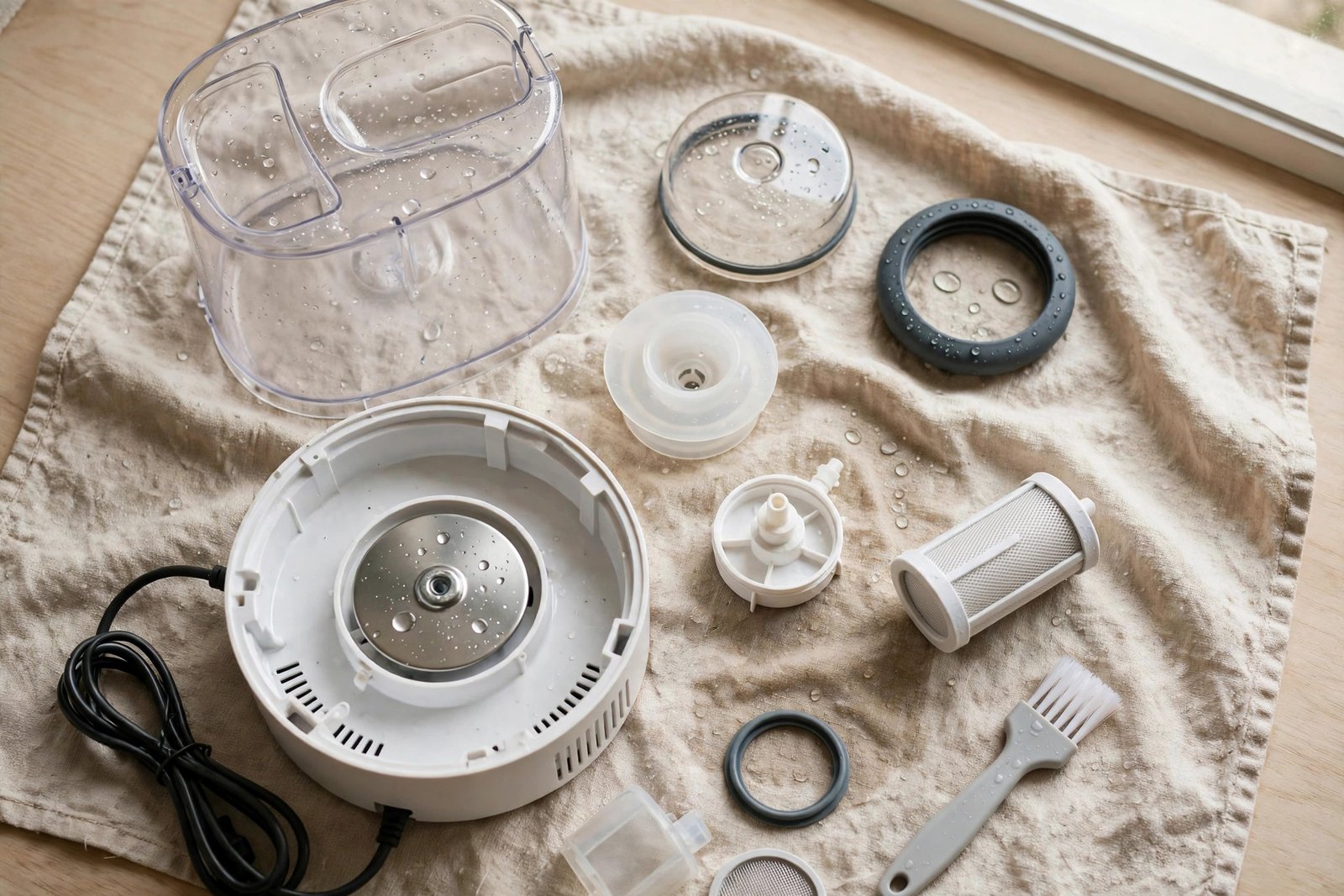
When winter ends, do not just unplug the humidifier and shove it in a cupboard — a unit stored wet will greet you in autumn with a science experiment inside. Give it the full clean, dry every part completely, and leave it disassembled on a towel for 24 hours.
Store it with the tank cap off and the tank separated from the base so air can circulate. Throw away the old wick or filter and buy a fresh one next season — a filter stored damp for six months is not worth reusing. Keep the manual with the unit.
When you bring the humidifier back out, clean it again before the first use, even if it went into storage clean — dust and spores settle over six months. The same discipline applies to other appliances: our guide to how to clean an air fryer follows the same clean-and-dry logic.
Troubleshooting: Common Humidifier Problems
It smells musty even after cleaning
The smell is coming from a part you missed — usually the base channel, the inside of the lid, or a wick that needs replacing. Take the unit fully apart, soak every water-contact part in vinegar, scrub with a brush, and replace the wick or filter. If the smell survives that, the mould is in a part you cannot reach, and it is time for a new unit.
Pink slime keeps coming back
Pink slime is Serratia marcescens, a common bathroom bacterium that loves damp surfaces. It is not dangerous to most healthy people, but it is a sign the tank is sitting wet between uses. The fix is the daily routine: empty, wipe dry, refill. If it still returns, switch to distilled water and clean every second day.
The mist is weak or stops entirely
Scale is the usual cause. Descale with vinegar, clean the disc or wick, and check that the tank is seated properly. On ultrasonic models, a scratched or dirty disc is the most common culprit — clean it gently with a soft brush, never anything metal.
It leaks
Check the tank cap seal and gasket, which wear out over time. Make sure the tank is seated correctly, and check for hairline cracks. A cracked tank cannot be fixed — replace it, or replace the unit.
Frequently Asked Questions
How often should I clean my humidifier?
Empty, wipe dry, and refill it every day, and give it a full clean — descale and disinfect — every third day. That is the schedule from the EPA and the Mayo Clinic.
Can I use vinegar to clean my humidifier?
Yes. White vinegar is the standard descaler: pour it into the tank and base, let it stand for 15 to 30 minutes, scrub away the scale, and rinse until the smell is gone. Vinegar removes scale but is not a disinfectant, so follow it with a separate step — 3% hydrogen peroxide, or the disinfectant your manual names.
How to clean a humidifier without vinegar?
Use citric acid instead: dissolve two tablespoons in a litre of warm water, pour it into the tank, let it stand for 20 minutes, scrub, and rinse well. Citric acid dissolves scale like vinegar, without the smell. You still need a separate disinfecting step afterwards.
Is it safe to use bleach in a humidifier?
Only if your owner’s manual specifically allows it. Some manuals, such as Vicks and Honeywell, specify one teaspoon of bleach per gallon of water for about twenty minutes. If your manual does not mention bleach, use the EPA’s default instead: 3% hydrogen peroxide. Never mix bleach with vinegar, and always rinse thoroughly afterwards.
Can a dirty humidifier make you sick?
Yes. A humidifier that is not cleaned regularly can grow mould and bacteria, which the unit then sprays into the air as a fine mist. The CPSC warns that dirty humidifiers can cause flu-like symptoms, coughing, and respiratory irritation — people with asthma, allergies, or weakened immune systems are most at risk.
Should I use distilled water in my humidifier?
Yes, if you can. Distilled water has almost no minerals, so it leaves almost no scale and produces almost no white dust. The EPA recommends it to reduce mineral release into indoor air. Tap water works, but it means more descaling and more white dust.
Conclusion
That is the routine: a one-minute daily rinse, a fifteen-minute clean every third day, and a proper dry before storage. Learning how to clean a humidifier is not complicated, but it pays off every night — cleaner air, fewer coughs, and a machine that lasts years instead of one season.
If you want the rest of your bedroom air to be as clean as your humidifier, our guide to the best air purifier for allergies covers the options worth buying.



