
How to Make Christmas Cake: The No-Soak Recipe for a Moist Fruit Cake

Learning how to make Christmas cake is one of those kitchen skills that pays off for years. A proper Christmas cake — dark, moist, packed with fruit and spice — is the centrepiece of the festive table, and a homemade one beats anything from a shop. The problem is the reputation: months of soaking, weeks of feeding, and a recipe that reads like a military operation.
It does not have to be that way. The no-soak method simmers the dried fruit for ten minutes instead of soaking it overnight, and the cake comes out just as moist. Bake it in November, feed it weekly, and ice it the week before Christmas.
What Is a Christmas Cake?
A Christmas cake is a rich fruit cake, traditionally made with dried fruit soaked in brandy or rum, warm spices, and treacle for colour and depth. It is baked low and slow, then “fed” with small amounts of alcohol over several weeks so it matures into something dense, moist and deeply flavoured. The finished cake is usually covered in marzipan and royal icing.
The tradition goes back to medieval plum porridge and the rich fruit cakes of Victorian Britain, when a cake made in November and fed until Christmas was a sign of a well-run household. The alcohol was not just flavour — it was a preservative, keeping the cake safe to eat for months without refrigeration.
Classic vs No-Soak: Which Method Should You Choose?
There are two ways to get the fruit ready, and the difference is time. The classic method soaks the dried fruit in brandy, rum or sherry for 12 hours or overnight — some bakers soak for a full week. The no-soak method simmers the fruit with butter, sugar and juice for about ten minutes. The heat plumps the fruit fast, and the cake can be baked the same day.
The results are closer than you might expect. A simmered cake is moist, rich and ready to eat the day it is baked, and it still improves with a few weeks of feeding. The classic version has a slightly deeper flavour — but only if you start it in time. A no-soak cake baked in November and fed weekly will beat a classic cake rushed in mid-December every time.
If it is already late November and you have not started, choose the no-soak method. If you are organised enough to soak fruit in October, the classic method is worth it. Either way, the recipe below works — the only difference is how the fruit is prepared, and that choice is the first decision when you learn how to make Christmas cake.
| Method | Fruit prep time | Effort | Result |
|---|---|---|---|
| Classic overnight soak | 12 hours to 1 week | Plan ahead, then easy | Deepest flavour, best with long maturing |
| Fast simmer (no-soak) | 10 minutes | One pan, same day | Moist and rich, ready to eat same day |
How to Make Christmas Cake: The No-Soak Recipe
This is the recipe to learn first. It makes one 8-inch (20 cm) round cake, serves 12 to 16, and takes about an hour of active work plus two to two and a half hours in the oven.
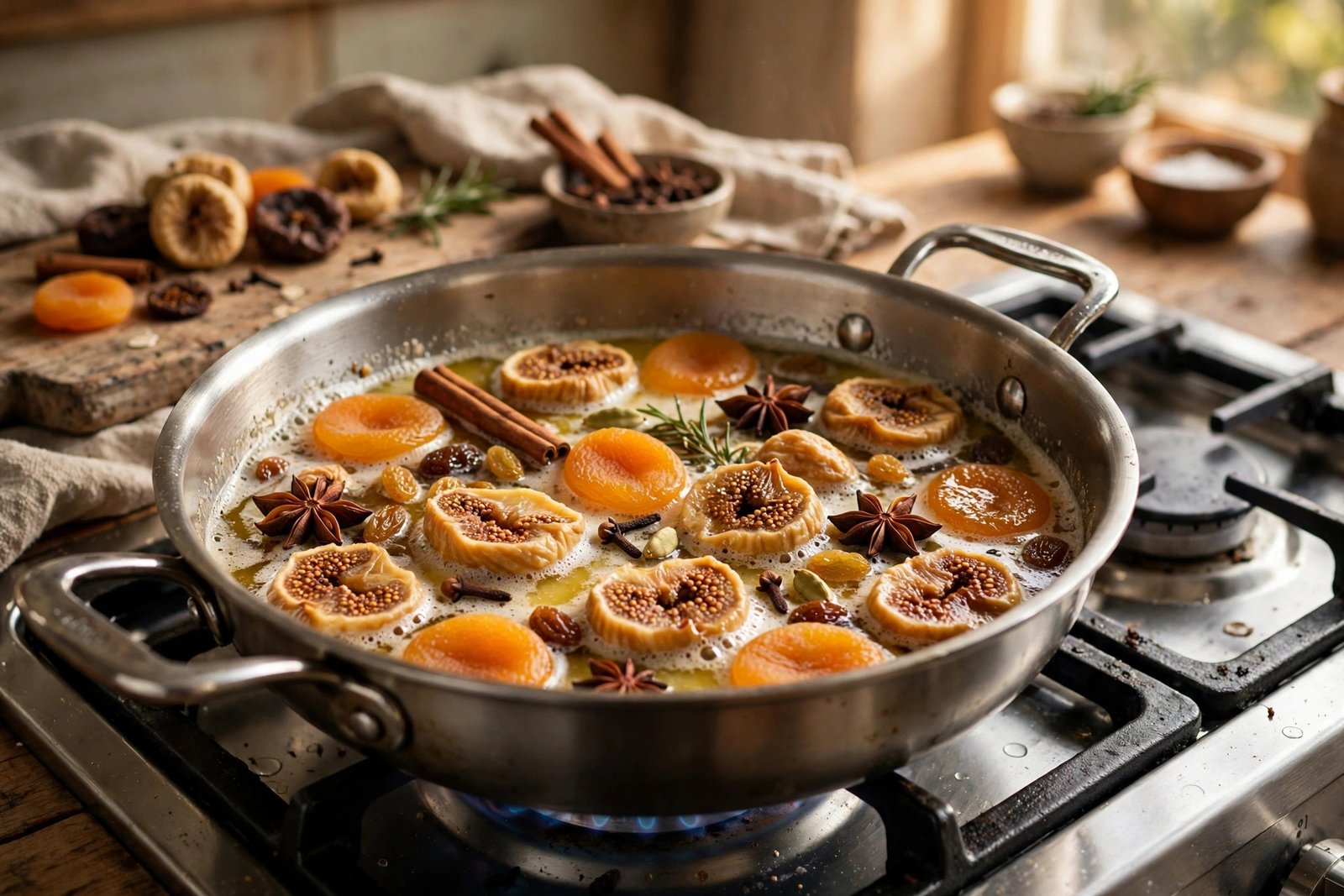
Ingredients: 600 g mixed dried fruit (raisins, sultanas, currants), 100 g glacé cherries halved, 150 g butter, 150 g soft brown sugar, 150 ml orange juice, zest of 1 lemon and 1 orange, 2 tbsp treacle or golden syrup, 4 eggs, 250 g plain flour, 75 g ground almonds, 1 tsp mixed spice, 1 tsp cinnamon, ½ tsp baking powder, 75 g chopped nuts (optional).
Step 1 — Simmer the fruit. Put the dried fruit, cherries, butter, sugar, orange juice and both zests into a large saucepan. Bring to a gentle simmer over medium heat and cook for 10 minutes, stirring often so it does not catch. The fruit will plump and the mixture will turn glossy. Take it off the heat and leave it to cool for about 30 minutes — warm fruit will melt the butter in the batter later.
Step 2 — Prepare the tin and oven. Preheat the oven to 150°C / 300°F (130°C fan, gas mark 2). Grease a deep 8-inch round tin and line the base and sides with a double layer of baking paper. Wrapping a strip of brown paper around the outside of the tin also helps stop the edges from over-browning.
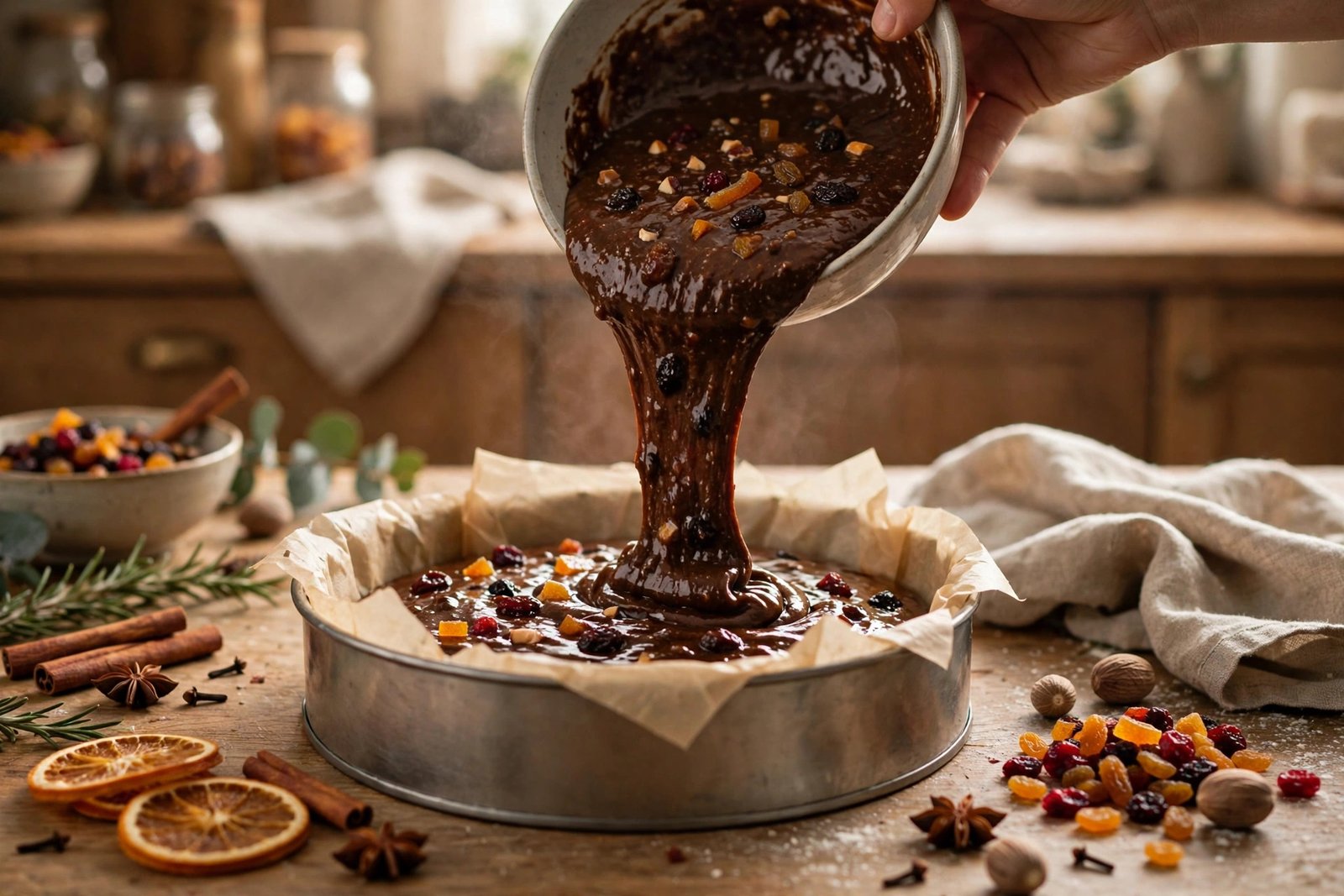
Step 3 — Mix the batter. Beat the eggs lightly, then stir them into the cooled fruit mixture with the treacle. Sift in the flour, ground almonds, spices and baking powder, and fold in gently with the chopped nuts if using. Do not overmix — a light touch keeps the cake soft.
Step 4 — Bake. Spoon the mixture into the tin and level the top. Bake at 150°C for 2 to 2.5 hours, checking after 2 hours. The cake is done when a skewer inserted into the centre comes out clean, or with just a few moist crumbs. If the top is browning too fast, lay foil loosely over it for the last half hour.
Step 5 — Cool and wrap. Leave the cake in the tin for 30 minutes, then turn it out onto a wire rack until completely cold. Wrap it in a double layer of baking paper, then foil, and store it in an airtight tin. Do not ice it yet — icing comes the week before serving.
For a detailed take on the same boiled-fruit technique, RecipeTin Eats’ Christmas cake recipes are a good reference, and Jamie Oliver’s Christmas cake collection covers the classic version well.
The Classic Overnight-Soak Method
If you have the time, the classic method is worth doing at least once. The night before baking, put 1 kg of mixed dried fruit in a large bowl with 150 ml of brandy, rum or sherry and the lemon and orange zest, and leave it covered overnight — 12 hours minimum, a week if you are organised. Stir it once or twice so all the fruit gets its turn in the liquid.
The next day, cream 250 g of softened butter with 200 g of light muscovado sugar until pale, beat in 4 eggs one at a time, then fold in the soaked fruit with its liquid, 250 g of plain flour, 75 g of ground almonds, baking powder and the same spices as the no-soak version. Bake in the same lined 8-inch tin at 150°C for 2 to 2.5 hours, until a skewer comes out clean.
The classic cake is a little darker and more complex in flavour, and it matures beautifully over four to six weeks of feeding. But it demands the same care with the tin lining and the low oven — a fruit cake baked too hot dries out at the edges before the middle is done.
How to Feed Your Christmas Cake
Feeding is what turns a good cake into a great one, and it is the quiet heart of how to make Christmas cake properly. Once a week, unwrap the cake, poke 10 to 12 holes in the top with a skewer, and spoon over 1 to 2 tablespoons of brandy, whisky or rum. Let it soak in, rewrap it tightly, and put it back in the tin. That is the whole job — five minutes, once a week.
Start feeding as soon as the cake is cold, and keep it up for at least four weeks. The alcohol keeps the cake moist and helps the flavours mature. If you prefer not to use alcohol, feed with orange juice or cooled black tea instead — the cake will still keep, though not for quite as long.
| Week | What to do |
|---|---|
| Week 1 (bake week) | Bake, cool, wrap in parchment + foil, store in airtight tin |
| Week 2 | Unwrap, skewer holes, feed 1–2 tbsp brandy, rewrap |
| Week 3 | Feed again; check the cake smells rich, not sour |
| Week 4 | Feed again; cake should feel heavy and moist |
| Week before Christmas | Stop feeding, rest 2–3 days, then marzipan + ice |
Never feed a cake that smells sour or shows mould — that means it was stored damp or wrapped while still warm. And never pour on more than 2 tablespoons at a time: too much alcohol makes the cake soggy. For more on storing baked goods, King Arthur Baking’s fruit cake guides explain the science of feeding and storage clearly.
How to Ice and Decorate Your Cake
Do not ice until the week before serving. Icing seals the cake, and once it is sealed you cannot feed it any more — so finish the feeding schedule first, then let the cake rest for two or three days before icing.
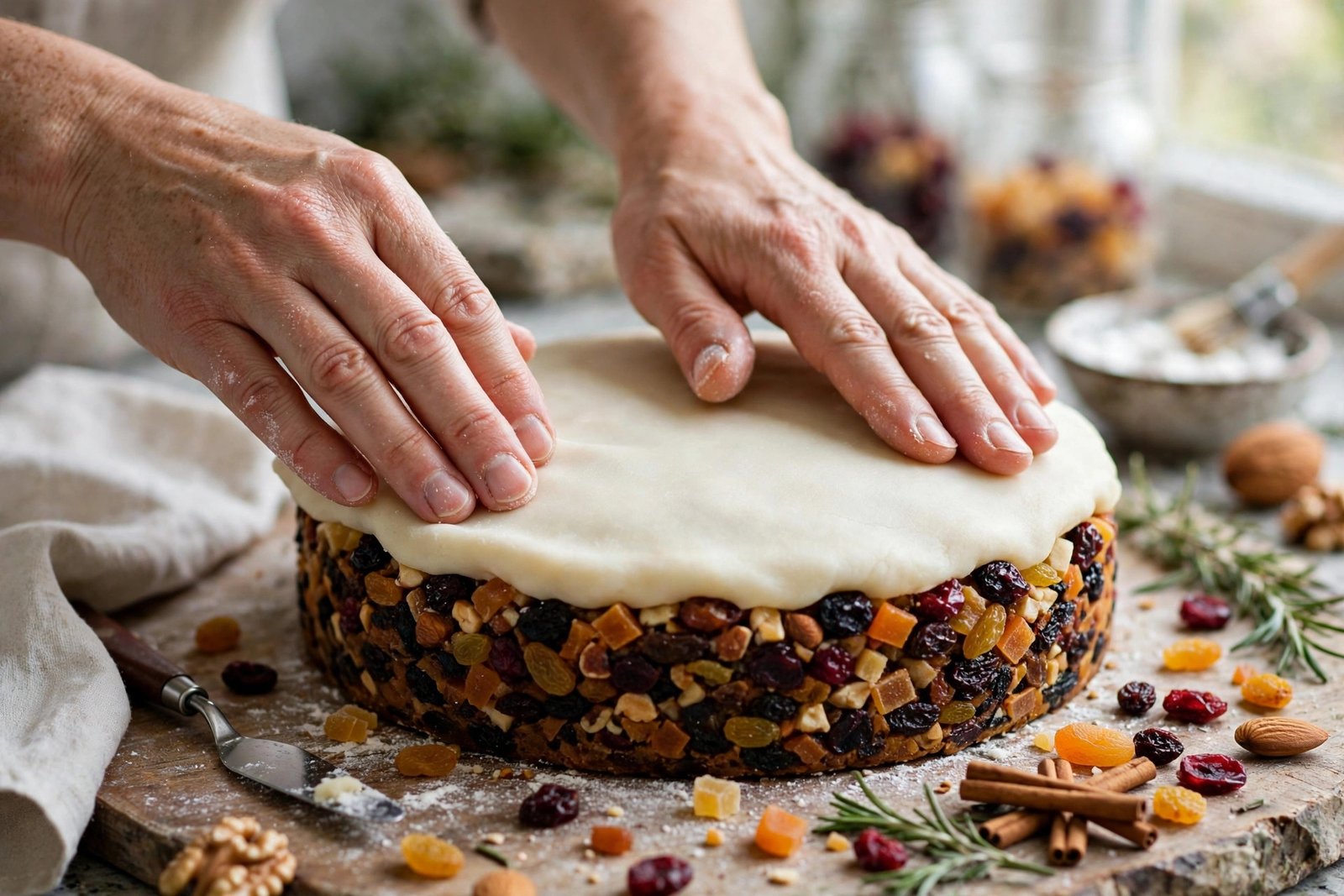
Marzipan first. Brush the cake with warmed apricot jam, then roll out marzipan to about 5 mm thick and drape it over the cake, smoothing it down the sides and trimming the excess at the base. Marzipan seals in moisture and gives the icing a smooth surface. Leave the marzipanned cake to dry for 24 to 48 hours before icing, or the icing will slide.
Royal icing for the classic look. Beat egg whites with icing sugar and a squeeze of lemon juice until the mixture holds stiff peaks, then spread it over the cake with a palette knife, pulling it up into snowy peaks. It sets hard and looks like fresh snow.
Simple glaze for a modern finish. If royal icing feels like too much, brush the marzipanned cake with a thin apricot glaze and decorate with sugared fruit — cranberries and rosemary sprigs rolled in caster sugar look like frost and take ten minutes.
Sugared fruit for the prettiest option. Dip cranberries, rosemary sprigs and bay leaves in lightly beaten egg white, roll them in caster sugar, and leave them to dry for an hour. Arrange them in a cluster on top of the cake with a cinnamon stick or two. It looks expensive, costs almost nothing, and needs no piping skill.
Whichever finish you choose, keep the cake in a cool, dry place once iced — not the fridge, which dries out royal icing and makes marzipan sweat. For step-by-step photos of the marzipan stage, Kitchen Sanctuary’s Christmas cake guide is worth a look.
Storing and Make-Ahead Timeline
A Christmas cake is the most forgiving thing you will bake all year, because it actually improves with time. Baked in November and fed weekly, it peaks at Christmas and keeps well into January. Store it double-wrapped in parchment and foil in an airtight tin, in a cool dark cupboard — never the fridge.
The timeline that works: bake in the second or third week of November, feed weekly through early December, stop feeding a week before Christmas, marzipan and ice in the final week. If you baked late — say early December — feed twice a week for two weeks instead.
Leftover cake keeps for weeks after Christmas, still wrapped in the tin. Slices also freeze well: wrap individual slices in cling film and foil, and defrost at room temperature for a few hours. It is excellent with a slice of sharp cheddar, as the British have insisted for generations.
If you are planning the whole Christmas table, our guide to hosting Christmas dinner covers the timing of everything else, and the cake pairs beautifully with a glass of mulled wine after the meal. For the rest of the baking, try our Christmas cookies and Christmas fudge.
Troubleshooting: What Went Wrong?
My cake is dry. The usual cause is an oven that runs hot, or a bake that went too long. Check your oven temperature with a thermometer — many ovens run 10 to 15 degrees hotter than the dial says. Next time, check the skewer at 2 hours, not 2.5. A dry cake can often be rescued by feeding it more generously for a week.
The fruit sank to the bottom. This happens when the batter is too thin or the fruit is too wet. Toss the fruit in a spoonful of the measured flour before folding it in — the coating helps it stay suspended. Make sure the fruit mixture has cooled properly before you add the eggs.
The top cracked or burnt. A cracked top usually means the oven was too hot at the start. A burnt top means the cake needed foil over it for the last half hour. Neither affects the flavour much — the icing covers a multitude of sins.
My cake tastes of alcohol. You fed it too much, or too recently. Stop feeding a full week before icing, and stick to 1 to 2 tablespoons per feed.
It is too sweet. Cut the sugar by 25 g next time and add an extra squeeze of lemon juice. The treacle adds colour and depth but also sweetness, so a tablespoon less treacle and a tablespoon more orange juice balances it.
Frequently Asked Questions
How far in advance should I make a Christmas cake?
Bake it in November — four to six weeks before Christmas is ideal, with weekly feeding. If you are late, the no-soak recipe can be baked in early December and fed twice a week for two weeks. It will still be good, just not quite as deep in flavour.
How do I know when my Christmas cake is done?
Insert a skewer into the centre after 2 hours. It should come out clean or with just a few moist crumbs. The cake should also feel firm when pressed gently, and the top should be an even dark golden brown. If in doubt, give it another 15 minutes — a fruit cake is hard to overbake at 150°C, and this is the moment in how to make Christmas cake where patience pays off.
Can I make a Christmas cake without alcohol?
Yes. Simmer the fruit in orange juice instead of brandy, and feed with orange juice or cooled black tea. The cake will be just as moist, though it will not keep for quite as long — eat it within two to three weeks of baking, and store it well wrapped.
How long does a Christmas cake keep?
Months, if it is fed with alcohol and stored double-wrapped in an airtight tin in a cool, dark place. An alcohol-free cake keeps two to three weeks. Once iced, keep it cool and dry — never in the fridge.
Conclusion
Knowing how to make Christmas cake comes down to three things: simmer the fruit instead of stressing about an overnight soak, bake it low and slow, and feed it once a week until Christmas. Do those three things and you will have a cake that tastes like it took months — because in a way, it did.
Bake it in November, feed it on Sundays, and ice it the week before Christmas. For a last-minute alternative, BBC Good Food’s last-minute Christmas cake is a solid backup.



