
How to Host Christmas Dinner Without Missing Christmas
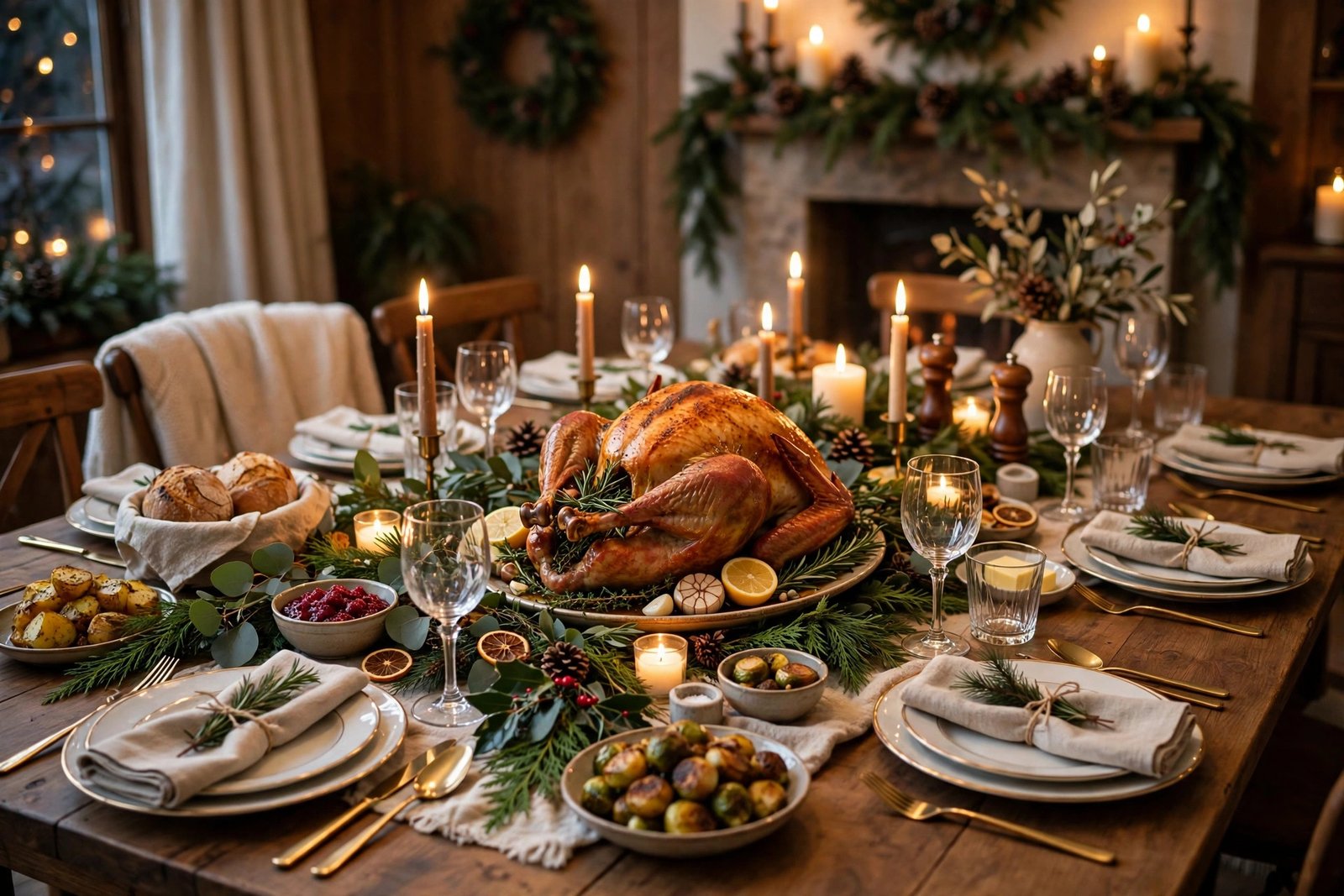
Picture this: it is 6 p.m. on Christmas Day, the turkey is resting, the table is set, and you are sitting down with a glass of something cold. That is the whole point of learning how to host christmas dinner properly — not a perfect meal, but a day you actually enjoy. Too many first-time hosts spend the holiday chained to the stove, emerging only to carve the turkey while everyone else has had the best part of the day.
It does not have to go that way. Christmas dinner is a logistics problem with a festive wrapper, and logistics can be solved in advance. With a four-week plan, a menu that respects your oven, and a firm rule about when the kitchen closes, you can serve a proper roast and still be at the table when the crackers are pulled.
This guide covers the guest list, the menu, the countdown, the day-of timeline, and the food-safety rules. It is written for a first-timer hosting four to fourteen people in an ordinary kitchen with one oven.
How to Host Christmas Dinner: The 4-Week Plan
The biggest mistake new hosts make is treating Christmas dinner as a one-day event. It is a four-week project with a busy final day, and the early work is what buys you a seat at the table. The first step in how to host christmas dinner without panic is to spread the load so no single day carries more than its share.
Start by deciding the shape of the day before you buy a single thing. What time will you eat? A 2 p.m. lunch and a 6 p.m. dinner need completely different cooking schedules. Pick the time, work backwards from it, and write it on the invitation. Then lock the guest list: the headcount decides the turkey size, the chairs, and the potatoes. Ask for dietary requirements now, not on Christmas Eve — one vegetarian and one nut allergy are easy to plan around in November and a nightmare on the day.
| When | What to do |
|---|---|
| 4 weeks out | Lock the guest list and eating time. Ask about allergies. Decide the menu and write the full shopping list. |
| 3 weeks out | Order the turkey. Buy drinks, crackers, napkins, and non-perishables. Check plates, glasses, and chairs. |
| 2 weeks out | Make and freeze desserts, cranberry sauce, and gravy base. Test any recipe you have never cooked. Clear fridge space. |
| 1 week out | Buy dry goods and vegetables that keep well. Set the table if you can. Write the day-of timeline. |
| 2–3 days out | Start thawing the turkey in the fridge. Buy cream, herbs, and salad items. Prep vegetables. |
| Christmas Eve | Prep stuffing, peel potatoes, make the trifle. Lay out serving dishes with labels. Go to bed at a normal hour. |
| Christmas Day | Cook to the timeline, rest the turkey, serve, then close the kitchen. |
Decide the Menu Before You Shop
A good Christmas menu has five parts: the bird, two or three vegetables, potatoes in one form, stuffing, and a sauce or two. That is it. First-timers go wrong by adding a sixth and seventh dish because it feels more generous. It is not — it is more oven space, more pans, more stress, and more food nobody eats.
Pick dishes that can be made ahead or cooked at the same temperature as the turkey. Roast potatoes, stuffing, and pigs in blankets all cook happily around 190–200°C. A dish that needs a different temperature or constant attention will own you on the day. Your menu should be boring in the best sense: familiar, tested, and forgiving.
The two sauces that matter most are cranberry sauce and gravy, and both are better made in advance. A proper homemade cranberry sauce takes twenty minutes and keeps for a week in the fridge. Our guide to making gravy from scratch shows how to build it from the turkey drippings, or make a base ahead and enrich it on the day. The Christmas dinner recipes at BBC Good Food are a solid reference for timings.
The Menu Math: How Much Food Do You Actually Need?
Running out of food is the fear; having three times too much is the reality, because most hosts cook for the guests they imagine rather than the guests they have. If this is your first time learning how to host christmas dinner, use the portions below as your starting point.
The rule of thumb for the turkey is about 1 lb (450 g) of bone-in bird per person. A whole turkey is mostly bone, and this amount leaves a sensible portion plus a little leftover for sandwiches. A 12 lb turkey feeds about twelve people — do not buy a 20 lb bird for eight guests unless you want turkey for a week.
| Dish | Per person | For 8 guests | For 12 guests |
|---|---|---|---|
| Turkey (bone-in) | ~1 lb / 450 g | 8–10 lb bird | 12–14 lb bird |
| Mashed potatoes | 1/2 lb / 225 g | 4 lb potatoes | 6 lb potatoes |
| Stuffing | 1/4–1/2 lb / 115–225 g | 2–3 lb | 3–4 lb |
| Vegetables (total) | 1/2 lb / 225 g | 4 lb mixed | 6 lb mixed |
| Gravy | 1/3 cup / 80 ml | ~3 cups | ~4 cups |
| Cranberry sauce | 2–3 tbsp | 1 1/2 cups | 2 cups |
| Dessert | 1 generous serving | 1 trifle or 1 cake | 1 large trifle + 1 cake |
Pick one potato style — mashed or roast, not both. Two styles mean two pots, two timings, and a second mountain of peeling. If you go mashed, our guide to making mashed potatoes from scratch covers the butter ratio that keeps them fluffy instead of gluey.
For vegetables, two is enough: one green and one sweet. A third is the classic first-timer mistake — colour on the table, chaos on the stove, and half of it comes back uneaten.
The Oven Schedule: One Oven, One Turkey, No Panic
Everything wants the oven at the same time, and there is only one oven. That is the central puzzle of the day, and the answer is sequencing, not speed. The turkey comes out, rests, and the sides go in. Resting is not dead time — it is the most important twenty minutes of the cook, and it is when your roast potatoes get their blast of heat.
Work backwards from the time you want to sit down. If dinner is at 3 p.m., the turkey needs to be out by about 2:30 p.m. so it can rest and be carved. A 12 lb turkey roasted at 325°F (165°C) takes roughly three to three and a half hours, so it goes in around 11 a.m. That leaves the morning free for peeling, stuffing, and setting the table.
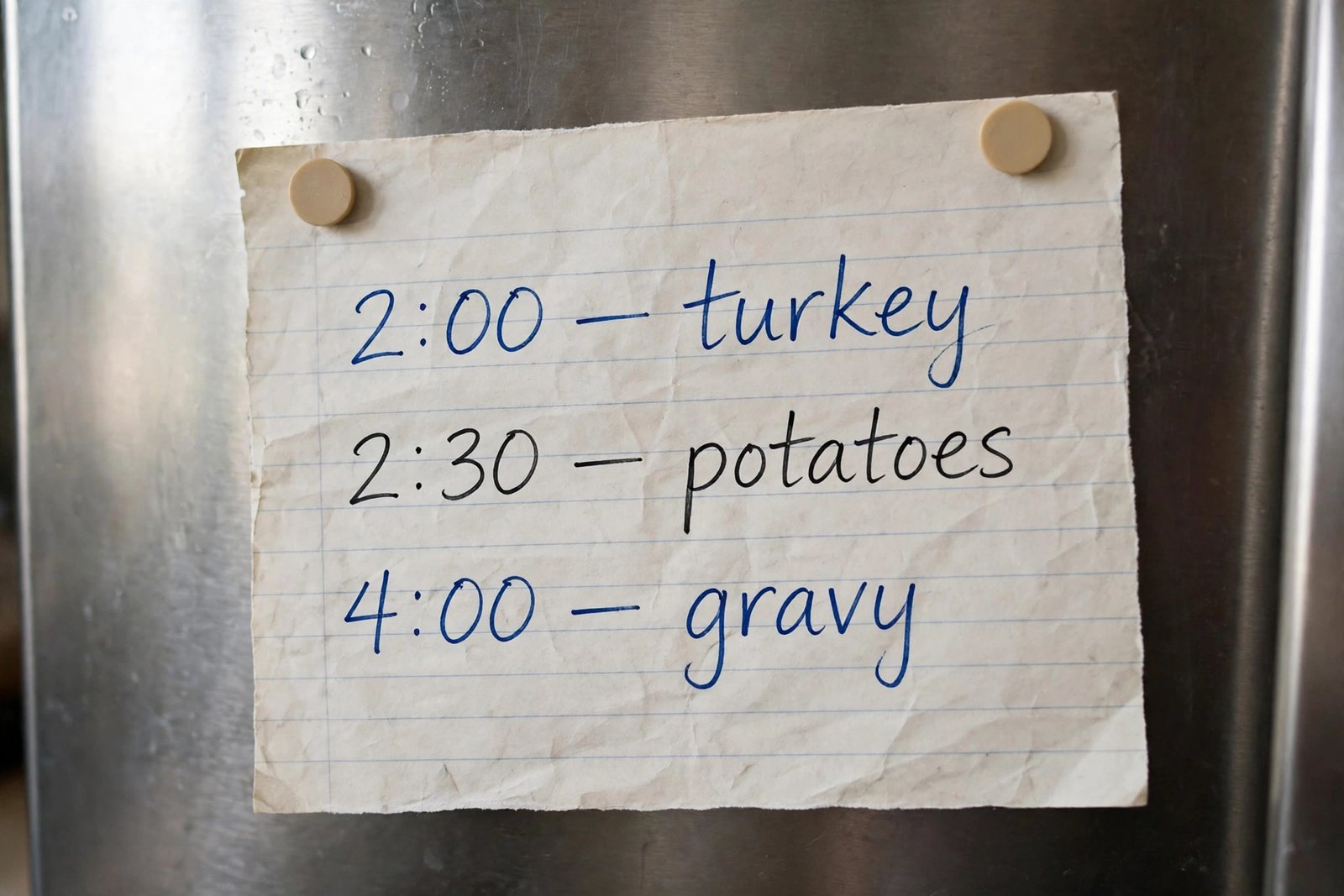
Write your timeline on paper and stick it to the fridge. When the day gets busy, the list does the thinking for you — cross each item off as it happens.
The turkey’s rest is sacred. Carving straight from the oven sends the juices across the board instead of keeping them in the meat. Twenty minutes of rest, loosely tented with foil, gives juicier slices and a free oven — use it to crisp the potatoes, warm the stuffing, and heat the plates, because cold plates steal heat from hot food in minutes. The roast turkey guides at The Spruce Eats are useful for roasting times by bird size.
Food Safety: The Rules That Actually Matter
Nobody remembers a Christmas dinner for its food safety, but everyone remembers the Christmas when half the family was ill on Boxing Day. The rules here are simple, and they come from the U.S. Department of Agriculture’s FoodSafety.gov guidance.
The first rule is the thaw. A frozen turkey must thaw in the fridge, never on the counter — allow about 24 hours for every 4 to 5 pounds, so a 16 lb bird needs four full days. Short on time? Use the cold-water method: submerge the bird in its packaging, change the water every 30 minutes, and allow 30 minutes per pound. Never use hot water.
The second rule is the temperature. Turkey is done when a food thermometer reads 165°F (74°C) in the thickest part of the breast, the innermost part of the thigh, and the innermost part of the wing. Colour and clear juices are not reliable guides — only the thermometer tells the truth. If you stuff the bird, the stuffing in the centre must also reach 165°F, which is why many experts recommend cooking stuffing separately.
The third rule is the two-hour rule: perishable food must not sit out for more than two hours — one hour above 90°F. That includes the turkey, the gravy, and the leftovers on the table while everyone lingers over dessert. Then pack leftovers into shallow containers and refrigerate them; they keep for three to four days. Full details are on the FoodSafety.gov food safety pages.
Part of learning how to host christmas dinner safely is accepting that these rules are not negotiable. A thermometer costs less than a takeaway and is the single most useful tool you will buy for the day. If you own one, check the battery; if not, buy one this week.
Setting the Table and the Mood
Keep the centrepiece low. Tall candles and big arrangements look wonderful in photographs and terrible across a dinner table, because nobody can see the person opposite them. A low runner of greenery, a few tea lights, and some pine cones do the job better. Put a cracker at each place now, not at the last minute.
Music is the cheapest atmosphere you can buy — start a playlist an hour before guests arrive, kept low enough to talk over. Dim the overhead lights and use lamps and candles; the same room looks twice as festive in warm light.
Carving and Serving Without the Ceremony
Carving at the table looks impressive and is almost always a mistake for a first-timer. It is slow, messy, and it puts the host under a spotlight while the food cools. Carve in the kitchen while the potatoes finish: slice the breast, separate the legs and thighs, and arrange it all on a warm platter with a little gravy over the top.
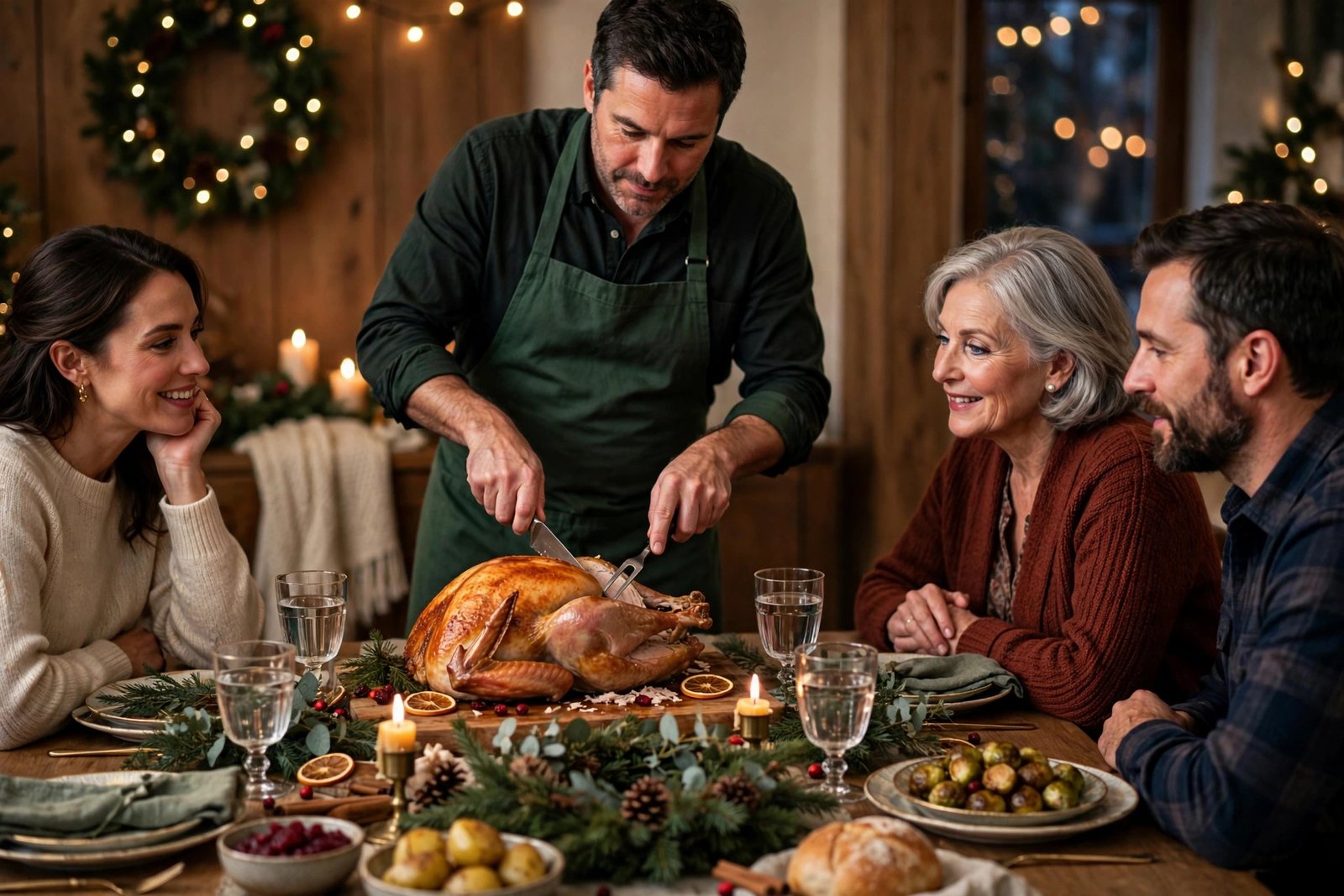
Serve family-style where you can. Put the platters on the table and let people help themselves — it is warmer, faster, and lets everyone take what they actually want.
Drinks deserve a plan too: about one bottle of wine per three adults, plus water, plus something non-alcoholic that is not an afterthought — a jug of spiced apple juice or an alcohol-free sparkling wine. Put the drinks where guests can reach them, and keep water on the table.
Dessert: Make It Ahead or Do Not Make It at All
Dessert is where first-time hosts most often overreach. A pudding that needs steaming, a cake that needs assembling, and a trifle that needs layering — all on the same day, after a full roast — is how hosts end up eating dessert standing in the kitchen. The rule is simple: dessert should be finished before Christmas Day begins, or it should not be on the menu.
A trifle is the ideal make-ahead dessert: layer it on Christmas Eve, chill it overnight, and it is better for the wait. A fruit cake or Yule log can be made days ahead, and a pavlova base can be baked the day before and filled in two minutes. If baking is not your strength, a good bought pudding with homemade brandy butter is perfectly respectable.

The baking guides at King Arthur Baking are a reliable source for make-ahead cakes and trifles if you want tested recipes rather than guesswork. And if you want more ideas for the whole festive table, the holiday recipes at Taste of Home cover everything from starters to the final slice of cake.
The “Kitchen Closes” Rule
Here is the rule that saves the day: pick a time, and when it arrives, the kitchen closes. No more cooking, no more washing up. The dishes can wait until the evening, the leftovers can be packed up later, and you are a guest at your own party now.
Tell your guests help is welcome but not required, and mean it. The kindest thing a guest can do is wash a few plates, and the kindest thing a host can do is accept the help. If someone offers to dry, hand them a tea towel.
Budget matters too: our guide to hosting a dinner party on a budget covers the same principles — plan the menu, buy early, spend on the food rather than the decorations — and they apply just as well at Christmas.
Frequently Asked Questions
How far in advance should I start planning Christmas dinner?
Four weeks is ideal — time to order the turkey, buy the non-perishables, test new recipes, and freeze desserts. Two weeks is the realistic minimum.
What is the hardest part of learning how to host christmas dinner?
The oven schedule. Everything wants the oven at once, and the trick is sequencing: the turkey rests while the sides cook. Write the timeline down and follow it. The cooking is straightforward; the timing is the skill.
How big a turkey do I need?
About 1 lb of bone-in turkey per person: 8–10 lb for eight guests, 12–14 lb for twelve. A bigger bird takes longer to cook and thaw, so do not overshoot by much.
Can I cook the turkey the day before?
You can, but it rarely pays: roast turkey reheats worse than it rests. Cook it on the day and use the resting time for the sides. If you must cook ahead, slice it, store it in gravy, and reheat gently, covered.
What should I do if a guest has a food allergy?
Ask early, cook their dish separately, and label everything. Use a separate pan and clean utensils. The most common Christmas allergens are nuts, gluten, dairy, and shellfish — check your stuffing, gravy, and dessert against each one.
How do I keep food warm while everyone sits down?
Warm the plates, cover dishes with foil, and keep the gravy on low heat. Serve within fifteen minutes of carving. A slow cooker on warm works for gravy and vegetables if the oven is full.
Conclusion
Hosting Christmas dinner is not a performance — it is a plan, a timeline, and a willingness to let some things be simple. Buy the turkey early, thaw it in the fridge, cook it to 165°F, rest it, and get the potatoes in while it rests. Make desserts ahead, set the table the night before, and close the kitchen when the meal is served.
The people at your table will not remember whether the sprouts were perfect. They will remember that you were at the table with them, laughing, pulling crackers, and eating the meal you made. That is the whole point — and it is entirely within reach, even the first time.



