

FAA Ground Stop November 2026: Why Every US Flight Was Grounded for Four Hours

On Friday afternoon, November 13, 2026, the skies over the United States went quiet in a way they had not since September 11, 2001. At 3:54 PM Eastern Time, the Federal Aviation Administration ordered a nationwide ground stop, holding every departing flight on the ground. The FAA Ground Stop November 2026 lasted about four and a half hours, until roughly 8:15 PM, and it left tens of thousands of travelers stranded in terminals nationwide while more than 4,000 planes already in the air were told to keep flying — and, in hundreds of cases, to turn around.
If you were caught in it, or you have a flight booked in the weeks ahead, you probably have two questions: what actually caused it, and could it happen again? The short answers are now clear. The stop was caused by a telecommunications outage during a routine maintenance upgrade, not by a cyberattack or a threat. And the system that failed is, in the words of Transportation Secretary Sean Duffy, “an incredibly old air traffic control system.”
This article lays out what happened hour by hour, the numbers behind the disruption, what it means for Thanksgiving travel, and what you can claim if your flight was cancelled. Every figure below is attributed to the source that reported it, because the figures changed through the evening as outlets reported at different times.
What Happened During the FAA Ground Stop November 2026
Air traffic controllers first noticed instability in their systems at 3:36 PM Eastern Time on Friday, November 13, 2026. Eighteen minutes later, at 3:54 PM, the FAA issued the nationwide ground stop: no commercial flight in the United States was allowed to take off. Planes already airborne were not ordered to land immediately — a ground stop halts departures, it does not clear the sky — but with controllers unable to rely on their usual data, hundreds of those flights were diverted or sent back to where they had started.
For the next four and a half hours, departure boards across the country turned red. The stop was lifted at about 8:15 PM Eastern Time, and flights began moving again that evening, but the damage was done: a backlog of cancelled and delayed flights, crews out of position, and aircraft in the wrong airports rippled into Saturday.
| Time (ET, Friday Nov 13, 2026) | What happened |
|---|---|
| 3:36 PM | Air traffic control instability first noticed |
| 3:54 PM | FAA announces nationwide ground stop |
| ~8:15 PM | Ground stop lifted after about 4.5 hours |
To understand how rare this was, consider the comparison everyone reached for on Friday evening. The only previous nationwide ground stop in American aviation history came on September 11, 2001, when the FAA ordered every aircraft in the country to land after the terrorist attacks. That order was a security response. This one was a systems failure — and the fact that a maintenance job could produce the same nationwide effect as a national emergency is what has made the story so unsettling.
Why the FAA Ordered a Nationwide Ground Stop
The cause, as described by the FAA and the Department of Transportation, was a temporary telecommunications outage that struck during a routine maintenance upgrade carried out by the FAA’s contractor, L3Harris. The work was part of a copper-to-fiber transition — replacing the old copper telephone lines that carry air traffic control data with modern fiber-optic connections.
Transportation Secretary Sean Duffy said the routers involved “got overloaded with data” during the upgrade and began giving controllers inconsistent data. In air traffic control, inconsistent data is not a minor glitch. Controllers need to know exactly where every aircraft is, at what altitude, and where it is heading. When the systems feeding them that picture cannot be trusted, the only safe option is to stop adding planes to the sky — which is what the ground stop did.
Duffy also used the moment to make a broader point about the state of the system, calling it “an incredibly old air traffic control system.” The system has long been criticized as aging infrastructure. The irony of Friday’s failure is the timing: only three days earlier, on November 10, the FAA had expanded its SMART air-traffic system, a modernization effort meant to improve exactly the kind of resilience that failed on Friday. The FAA has not yet published a full account of what went wrong, and it may be weeks before the investigation is complete; travelers can watch for updates on the agency’s website at faa.gov.
Was the Ground Stop Caused by a Cyberattack?
Within minutes of the ground stop, the obvious question on social media and in newsrooms was whether someone had attacked the system. The answer from every official source so far is no. Department of Homeland Security Secretary Markwayne Mullin said there was no indication of a threat or deliberate attack. The FBI said it does not believe the outage was a cyberattack.
A cyberattack on air traffic control would be a national security event with a very different response. The alternative explanation is in some ways more worrying: nobody attacked the system. A contractor’s routine maintenance job did it. The failure was internal, not external, which puts the focus squarely on how the FAA and its contractors test upgrades to critical infrastructure.
The official statements are framed carefully — “no indication” and “does not believe” — which is standard language while an investigation is still running. Reuters reported the outage and the official response on November 13, and Scientific American covered the story the same day, updating its reporting on November 14.
The Numbers: Flights in the Air, Diversions, and Cancellations
The scale of the disruption is best understood through the numbers reported through Friday evening and into Saturday — with one important warning. Different outlets reported different totals because they measured at different times, as the situation was still unfolding. None of the numbers below should be read as a final total; each is attributed to its source and its moment.
When the ground stop was issued at 3:54 PM, there were 4,042 flights airborne over the United States, according to Flightradar24. Those planes had to go somewhere. According to aviation data firm Cirium, 827 flights were diverted, including 670 that returned to their airport of origin — a costly outcome for airlines and passengers alike, since a returned flight has to be re-crewed, re-fueled, and re-slotted.
On cancellations, the picture grew worse through the evening. FlightAware, the flight-tracking service, reported at the time that more than 1,000 flights had been cancelled and nearly 10,000 delayed. By Friday evening, ABC News, cited by Canadian Travel News, reported nearly 5,000 cancellations. The following day, Saturday, November 14, about 2,000 more flights were cancelled, according to the same reporting — the ripple effect of crews and aircraft being out of place after the stop was lifted.
Those figures explain why the disruption felt so much bigger than a four-and-a-half-hour stop. A ground stop is not a pause button. Every cancelled flight leaves passengers to rebook, crews to reassign, and planes to reposition. For live flight status, FlightAware is one of the most useful tools for travelers checking whether their own flight is affected.
What Happened to Passengers on the Ground
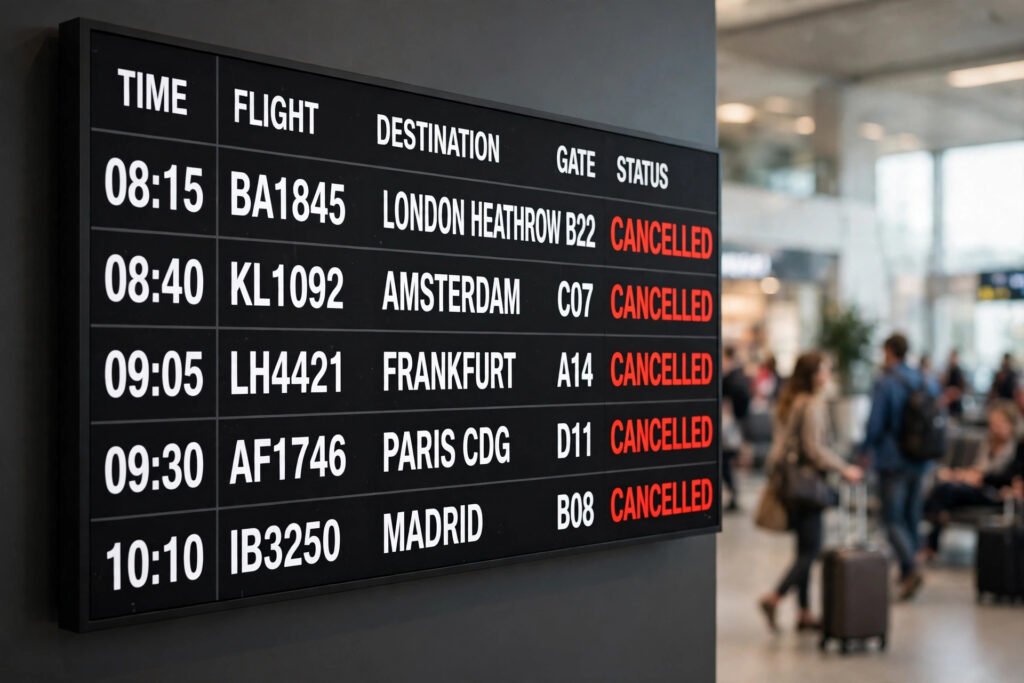
For the travelers stuck in terminals, the ground stop played out as a long, confusing wait. Departure boards flipped to “cancelled” or “delayed” with little explanation at first. Gate agents, who rely on the same FAA systems, often had no more information than the passengers. Some travelers watched their planes sit at the gate, fully boarded, for hours before being told the flight was off. Others, already in the air, landed somewhere they had never intended to visit.
The experience was uneven. Passengers on major airlines with large networks generally had more rebooking options, because those carriers could move people onto later flights or through different hubs. Travelers on smaller carriers, or on the last flight of the day to a small airport, often had no same-day option at all. The people who got home fastest were usually the ones who acted earliest. Rebooking through an airline’s app or website, rather than joining the queue at the gate, saved hours.
Your Rights When a Flight Is Cancelled
If your flight was cancelled because of the ground stop, the rules are on your side — but only if you know them and ask for what you are owed. The U.S. Department of Transportation requires airlines to give you a full refund if they cancel your flight and you choose not to travel on the rebooked alternative. That applies even for non-refundable tickets. The U.S. Department of Transportation publishes the full rules on its website, and it is worth reading them before you accept a voucher you do not want.
Start by deciding what you actually need. If you still need to get to your destination, ask the airline to rebook you on the next available flight, including on a partner airline if that gets you there sooner. Airlines are not required to rebook you on a competitor, but they often will if you ask firmly and politely, especially during a mass disruption when their own flights are full. If you no longer need to travel, request the refund instead of a travel credit — a credit is the airline’s preferred outcome, not yours.
Keep every receipt. Meals, hotels, and ground transport you pay for during a disruption are not automatically reimbursed by the airline, but many carriers will cover reasonable expenses during a mass cancellation if you submit a claim, and your travel insurance may cover the rest. The best travel insurance for a trip covers trip interruption and delay, and the difference between a policy that pays and one that does not is usually in the fine print. The TSA also has guidance on what to expect at the airport during disruptions.
What the Ground Stop Means for Thanksgiving Travel
The timing of the outage could hardly be worse for the calendar. Thanksgiving falls on Thursday, November 26, 2026, and the days around it are the busiest travel period of the year in the United States. Millions of people will fly in the week of the holiday, and the memory of a nationwide ground stop two weeks earlier is fresh in everyone’s mind.
The reassuring news is that the FAA head has said airlines should be back to a normal schedule by the end of the weekend after the outage, and there is no indication that the ground stop will have any direct effect on Thanksgiving flights. The outage was a one-off failure during a specific maintenance job, not a recurring problem. But the episode has made one thing clear: the system has a single point of failure that a routine upgrade was able to trigger.

If you are flying for Thanksgiving, the practical advice is the same as it always is, only more so. Book the earliest flight of the day — the first departures are the least likely to be affected by cascading delays. Build in a buffer: fly the day before the day you actually need to be there, not the morning of the holiday. And pack for the possibility of a delay, not just the trip you planned: a charged phone, snacks, and a change of clothes in your carry-on turn a miserable night in an airport into an inconvenience. Our guide on how to pack for a winter trip covers the carry-on essentials that matter most when a delay stretches into hours.
It is also worth thinking about what you pack in, not just what you pack. A good carry-on and a well-organized personal item make a long airport wait far more bearable, and our roundup of the best travel backpack picks for 2026 covers bags designed for exactly that kind of trip. And our guide on how to find cheap flights can help you book the next trip for less.
Frequently Asked Questions
How long did the FAA ground stop last in November 2026?
The FAA Ground Stop November 2026 lasted about four and a half hours. It was announced at 3:54 PM Eastern Time on Friday, November 13, 2026, and lifted at about 8:15 PM the same evening.
Was the ground stop a cyberattack?
No, according to the officials investigating it. DHS Secretary Markwayne Mullin said there was no indication of a threat or deliberate attack, and the FBI said it does not believe the outage was a cyberattack. The cause was a telecommunications outage during a routine maintenance upgrade by FAA contractor L3Harris.
Why did the FAA ground all flights instead of just slowing them down?
Controllers rely on accurate data about every aircraft’s position and altitude. When the routers overloaded and began giving inconsistent data during the upgrade, the FAA could not trust the picture controllers were seeing. A ground stop — halting departures — was the safe option until the data feed was reliable again.
How many flights were cancelled because of the ground stop?
The totals depend on when they were counted. FlightAware reported more than 1,000 cancellations and nearly 10,000 delays at the time, while ABC News reported nearly 5,000 cancellations by Friday evening and about 2,000 more on Saturday, November 14. Cirium reported 827 diversions, including 670 flights that returned to their airport of origin.
Can I get a refund if my flight was cancelled?
Yes. The U.S. Department of Transportation requires airlines to give a full refund if they cancel your flight and you choose not to travel on the rebooked alternative, even for non-refundable tickets. Ask for the refund rather than a travel credit if you no longer need to travel.
Will the ground stop affect Thanksgiving travel?
There is no indication it will. The FAA head said airlines would be back to a normal schedule by the end of the weekend after the outage, and the cause was a specific maintenance failure, not a recurring problem. For Thanksgiving, book early flights and build in a buffer day if you can.
Conclusion
The FAA Ground Stop November 2026 was a four-and-a-half-hour failure that grounded every departing flight in the United States, diverted hundreds of planes, and cancelled thousands of flights — and it was caused by a routine maintenance job, not an attack. That is the fact that should stay with you. A contractor’s copper-to-fiber upgrade overloaded routers, the data controllers depend on became unreliable, and the FAA did the only safe thing it could: stop departures until the system could be trusted again.
For travelers, the lesson is practical rather than political. Know your refund rights before you fly, keep your receipts, rebook through the app before you join the queue, and build buffer time into important trips. The system is running again. Whether it is fixed is a question the FAA’s investigation still has to answer.



