

Every baker reaches the same fork in the road sooner or later: the hand mixer vs stand mixer question. You are standing in a kitchen shop, or scrolling late at night, looking at a compact tool that costs less than a weekly shop and a heavy machine that costs as much as a small appliance — and wondering whether the big one is really worth it. The honest answer is that neither mixer is better in every kitchen. The right one depends on what you bake, how often you bake it, and how much counter and cupboard space you are willing to give up. This guide compares the two using the facts that actually decide the purchase: power, batch size, the jobs each one handles well, attachments, cost, and storage.
Hand Mixer vs Stand Mixer at a Glance
If you only have thirty seconds, here is the short version. A hand mixer is a small, light tool you hold over a bowl. It suits smaller, lighter batches and quick jobs. A stand mixer is a heavy machine that sits on the counter and mixes on its own. It suits large quantities, heavy dough, long mixing sessions, and hands-free work. That single difference — held in your hand versus standing on its own — explains almost everything else, from price to power to the recipes each one wins.
| Feature | Hand Mixer | Stand Mixer |
|---|---|---|
| How it works | Handheld; you hold and move it around the bowl | Stands on the counter; attachment moves around a stationary bowl (planetary action) |
| Best batch size | Small to medium; one or two egg whites, a small bowl of cream | Medium to large; bowl capacities up to 7 quarts |
| Power | Typically 60 to 400+ watts | Larger, more powerful motors built for long, heavy mixing |
| Speeds | Typically 5 to 9 speeds | Typically 10 speeds |
| Hands-free? | No — you hold it throughout | Yes — it runs on its own while you add ingredients or prep |
| Heavy dough | Not recommended for frequent bread kneading | Built for bread dough and long kneading |
| Attachments | Beaters, whisk, sometimes dough hooks | Paddle, whisk, dough hook, plus pasta, meat grinder and more |
| Typical price | Generally $25 to $100 | Generally $250 to $500+ |
| Storage | Fits in a drawer or small cupboard | Needs permanent counter space or a large cupboard |
What Is a Hand Mixer?
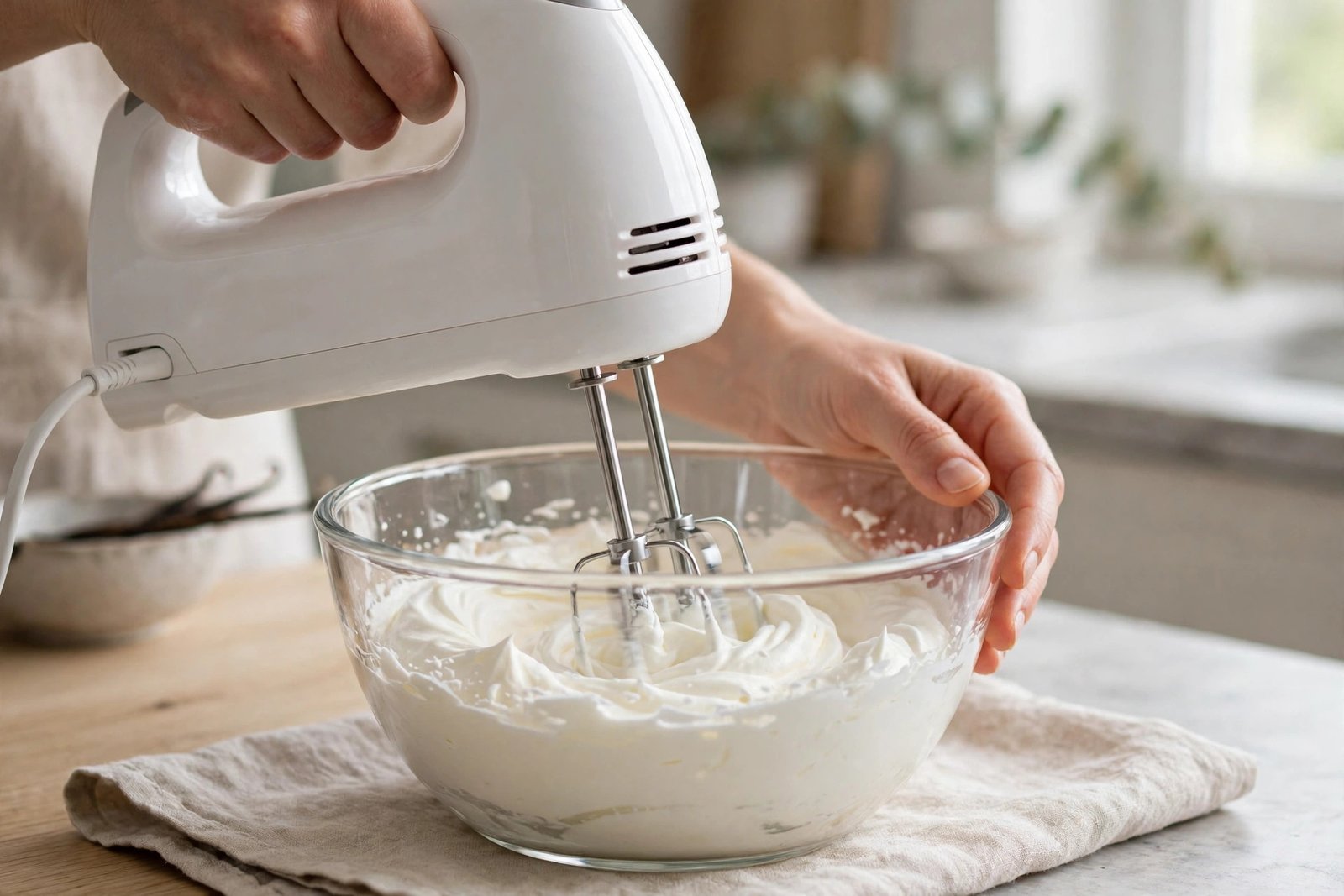
A hand mixer is exactly what it sounds like: a compact electric mixer you grip in one hand and lower into a bowl. Two beaters spin, you guide them around the mixture, and when the job is done you lift the mixer out, eject the beaters, and wash them. Most models weigh only a couple of pounds, and the whole tool — mixer plus beaters — fits in a kitchen drawer.
Hand mixers typically run from 60 to 400+ watts and offer 5 to 9 speeds. That range is wide: a cheap basic model will whip cream and stir cake batter, while a stronger model at the top end will power through thicker cookie dough without slowing down. The lowest speed folds in dry ingredients without sending flour across the kitchen; the highest whips egg whites to stiff peaks.
The appeal is convenience. There is nothing to assemble, nothing heavy to lift out of a cupboard, and cleanup takes about a minute. For someone who bakes once or twice a month — a birthday cake, a tray of brownies, a bowl of mashed potatoes — a hand mixer does the job and then disappears. It is also the better tool when the quantity is small: a little cream in a narrow bowl is easier to reach with a hand mixer you can tilt and angle than with a large stand mixer bowl that the whisk barely touches.
What Is a Stand Mixer?
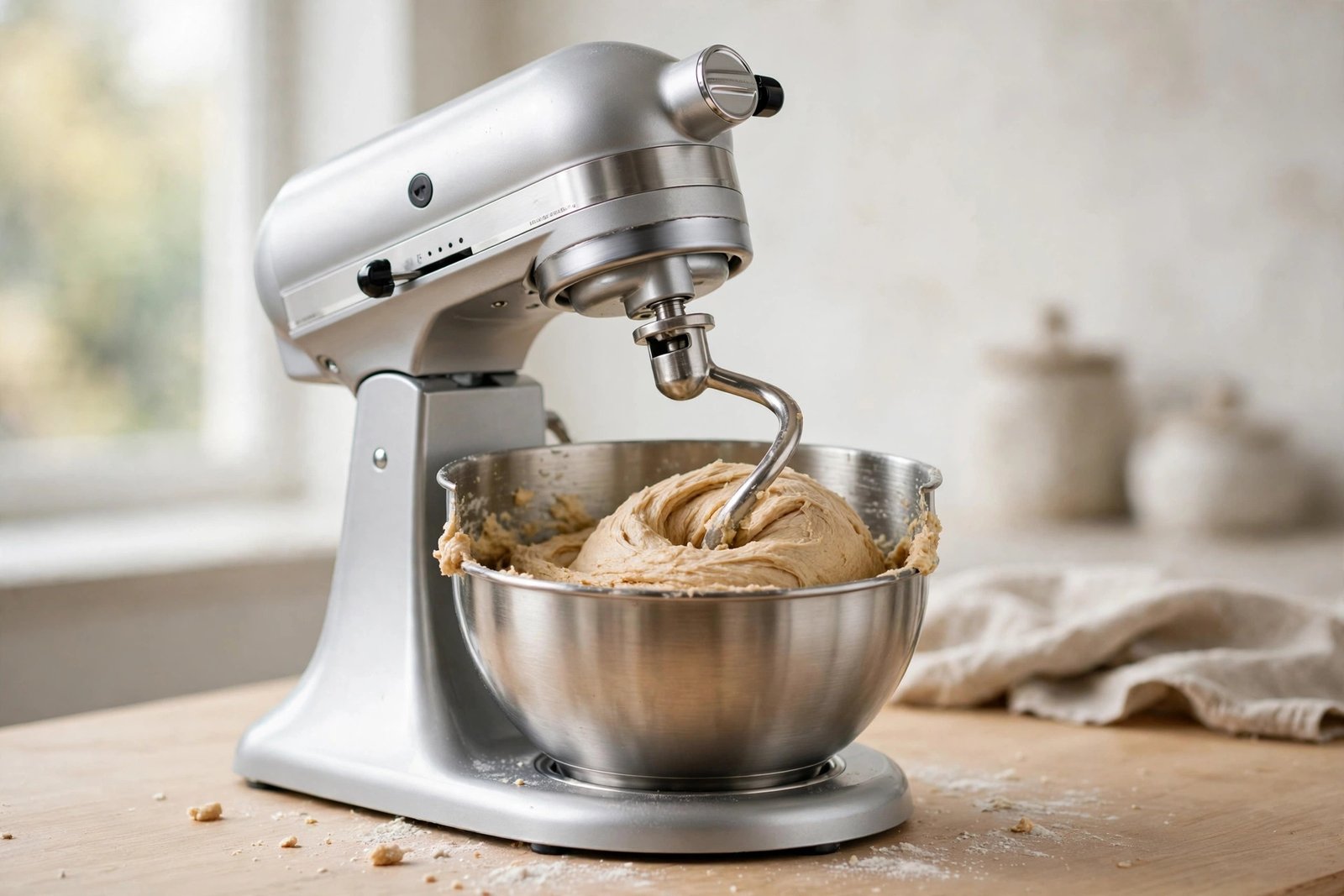
A stand mixer is a different kind of machine. The motor sits in a head mounted on a heavy stand, a bowl locks in underneath, and the attachment — paddle, whisk, or dough hook — rotates while also travelling around the bowl. That movement is called planetary action: the attachment spins on its own axis while orbiting the stationary bowl, so it reaches ingredients at the edges instead of only the centre. It is the reason a stand mixer can mix a thick dough evenly without you scraping the bowl every thirty seconds.
Stand mixers typically offer 10 speeds and bowl capacities up to 7 quarts, which is enough for dozens of cookies or several loaves of bread in a single batch. The motors are bigger and more powerful than a hand mixer’s, and they are built to keep turning through dense dough and long mixing times without overheating. That stamina is the real point: a stand mixer does not just mix faster, it mixes longer, under load, without tiring — because it has no arm to tire.
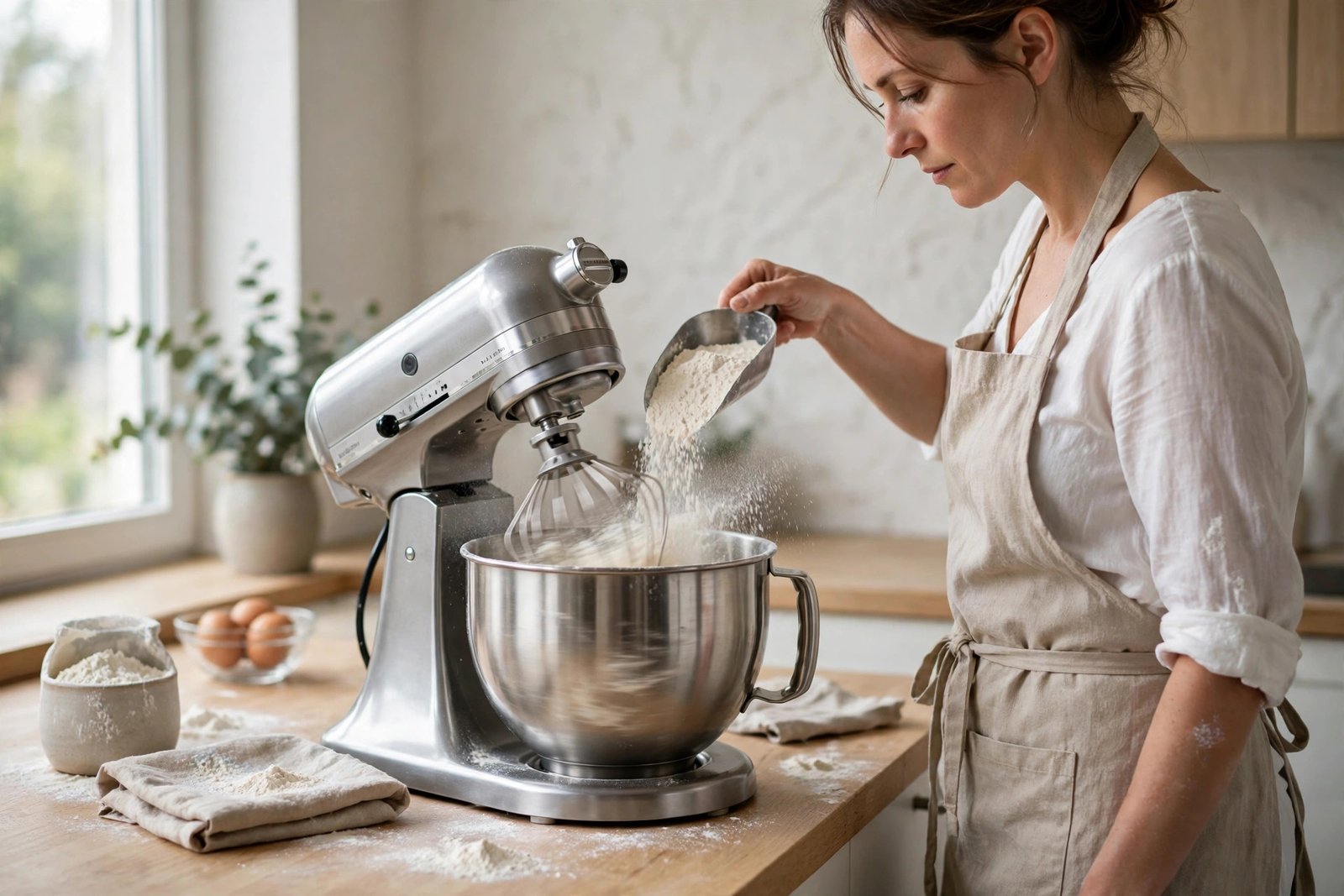
The other defining feature is hands-free operation. Once the mixer is running, your hands are free. You can add flour a spoonful at a time, pour in a slow stream of oil, grease a baking tin, or simply watch the dough come together and judge when it is ready. For recipes that need ingredients added during whipping — a buttercream that takes butter piece by piece, a meringue that needs sugar sprinkled in gradually — that freedom turns a juggling act into a calm, controlled process.
Batch Size and Heavy Dough
Batch size is where the two mixers separate most clearly. A hand mixer suits smaller, lighter batches: a single cake, a bowl of frosting, a small batch of cookies. It works in almost any bowl, including the saucepan you just melted butter in. Whipping one or two egg whites is a hand mixer job — the beaters can reach a small amount of liquid in a narrow bowl, where a stand mixer whisk might spin above it and barely touch it.
A stand mixer, by contrast, is built for scale. Large cookie batches, double cake recipes, bread dough for the week — these are the jobs it exists for. With bowl capacities up to 7 quarts, it can hold a triple batch of dough without the mixture climbing over the beaters, and its weight keeps it planted on the counter while the dough pulls and drags.
Bread is the clearest dividing line. A stand mixer with a dough hook can knead bread dough for eight or ten minutes while you do something else. A hand mixer, even one that comes with dough hooks, is not built for that. Consumer Reports notes hand mixers are best at light-duty jobs like whipping cream, and stiff, low-hydration dough is exactly the kind of sustained resistance their motors are not designed for. If you bake bread every week, that advice alone settles the question.
Tasks Each Mixer Wins
The fairest way to choose is task by task, because most bakers do not bake one thing.
Jobs where the hand mixer wins
Whipping a small quantity of cream for two servings of dessert. Beating one or two egg whites for a meringue topping. Making frosting for a dozen cupcakes. Mixing pancake batter on a weekday morning. Mashing potatoes in the pot they cooked in. In each case the job is small, quick, and light — and the hand mixer is already in the drawer, ready in seconds, with almost no cleanup. The stand mixer could do most of these too, but hauling a heavy machine onto the counter, locking in a large bowl, and washing that bowl afterwards turns a two-minute job into a ten-minute one.
Jobs where the stand mixer wins
Kneading bread dough. Making a large batch of cookie dough that would strain a hand mixer. Whipping a big bowl of cream for a party. Creaming butter and sugar for several minutes until pale and fluffy. Any recipe that needs ingredients added while the mixer runs — King Arthur Baking explains why a stand mixer makes pie crust easier, because the mixer works the butter into the flour while your hands stay free to prep the next step. Cake batter, brownie batter, and a standard batch of cookies sit comfortably in either machine, so if those are most of your baking, buy on price, space, and how much you enjoy the process — not on performance.
Attachments: A Mixer or a Kitchen System?
A hand mixer comes with beaters and usually a whisk; some models add dough hooks. That is the whole kit, and it covers mixing, beating, and whipping. It is a focused tool, and its focus is its charm.
A stand mixer starts with three attachments — a flat paddle for batters and doughs, a wire whisk for cream and egg whites, and a dough hook for bread — and then keeps going. The power hub on the front accepts attachments that turn the machine into something else: a pasta roller and cutter, a meat grinder, a vegetable spiralizer, a grain mill, an ice cream maker. KitchenAid’s guide to choosing between the two makes this versatility one of the stand mixer’s main advantages, and it is a fair point — but only if you will actually use those attachments. A pasta attachment still in its box after two years is not versatility, it is clutter. Buy the stand mixer for mixing; treat the attachments as a pleasant surprise later.
Cost, Storage, and Cleanup
Price is the most visible difference. Hand mixers generally cost $25 to $100, with the best-known brands sitting in the middle of that range. Stand mixers generally cost $250 to $500 or more, with premium models and larger bowls pushing higher. That is a five-to-ten-times price gap, and it is the reason most kitchens start with a hand mixer.
Storage is the hidden cost. A hand mixer and its beaters fit in a drawer. A stand mixer weighs as much as a small dog and needs either a permanent spot on the counter or a strong shelf and a willingness to lift it out every time. If your kitchen is small, or your counters are already crowded, that matters more than any specification. A mixer you cannot be bothered to lift out is a mixer you will not use. Cleanup, by contrast, is close to a tie: hand mixer beaters rinse in seconds, while stand mixer bowls and attachments are larger but often dishwasher-safe.
Who Should Buy Which?
Buy a hand mixer if you bake occasionally, mostly in small batches, and want something cheap, light, and easy to store. It is the right choice for a first mixer, a small kitchen, a tight budget, or a baker whose recipes are mostly cakes, frosting, cream, and egg whites. It is also the right second mixer for a stand mixer owner who is tired of washing a seven-quart bowl to whip half a cup of cream.
Buy a stand mixer if you bake at least weekly, make bread or large batches, or want to mix hands-free while you prep the rest of the recipe. It is the right choice for a serious home baker, a family that bakes in bulk, or anyone whose arm aches after five minutes of holding a mixer over stiff dough. If you already know you will use it every week, the price stops being a gamble and becomes an investment.
If you are still torn, consider the sequence most bakers actually follow: start with a hand mixer, learn what you bake most, and upgrade to a stand mixer when you can name the specific jobs the hand mixer struggles with. If you want to compare other kitchen appliances first, our blender vs food processor guide follows the same approach, and the slow cooker vs Instant Pot comparison is useful if you are choosing between two appliances that do similar jobs in very different ways. For quieter mornings, how to make cold brew coffee at home pairs well with whatever you bake next.
Frequently Asked Questions
Can a hand mixer knead bread dough?
It can manage a soft, small dough once in a while, especially if the model includes dough hooks. But it is not built for frequent kneading, and stiff, low-hydration dough will strain the motor and your arm. For regular bread baking, a stand mixer with a dough hook is the better tool.
Is a stand mixer worth it if I only bake occasionally?
Probably not. A stand mixer earns its price through frequent, heavy use. If you bake once a month or less, a good hand mixer will handle your recipes for a fraction of the cost and storage space. Spend the difference on better ingredients instead.
Can a stand mixer whip a small amount of cream?
Sometimes, but not always well. A whisk in a large bowl can spin above a small quantity of cream without reaching it. Some bakers adjust the bowl height or use a smaller bowl; others keep a hand mixer for small jobs. This is one of the few tasks where the cheaper tool genuinely works better.
In the hand mixer vs stand mixer debate, can I own both?
Yes — and many keen bakers do. The hand mixer handles quick, small jobs; the stand mixer handles big batches, dough, and long mixing. If you have the space and the budget, owning both means you always reach for the right tool instead of forcing one mixer to do everything.
How do I choose a hand mixer?
Look for a comfortable grip, a genuine slow speed, easy beater release, and enough watts for your thickest batter — models typically range from 60 to 400+ watts. KitchenAid’s hand mixer buying guide is a useful checklist for comparing speeds, weight, and attachments before you buy.
How long does a stand mixer last?
With normal home use, a well-made stand mixer can last decades. The heavy base, metal gears, and simple design are built for longevity, which is part of why the higher price can make sense for a regular baker. Keep it clean, do not overload the bowl, and use the right speed for dough.
Conclusion
The hand mixer vs stand mixer choice is not really about which mixer is better. It is about which baker you are. If your baking is occasional, small-batch, and light, the hand mixer is the smarter buy: cheap, quick, and always within reach. If your baking is frequent, large-batch, or heavy on bread and dough, the stand mixer is the tool that will change how you bake — hands-free, steady, and built to keep going long after your arm would have given up.



