
How Much Should You Spend on Christmas Gifts? The Honest 2026 Guide

Every December, the same question lands in millions of households: how much should you spend on Christmas gifts without wrecking January? There is no single right number, and anyone who gives you one is guessing. The honest answer depends on your income, your list, and how much debt you are willing to carry into the new year.
This guide gives you real numbers instead of vibes: what Americans actually plan to spend this year, sensible ranges for each person on your list, a simple rule for setting your total, and the hidden costs that quietly blow up most gift budgets.
The Short Answer: Start With Your Income, Not the Average
If you want one number to work from, here it is: most households can spend about 1.5% of their annual take-home pay on Christmas gifts without stress. On $60,000 take-home, that is $900. On $40,000, $600. On $100,000, $1,500.
That is a ceiling, not a target. Plenty of families spend far less and have a better Christmas for it. The point of the rule is that it scales with what you actually earn, which is exactly what national averages do not do.
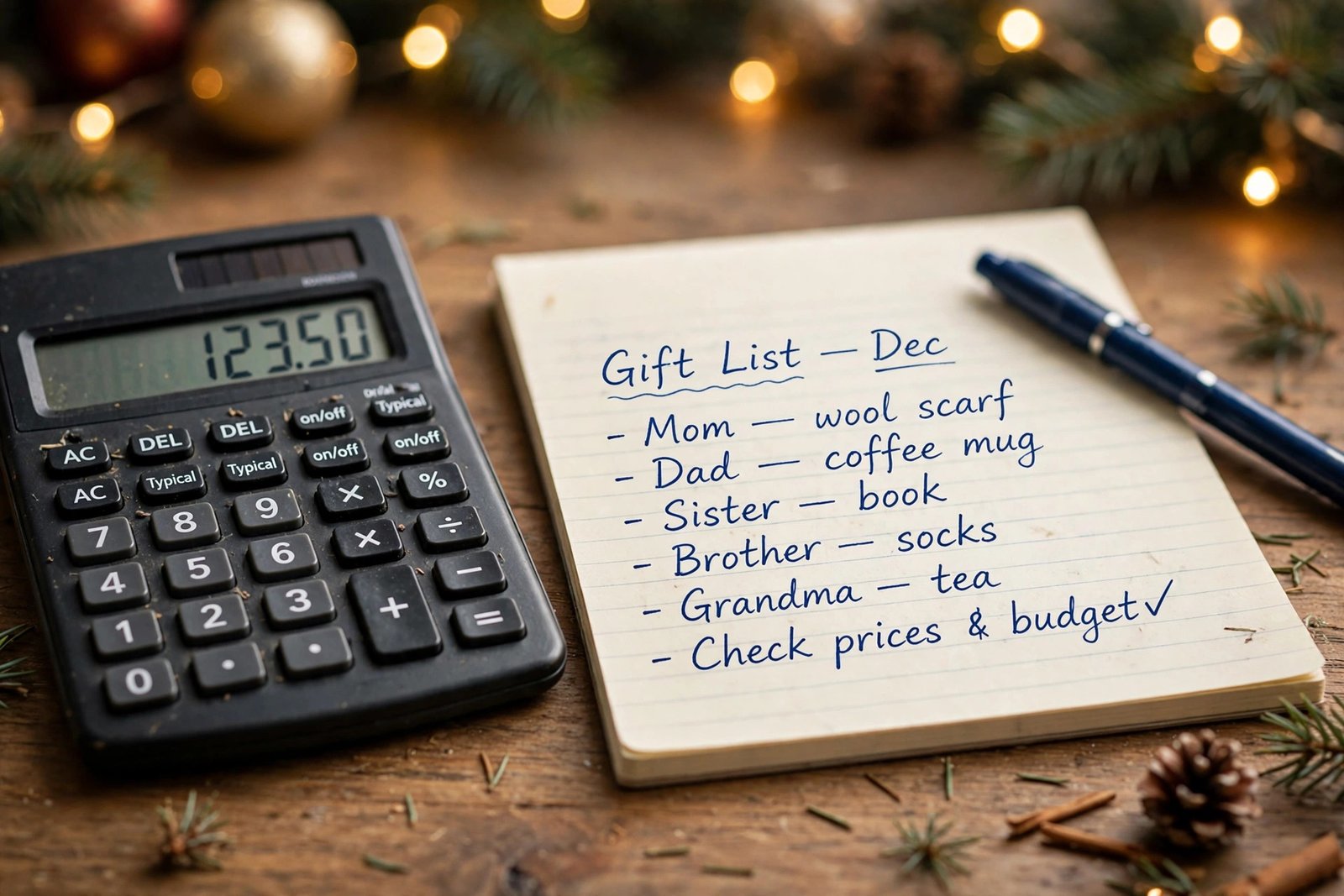
Before you spend a dollar, do two things. First, list every person you are buying for — including the ones you always forget until December 23, like the dog walker and your kid’s teacher. Second, decide your total before you decide any single gift. That total is your answer to how much should you spend on Christmas gifts this year.
What Americans Actually Spend on Christmas Gifts in 2026
The big surveys disagree with each other, and that is useful information. They disagree because they measure different things — gifts only, gifts plus the whole season, per person, per household. Read the third column before you compare the numbers.
Gallup’s October 2026 poll found that Americans expect to spend an average of $1,011 on Christmas gifts — about the same as the $1,007 they expected in October 2025. But the median tells a different story: half of adults plan to spend $500 or less. Averages get pulled up by the 36% of adults who expect to spend $1,000 or more. If your number is closer to $500 than $1,011, you are in the majority, not behind it.
NerdWallet’s 2026 Holiday Spending Report puts the average planned gift spend lower, at $879 among people who plan to buy gifts — down 21% from $1,107 in 2025. The same survey found holiday spenders expect to spend $2,525 in total once travel, parties, and food are included. That gap between gifts and everything else is the whole story of this article.
The National Retail Federation’s 2025 holiday survey found consumers planned to spend $890.49 per person across the season: $627.93 on gifts and $262.56 on food, decorations, and greeting cards. That was the second-highest figure in the survey’s 23-year history, just below 2024’s record of $901.99.
Deloitte’s 2026 Holiday Retail Survey puts the average household at $1,654 for the whole season — $988 on retail goods and $666 on travel, events, and entertaining. The income split is stark: households earning under $50,000 expect to spend $693, while households earning $200,000 or more expect to spend $3,607. Same holiday, five times the budget.
| Survey | Figure | What it actually covers |
|---|---|---|
| Gallup, Oct 2026 | $1,011 | Gifts only, per adult; median is $500 |
| NerdWallet, Sept 2026 | $879 | Gifts only, per gift buyer; down 21% from 2025 |
| NRF, Oct 2025 | $628 gifts / $890 total | Gifts plus $263 of food, decorations, and cards, per person |
| Deloitte, 2026 | $1,654 | Whole season per household, including travel and events |
The takeaway is simple. If someone quotes you one of these numbers as “what you should spend,” ask what it counts. A gifts-only figure and a whole-season household figure are not the same budget.

How Much Should You Spend on Christmas Gifts Per Person?
Totals are abstract. Per-person ranges are where a budget actually lives or dies. The ranges below are starting points you adjust for your income and your relationships — not rules carved in stone.
| Who | Usual range | Good to know |
|---|---|---|
| Your children | $50–$150 each | Kids remember the experience, not the price tag; one wanted gift beats three filler ones |
| Partner or spouse | $50–$150 | Agree a cap together — mismatched spending is the most common December argument |
| Parents | $25–$75 each | Experiences and practical help often land better than objects |
| Close friends | $25–$75 | A spending cap agreed in advance removes the awkward escalation |
| Siblings and in-laws | $25–$50 | Secret Santa or a draw keeps big families affordable |
| Coworkers | $10–$25 | Keep it modest and even — nobody wants to be the office big spender |
| Teachers, coaches, service people | $10–$25 | Check the rules first: some recipients legally cannot accept more |
| Extended family and acquaintances | $10–$25 | A card and something small is plenty; presence beats presents |
Do the math on your own list before you shop. Ten people at an average of $50 is $500. Add two kids at $100 each and a partner at $100, and you are at $800 before you have bought a single roll of wrapping paper.
For parents, the hardest category is usually your own kids. If you want ideas that fit a budget rather than break it, our guide to the best gifts for mom in 2026 focuses on thoughtful picks at every price point — and the same thinking applies to everyone on your list.

The 1.5% Rule: The Only Formula You Need
Here is how much should you spend on Christmas gifts if you want a formula instead of a feeling. Take your annual take-home pay — what actually lands in your bank account after tax — and multiply by 1.5%. That is your gift budget.
On $50,000 take-home, that is $750. On $80,000, it is $1,200. On $30,000, it is $450, and that is a perfectly respectable Christmas. The formula works because it ties spending to reality, not to what your neighbors spend or what the ads say.
If 1.5% feels impossibly low for the list you have, the answer is not to raise the percentage. It is to shrink the list. Draw names with extended family. Set a $25 cap with friends. Give your parents an experience instead of an object.
And if you are carrying credit card debt into December, the honest number is lower still — possibly zero for anyone outside your immediate family. A gift bought with borrowed money at 20% interest costs a quarter more by the time you pay it off.
The Hidden Costs That Blow Up Gift Budgets
Gifts are only about 70% of what December costs, and that is the part of the answer to how much should you spend on Christmas gifts that most people miss. The NRF’s own split makes this plain: of the $890 per person it measured, $263 went to food, decorations, and cards — not gifts. Deloitte’s $1,654 household figure includes $666 of travel, events, and entertaining.
Postage and shipping. Mailing gifts across the country can add $10–$20 per parcel. Ship early, use flat-rate boxes, or send a gift card and a video call instead.
Wrapping, cards, and gift bags. A roll of decent paper, tape, ribbon, and ten cards easily runs $30–$50. Buy it in January on clearance, or switch to reusable bags and brown kraft paper, which looks better anyway.
The “one more thing” trap. The small add-ons — the stocking fillers, the extra box of chocolates, the gift for the neighbor you forgot — are where budgets quietly die. Give them their own line in the budget, even if it is only $50. Our roundup of the best stocking stuffers for 2026 keeps those small gifts cheap on purpose.
Add a 10% buffer to your total for all of this. If your gift budget is $800, plan for $880.
The 4-Gift Rule: Something They Want, Need, Wear, and Read
If the per-person ranges still feel overwhelming, try the 4-gift rule. Each child gets four gifts: something they want, something they need, something to wear, and something to read. That is it. Four gifts, four categories, no sprawling pile under the tree.
Parents who use it say the same two things. First, it cuts spending without cutting joy — kids open four gifts they actually care about instead of twelve they forget by Boxing Day. Second, it ends the sibling comparison problem, because every child gets the same number of gifts.
The 4-gift rule also solves the hardest budgeting problem of all: knowing when to stop. When the four boxes are ticked, you are done. No more browsing, no more “just one more thing.”
Service People, Teachers, and the $20 Rule You Did Not Know About
Some people on your list have legal limits on what they can accept. Your mail carrier is the best-known example. Under federal ethics rules, USPS employees may accept a noncash gift worth $20 or less per occasion, and no more than $50 in total from one customer in a calendar year. Cash is never allowed, in any amount — not a $5 bill, not a $100 check, and not a Visa gift card, which counts as a cash equivalent.
A $15 coffee shop gift card or a box of chocolates is perfect. A $50 bill in a Christmas card is not a generous tip; it is a gift your carrier has to refuse or report. The same $20-or-less thinking works for most service people: the delivery driver, the cleaner, the person who cuts your hair.
Teachers are a different case — there is no federal rule, but many schools cap gifts at $25–$50, and some ban them entirely. A handwritten note from your child plus a small gift card is the safest combination.
How to Build a Budget That Survives December
A number on a page is not a budget. A budget is a number plus a system that keeps you inside it. The Consumer Financial Protection Bureau’s five-step holiday spending plan is the clearest version of that system: set a budget that covers all your usual bills first, make a list, get creative with low-cost gifts, decide how you will pay, and track what you spend.
Step 1: Set the total. Use the 1.5% rule, or whatever your bank balance honestly allows. Write the number down.
Step 2: Divide it by person. Use the ranges in the table above. If the per-person numbers add up to more than your total, cut the list or lower the ranges.
Step 3: Add the hidden costs. Postage, wrapping, hosting, travel. Add 10% as a buffer.
Step 4: Pay with cash or a debit card. Leave the credit card at home unless you can pay the balance in full. Cash makes the budget physical — when the envelope is empty, you are done.
Step 5: Track every purchase the same day. A notes app, a spreadsheet, a piece of paper taped to the fridge — the tool does not matter. What matters is that the running total is always visible.
If you are also thinking about the bigger financial picture, December is a good moment to look at the tax side too. Our guide on how to reduce your tax bill before year-end covers the moves still available before December 31.
Mistakes That Turn a Good Budget Into January Debt
Most blown Christmas budgets are not caused by one big purchase. They are caused by three small habits. If you recognize any of these, fix them now, while there is still time.
Shopping without a list. Every unplanned purchase is a budget leak. If it is not on the list, it does not go in the basket. Our full rundown of the mistakes to avoid when buying Christmas gifts covers the other traps in more detail.
Using buy-now-pay-later for gifts. Splitting a $120 gift into four payments does not make it a $30 gift. It makes it a debt that outlives the wrapping paper.
Forgetting January. Rent, bills, and the car insurance renewal all arrive in January whether or not you overspent in December. A budget that leaves January uncovered is not a budget — it is a loan from your future self.
Frequently Asked Questions
How much should you spend on Christmas gifts if you are broke?
As little as possible — and that is a complete answer, not a cop-out. A $10 thoughtful gift, a homemade gift, or an offer of your time costs almost nothing and means more than a $100 gift bought on credit. If money is genuinely tight, tell your family early and suggest a spending cap or a gift draw.
Is $100 per person too much for Christmas?
It depends on your income and your list. For a partner or a child, $100 sits comfortably inside the usual $50–$150 range. For a coworker or a distant relative, $100 is far too much. The question is never the single gift — it is whether all your gifts together fit inside a total your income can support.
What is a reasonable Christmas budget for a family of four?
Using the 1.5% rule, a household with $60,000 of take-home pay would budget about $900 for gifts, plus roughly $100–$150 for wrapping, cards, postage, and hosting extras. Households with kids plan to spend more on gifts than the average, so build that in rather than being surprised by it.
Should couples set a spending limit for each other?
Yes — and it is one of the best things you can do for your relationship in December. Agreeing a cap in advance removes the guessing, the competition, and the quiet resentment when one person spends three times what the other did.
How do I stop overspending on Christmas every year?
Three things, in order: decide your total before you shop, pay with cash or debit so the limit is physical, and track every purchase the same day. If you still overspend, the problem is usually the list, not your willpower — cut the list next year and set caps with friends.
Do people actually spend $1,000 on Christmas gifts?
Some do — 36% of adults told Gallup they expect to spend $1,000 or more in 2026. But the median adult plans to spend $500 or less, and NerdWallet found the average gift buyer plans $879, down from $1,107 last year.
Conclusion
So, how much should you spend on Christmas gifts? Enough to show the people you love that you thought about them — and not a dollar more than your income can carry without debt. For most households, that lands somewhere between 1% and 1.5% of take-home pay, divided thoughtfully across the people who matter.
The surveys will keep publishing big numbers. The ads will keep telling you that love has a price tag. Neither of them pays your January bills. Set your total tonight, write your list, and shop like someone who already knows how the story ends.



