

How to Reduce Your Tax Bill Before Year-End: 12 Moves to Make Before December 31
Learning how to reduce your tax bill before year-end is one of the highest-value uses of a few spare hours in November and December. The tax code runs on the calendar year, and that means most of your best levers — retirement contributions, loss harvesting, charitable gifts, and deductible spending — expire when the clock hits midnight on December 31. Act now and you could shave thousands off the return you’ll file in 2027. Wait until January, and most of these doors are closed for good.
The good news: you don’t need an expensive accountant or a complicated scheme. The moves below are the ones tax professionals actually recommend to ordinary earners, and every figure reflects verified 2026 limits.
Know the 2026 Numbers First
Every year-end tax decision starts with the same handful of figures: the 2026 standard deduction amounts and the updated contribution caps — the inflation-adjusted numbers the IRS released in Revenue Procedure 2025-32.
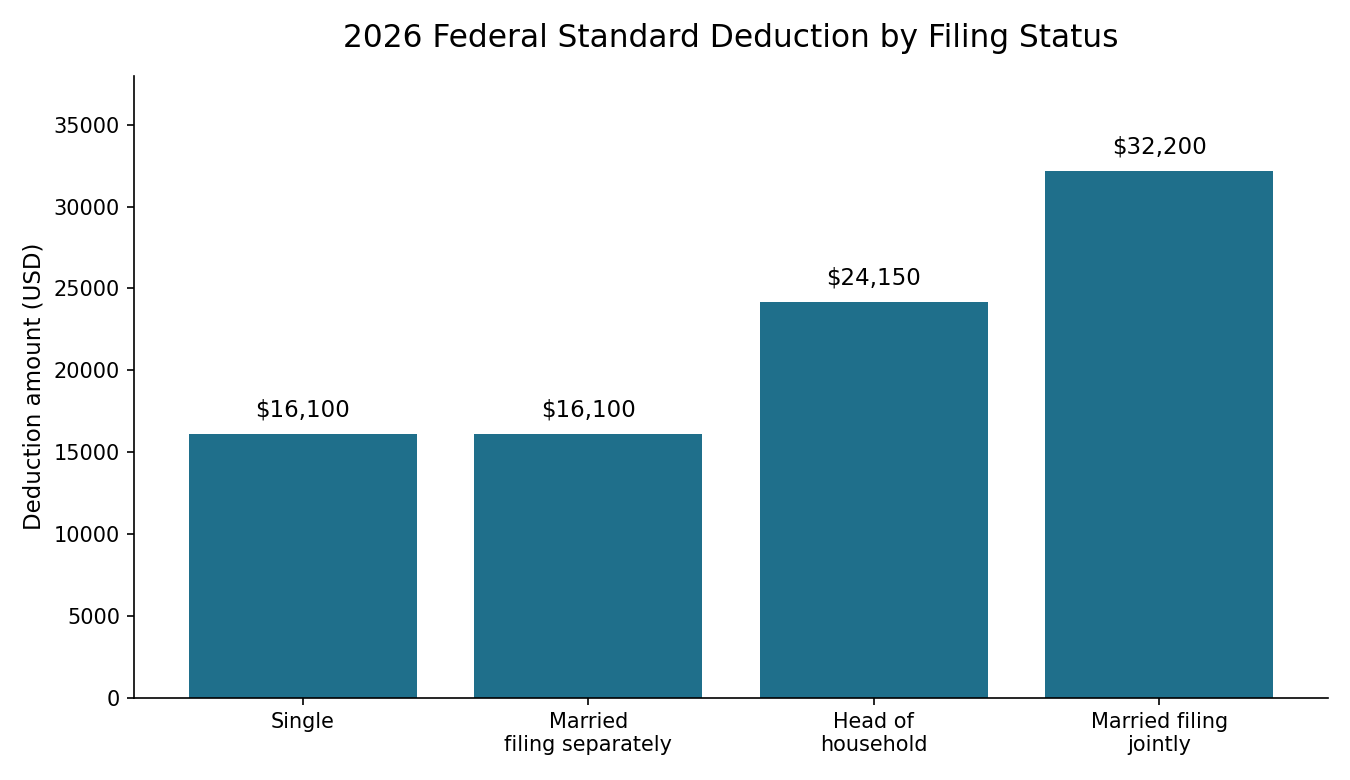
2026 federal standard deduction by filing status. Source: IRS Revenue Procedure 2025-32 (via Fidelity). Taxpayers age 65 or older (or blind) add $2,050 per qualifying condition if unmarried or $1,650 per condition if married.
| Filing status | 2026 standard deduction |
|---|---|
| Single | $16,100 |
| Married filing jointly | $32,200 |
| Married filing separately | $16,100 |
| Head of household | $24,150 |
Also locked in for 2026: the 2026 retirement contribution limits — $24,500 for 401(k)-type plans, $7,500 for IRAs, and $4,400/$8,750 for HSAs. Keep these handy; nearly every move below is about getting as close to these caps as you can.
How to Reduce Your Tax Bill Before Year-End: The 12 Moves
Think of these as a checklist, ordered by how much tax they can realistically save a typical household. Doing even four or five before December 31 beats whatever you were planning to do in April.

1. Max out your 401(k) while there’s still payroll time
This is the single biggest lever most employees have. Every dollar you contribute to a traditional 401(k), 403(b), or 457 plan in 2026 comes off your taxable income dollar for dollar. For 2026 the employee deferral limit is $24,500, and if you’ll be 50 or older by year-end you can add an $8,000 catch-up — or $11,250 if you’re between 60 and 63 under the SECURE 2.0 “super catch-up” rule.
Do the math: a single filer earning $90,000 who bumps contributions by $5,000 over the final weeks of the year lands in the 22% federal bracket, where that shift saves roughly $1,100 in federal tax alone. Going from zero to the full $24,500 could cut the federal bill by nearly $5,400.
The critical detail: 401(k) contributions have to come through payroll, so they only count if they land by December 31, 2026. Log into your plan portal now and raise your contribution percentage for your remaining paychecks — and capture your full employer match first; it’s an instant return no tax strategy should make you skip.
2. Fund your IRA — you’ve got until April 2027, but don’t wait
Unlike your 401(k), IRA contributions for 2026 can be made all the way through the tax filing deadline (April 15, 2027). For 2026 the IRA limit is $7,500 if you’re under 50, plus a $1,100 catch-up if you’re 50 or older. A traditional IRA contribution is deductible if you aren’t covered by a workplace plan, or if your income falls below the IRS phase-out thresholds — so check before you assume.
If your income is too high to deduct a traditional IRA contribution, consider the backdoor Roth: make a nondeductible traditional IRA contribution and convert it. It requires careful handling (the pro-rata rule applies if you hold other pre-tax IRA balances), but it’s a legitimate maneuver for high earners shut out of direct Roth contributions, which begin phasing out at $153,000 for single filers and $242,000 for joint filers in 2026.
3. Top up your HSA — the only triple-tax-advantaged account
If you’re enrolled in a qualifying high-deductible health plan, the Health Savings Account is the most tax-efficient vehicle in the entire code: contributions are deductible, growth is tax-free, and withdrawals for medical expenses are too. The 2026 HSA limits are $4,400 for self-only coverage and $8,750 for family coverage, with a $1,000 catch-up contribution available from age 55.
Here’s the move most people miss: you can contribute to an HSA through the April 2027 filing deadline, just like an IRA, and you don’t have to spend the money on this year’s medical bills. Fund it now, invest the balance like a retirement account, and let decades of tax-free growth do the heavy lifting. A family in the 24% bracket saves $2,100 in federal tax on a maxed-out $8,750 contribution.
4. Harvest your investment losses before December 31
If you hold losing positions in a taxable brokerage account, selling them before year-end lets you “harvest” those losses to offset capital gains — and up to $3,000 of any leftover net loss can offset ordinary income (like your salary), with the remainder carrying forward indefinitely.

Example: you sold stock earlier in 2026 for a $9,000 gain, but another holding is down $6,000. Selling the loser before December 31 leaves just $3,000 taxable — a $900 saving in the 15% capital gains bracket from a sale you’d probably make eventually anyway.
Watch the wash-sale rule: if you buy the same or a “substantially identical” security within 30 days before or after the sale, the IRS disallows the loss. The clean workaround is to swap into a similar-but-not-identical fund and wait out the 30 days. Trades must be completed by December 31, so place them well before the holiday week — and note this only works in taxable accounts, never inside an IRA or 401(k).
5. Bunch your charitable giving — especially this year
Two big changes make 2026 a fascinating year for charitable strategy. First, non-itemizers get a brand-new above-the-line deduction for cash gifts: up to $1,000 for single filers and $2,000 for joint filers, claimable on top of the standard deduction. Second, if you do itemize, a new rule disallows the first 0.5% of your adjusted gross income in charitable gifts — at $200,000 of AGI, the first $1,000 yields no deduction.

This is where “bunching” comes in. If your annual giving sits just below the itemizing threshold, consider doubling up: make your 2027 gifts this December so the total pushes you over the standard deduction line, then take the standard deduction next year. A $12,000 donation bunched into 2026 plus $6,000 of other itemizable expenses clears the $16,100 single-filer bar; spread across two years, neither year would clear it.
For larger gifts, a donor-advised fund lets you take the full deduction in 2026 while distributing the money to charities over future years — ideal for bunching. If you’re 70½ or older, a qualified charitable distribution (QCD) from your IRA satisfies RMD requirements without the money ever hitting your taxable income. Gifts must be completed by December 31 — don’t cut it close.
6. Consider a partial Roth conversion
A Roth conversion moves money from a traditional IRA or 401(k) into a Roth account. You pay tax on the converted amount now, but all future growth and withdrawals are tax-free — a trade that can save far more over your lifetime than it costs in 2026 tax.
The sweet spot: estimate your 2026 taxable income, then convert just enough to reach the top of your current marginal bracket without spilling into the next one. Conversions must be completed by December 31 and can’t be undone — so run the numbers carefully before pulling the trigger. A big conversion can also spike your Medicare premiums (IRMAA) two years later.
7. Spend down your FSA — use it or lose it
Flexible Spending Accounts are the classic year-end scramble for a reason: health FSA money is generally use-it-or-lose-it. For 2026 the FSA contribution limits for 2026 rose to $3,400, and plans that allow carryover can roll up to $680 into next year — everything beyond that vanishes if unspent.
Check your balance now and schedule the appointments: eye exams, new glasses, dental work, prescription refills, and eligible over-the-counter medications all qualify. Many plans offer a grace period of up to two and a half months instead of a carryover — but never both — so confirm which rule your employer uses.
8. Business-owner moves: the December sprint
Self-employed? Your year-end toolkit is bigger than an employee’s. A Solo 401(k) lets you contribute as both employee ($24,500 for 2026) and employer, up to a $72,000 combined ceiling. A SEP IRA is simpler with the same $72,000 ceiling, capped at 25% of compensation.
Then there’s timing. On a cash basis you can legally shift income and expenses across the year boundary: send December invoices a touch later to defer income into 2027, or prepay January expenses — rent, software subscriptions, supplies — before December 31 to accelerate deductions into 2026. If you need equipment, check with your accountant about current Section 179 and bonus depreciation rules before buying.
Two housekeeping items pay for themselves: review whether your S Corp vs LLC: which is better for your business election still makes sense at your current profit level, and tighten up your billing — the best invoicing software for freelancers means cleaner books and less income accidentally slipping into next year.
9. Check your withholding so you don’t owe a penalty
A smaller tax bill means nothing if you get hit with an underpayment penalty for not paying enough during the year. The IRS safe harbor: as long as your withholding and estimated payments total at least 100% of last year’s tax (110% if your AGI exceeded $150,000) or 90% of this year’s tax, you’re penalty-proof even if you owe a balance in April.
December is your last chance to adjust: bump withholding on your final paychecks, or make a fourth-quarter estimated payment by January 15, 2027 (which still counts toward 2026). A new job, a salary you just negotiated upward, or a side business taking off are the usual culprits behind underpayment — run the IRS Tax Withholding Estimator with your year-to-date numbers.
10. Take your required minimum distributions
If you’re 73 or older (the SECURE 2.0 age), your traditional IRA and 401(k) required minimum distributions must come out by December 31. Miss it and the penalty is 25% of the amount you should have withdrawn (10% if corrected promptly) — one of the harshest penalties in the code.
Two nuances: if this is the year you turned 73, you may delay your first RMD to April 1, 2027 — but then you’d take two distributions in 2027, likely pushing you into a higher bracket. And if you’re charitably inclined, a QCD (see move #5) satisfies the RMD without increasing your taxable income at all.
11. Run the itemize-vs-standard math — the rules changed
With the standard deduction at $16,100 single / $32,200 joint, roughly 9 in 10 filers take it and skip Schedule A entirely. But 2026 changed the calculus in any itemizing compared with the standard deduction in 2026 analysis: the SALT deduction cap jumped to $40,400, pulling many homeowners in high-tax states back over the itemizing line.
There’s also a new bonus for older filers: taxpayers 65 and older can claim an additional $6,000 deduction per qualifying person for 2025–2028, phasing out above $75,000 of AGI ($150,000 joint). Combined with the standard age-65 add-on, a 68-year-old single filer could stack $16,100 + $2,050 + $6,000 = $24,150 before itemizing a single receipt. If you’re near the line, total up mortgage interest, SALT, charitable gifts, and medical expenses exceeding 7.5% of AGI — you might be surprised.
12. Accelerate deductible spending into December
The simplest move of all: pay January’s deductible bills in December. Make your January mortgage payment before year-end to pull a month of interest into 2026. Prepay property taxes if your locality allows (mind the SALT cap). Business owners can stock up on supplies or prepay subscriptions.
The flip side: if you expect a higher bracket next year, consider deferring deductions into 2027 instead. Tax planning is always about comparing this year’s rate against next year’s — the right answer depends on your personal trajectory.
Frequently Asked Questions
What is the absolute deadline for 2026 year-end tax moves?
Most moves — 401(k) contributions via payroll, tax-loss harvesting trades, charitable gifts, Roth conversions, RMDs, and deductible spending — must be completed by December 31, 2026. The exceptions are IRA and HSA contributions, which you can make through the April 15, 2027 tax filing deadline, and estimated tax payments, which are due January 15, 2027.
Can I still contribute to my 401(k) after December 31?
No. 401(k), 403(b), and 457 contributions must come through payroll deductions during the calendar year, so anything after December 31 counts toward 2027. If you’re short of the $24,500 limit, your only option is to increase contributions on your remaining 2026 paychecks.
Does tax-loss harvesting work inside my IRA or 401(k)?
No — and this is a common misconception. Losses inside tax-advantaged accounts can’t be deducted because gains there aren’t taxed either. Harvesting only works in regular taxable brokerage accounts, where realized losses offset gains and up to $3,000 of ordinary income per year.
How much can I deduct for charity in 2026 if I don’t itemize?
For 2026, a new law lets non-itemizers deduct up to $1,000 in cash gifts ($2,000 for married couples filing jointly) on top of the standard deduction. If you itemize, cash gifts remain deductible, but the first 0.5% of your AGI is now excluded. Either way, gifts must be completed by December 31.
What is the single biggest tax-saving move before year-end?
For most W-2 employees, it’s maxing out pre-tax 401(k) contributions — up to $24,500 for 2026, or $32,500–$35,750 with catch-ups at 50-plus. Nothing else available in December reduces taxable income dollar-for-dollar at that scale with so little effort.
A Quick Note Before You Act
Disclaimer: This article is general information for educational purposes and is not professional tax advice. Tax law is complex and changes frequently, and the right strategy depends on your income, filing status, state, and personal circumstances. Figures cited reflect 2026 federal limits as published by the IRS; state rules differ. Before making large moves like Roth conversions or business-entity changes, consider consulting a qualified tax professional.
The Bottom Line
Reducing your tax bill before year-end isn’t about loopholes — it’s about using the provisions Congress already wrote for you, before the calendar takes them away. Fund the retirement accounts, harvest the losses, bunch the gifts, spend down the FSA, and check your withholding. Each move is modest on its own; stacked together, they routinely save households thousands of dollars for an afternoon’s work.
Start with the two highest-impact items today: raise your 401(k) contribution rate for your remaining paychecks, and check your FSA balance before the use-it-or-lose-it deadline. the December 31 deadline does not negotiate.