

You seared a steak, and the skillet looks like it survived a small fire. There are browned bits stuck to the bottom, a ring of grease around the edge, and the question everyone asks the first time they learn how to clean a cast iron skillet: can I just wash this thing, or will soap strip the seasoning I spent weeks building?
The short answer is that you can wash a cast iron skillet — including with a little dish soap — and the seasoning will be fine, as long as you clean it the right way, dry it properly, and give it a thin coat of oil afterward. What actually ruins a skillet is not soap. It is water left sitting, long soaks, harsh scrubbing, and storage while damp. This guide walks through the everyday five-minute clean, the salt scrub for stuck food, the rust rescue for a neglected pan, and the small habits that keep the seasoning slick for years.
What Seasoning Actually Is — and Why It Changes the Wash
Seasoning is not a coat of oil sitting on the surface. It is a thin layer of polymerised oil bonded to the iron when oil is heated past its smoke point, a process that turns liquid fat into a hard, slick skin. That skin is what keeps food from sticking and rust from starting, and it is tougher than most people assume. A little dish soap and a soft sponge do not dissolve it. What does damage it is sustained soaking, aggressive scouring with steel wool, and cooking highly acidic food for a long time in a new pan.
That distinction changes the wash completely. Instead of asking ‘can I use soap’, ask ‘am I leaving water on the pan’. Soap is a mild cleaner; water is the enemy, because bare iron rusts fast when it stays wet. The routine below is built around that idea: clean it while it is still warm, dry it fully, and finish with a whisper of oil.
Most modern guidance now agrees that a small amount of mild dish soap is safe for a well-seasoned pan. The Lodge cast iron care guide says soap is fine as long as you rinse and dry the pan straight away, and it recommends a stiff brush or non-metal scrub pad for stuck food. Lodge has sold cast iron for more than a century, so its advice reflects what actually happens in home kitchens rather than the old no-soap rule.
There are two kinds of advice about cast iron, and they point in different directions. The traditional rule is ‘never use soap, never soak, just wipe and re-oil’. The modern, tested view is that a well-seasoned pan tolerates a little soap and a quick wash. The America’s Test Kitchen guide to cleaning and seasoning cast iron explains that seasoning is a polymer layer, not a coating of oil, which is why mild soap does not strip it. The difference matters: if you follow the old rule too strictly, you end up with a pan that smells stale; if you wash carelessly and leave it wet, you get rust. The middle path — quick wash, full dry, light oil — is the one that works.
How to Clean a Cast Iron Skillet: The Everyday Clean (5 Minutes)
For a normal weeknight cook, the routine takes about five minutes, and most of that is drying. While the pan is still warm — not hot enough to burn you, but warm to the touch — scrape out loose food with a flat wooden spoon or a plastic pan scraper. Rinse under hot water and wipe the inside with a non-metal scrub pad or a stiff brush. If there is a thin film of grease, add a single drop of mild dish soap and wash as you would any pan. Rinse, then move straight to drying. Do not leave the pan in the sink while you eat.
Dry it right away. Towel-dry the pan, inside and out, then put it on a low burner for two to three minutes until every drop of water has evaporated. You will see the last wisps of steam disappear. Take it off the heat and let it cool for a minute. A dry pan is a safe pan — rust needs water, and a pan that is fully dry cannot rust while it sits in the cupboard.
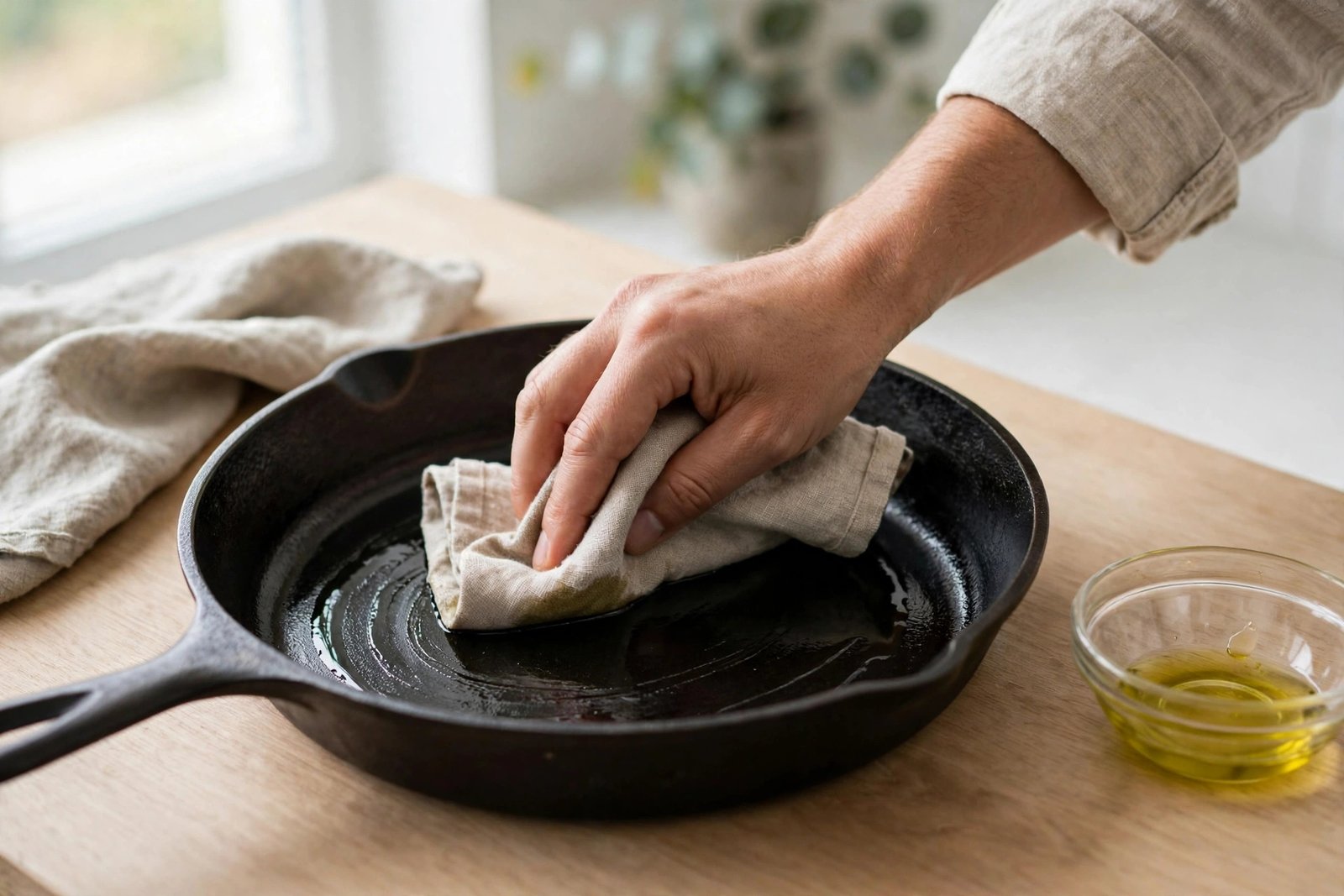
A very light wipe of oil finishes the job. Put a few drops of a neutral oil — canola, grapeseed, or refined vegetable oil — on a paper towel and rub it over the whole cooking surface, then wipe it almost all away. The pan should look dry, not greasy. That thin film is enough to keep the seasoning conditioned until the next cook. If you can see or feel oil, you used too much; wipe again.
Stuck Food? Try the Salt Scrub
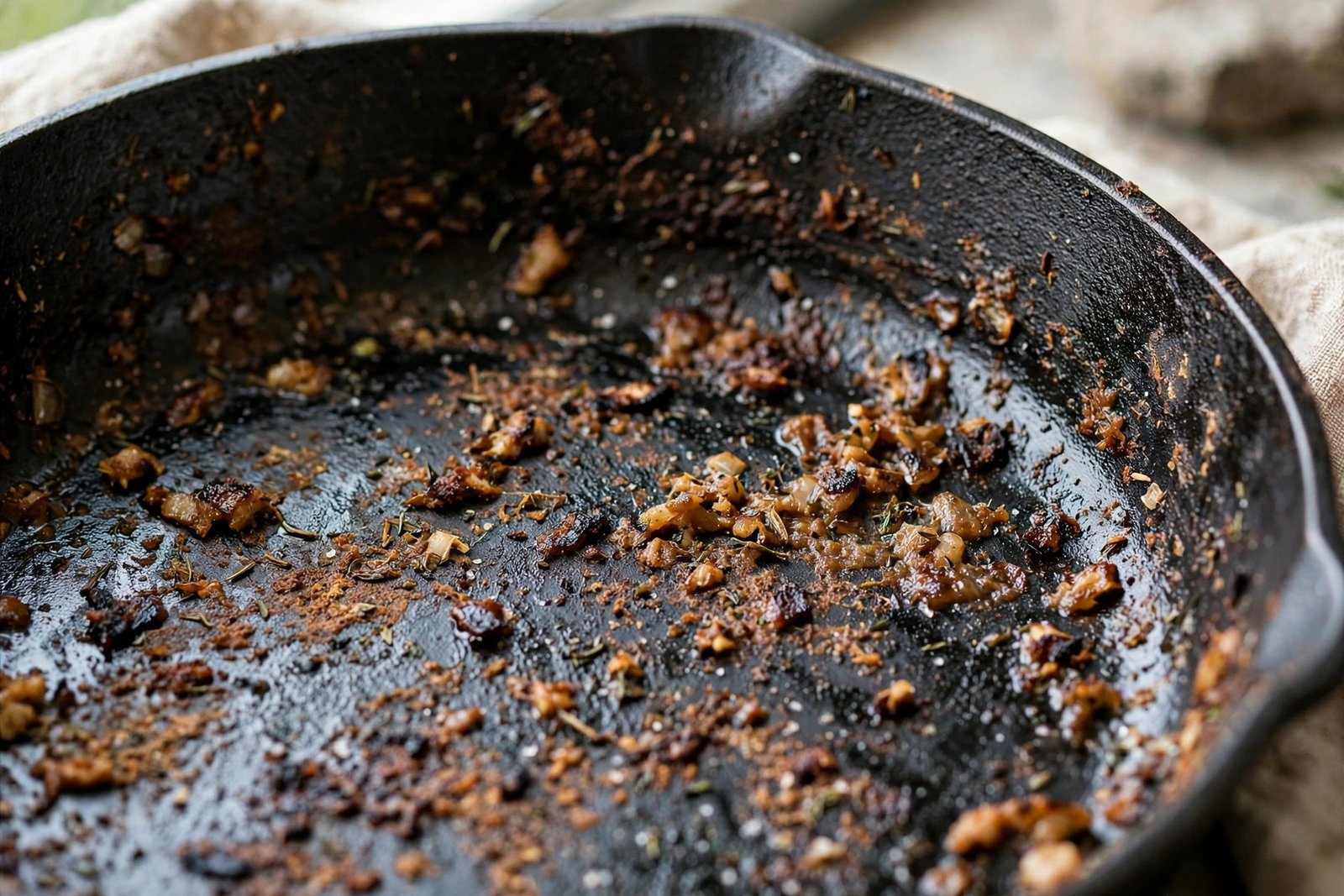
For food that clings — a fried egg that welded itself to the bottom, or a sauce that reduced to a dark patch — a salt scrub lifts it without damaging the seasoning. Pour a generous handful of coarse kosher salt into the warm pan, add just enough water to make a paste, and scrub with a folded paper towel or a non-metal pad. The salt is abrasive enough to lift the residue but soft enough not to cut through the polymer layer. Wipe out the dirty salt, rinse with hot water, and dry and oil as usual. For most stuck food, this takes two minutes.
If the salt alone does not work, use the pan’s own heat. Put the pan back on a medium burner, add a little water, and let it simmer for two to three minutes to loosen the residue, then scrape with a flat wooden spoon. This is sometimes called deglazing, and it is the same technique used for a stainless steel pan. Do not use a metal spatula with a sharp edge, and do not reach for steel wool, which will cut the seasoning.
Some cooks swear by the chain-mail scrubber, a small mat of stainless steel rings that scrubs without cutting. It works well, but the salt method is free and already in your cupboard. The Farmers’ Almanac guide to cleaning cast iron recommends the salt and oil method for regular cleaning, and it notes that a well-seasoned pan improves with use rather than with special products.
When Water Is Fine (and When It Is Not)
Plain water is fine for a cast iron skillet, as long as the contact is brief. A quick rinse under a hot tap, a wipe, and a full dry is a normal wash. The risk is not water itself but water left standing: a pan left to soak in a sink, or put away while damp, will show rust spots within a day. Cast iron is porous, and once water sits in the pores it starts the oxidation process.
You can wash a skillet with water and a little soap after most meals. The exception is a brand-new pan whose seasoning is still thin: for the first few cooks, favour wiping and a salt scrub over a full wash, and cook fatty foods to help build the layer. Once the pan has a few weeks of regular use, the seasoning is tough enough for a normal wash.
Do not soak the pan. Do not put it in the dishwasher. Do not leave it to air-dry on a rack. Each of these leaves water in contact with the iron for long enough to start rust, and the dishwasher’s harsh detergent and long hot cycle can also dull the seasoning. A pan that has been through a dishwasher is not ruined — it just needs a scrub, a dry, and a re-season — but the habit is worth avoiding.
Dry It Like You Mean It
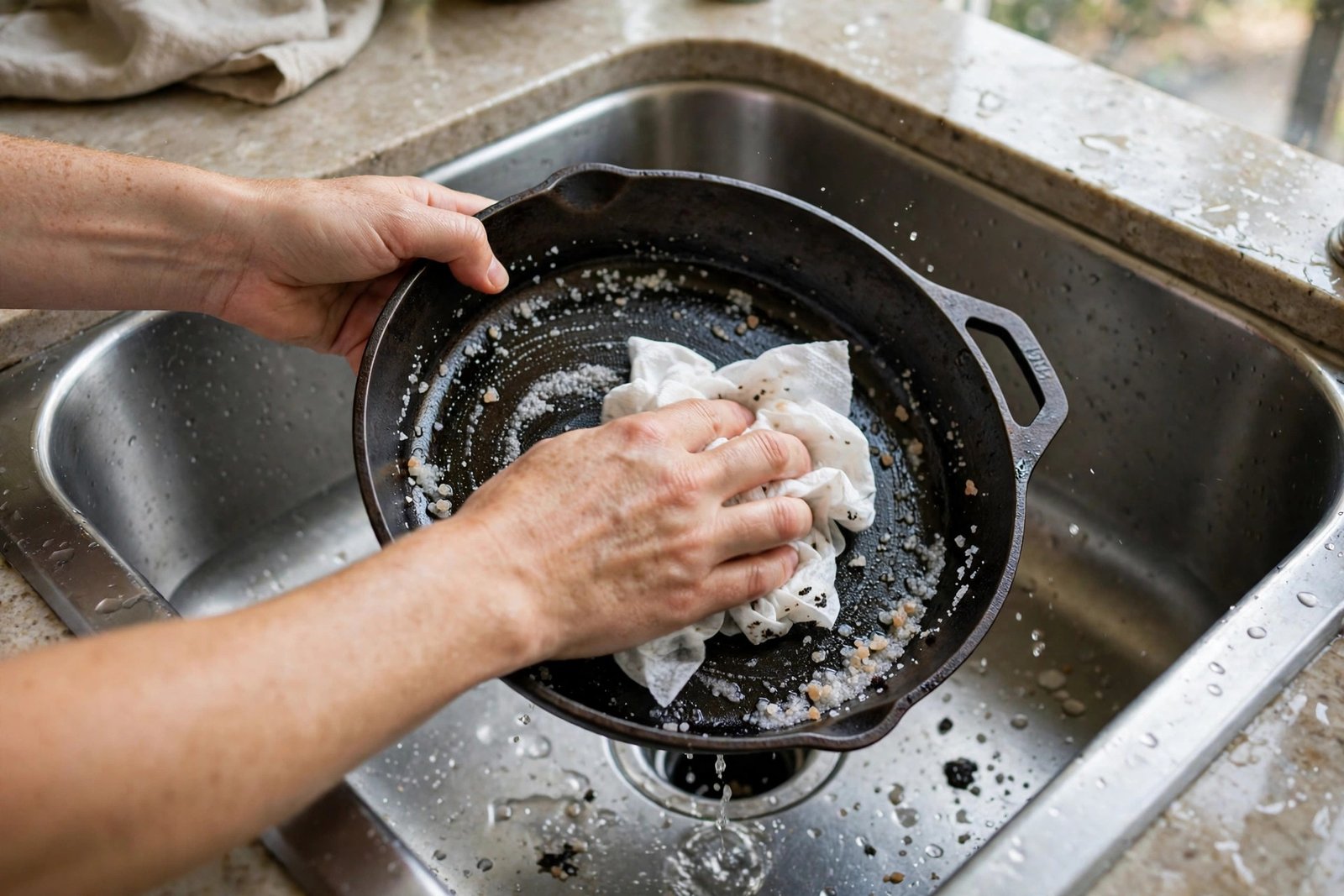
Water left on cast iron is the fastest route to rust. Even a few drops in the handle join or around the pour spouts can leave orange spots overnight. Towel-drying removes most of the water, but the burner step removes the rest, including the film that hides in the pores. Heat the pan on low until the water evaporates, then let it cool before you oil it.
The most reliable drying method is heat, not air. A low burner for two to three minutes, or a few minutes in a warm oven, drives off water that a towel cannot reach. You will know it is dry when the surface looks matte and no steam rises. The American habit of towel-drying and putting the pan away is fine in a dry climate, but in a humid kitchen the burner step is the difference between a pan that stays black and one that spots.
The same physics explains why you should not stack a damp pan. Moisture trapped between two pans has nowhere to go, so it sits and rusts the lower surface. If you must stack, put a paper towel between the pans and make sure both are bone dry first. A dry pan in a dry cupboard will last for decades without a spot of rust.
How to Re-Oil After Cleaning
A freshly cleaned skillet benefits from a whisper of oil, not a bath. The point is to replace the tiny amount of oil the wash removed and to keep the surface conditioned. Use a neutral oil with a high smoke point — canola, grapeseed, or refined vegetable oil — and avoid extra-virgin olive oil or butter for this step, because they can go rancid or sticky at room temperature.
Once it is dry, put a few drops of oil on a paper towel and wipe the whole cooking surface, the inside walls, and the handle. Then take a clean paper towel and wipe it all off. The pan should look dry and feel dry to the touch. That is enough — the seasoning layer is only a few molecules thick, and excess oil turns gummy rather than protective. If you cook with the pan often, this light oiling after each wash is all the maintenance it needs.
Rust Rescue: How to Save a Neglected Skillet
Found a rusty skillet at a flea market, or rescued one from the back of a cupboard? Rust is fixable. Scrub the rusted area with coarse salt and a little oil, or with a non-metal scrub pad and hot water, until the orange is gone and the iron looks grey. For heavy rust, a 50/50 mix of white vinegar and water, left for one to three hours, will dissolve the rust — but do not leave it longer, because vinegar will also eat the good iron. Rinse, dry on a burner, and the pan is ready to re-season.
Once the rust is gone, you need to rebuild the seasoning. Rub a very thin layer of a high-smoke-point oil over the whole pan, inside and out, then wipe it almost all off. Place the pan upside down in an oven at 230°C (450°F) for an hour, then let it cool in the oven. Repeat that oiling and baking cycle two or three times. The pan will come out dark and slick. It will not be non-stick on day one, but a few weeks of cooking with fats will finish the job.
Seasoning is simply oil heated past its smoke point until it bonds to the iron. If you want the full method, our guide on how to season a cast iron skillet walks through oil choice, oven temperature, and how many coats to apply. A pan that has been stripped to bare iron needs two or three coats before it behaves; a pan that just lost a patch needs one light coat after cleaning.
Storage: Keeping the Pan Ready for Next Time
A cast iron skillet stores best where air can circulate and moisture cannot collect. Hang it from a hook if you have the space, or keep it on a shelf with the lid off. If you stack pans, put a paper towel or a folded tea towel between them to stop moisture from getting trapped and to protect the seasoning from scratches. Keep it away from the sink area, where splashes keep the air damp.
A simple habit is to store the pan with a very light coat of oil and a paper towel inside. The towel absorbs any stray moisture and stops dust from settling on the cooking surface. If you use the pan every day, this is unnecessary — the regular cooking keeps the seasoning fed — but for a pan used once a week or less, the towel trick keeps it ready to cook.
The same wipe-down habit that keeps a skillet ready also helps other kitchen tools. The routine for cleaning a coffee maker and the method for cleaning a microwave use the same idea: clean while warm, dry fully, and do not let water sit. A kitchen that dries its tools is a kitchen that does not fight rust or stale smells.
What Not to Do With Cast Iron
Avoid these common mistakes. Do not use a dishwasher, do not soak the pan, and do not use oven cleaner or harsh detergents. Do not heat an empty pan on high until it smokes — the “blackened” stage can damage the seasoning and, in extreme cases, warp a thin pan. Do not plunge a hot pan into cold water; the thermal shock can crack it. And do not store food in the pan overnight, because acidic food will eat into the seasoning and pick up a metallic taste.
Dishwashers are the worst offender because they combine a long hot cycle, harsh detergent, and a drying phase that leaves the pan damp. A single dishwasher run will not destroy a pan, but repeated runs dull the seasoning and invite rust in the pores. If a pan has been through the dishwasher, wash it by hand, dry it on a burner, and give it a light oil. The seasoning will recover with a few cooks.
Frequently Asked Questions (FAQ)
Can I use soap on a cast iron skillet?
Yes. A small amount of mild dish soap is fine on a well-seasoned pan. Wash quickly, rinse, dry fully on a burner, and wipe with a thin layer of oil. Avoid harsh detergents and do not soak the pan.
Should I soak my cast iron skillet?
No. Soaking can cause rust and damage the seasoning. If food is stuck, use the salt scrub or simmer a little water in the pan to loosen it, then wash and dry straight away.
How do I remove rust from a cast iron skillet?
Scrub the rust off with coarse salt and oil or a non-metal pad, or soak it briefly in a 50/50 mix of white vinegar and water for one to three hours. Rinse, dry on a burner, and re-season with a thin coat of oil baked in the oven.
What is the best oil to season cast iron?
For regular maintenance, a neutral oil with a high smoke point — canola, grapeseed, or refined vegetable oil — works best. Flaxseed oil gives a hard finish but can flake; extra-virgin olive oil and butter can go rancid. Use a very thin coat and wipe off the excess.
Can I use a metal spatula on cast iron?
Yes, a flat metal spatula is fine and even helps smooth the seasoning over time. Avoid sharp edges and do not gouge the surface. Wooden and silicone tools are also safe.
Is it safe to cook acidic food in cast iron?
For short cooking times, yes — a quick tomato sauce or a splash of wine is fine in a well-seasoned pan. Avoid simmering highly acidic food for a long time in a new or lightly seasoned pan, because the acid can strip seasoning and give food a metallic taste.
Conclusion
Learning how to clean a cast iron skillet is mostly about unlearning the fear of soap and water. Wash it while it is warm, dry it on a burner until the steam stops, wipe it with a whisper of oil, and store it dry. That is the whole routine, and it takes five minutes. A pan treated that way only gets better: the seasoning builds with each cook, the surface gets slicker, and the skillet becomes the pan you reach for first. Treat it gently, keep it dry, and it will outlast every other pan in the kitchen.
For method detail from established home and food sources, see the cast iron cleaning guide, which covers the salt scrub and the drying step in more depth.



