

How to Save for a House Down Payment: A Realistic Plan That Works
The hardest part of buying a home isn’t the mortgage paperwork or the house hunt. It’s the savings. Learning how to save for a house down payment is the part that breaks most plans, because the target feels so big that people either give up before they start or chase advice that doesn’t match their real budget. The truth is more encouraging than the internet makes it sound: you don’t need 20%, you don’t need a six-figure salary, and you don’t need to live on rice and beans for a decade. What you need is a realistic number, a system that runs on autopilot, and a timeline you can actually see yourself finishing. That’s exactly what this guide builds, step by step.
First, Know Your Real Target: How Much Down Payment Do You Actually Need?
Most people set their savings goal based on a myth. They hear “20% down” and do the math on a $400,000 home — $80,000 — and conclude that homeownership is ten years away. But 20% is not the minimum. It’s the level at which you avoid private mortgage insurance on a conventional loan. Many buyers put down far less, and Freddie Mac’s own homebuyer guidance actively works to dispel this “20% myth,” noting that qualifying buyers can use low-down-payment options starting around 3%. Low down payment mortgage options are one of the main reasons first-time buyers get into homes sooner than they expected.
Here’s what the major loan types actually require. FHA loans, insured by the Federal Housing Administration, require as little as 3.5% down for borrowers with a credit score of 580 or higher. Conventional loans offer low-down-payment options too, often starting in the 3–5% range. On a conventional loan, putting down less than 20% means you’ll pay private mortgage insurance, which protects the lender — not you — and which can generally be cancelled once you’ve built enough equity. For a rundown of the FHA side, HUD’s own single-family mortgage programs page explains how its insured loans lower the entry barrier.
Run the math both ways before you set your goal. A 3.5% FHA down payment on a $300,000 home is $10,500 — a very different number than $60,000. Yes, a smaller down payment means a bigger monthly payment and possibly mortgage insurance, so weigh both sides honestly. But if a realistic target keeps you saving while an “ideal” target makes you quit, the realistic target wins. Pick the price range first — our guide on how much house can I afford walks through that — then multiply by your down payment percentage. Add a buffer for closing costs, which vary by state and loan type, and you have a target with a name and a number. Vague goals don’t get saved toward.
How to Save for a House Down Payment: The Realistic Plan
A savings plan that only works on paper is not a plan. This one is built for real paychecks, real rent, and real life getting in the way. Each step feeds the next. This is a practical approach to how to save for a house down payment on a real-world budget.
Step 1: Put the number where you can see it
Write your target on one line: home price × down payment percentage + closing-cost buffer. Then work backward into a monthly number. If your target is $25,000 and your timeline is four years, you need to bank about $520 a month. That’s the kind of specificity that changes behavior, because now every dollar has a job. Break it further into a weekly figure if that feels more doable — $130 a week sounds less scary than $520 a month, even though it’s the same.
Reality-check the timeline before you commit to it. The chart below shows how long it takes to save a $80,000 target (20% of a $400,000 home) at different monthly savings amounts — but the same arithmetic applies to whatever your target is: target divided by monthly savings equals months. If your monthly number looks impossible, the honest answer is to extend the timeline or lower the target, not to squeeze yourself until the plan collapses.
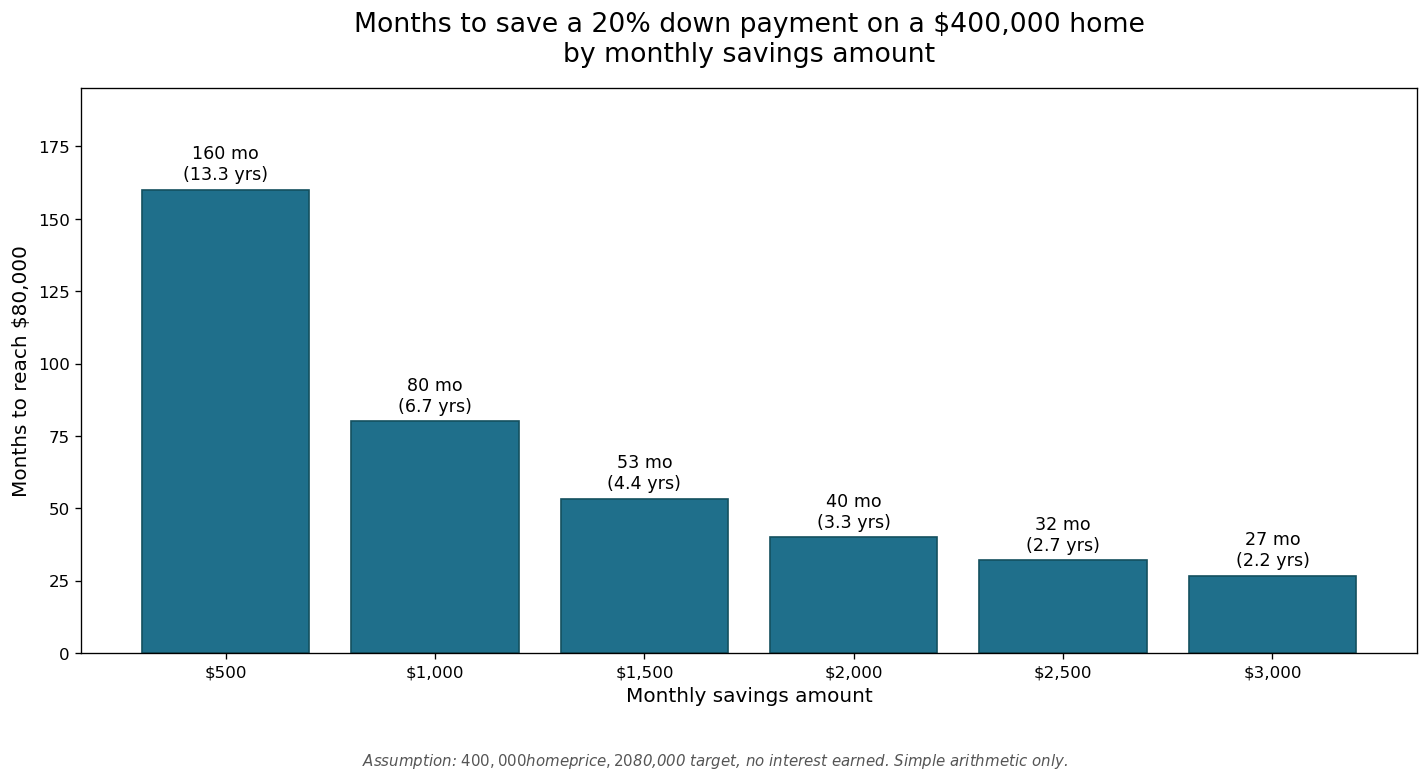
If the timeline still feels endless, that’s information, not failure. It usually means the target needs adjusting — a lower price range, a low-down-payment loan, or down payment assistance (more on that in step 7) — rather than superhuman discipline.
Step 2: Find the money hiding in your current budget
Before you earn an extra dollar, audit the ones you already have. Pull three months of bank statements and sort spending into what genuinely matters and what’s autopilot. Subscriptions you forgot, food delivery that’s become a habit, the streaming bundle you never watch — these are the low-hanging fruit. Our walkthrough on how to budget on a low income lays out a simple system for this even when money is tight.

Start with the big recurring costs, not the coffee. Housing, car payments, insurance premiums, and phone plans are where hundreds hide. Calling your insurer for a re-quote or refinancing a high-interest car loan can free up more in one afternoon than a year of skipping lattes. Set a rule: every dollar you cut from recurring spending gets moved to the down payment fund on the same day, before it can evaporate into something else.
Step 3: Give your down payment its own account — and automate it
This is the step that separates people who hit their target from people who don’t. Open a separate savings account used only for the down payment. A separate high-yield savings account is the classic choice: your money stays liquid and insured, but it’s out of your checking account’s reach, which matters more than most people admit. Rates vary, so shop around, but even modest interest beats a checking account paying nothing.
Then automate the transfer for the day your paycheck lands. Payday is the one moment the money is there and the excuses aren’t. Automatic transfers mean you never rely on willpower, and willpower is the least reliable financial tool ever invented. If your income is irregular, automate a base amount and top it up manually in good months. Automating your transfers is one of the simplest ways to stay consistent while you learn how to save for a house down payment.
Step 4: Attack high-interest debt first
Credit card balances charging double-digit interest are a direct tax on your down payment. Every month you carry a balance, the interest you pay is money that could have gone into the house fund — and the debt also hurts your debt-to-income ratio, which lenders scrutinize. Wiping out high-interest debt first can actually speed up your home purchase instead of delaying it. If you’re juggling multiple balances, the payoff strategies in how to pay off debt fast will help you sequence them efficiently.
One important nuance: keep your emergency fund intact while you do this. Raiding the emergency fund to save for the house just converts one problem into a more expensive one. If you don’t have that buffer yet, build a small one before you redirect everything to the down payment.
Step 5: Grow the top line with extra income
Cutting has a floor; earning doesn’t. Even $300–$500 a month in extra income can cut years off a savings timeline — run your own numbers through the chart math above and see. Overtime at your current job is usually the simplest option. After that: freelancing a skill you already use at work, weekend gig work, or selling things you don’t use. Our list of side hustles that need no money to start is built for exactly this situation.

The rule for extra income: 100% of it goes to the down payment fund until the target is met. Lifestyle creep is the enemy here. It helps to give the side income its own deposit destination so it never mixes with spending money. Tell yourself the gig ends when the down payment is done — a finish line keeps the effort up in month fourteen.
Step 6: Harvest windfalls on purpose
Tax refunds, work bonuses, cash gifts, a side gig payout — money you weren’t counting on is the easiest money to save, because your lifestyle doesn’t miss it. Make a standing decision now: half of every windfall (or all of it, if you can) goes straight to the down payment account the day it arrives. People who decide this in advance save windfalls; people who “see how they feel” spend them. Two or three good tax seasons can shave a full year off your timeline.
Step 7: Check down payment assistance before you assume you’re on your own
This is the step almost everyone skips, and it can change the math completely. Most states have housing finance agencies offering down payment assistance — grants you don’t repay, or low-interest second loans — and many cities, counties, and nonprofits run their own programs. Employer-assisted housing programs exist too. FHA loans also allow the entire 3.5% down payment to come from acceptable gift funds or assistance programs in many cases. A twenty-minute search on your state’s housing finance agency site can be worth thousands. HUD’s mortgage program pages are a good starting point for understanding which loan types pair with assistance.
Mistakes That Stall Down Payment Savings
Watch for these traps, because each one quietly adds months to the timeline:
- Saving in your checking account. If it’s visible and spendable, it will be spent. Separate account, always.
- Chasing the “perfect” timeline. An 18-month plan you abandon beats nothing; a 4-year plan you finish beats everything. Be honest about which you’ll actually do.
- Ignoring your credit while you save. A better score can mean a lower down payment requirement and cheaper mortgage insurance. Pay on time, keep card balances low, and don’t open new credit lines while saving.
- Waiting for prices to fall. Nobody can time the housing market. Your savings plan is within your control; market timing isn’t. Build the fund, then buy when the numbers work.
- Forgetting closing costs. The down payment isn’t the whole cash picture. Plan for closing costs on top of it so you aren’t scrambling at the finish line.
Frequently Asked Questions
How much should I save for a house down payment?
It depends on your loan type and home price. FHA loans require as little as 3.5% down for borrowers with a 580+ credit score, conventional low-down-payment options start around 3–5%, and 20% is the level that lets you skip private mortgage insurance on a conventional loan. Pick your price range and loan type first, then multiply — that gives you a target you can actually plan around.
Can I buy a house with less than 20% down?
Yes. Low-down-payment mortgages are mainstream, not exotic. The tradeoff is real — a smaller down payment usually means a higher monthly payment and mortgage insurance — but for many buyers, buying sooner with a smaller down payment beats renting for years while chasing 20%. Run both scenarios before deciding.
How long does it take to save for a down payment?
Pure arithmetic: your target divided by your monthly savings. A $25,000 target at $520 a month takes about four years; the same target at $1,000 a month takes just over two. Low-down-payment loans, assistance programs, and extra income are the three levers that shorten the timeline fastest.
Where should I keep my down payment savings?
In a separate, liquid, insured account — typically a high-yield savings account — not invested in the stock market. The timeline is usually too short for market risk: a dip right before you’re ready to buy could force you to delay. Keep it boring and separate.
Should I pay off debt or save for a down payment first?
Do both, but sequence matters: build a small emergency buffer, then attack high-interest debt while saving what you can. Eliminating credit card debt lowers your interest costs and improves your debt-to-income ratio, which can help your mortgage approval. Low-interest debt like a modest car loan can usually coexist with saving.
Do down payment assistance programs really exist, or is that a scam?
They really exist. State housing finance agencies, local governments, nonprofits, and some employers offer grants and low-cost loans for down payments and closing costs. They’re not scams, but they do have eligibility rules around income, home price, and often first-time-buyer status — check your state’s housing finance agency for what’s available where you live.
Conclusion
Saving for a house down payment isn’t about finding some secret trick — it’s about replacing a scary, vague goal with a specific number, a monthly system that runs without willpower, and a timeline you’ve honestly pressure-tested. Set a realistic target based on what loans actually require, give the money its own automated home, cut the recurring costs that quietly drain you, add income where you can, and check assistance programs before assuming you’re doing this alone. Every automated transfer is a vote for the front door you’re going to walk through. Start this month, and let the chart math do the rest. Follow the steps above and you will know exactly how to save for a house down payment — and actually finish the plan.



