

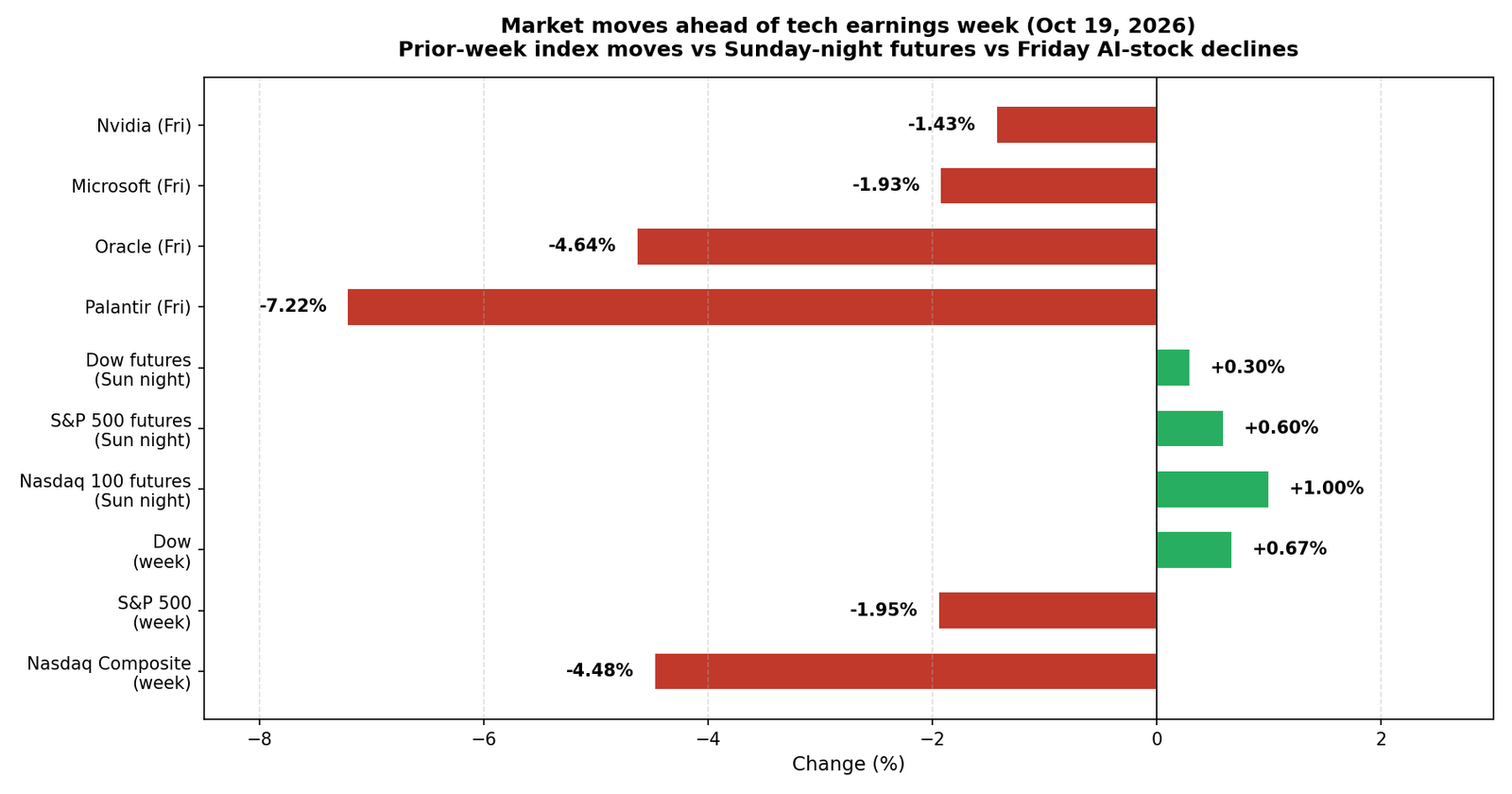
After a bruising week that saw the Nasdaq Composite shed 4.48%, tech earnings this week could not arrive at a more pivotal moment. Starting Tuesday, October 20, a parade of heavyweights — SpaceX, Netflix, Tesla, Meta, IBM, Lam Research and Western Digital — reports third-quarter results, and investors are treating the slate as a verdict on the AI trade that has powered this bull market through its fourth anniversary. As of Sunday night, October 18, 2026, futures were pointing to a modest rebound: Nasdaq 100 futures up 1%, S&P 500 futures up 0.6% and Dow futures up 0.3%, according to AIStockWire’s Sunday evening brief. Whether that bounce holds depends on what the numbers — and the guidance — say about AI spending.
Below is the full schedule, the numbers to watch at each company, and the three questions that will decide whether the tech earnings this week calm markets or deepen last week’s selloff.
What Happened Last Week: The Selloff That Set Up This Earnings Week
Last week was the Nasdaq’s worst since late June. The Nasdaq Composite fell 4.48% to close Friday at 26,140.03, the S&P 500 dropped 1.95% to 7,659.44 — its biggest weekly decline since June — while the Dow managed a 0.67% gain, its second straight weekly advance, as money rotated out of tech and into healthcare and consumer staples, per Reuters’ reporting. The PHLX Semiconductor Index fell for an eighth straight session, its longest losing streak since October 2008, and the Cboe Volatility Index closed Friday at 19.99, up from 15.21 the Monday before.
The trigger was not any single company’s earnings miss. It was financing — specifically, how the AI infrastructure boom is being paid for. As Reuters’ Lewis Krauskopf reported on October 16, worries “rippled through markets over risks tied to the financing of the AI build-out boom,” with investors zeroing in on CoreWeave, the AI cloud company carrying roughly $50 billion in debt. CoreWeave’s bond yields climbed to a record 15% on October 14, reviving fears that data centers are being financed with an unsustainable wall of debt. Credit spreads widened for all eight AI borrowers tracked in one survey between October 8 and 15, with the median spread jumping from 334 to about 413 basis points — and CoreWeave’s median spread ballooning 86 basis points to 934.

The pain was concentrated in AI-linked names. On Friday, October 16, Palantir plunged 7.22% to $186.03, its steepest drop among large software names, according to Gotrade’s daily stock brief. Oracle lost 4.64%, Microsoft fell 1.93% to $529.05 and Nvidia dropped 1.43% to $214.13. Super Micro Computer sank about 10%. The 10-year Treasury yield ended the session at 5.10%, and WTI crude broke above $101 a barrel — a reminder that inflation pressure and high rates are the other half of the AI trade’s problem.
Strategists at Deutsche Bank and RBC Capital Markets separately pulled back on their tech-sector recommendations last week; on October 9, Deutsche Bank said the rotation into tech had “run far and the risk-reward no longer looks favorable in the near term,” per Reuters. As Natixis portfolio strategist Garrett Melson put it: “It certainly feels like the narrative in the market is a little bit jittery. Clearly there’s a lot of uncertainty around where AI stands right now.”
If you’re following the CoreWeave angle specifically, our earlier coverage of CoreWeave’s debt-fueled AI buildout lays out why the bond market became the sector’s biggest risk. And with the Federal Reserve’s next rate decision landing October 28 — with odds of a rate hike rising after a hotter-than-expected September inflation report — the financing story ties directly into our analysis of the Fed’s 2026 rate path.
The Full Tech Earnings This Week Calendar
All of the following report after the market close. Estimates below are consensus EPS figures from Robinhood’s earnings calendar as of October 18, per AIStockWire:
Tuesday, October 20 — SpaceX and Netflix Open the Books
SpaceX (SPCX) reports at 3:30 p.m. CT with a consensus estimate of $0.16 EPS — a rare earnings disclosure for Elon Musk’s space company, and one investors will parse for clues about Starlink economics and the company’s deepening role in the AI data-center buildout. Netflix (NFLX) reports the same evening (consensus $0.82), with the market focused on subscriber growth, the advertising business, content spending and margins. Per TipRanks’ earnings calendar, Netflix’s results will give the market its first read on consumer discretionary spending before the bigger names arrive. Tuesday also brings GE Aerospace, General Motors and United Airlines before the open — a broad economic cross-section.
Wednesday, October 21 — The Main Event: Tesla, Meta, and the Chip Makers
Wednesday is the busiest day of the month for tech. Tesla (TSLA) and Meta (META) both report after the close, alongside IBM, Lam Research and Texas Instruments.
For Meta (consensus ~$5.89–$6.76 EPS depending on the source), the question is whether massive AI capital expenditure is translating into better profitability. As Yonhap Infomax reported, this will be Meta’s first earnings since launching its AI agent “Muse,” and its stock has risen more than 15% since that unveiling — putting extra weight on any capex guidance. Watch advertising revenue growth, capital expenditures, and any signals about AI product commercialization.
For Tesla (consensus ~$0.40 EPS), the market already knows the company delivered 486,500 vehicles and produced 464,400 in Q3 while deploying 13.7 GWh of energy storage. The focus shifts to automotive gross margins, average selling prices, progress on Robotaxi and the Cybercab, and AI-related investments. LSEG data shows Tesla’s EPS is estimated to have declined about 14.5% year over year, and Wolfe Research has warned of a “tough quarter for auto stocks.”
Lam Research (consensus $2.18) and Texas Instruments (consensus $2.41) report into a semiconductor index mired in its worst losing streak since 2008 — making their guidance on memory and equipment demand the next real data point for the chip trade. IBM (consensus $2.87) rounds out the day.
Thursday, October 22 — Western Digital Caps the Week
Western Digital (WDC) reports Thursday after the close (consensus $4.06), following a 16.4% slide last week as memory and storage stocks took the brunt of the selloff. Also reporting: Nasdaq Inc. itself, Comcast, and a raft of consumer and industrial names.
Friday, October 23 — A Quieter Close
American Express (AXP) reports before the open, offering a final read on consumer spending for the week, alongside SLB.

Three Questions These Earnings Must Answer
The 2026-10-19 tech earnings calendar matters less for any single company’s numbers than for three themes that decide whether the AI trade keeps working:
1. Is AI capex actually turning into profits?
This is the Meta question, and by extension the whole market’s. Hyperscalers have spent massively on data centers all year; Meta’s Wednesday call will be judged on whether that spending is producing revenue, margin expansion, or just bigger bills. Any divergence between Tesla’s, Meta’s and IBM’s Wednesday reactions will tell investors which part of the technology trade is holding up.
2. Can the debt story be defused?
Credit markets, not equity desks, drove last week’s fear. CoreWeave’s 15% bond yields and the widening spreads across AI borrowers mean every executive commentary on how infrastructure spending is financed will be dissected. Comments from Tesla and Meta on their own capex funding — cash flow versus debt — carry unusual weight this week.
3. Does the Fed hijack the narrative?
The Fed meets October 27–28, and a hotter September inflation report has raised the odds of a rate hike. With the 10-year Treasury at 5.10%, any hawkish signal — or any earnings commentary that sounds like it’s pre-positioning for higher-for-longer rates — could overwhelm even decent numbers. The earnings calendar and the rate calendar are colliding this month.
What Investors Are Watching For Each Company
- Netflix: subscriber additions, ad-tier momentum, content spend discipline, free cash flow.
- SpaceX: Starlink economics, launch cadence, any new government or enterprise contract color.
- Tesla: automotive gross margin, energy business growth, Robotaxi milestones, AI capex trajectory.
- Meta: ad revenue growth, capex guidance, monetization progress for AI products including Muse.
- Lam Research & Texas Instruments: forward guidance on chip demand after the PHLX’s 8-day losing streak.
- Western Digital: memory pricing and demand signals after last week’s 16.4% decline.
- IBM: enterprise software and AI consulting demand as a read on corporate AI budgets.
FAQ: Tech Earnings This Week
Which tech companies report earnings this week (October 19–23, 2026)?
SpaceX and Netflix report Tuesday, October 20; Meta, Tesla, IBM, Lam Research and Texas Instruments report Wednesday, October 21; Western Digital reports Thursday, October 22. All report after the market close. American Express reports Friday before the open.
Why did tech stocks fall last week before earnings?
The Nasdaq Composite fell 4.48% and the S&P 500 dropped 1.95% in the week ending October 16, driven by investor concerns over how AI infrastructure spending is financed. CoreWeave’s record bond yields (15%) revived fears about debt-financed data centers, and credit spreads widened across AI borrowers. Deutsche Bank and RBC also pulled back tech recommendations.
What are stock futures saying on Monday, October 19?
As of Sunday night, October 18, futures pointed to a rebound: Nasdaq 100 futures were up about 1%, S&P 500 futures up 0.6%, and Dow futures up 0.3% (per AIStockWire’s 9:50 p.m. ET snapshot), suggesting dip-buying ahead of the week’s earnings.
When do Meta and Tesla report earnings?
Both Meta Platforms (META) and Tesla (TSLA) report third-quarter 2026 results after the market close on Wednesday, October 21, 2026. Meta’s conference call is scheduled for 1:30 p.m. PT, alongside Tesla, IBM, Lam Research and Texas Instruments.
Is the AI trade over?
Not necessarily — the S&P 500 sits only about 2% below its October record high, and last week’s rotation lifted healthcare and consumer staples, which suggests selective de-risking rather than a broad market break. But the AI trade’s terms are being renegotiated: investors now want proof that AI spending generates profits, not just debt. This week’s earnings are the first big test of that new standard.
How should long-term investors read this earnings week?
Focus on guidance and capital allocation, not headline EPS beats or misses. The companies that pair solid results with credible explanations of how AI spending pays for itself — and how it’s financed — are the ones most likely to stabilize their stocks. Also watch the Fed meeting October 27–28, which could matter more than any single report.
Conclusion: Earnings Will Either Confirm the Selloff or Kill It
The week of October 19 is a genuine inflection point. Last week’s 4.48% Nasdaq slide was a vote of no confidence in how the AI boom is financed; this week’s tech earnings are the rebuttal. If Meta, Tesla and Netflix deliver strong numbers with confident guidance on AI returns, the Sunday-night futures bounce could extend into a relief rally. If guidance wobbles — or if capex plans grow faster than profits — the rotation out of tech could accelerate, with the Fed’s October 28 decision as the next catalyst. Watch Wednesday after the close: that’s when the market gets its answer.
Editor’s note: This article was published on October 19, 2026. Market figures are based on verified reporting as of Sunday, October 18, 2026 (ET), from Reuters, AIStockWire, TipRanks, Gotrade and Summa Money. This is not investment advice.



