

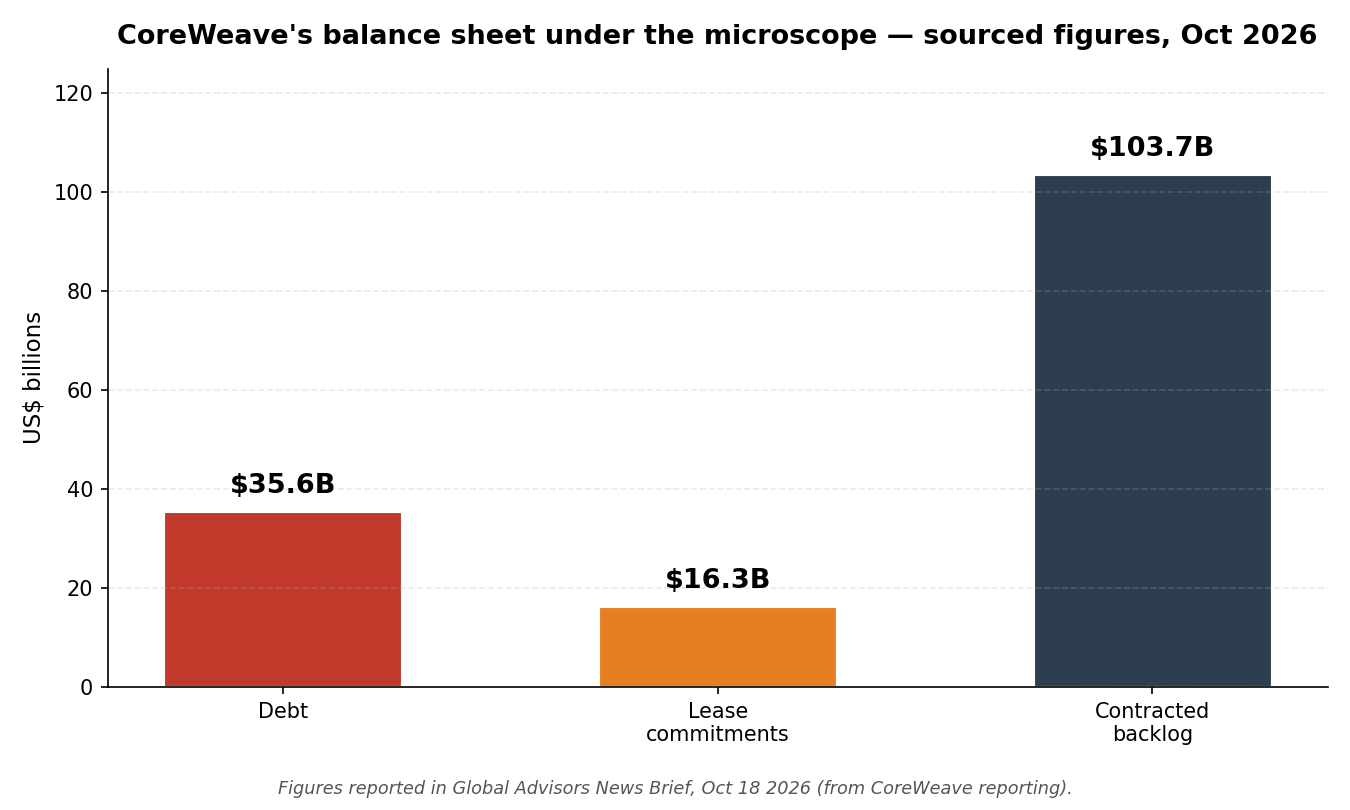
In October 2026, the coreweave stock news story flipped from an AI-infrastructure success tale into a cautionary lesson about debt. CoreWeave, the Nvidia-backed “neocloud” that rents GPU power to AI companies, watched its bond yields touch 15% while its shares slid sharply — as investors questioned whether $103.7 billion in contracted backlog can really service $35.6 billion in debt and $16.3 billion in lease commitments. Bond markets are now pricing the company like a distressed borrower, and its stock is trading more than 55% below its 52-week high. Here is what happened, why credit investors are so nervous, and what equity holders should watch next.

CoreWeave Stock News: The Week Bond Markets Lost Patience
The squeeze began in the credit market on October 13, 2026, when the yield on CoreWeave’s unsecured bonds reportedly touched 15%, according to a PR Newswire investigation notice published October 14. The equity market followed immediately: the next day, CoreWeave (NASDAQ: CRWV) opened at $71.79, down about 7.74% from the prior close of $77.81, and by midday the stock was down more than 15%.
Wednesday, October 14, was the worst of it. Reuters reported the shares dropped more than 15%, with a further 6% decline in premarket trading on Thursday — even as CEO Mike Intrator expressed confidence in the company’s customer contracts. By Thursday’s close, the 2031 and 2032 bond yields sat near 15%, and at one point yields on the bonds due 2031 climbed above 16%, while the 2032 notes traded below 80 cents on the dollar. Friday brought a partial bounce: shares rose 5.9% to close at $69.69 after reports that Nvidia offered reassurance about the company’s financial position — though that still left the stock down 21.1% over the prior four weeks. By Friday, October 16, shares had fallen again to $61.39.
The damage adds up fast. Before the selloff, CRWV had already fallen more than 45% below its 52-week high of $150.40. In the extended session during the worst of the slide, the stock traded as low as $65 — 53% off that high — and at $59.51 it hit its lowest daily low in a year. For scale, the company carries a market cap in the mid-$30-billion range, so each percentage-point move represents serious money.
CoreWeave in 60 Seconds
CoreWeave, founded in 2017 and headquartered in Livingston, New Jersey, is an AI “neocloud” — a cloud infrastructure company that provides high-performance computing resources, chiefly Nvidia GPUs, optimized for artificial intelligence, machine learning, and other heavy compute workloads. Its roughly 2,200 employees run data centers that rent GPU capacity to AI labs and enterprises, rather than selling software the way traditional cloud providers do.
The business model is capital-hungry by design: to meet surging AI demand, CoreWeave spends heavily on Nvidia chips, data centers, power, and networking — and it funds much of that expansion with borrowed money. Revenue has grown explosively (second-quarter 2026 revenue roughly doubled year over year to $2.575 billion), but the company is loss-making: the same quarter showed a $626 million net loss, driven largely by about $640 million in interest expense. An October 16 Fortune piece framed it as a loss-making AI neocloud and asked one of its investors how the company will climb out of the debt hole.
One term keeps appearing in every report: contracted backlog. CoreWeave defines it as remaining performance obligations plus other estimated amounts, subject to delivery — essentially the pipeline of signed customer contracts it has not yet fulfilled. The number, roughly $103.7–104 billion, is the centerpiece of the company’s defense. The question the bond market is asking: will that backlog convert into enough cash to service the debt that built it?
Why Bond Markets Are Nervous
The October 18 Global Advisors news brief summarized the market’s core worry: investors are scrutinizing whether $103.7 billion in contracted backlog can sufficiently service $35.6 billion in debt and $16.3 billion in lease commitments — roughly $52 billion in obligations. Here are the specific pressure points the market is pricing in:
The interest bill is enormous. CoreWeave’s second-quarter 2026 interest expense was about $640 million — more than its adjusted operating income, according to market coverage of the selloff. When a company pays more to service debt than it earns from operations, every refinancing round becomes a bigger gamble.
Capital spending keeps rising. During the August 11, 2026 second-quarter earnings call, management raised full-year capital-expenditure guidance from a range of $31–35 billion to $35–39 billion — an increase of about 10.8% at the midpoint, and more than double the $14.9 billion spent in 2025. Analysts called the investment cycle “more pronounced than expected.” And the company has already raised more than $35 billion this year.
The GPUs themselves may be worth less than assumed. Coverage of the selloff flagged a Gartner warning that most neocloud providers may not survive to 2030, partly because of aggressive assumptions about how long AI chips stay valuable: CoreWeave depreciates GPUs over about six years, while skeptics argue two to three years is more realistic for cutting-edge AI hardware. Reported depreciation of $1.3 billion against $2.57 billion of revenue underscores how fast the hardware eats the top line.
Default insurance is flashing red. Reuters reporting cited by market coverage shows the cost of insuring CoreWeave’s debt against default rising sharply — implying nearly a 63% chance of default within five years, compared with about 30% a year earlier. A 15%+ bond yield is the credit market’s way of saying it needs distressed-level compensation for the risk.
The filings say the quiet part out loud. CoreWeave’s own filings have flagged that if cash flows and capital resources prove insufficient to service debt, the company could be forced to delay investments, raise more debt or equity, or dispose of assets. That is standard boilerplate in leveraged companies — but investors tend to read it very carefully when yields are at 15%.
It is a useful moment to remember that managing debt aggressively matters for companies too — just with many more zeros attached. The bond market is essentially running the same calculation any household lender runs: can the borrower make the payments, and what happens if it can’t?

What This Means for Shareholders
For equity holders, the stock move has been brutal but not disorderly — it is a repricing, not a freeze. From a Friday close of $82.08 on October 9, the shares slid through $80.26, $77.81, and $65.78 by Wednesday, hit an intraday low of $59.51 on Thursday, then closed that day at $69.69 on the bounce before dropping to $61.39 on Friday. Trading volume exploded: Wednesday’s session saw over 111 million shares change hands against an average of about 34 million.
Three developments now sit directly on the shareholder-risk checklist:
1. A shareholder investigation was announced. On October 14, SueWallSt issued an investigation notice (carried by PR Newswire and Morningstar) concerning whether CoreWeave adequately disclosed the borrowing-cost and refinancing risk tied to its debt-funded expansion. Investigation notices like this are common after sharp selloffs and do not prove wrongdoing, but they signal that plaintiffs’ lawyers smell a disclosure fight.
2. Short sellers are circling. Short interest in CRWV sits around 17% of the float — an elevated level that shows a large cohort of investors is positioned for further decline. High short interest can fuel sharp rallies if news turns, but it is also a vote of no confidence from professional money.
3. The rate backdrop is not helping. The 10-year Treasury yield was forecast around 5.105% and the high-yield credit spread widened to 3.286% in mid-October. High rates punish leveraged growth stories first: refinancing gets more expensive, future cash flows get discounted more aggressively, and every incremental data-center dollar has to earn its keep faster. If you want context on how rate moves ripple through borrowing costs, see our explainer on the 2026 Fed rate hikes.
Bull Case vs Bear Case
Neither side of this debate is quiet. Here is what each camp is actually saying — reported positions, not analyst endorsements, and definitely not investment advice:
The bull case rests on the contracts. CEO Mike Intrator, in an internal memo reported by market coverage, called the market reaction “irrational” and pointed to the roughly $104 billion contracted backlog and customer commitments as the company’s defense. Nvidia’s reported reassurance about CoreWeave’s financial position triggered the 5.9% Friday bounce. The company is also expanding: a recent deal with AdaniConneX for a 240 MW AI data center at its Taloja campus in Navi Mumbai — set to deploy Nvidia’s Vera Rubin platform — shows hyperscaler-grade demand is still arriving. Bulls argue the backlog is real, the customers are real, and the bond market is confusing a funding problem with a business problem.
The bear case rests on the math. Bonds at 15–16% yields and 80 cents on the dollar, a 63% implied five-year default probability, a $640 million quarterly interest bill that outruns operating income, and a Gartner warning that most neoclouds may not survive to 2030. Bears argue the GPU collateral depreciates faster than assumed, refinancing needs will only grow as the $35–39 billion capex program continues, and the backlog is estimated future revenue — not cash. The stock’s 53% peak-to-trough slide, they say, is the market repricing financing risk, not overreacting to it.
What to Watch Next
Market coverage has converged on three near-term milestones that will decide whether this was a scare or a structural turn:
November quarterly results. The next earnings report is the first real test of the backlog thesis. Watch revenue conversion, cash generation, and — most importantly — any update on interest expense and refinancing plans, not just the top line.
Any refinancing moves. With yields at distressed levels, any new debt raise, bond buyback, asset sale, or credit facility will tell investors how management plans to bridge the gap. A refinancing at materially better terms would collapse the bear thesis quickly.
The March 2027 bond-document deadline. Market coverage flags a March 2027 bond-document and covenant test deadline as a potential line in the sand for the company’s debt structure. Miss a test, and the creditors get leverage.
The broader context matters too: the repricing has already spread to peers and lenders, with Nebius, Oracle, and Dell shares falling and questions mounting about private-credit exposure from insurers. CoreWeave is the stress test for the whole AI-infrastructure financing model — if the neocloud pioneer can’t fund itself cheaply, the cost of the entire AI buildout goes up. Credit markets reward borrowers who prove they can service obligations in any rate environment, which is why investors who study how creditworthiness is built and measured will recognize the same logic at corporate scale.
Frequently Asked Questions
Why is CoreWeave stock falling in October 2026?
CoreWeave’s bond yields touched 15% in mid-October 2026, and the stock followed: shares fell from about $82 to the low $60s in a week. Investors are questioning whether the company’s roughly $103.7 billion contracted backlog can service $35.6 billion in debt and $16.3 billion in lease commitments, especially as interest expense (about $640 million in Q2 2026) exceeds adjusted operating income.
How much debt does CoreWeave have?
Per the October 18, 2026 reporting, CoreWeave carries about $35.6 billion in debt plus $16.3 billion in lease commitments — roughly $52 billion in total obligations. The company has raised more than $35 billion in 2026 alone and guided full-year capital spending of $35–39 billion.
What is the chance CoreWeave defaults?
Market pricing of credit-default protection implied nearly a 63% chance of default within five years in mid-October 2026, up from about 30% a year earlier, according to Reuters-sourced market coverage. That is the bond market’s estimate, not a prediction — it reflects how much compensation investors currently demand for the risk.
Is CoreWeave profitable?
No. CoreWeave is a loss-making company: second-quarter 2026 revenue was about $2.575 billion (roughly double a year earlier), but the net loss was about $626 million, driven largely by roughly $640 million in interest expense. The company is often described as a loss-making AI “neocloud.”
What is CoreWeave’s contracted backlog?
CoreWeave defines contracted backlog as remaining performance obligations plus other estimated amounts, subject to delivery — essentially signed customer contracts not yet fulfilled. It stands at roughly $103.7–104 billion and is the centerpiece of management’s case that the company can grow into its debt load.
Should I buy CoreWeave stock now?
This article is news and analysis, not investment advice. The bull case points to the $104 billion backlog, Nvidia’s reassurance, and ongoing expansion; the bear case points to 15–16% bond yields, a 63% implied default probability, and rising refinancing costs. Anyone considering the stock should read the company’s filings, understand the leverage, and do their own research.
Conclusion
The October 2026 coreweave stock news story is really a story about the cost of money. CoreWeave built one of the world’s largest GPU clouds on borrowed funds, and for a while the market priced it on growth. In a single week, bond yields hit 15%, default-insurance pricing implied a 63% five-year default probability, and the stock lost more than half its value from its 52-week high. Management says the reaction is irrational and points to $104 billion in signed contracts; the credit market says contracts are not cash.
Both can be right for a while. What settles it is boring but decisive: November earnings, refinancing moves, and the March 2027 covenant tests. Until then, CoreWeave remains the market’s stress test for the entire AI-infrastructure boom — the clearest live example of what happens when the buildout of the future has to be financed in the present, at 15%.
Disclaimer: This post is news and analysis for general information only. It is not investment advice. Markets are volatile, and leveraged companies carry real risk — do your own research or consult a qualified financial adviser before making investment decisions.