

Why Starting Small Beats Waiting for “Enough” Money
If you want to start investing with little money, here’s the uncomfortable truth most beginners get backwards: the amount you start with matters far less than when you start. Someone who invests $200 a month starting at 25 will end up with dramatically more than someone who invests $400 a month starting at 35 — even though the second person puts in more cash overall. The difference is time, and time is the one ingredient you can never buy back.
This isn’t motivational fluff. It’s math. Money invested early compounds — your gains start generating their own gains, year after year (that’s how compound interest works). A dollar invested at 25 has 40 years to multiply. The same dollar invested at 35 has only 30. That missing decade is brutally expensive.
The good news? The barriers that kept small investors out are gone. Commissions are zero at most brokerages. Fractional shares let you buy a slice of a $500 stock with $5. And plenty of brokerages let you open an account with no minimum at all. If you’ve been telling yourself you’ll start “once you have real money,” this guide is your permission to stop waiting. And if you need to build up that first stake, side hustles you can start with no money can get you there faster.
How Much Money Do You Actually Need to Start?
Less than the cost of a pizza. Seriously.
Most major brokerages — Fidelity, Schwab, Robinhood, Vanguard — now offer fractional shares and $0 commissions on stock and ETF trades. That means you can buy $10 worth of an S&P 500 ETF instead of needing the full $500+ share price. Several brokerages have no account minimums at all.
The real question isn’t “how much do I need?” but “how much can I invest consistently?” Even $25 or $50 a month, invested automatically, builds genuine wealth over time. Consistency beats lump sums for beginners because it removes emotion from the equation — you buy every month whether the market is up or down.

7 Steps to Start Investing With Little Money
Step 1: Build a Mini Emergency Fund First
Before a single dollar goes into the market, park $500–$1,000 in a separate savings account. This is your shock absorber. Without it, the first car repair or medical bill forces you to sell investments at the worst possible moment — possibly at a loss. Investing money you might need within the next 3–5 years is speculation, not investing.

Step 2: Grab Your Employer’s 401(k) Match
If your job offers a 401(k) match, contribute enough to capture the full match before doing anything else. A 50% or 100% match is an instant 50–100% return — no investment on earth reliably beats free money. This one move is worth more than any stock pick you’ll ever make.
Step 3: Open the Right Account
Where you invest matters almost as much as what you buy, because taxes quietly eat returns. Here’s how the main options compare for a beginner starting small:
| Account | Best For | Tax Perk | 2026 Contribution Note |
|---|---|---|---|
| 401(k) | Employees with a company match | Pre-tax contributions lower today’s taxable income | Contribute at least enough for the full employer match |
| Roth IRA | Beginners and lower earners | Tax-free withdrawals in retirement | Ideal when you’re in a lower tax bracket now than you’ll be later |
| Taxable brokerage | Overflow after tax-advantaged accounts | No special perk, but no withdrawal rules | Maximum flexibility — use for goals before retirement |
For most beginners starting small, the winning order is: 401(k) up to the match → Roth IRA → taxable brokerage account. A Roth IRA is especially powerful when you’re young because decades of tax-free growth do the heavy lifting.
Step 4: Pick Simple, Diversified Investments
Forget stock picking. With a small account, your edge isn’t research — it’s diversification and low costs. One share of a total stock market index ETF (like VTI) or an S&P 500 ETF (like VOO) instantly spreads your money across hundreds of companies. If one company stumbles, you barely feel it.
A reasonable starter portfolio: 80–90% in a broad stock index fund, 10–20% in a bond index fund if you want a smoother ride. That’s it. Complexity is the enemy of the small account.
Step 5: Automate With Dollar-Cost Averaging
Dollar-cost averaging just means investing a fixed amount on a fixed schedule — say $100 every payday — no matter what the market is doing. When prices drop, your $100 buys more shares. When prices rise, it buys fewer. Over time, this smooths out your average cost and, more importantly, removes the temptation to time the market. Set up automatic transfers and then try to forget the account exists.
Step 6: Keep Fees Near Zero
Fees are termites. A 1% annual fee sounds tiny, but over 30 years it can devour roughly a quarter of your returns. With a small account, fees hurt even more because they’re a bigger slice of a small pie. Choose funds with expense ratios under 0.10% — many broad index ETFs charge 0.03% or less. And never pay a commission to buy a stock or ETF in 2026; free trading is the industry standard.
Step 7: Increase Contributions Over Time
Start where you are — even $25 a month. Then raise it gradually: bump contributions 1% of your income each quarter, or divert half of every raise into investments. Lifestyle creep is the silent killer of wealth; automating increases before you get used to the extra money defeats it.
What $200 a Month Actually Becomes
Let’s make compounding concrete. Assuming a 7% average annual return (below the stock market’s long-term historical average of ~10%, to stay conservative), here’s what $200 a month grows into: $34,617 after 10 years, $104,185 after 20 years, and $243,994 after 30 years — from total contributions of just $24,000, $48,000, and $72,000 respectively.
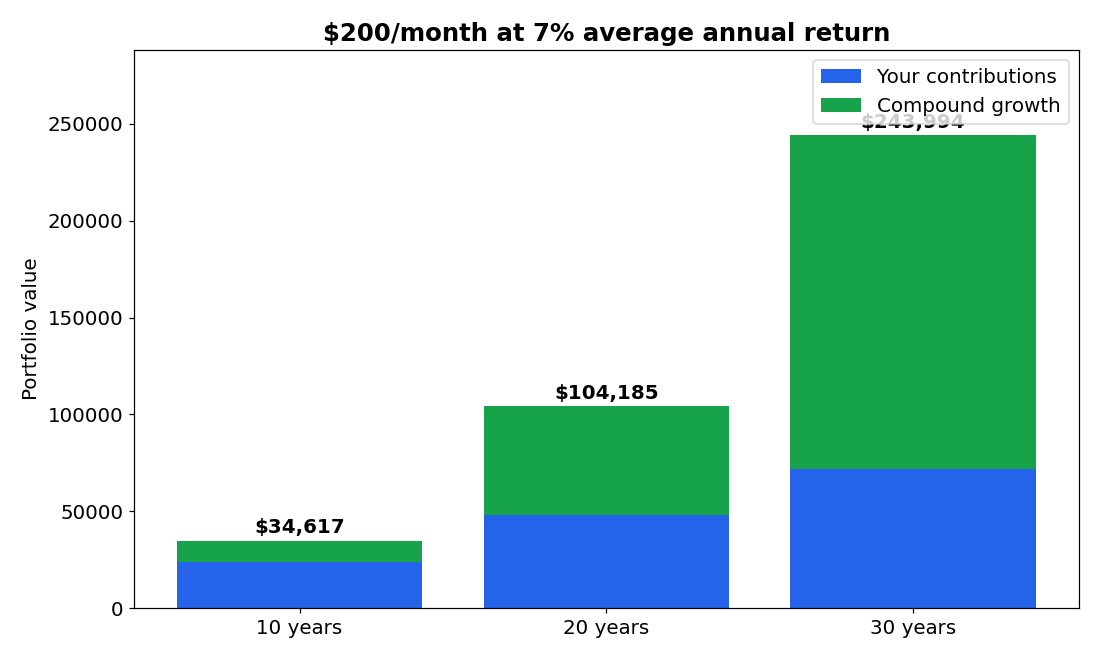
The pattern is the whole lesson: in the first decade, most of the balance is your own contributions. By decade three, growth has taken over — your money is earning more than you are putting in. That’s why starting at 25 with $200 beats starting at 35 with $400. Time does the heaviest lifting, and it’s free.
5 Mistakes That Kill Small Accounts
1. Trading instead of investing. Buying and selling frequently racks up taxes and bad timing decisions. Studies consistently show active traders underperform patient index investors.
2. Panic-selling during dips. Every market crash in history has eventually recovered. Investors who sold during downturns locked in losses; those who kept buying through them bought at a discount.
3. Chasing hot tips. By the time a “can’t-miss” stock reaches you, the easy gains are gone. If you don’t understand what a company does, don’t buy it.
4. Ignoring the emergency fund. Investing without a cash buffer means the next surprise expense becomes a forced sale — often at a loss.
5. Waiting for the “right time.” There is no right time. Money invested across decades smooths out any single bad entry point. The best day to start was years ago; the second-best day is today.
Frequently Asked Questions
How much money do I need to start investing?
As little as $1. Most major brokerages have no minimums and offer fractional shares, so you can start with whatever you have. The habit of investing regularly matters far more than the starting amount.
What’s the safest investment for a beginner?
A diversified total stock market or S&P 500 index fund is the standard starting point. No investment is risk-free, but broad diversification across hundreds of companies eliminates the risk of any single company wiping you out, and the market has never lost money over any 20-year period.
Should I pay off debt before investing?
Always capture your 401(k) employer match first — it’s free money. Then prioritize high-interest debt (above ~6–7%) before investing more, since guaranteed 7%+ “returns” from killing high-interest debt beat uncertain market returns. Low-interest debt like most mortgages can run alongside investing.
Is it better to invest a lump sum or a little each month?
For beginners, a little each month (dollar-cost averaging) wins on psychology: it’s automatic, it removes timing decisions, and it keeps you investing through downturns when shares are cheapest.
Can I lose all my money in index funds?
In practical terms, no. A total-market index fund holds thousands of companies; losing everything would require the entire economy to permanently collapse — in which case your savings account wouldn’t save you either. Short-term drops of 20–50% are normal and have always recovered.
Do I need a financial advisor to start?
No. A beginner with a small account doesn’t need an advisor — a low-cost index fund portfolio and automatic contributions cover 95% of what matters. Advisors become worth considering at higher asset levels or for complex tax situations.
The Bottom Line
Starting to invest with little money isn’t a handicap — it’s the normal way wealth gets built. Open an account with no minimum, automate a small monthly contribution into a diversified index fund, keep fees near zero, and give compounding decades to work. Ten years from now, you’ll be glad you started with $50 instead of waiting until you had $5,000. The market rewards patience, not starting capital.
Disclaimer: This article is for educational purposes only and is not financial advice. Investing involves risk, including possible loss of principal. Consider consulting a qualified financial professional for advice tailored to your situation.




[…] and plant one passive seed (templates, print-on-demand). Once the money starts coming in, learn how to start investing with little money so your earnings keep growing on their own. A year from now, the only regret is starting […]
[…] that same 20% becomes your wealth-building engine. It does not take much to begin: our guide on how to start investing with little money shows how small, consistent contributions compound over time. Budgeting on a low income is not the […]
[…] sitting in emergency savings earns modest interest; money you don’t need as a buffer could be invested for long-term growth or used to pay off high-interest debt fast. The fund is insurance, not an investment — size it […]
[…] actively managed funds. If you’re still building your financial foundation, our guide on how to start investing with little money pairs well with this […]