

Best Morning Routine for Night Shift Workers: A Step-by-Step Wind-Down Guide
Your alarm goes off at 7 a.m. — except for you, that’s bedtime. If you work nights, your “morning” starts when everyone else is pouring their first coffee, and the routine you follow in those first 90 minutes home decides whether you get real, restorative sleep or five groggy hours of tossing under thin curtains. This guide walks through the best morning routine for night shift workers: a practical wind-down sequence built around the three things that matter most for daytime sleep — light control, a light recovery meal, and a consistent ritual that tells your brain the day is done.
Here’s the honest truth up front: no routine fully erases the challenge of sleeping against your body clock. But nurses, warehouse crews, security guards, and factory teams have been refining this playbook for decades, and the difference between workers who protect their sleep and those who wing it is enormous. Let’s build yours.
Why night shift mornings are a different game
Day workers fall asleep with biology on their side. Darkness triggers melatonin, core body temperature drops, and the world goes quiet. You get none of that at 8 a.m. Instead you get bright daylight working directly against your body clock — light is the strongest signal telling your brain to stay awake, and morning sun is the strongest light there is.
That’s why the standard advice (“just go to bed when you get home”) fails so many night shift workers. Your body isn’t winding down; it’s ramping up. Cortisol rises in the morning, traffic starts, phones buzz, and your bedroom fills with light. A good routine doesn’t fight this with willpower — it removes the wake-up signals one by one until sleep becomes the path of least resistance.
Think of your post-shift morning as the mirror image of an evening routine. A day worker dims lights, eats dinner, and relaxes before bed. You do the same thing — just at 7 a.m. The structure below takes about 90 minutes from door to pillow, and every step has one job: lowering the volume on the waking world.
The best morning routine for night shift workers: your 90-minute wind-down
Below is the full sequence. It’s designed to fit the gap between walking through your front door and falling asleep — roughly 90 minutes. Some people compress it to an hour; the order matters more than the exact timing.
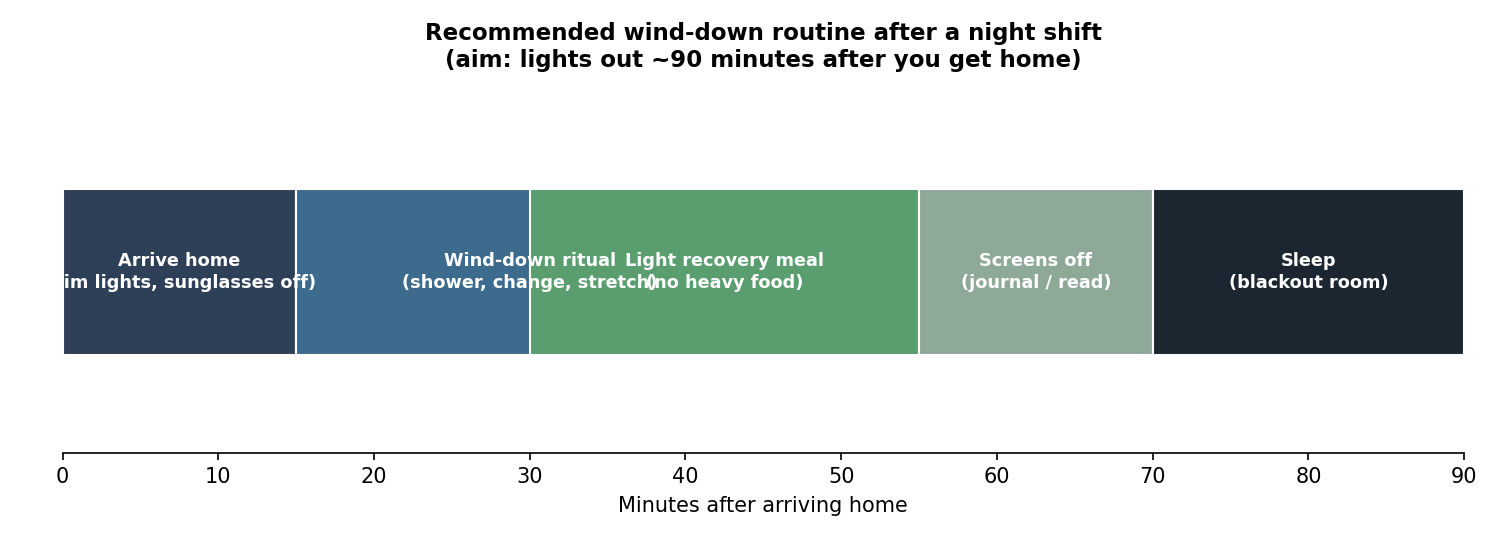
Step 1: Block the light before you even get home (0–15 minutes)
Your wind-down starts on the commute, not at your front door. Morning sunlight hitting your eyes tells your brain to suppress melatonin and fully wake up — exactly what you don’t want twenty minutes before bed. The standard fix is simple: wear dark sunglasses on the drive or walk home, even on cloudy days. Many sleep specialists who work with shift workers recommend this as the single highest-impact habit, because it’s the only step that protects you during the brightest part of your morning.

When you walk in, keep the house dim. Don’t flip on every overhead light. If you live with day-shift people, this is worth a calm conversation in advance — ask for low lamps instead of full kitchen fluorescents during your wind-down window. Blackout curtains in the bedroom matter enormously, but they can’t help if you spend 45 minutes under bright lights first.
Step 2: Run a real wind-down ritual (15–45 minutes)
After a night of physical or mental intensity, your nervous system is still in work mode. You need a decompression ritual — the same three or four calming actions, in the same order, every single day. Consistency is the point: after a week or two, your brain starts associating the sequence with sleep the way it associates a bedtime story with sleep for a child.
A solid ritual looks like this: hot shower, change into dedicated sleep clothes (not the T-shirt you lounged in yesterday), ten minutes of gentle stretching or slow breathing, and something quiet and analog. This is a good slot for starting a simple journaling habit — dumping tomorrow’s to-do list and today’s lingering thoughts onto paper gets them out of your head before the pillow. Reading a physical book works too. Little choices like these are what make the best morning routine for night shift workers stick. What doesn’t work: “relaxing” with your phone, which we’ll get to.
Step 3: Eat a light recovery meal (45–70 minutes)
You probably haven’t eaten a real meal in six or seven hours, and going to bed genuinely hungry makes sleep shallow. But a heavy, greasy plate at 8 a.m. is just as bad — your digestive system is also on a circadian rhythm, and a big meal close to sleep can leave you uncomfortable and restless.
Aim for something light, warm, and easy: oatmeal with banana, eggs on toast, yogurt with berries, a bowl of soup. Think breakfast-sized, not dinner-sized. Keep caffeine out of this window entirely — coffee at 7 a.m. might feel necessary on the drive home, but its half-life means it’s still in your system at 2 p.m. If you need something warm in your hands, make it herbal tea or just hot water with lemon.

One more thing about timing: try to finish eating at least 20–30 minutes before you plan to sleep. That small buffer lets the “I’m full and comfortable” signal settle in rather than competing with the “I’m trying to fall asleep” signal.
Step 4: Screens off, brain off (70–85 minutes)
This is the step everyone knows and nobody does. Screens are uniquely bad before daytime sleep for two reasons: the blue-wavelength light suppresses melatonin, and the content — news, social feeds, group chats — is engineered to keep your brain alert and emotionally engaged. Doomscrolling at 8:30 a.m. after a night shift is practically a recipe for lying awake until noon.
Set a hard rule: no phone in the bedroom, or at minimum face-down on do-not-disturb across the room. Tell friends and family your sleep hours clearly and repeatedly — most “urgent” daytime interruptions come from people who simply forgot you’re asleep. A cheap alarm clock removes the last excuse for keeping the phone by the bed.
Step 5: Sleep in a proper cave (85–90 minutes)
Your bedroom needs to impersonate midnight. That means blackout curtains or a good sleep mask (curtains are better, because masks slip), the room cool — most people sleep best a few degrees cooler than their daytime comfort zone — and steady background sound to mask daytime noise. A fan, a white-noise machine, or even a simple app on an old phone works. Earplugs are the backup plan, though many people find them uncomfortable for a full sleep stretch.
Keep the room reserved for sleep. If your bedroom doubles as a home office or TV room, your brain never fully files it under “sleep happens here.” It’s a small psychological shift, but shift workers who protect the bedroom as a sleep-only zone tend to fall asleep faster — there’s a reason standard sleep hygiene guidance keeps repeating it.
Before daytime sleep: what helps vs. what hurts
Once the routine is in place, most sleep problems come down to a handful of repeat offenders. Here’s the quick-reference version:
| Do this | Not this |
|---|---|
| Wear sunglasses on the commute home | Walk or drive home squinting into morning sun |
| Eat a light meal: oatmeal, eggs, yogurt, soup | A heavy fried breakfast or fast food right before bed |
| Cut caffeine at least 6 hours before sleep | “One more coffee” to get through the drive home |
| Keep the same sleep schedule, even on days off (as close as you can) | Flipping to a day schedule every weekend |
| Use blackout curtains + white noise | Thin curtains and “I’ll sleep through the noise” |
| Phone on do-not-disturb, out of the bedroom | Scrolling in bed “just for five minutes” |
| A short, consistent ritual: shower, stretch, journal | Collapsing straight into bed still wired from work |
| Talk to your household about quiet hours | Hoping everyone just figures it out |
The caffeine row deserves emphasis because it’s the most common self-sabotage. Night shift workers often drink coffee late in the shift to stay sharp, then wonder why they’re staring at the ceiling at 10 a.m. The CDC’s guidance for shift workers flags stimulant timing as one of the basics worth getting right — front-load your caffeine early in the shift and taper off well before quitting time.
Keeping the routine on your days off
Here’s where most routines die. You work four nights, then on Friday you stay up all day to see your family, sleep Friday night like a day person, and spend Sunday night staring at the ceiling dreading Monday. Every flip of your schedule is effectively jet lag you gave yourself on purpose.
Protecting the best morning routine for night shift workers on your days off matters as much as the routine itself. The ideal is boring: keep roughly the same sleep window on days off. If you sleep 8 a.m.–3 p.m. on workdays, aim for something like 9 a.m.–4 p.m. on days off rather than flipping to midnight–7 a.m. You don’t have to be perfect — social and family life is real, and total rigidity will make you miserable. But every hour closer to your work schedule is an hour less of adjustment when the next shift block starts.
Use your waking hours on days off intentionally, too. Many night shift workers find their quiet morning-waking hours (late afternoon) are their most focused time of day — good for errands, exercise, or low-effort side hustles that don’t demand a 9-to-5 schedule. And get some daylight: a walk in the afternoon sun helps anchor your body clock and makes the next night’s sleep come easier. Light is a tool — you just want it in the afternoon, not at 7 a.m.
Frequently asked questions
How many hours of sleep does a night shift worker need?
The same as everyone else: most adults do best with around 7–9 hours. Night shift workers often get less, not because they need less but because daytime sleep gets interrupted — which is exactly what the light-blocking and noise steps above are designed to prevent. Protect the full window; don’t assume you’ll “catch up” later.
Should I really wear sunglasses on the way home?
Yes — it’s one of the simplest, most widely recommended habits for night shift workers. Bright morning light is the strongest “stay awake” signal your brain receives, and blocking it during your commute keeps your body in wind-down mode instead of flipping into daytime alertness right before bed.
Is it bad to eat a big meal after a night shift?
A heavy meal close to sleep can make it harder to fall asleep and stay asleep, since digestion stays active. Eat — going to bed hungry isn’t good either — but keep it light and give yourself 20–30 minutes before lying down. Save the big celebratory breakfast for a day off when you don’t need to sleep right after.
Should I keep my night schedule on days off?
As close as you reasonably can. Staying near your work sleep window avoids the repeated “jet lag” of flipping back and forth, which is one of the hardest parts of shift work. If family or social plans pull you toward daytime hours, compromise partway rather than flipping completely — and get back on schedule the day before your next block.
Do blackout curtains actually make a difference?
For the best morning routine for night shift workers, they’re one of the highest-impact changes you can make. Daylight suppresses melatonin and signals wakefulness, so a dark room removes the single biggest obstacle to daytime sleep. If new curtains aren’t in the budget right now, a well-fitting sleep mask is a solid stopgap.
What if I still can’t fall asleep after doing everything right?
First, don’t lie in bed frustrated — get up, go to another dim room, and do something boring until you feel drowsy, then try again. Second, look for the leak: late caffeine, a bright commute, or an inconsistent schedule are the usual culprits. If sleeplessness persists for weeks despite a solid routine, that’s worth discussing with a doctor rather than powering through.
The bottom line
The best morning routine for night shift workers isn’t complicated — it’s just deliberate. Block the light on your way home. Run the same calming ritual every day. Eat something light. Put the phone away. Sleep in a dark, cool, quiet room. None of these steps is heroic on its own, but together they do something powerful: they give your body the consistent “the day is over” signal it needs to do the one thing morning light is telling it not to do.
Start with the two highest-impact changes — sunglasses on the commute and real blackout curtains — and add the rest over a week or two. Your future self, waking up at 3 p.m. actually rested, will thank you.




[…] wind-down. If you work nights, a short journaling session can be a genuinely calming part of your wind-down routine for night shift workers, helping your brain switch off after a […]
[…] you work night shifts or rotating schedules, consistency matters even more: anchor your sleep window as firmly as your job allows, and use […]