

How to Start Journaling for Beginners: A No-Pressure Guide That Actually Sticks
You already know how to start journaling for beginners in theory: buy a notebook, open it, write. And yet that notebook is probably sitting in a drawer right now with three entries in it, all from the same week. You are not lazy and you are not doing it wrong. You were just handed a method that was never designed for beginners — long, daily, essay-style entries with no structure and no mercy for missed days. This guide replaces all of that with a no-pressure system built around one-minute entries, ready-made prompts, and honest fixes for the exact mistakes that make most beginners quit within a week.
There is no perfect journal, no magic time of day, and no minimum word count here. There is only a pen, a few minutes, and a system small enough that you will actually keep doing it.
Why Most Beginners Quit Journaling Within a Week
Before we talk about what works, it helps to name what usually goes wrong. Almost every abandoned journal dies from one of these five mistakes:
- Starting with a blank page and zero direction. “Dear diary, today I…” is where motivation goes to die. Without a prompt, every entry feels like homework.
- Buying supplies instead of building the habit. The $40 leather journal and the set of fineliners feel like progress. They are not. They raise the stakes so high that a messy first entry feels like ruining something precious.
- Writing essays. Beginners assume an entry should be a page or more. It does not. Length is the number-one killer of new journaling habits.
- Demanding a perfect streak. Miss one day, feel guilty, miss three more days, quit. The streak mindset turns a helpful tool into a source of shame.
- Comparing to aesthetic journals online. Those watercolor spreads with washi tape are art projects, not journals. Your journal’s only job is to hold your thoughts, not to look good on camera.
The system below is engineered to dodge every one of these. It starts tiny, stays ugly on purpose, and treats missed days as completely normal.
How to Start Journaling for Beginners: The One-Minute System
Forget everything you have seen about journaling routines. Your only goal for the first two weeks is this: write for one minute, most days. That is the whole system. Here is how it works.
The One-Minute Entry Template
Each entry has exactly three lines. Fill in whatever comes to mind — fragments are fine, bad spelling is fine, honesty matters more than grammar.
- Line 1 — Today: one thing that happened. (“Long meeting ran over. Ate leftovers standing up.”)
- Line 2 — Feeling: one honest word or phrase about your state. (“Drained but relieved it’s Friday.”)
- Line 3 — Noted: one thing you want to remember, decide, or let go of. (“Call the dentist. Stop replaying that email.”)

That is a complete entry. It takes about sixty seconds, and it still captures the three things journals are actually for: recording your life, naming your feelings, and parking the thoughts that loop in your head at 2 a.m.
The best journal is the one you will actually open. A cheap notebook you write in beats a beautiful one you are afraid to touch.
When and Where to Do It
Attach journaling to something you already do — this is called habit stacking, and it works far better than relying on motivation. Keep the journal and pen wherever that anchor moment happens: next to the coffee maker for a morning minute, on the nightstand for an evening wind-down. If you work nights, a short journaling session can be a genuinely calming part of your wind-down routine for night shift workers, helping your brain switch off after a shift.
When figuring out how to start journaling for beginners, visibility matters more than timing. A journal you can see gets used; a journal in a drawer gets forgotten. Leave it out. Let it look a little messy. That is the point.
5 Beginner Journaling Methods Compared
Once the one-minute habit feels easy — usually after a couple of weeks — you might want a little more structure. Here are the five most beginner-friendly methods, compared honestly so you can pick the one that fits your life.
| Method | Daily time | Cost | Best for |
|---|---|---|---|
| One-minute log | ~1 minute | Any notebook | Building the habit with zero pressure |
| Gratitude list | ~5 minutes | Any notebook | Shifting focus on stressful days |
| Prompted journaling | ~10 minutes | Any notebook | People who freeze at blank pages |
| Free writing | ~15 minutes | Any notebook | Processing emotions and untangling thoughts |
| Bullet journal | ~20 minutes | Notebook + pen | Organizers who want tasks and notes in one place |
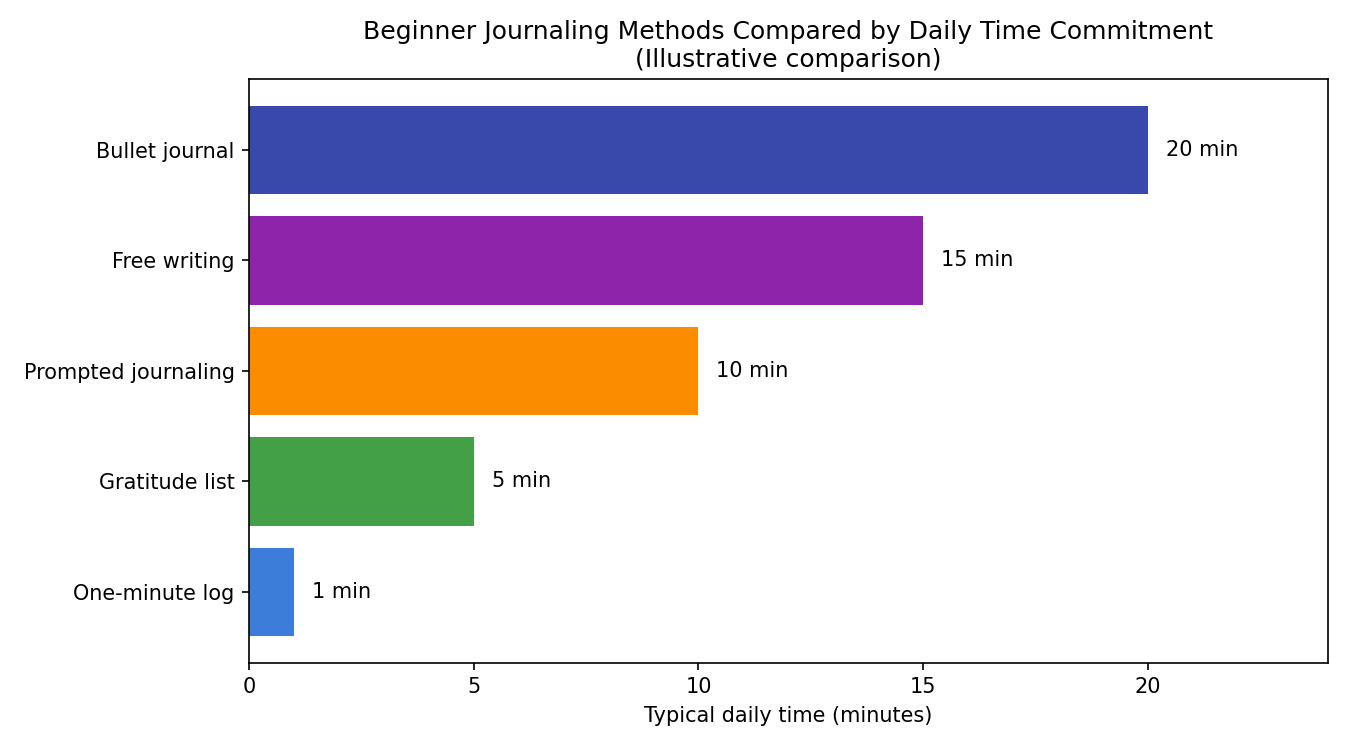
A few notes on the table. Every method works with the cheapest notebook you own — do not let anyone tell you that you need special supplies. The bullet journal method is the most structured of the five and doubles as a planner, which is great if your journal keeps turning into a to-do list anyway. Gratitude journaling has been covered extensively by researchers at UC Berkeley’s Greater Good Science Center, and it is the easiest upgrade from the one-minute log: just add three things you are grateful for as your third line.
Free writing deserves a special mention. The idea comes from morning pages, popularized by Julia Cameron — three pages of unfiltered, unedited writing. You do not need three pages as a beginner. Start with ten minutes and a timer, and stop when it rings.
30 Ready-Made Journal Prompts for Beginners
The blank page is the enemy, so here is your ammunition. Pick one prompt per entry — never try to answer several. For a deeper collection of guided prompts, journaling prompts from PositivePsychology.com are a solid free resource.
Morning prompts (2 minutes)
- What is one thing I want to get done today, and why does it matter?
- How did I sleep, and what does my body need this morning?
- What am I looking forward to today, however small?
- What is one worry I can set aside until later?
- What would make today feel like a win?
- Who do I want to be kinder to today, including myself?
Evening prompts (wind-down)
- What is one moment from today I want to remember?
- What drained me today, and what gave me energy?
- What did I learn — about work, people, or myself?
- What is still on my mind that I can write down and release?
- What am I grateful for right now? (Name three.)
- What is one thing I would do differently tomorrow?
Prompts for tough days
- What is the story I am telling myself right now — and is it definitely true?
- What would I say to a friend going through exactly this?
- What is one small thing within my control today?
- What do I need most right now: rest, action, or comfort?
- What has helped me through hard days before?
- What can I let go of, even just for tonight?
Prompts for ideas and growth
- What is an idea I keep coming back to?
- What skill would I love to have a year from now?
- What is something I believed last year that I see differently now?
- If money were no object for one month, what would I try?
- What is a small risk worth taking this week?
- What does my ideal ordinary Tuesday look like?
Prompts for money and work
- Where did my money actually go this week?
- What is one work task I keep avoiding, and what is the smallest first step?
- What would I do with an extra $200 a month?
- What is a side project I could start with zero budget?
- What financial decision am I proud of lately?
- What does “enough” look like for me right now?
That last category is more useful than it looks. Plenty of people use a journal to think through practical plans — from brainstorming side hustles you can start with no money to clarifying why they want to start investing with little money. Writing forces vague intentions into concrete next steps.
The 7 Mistakes That Make Beginners Quit (and What to Do Instead)
- Mistake: Writing for an audience. If you imagine someone reading it, you will censor yourself and the journal becomes useless. Fix: write as if the pages self-destruct. They are yours alone.
- Mistake: Rereading and judging old entries. Cringing at last month’s entries makes you stop writing new ones. Fix: do not reread for the first 90 days. The value is in the writing, not the archive.
- Mistake: Journaling only when life is dramatic. Then the journal becomes a misery log and you avoid it. Fix: write on boring days too — especially boring days. Ordinary life is most of life.
- Mistake: No dedicated spot for the journal. Hunting for it every evening adds just enough friction to kill the habit. Fix: one visible home for the journal and pen. Always.
- Mistake: Trying to fix your whole life in one entry. Overwhelm leads to avoidance. Fix: one prompt, one entry, done. Small and finished beats big and abandoned.
- Mistake: Treating a missed day as failure. This is the big one. Fix: decide in advance that missing days is allowed. The rule is “most days,” not “every day.” A journal with gaps is infinitely better than a journal in a drawer.
- Mistake: Waiting until you “feel like it.” You rarely will, especially at first. Fix: shrink the task until resistance disappears. One minute is almost always doable — and starting is the hard part, not continuing.

Paper vs. Digital: What Should You Use?
Honest answer: whichever one you will actually open. Paper has real advantages for beginners — no notifications, no battery, and handwriting naturally slows you down, which helps you think. A basic lined notebook and a pen you like are genuinely all you need.
Digital has its place too. A notes app on your phone means you can journal anywhere, and search makes old entries findable. The downside is distraction: opening a journaling app next to your messages and social feeds takes discipline most beginners do not have yet.
My suggestion for how to start journaling for beginners: start on paper for the first month. It removes every excuse related to screens and keeps the ritual tactile and simple. You can always switch later — the habit is the asset, not the medium.
How to Make Journaling Stick Past Week One
Once you understand how to start journaling for beginners, week one runs on novelty. Week two and beyond run on design. Here is the maintenance plan:
- Keep the bar embarrassingly low. One minute is always allowed, even on month six. You can write more whenever you want, but you never have to.
- Stack it on an existing habit. Coffee, lunch, bedtime — pick one anchor and never journal “whenever.”
- Forgive gaps immediately. Missed four days? The next entry is just… the next entry. No catch-up, no guilt paragraph.
- Review monthly, not daily. Once a month, skim the past weeks. You will be amazed how much you have forgotten — and how clearly you can see patterns in your energy, spending, and moods.
- Upgrade only when bored. When one-minute entries feel too small, try the prompt lists or a longer method from the comparison table. Let the habit grow instead of forcing it.
Researchers have studied expressive writing — the practice of writing about thoughts and feelings — for decades, and the American Psychological Association has covered this body of research. You do not need to understand the science to benefit from it. You just need a pen and sixty seconds.
FAQs About Starting a Journal
How long should I journal each day as a beginner?
One to five minutes is plenty. The biggest beginner mistake is assuming entries need to be long. Short, regular entries build the habit; length can come later if you ever want it.
What do I write about if nothing happened today?
Write about the nothing. “Quiet day. Work was fine. Walked after dinner. Thinking about the weekend.” Ordinary entries are the backbone of a journal — and they are often the most interesting to reread months later. When in doubt, use a prompt from the list above.
Is it better to journal in the morning or at night?
Neither is objectively better — the best time is the one you will actually do consistently. Morning entries tend to focus on intentions for the day; evening entries tend to process what happened. Try each for a week and keep the one that sticks.
Do I need an expensive journal to start?
No. Any notebook works, including a $2 one. Expensive journals can actually hurt beginners by making the first messy entry feel like vandalism. Start cheap; upgrade later if you want to, once the habit is solid.
What if someone reads my journal?
This fear stops more beginners than any other. Practical fixes: keep it somewhere private, skip names when writing about people, or use a lockable notebook or password-protected app. And remember — writing honestly is the entire point. A censored journal helps no one.
How is journaling different from just thinking?
Thinking loops; writing lands. When thoughts stay in your head, they circle. When you write them down, you have to choose words, and choosing words forces clarity. That is why a one-minute entry can untangle something you have been turning over for days.
Conclusion: Start Ugly, Stay Honest
Learning how to start journaling for beginners is not about finding the perfect notebook, the perfect pen, or the perfect routine. It is about lowering the bar until the habit is almost impossible to fail: one minute, three lines, most days. Use the prompts when the page feels blank. Forgive every missed day without a second thought. Let the entries be messy, boring, and short.
Do that for a month and something quiet happens. You start noticing patterns — what drains you, what energizes you, what you actually want. The journal stops being a task and becomes a conversation with yourself. And it all starts with sixty seconds and an ugly first page. Open the notebook tonight.




[…] of gentle stretching or slow breathing, and something quiet and analog. This is a good slot for starting a simple journaling habit — dumping tomorrow’s to-do list and today’s lingering thoughts onto paper gets them […]
[…] the ritual — everything else is preparation for it. If journaling helps you think, our guide on how to start journaling for beginners pairs well with this […]