

One bad week abroad — a cancelled flight, a hospital visit, a stolen bag — can turn a $4,000 trip into a $40,000 disaster. That’s why choosing the best travel insurance for international travel matters more than most travelers admit: the right plan is a few hundred dollars of protection against five-figure surprises. But the market is a maze of tiers, limits, and fine print. This guide compares seven genuinely good plans — what each one is best for, what it actually covers, and what it really costs — using current 2026 data so you can pick with confidence.

How Much Does Travel Insurance Cost in 2026?
Before comparing plans, anchor your expectations: comprehensive travel insurance typically costs 4% to 10% of your prepaid, non-refundable trip costs, according to Squaremouth’s 2026 cost analysis. Their sales data puts the average policy at $314 for a 15-day trip — roughly $21 per day. A $5,000 trip therefore runs about $200 to $500 to insure.
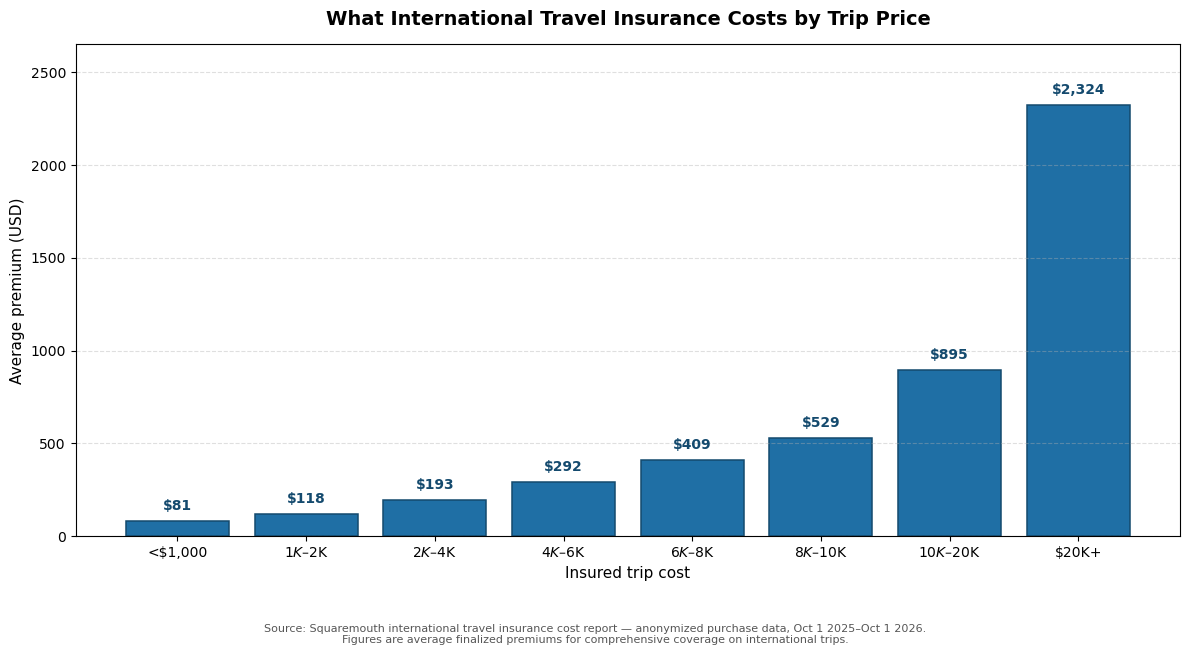
The relationship between trip cost and premium is nearly linear, as Squaremouth’s international travel insurance cost report shows (based on actual purchases from October 2025 to October 2026):
The 7 Best Travel Insurance Plans for International Trips
There is no single “best” plan — only the best plan for your trip. An adventure trekker and a retired couple on a cruise need completely different coverage. Here is what each of these seven well-established providers is best for, with real coverage tiers so you can compare honestly.
1. World Nomads — Best for Adventure Travelers
If your itinerary involves scuba diving, trekking, or skiing, start here. World Nomads covers 250+ activities on its Standard plan and 300+ on Explorer, and you can buy or extend coverage while already abroad — a rare flexibility. For US residents, the tiers break down as: Standard ($125,000 emergency medical, $400,000 evacuation, $2,500 trip cancellation), Explorer ($150,000 medical, $500,000 evacuation, $10,000 cancellation), and Epic ($250,000 medical, $700,000 evacuation, $15,000 cancellation), per current plan comparisons. Explorer and Epic also offer optional Cancel For Any Reason add-ons (50% and 75% reimbursement respectively). The trade-off: trip-cancellation limits are modest compared to cancellation-focused insurers, so it’s ideal when the activities are the risk, not the prepaid costs.
2. SafetyWing — Best for Digital Nomads and Long Trips
SafetyWing’s Nomad Insurance works like a subscription: rolling 4-week coverage (from about $62.72 per 4 weeks for ages 18–39) across 185+ countries, which you can start and stop as you travel. The Essentials tier offers around $250,000 in emergency medical coverage with a $100,000 lifetime evacuation limit. It’s not the plan for a $15,000 prepaid honeymoon — trip-cancellation benefits are limited — but for months-long, multi-country travel where medical coverage is the priority, the price-to-flexibility ratio is hard to beat. Note the evacuation cap is lower than competitors, so pair it with a dedicated evacuation membership if you’re heading somewhere truly remote.
3. Allianz Travel — Best for Trip Cancellation Protection
Allianz is the cancellation specialist: its OneTrip tiers scale trip-cancellation limits from $10,000 (Basic) up to $100,000 (Prime) and $200,000 (Premier), with emergency medical of $10,000/$50,000/$75,000 and evacuation of $50,000/$500,000/$1,000,000 respectively. Kids 17 and under are covered free on many plans when traveling with a parent or grandparent. Allianz’s annual plans are also worth a look if you take three or more trips a year — one yearly premium often undercuts three single-trip policies. Choose Allianz when your biggest risk is losing prepaid, non-refundable trip costs.
4. AXA Assistance — Best for Emergency Evacuation
Medical evacuation is the scariest line item in travel — a single air ambulance can top $100,000 — and AXA leads here with evacuation limits up to $1,000,000 including security evacuation on its higher tiers, alongside around $250,000 in emergency medical coverage. Cancel For Any Reason is available as an add-on. If you’re traveling to regions with limited hospital infrastructure — parts of Africa, Central Asia, remote Pacific islands — AXA’s evacuation strength is the feature that matters most.
5. Tin Leg — Best for High Medical Limits (Including Seniors)
Tin Leg’s Gold plan pairs a $500,000 emergency medical limit with $250,000 evacuation and CFAR availability, and the company is notably friendly to older travelers, offering plans to travelers up to age 99 — well beyond many competitors’ cutoffs. Trip-cancellation coverage is solid rather than chart-topping. If you’re over 65 and finding that other insurers quietly price you out or cap your medical limits, Tin Leg deserves the first quote.
6. Seven Corners — Best for Long-Term and Complex Trips
Seven Corners specializes in trips that don’t fit the standard two-week mold: semesters abroad, sabbaticals, and multi-month journeys. Its plans offer medical limits from $250,000 up to $1,000,000, evacuation up to $1,000,000, and CFAR options. The company’s long-term medical plans are a frequent pick for expatriates and extended-stay travelers who need something between vacation insurance and full expat health coverage.
7. Faye — Best Modern, App-First Experience
Faye is the newcomer built for people who expect insurance to work like an app: instant reimbursements through the Faye Wallet, proactive delay detection, and 24/7 human assistance. Coverage is genuinely competitive — medical limits of $250,000 to $500,000, evacuation up to $1,000,000, CFAR available — backed by an A.M. Best A+ rated underwriter. If you’ve ever dreaded the paperwork of a traditional claim, Faye’s digital-first experience is the differentiator.

Side-by-Side Comparison
Limits vary by plan tier and your state or country of residence — always confirm the current figures in the policy wording before you buy. This table uses each provider’s representative mid-to-upper tier for international trips:
| Provider | Best for | Emergency medical | Evacuation | Trip cancellation | CFAR available |
|---|---|---|---|---|---|
| World Nomads | Adventure activities | $125K–$250K | $400K–$700K | $2.5K–$15K | Yes (Explorer/Epic) |
| SafetyWing | Nomads, long trips | ~$250K | $100K lifetime | Limited | No |
| Allianz Travel | Trip cancellation | $10K–$75K | $50K–$1M | $10K–$200K | Yes |
| AXA Assistance | Evacuation | ~$250K | Up to $1M | Varies by tier | Yes |
| Tin Leg | High limits, seniors | Up to $500K | $250K | Varies by tier | Yes |
| Seven Corners | Long-term trips | $250K–$1M | $250K–$1M | Varies by tier | Yes |
| Faye | App-first experience | $250K–$500K | $250K–$1M | Varies by tier | Yes |
Read the table by your biggest risk. Heavy prepaid costs? Sort by the trip-cancellation column and Allianz jumps out. Trekking in Nepal? The evacuation column points to AXA or World Nomads’ Epic tier. Months abroad on a laptop? SafetyWing’s subscription model wins on flexibility.
How to Choose the Right Plan
Match the plan to the trip, not to a review score. Start with three questions: (1) How much prepaid, non-refundable money is at stake? That sets your trip-cancellation needs. (2) What’s the medical risk — routine cities or remote adventure? That sets your medical and evacuation minimums (look for at least $100,000 medical and generous evacuation for remote destinations). (3) How long and how complex is the trip? Multi-month journeys favor SafetyWing or Seven Corners; one big annual vacation favors Allianz or Faye.
Two practical rules: buy within 14–21 days of your first trip payment if you want a pre-existing condition waiver or CFAR — both are time-sensitive add-ons. And budget for insurance the same way you budget for flights: travelers who trim everyday spending or build a realistic low-income budget often find the premium is already covered by a month of smarter grocery runs. Keep your emergency fund intact for deductibles and the expenses insurance doesn’t touch.

Frequently Asked Questions
What does travel insurance usually cover?
A comprehensive plan typically covers five things: trip cancellation and interruption (reimbursement of prepaid, non-refundable costs for covered reasons), emergency medical expenses abroad, emergency medical evacuation, baggage loss or delay, and travel delay benefits. Most plans also include 24/7 assistance hotlines. What’s not covered by default: fear of travel, known events (like a named hurricane after you buy), and high-risk activities unless your plan explicitly includes them.
Does travel insurance cover pre-existing conditions?
Usually only with a waiver — and the waiver is time-sensitive. Most insurers, including Allianz, Tin Leg, and Seven Corners, will waive the pre-existing condition exclusion if you buy the policy within 14 to 21 days of your initial trip payment and insure the full prepaid trip cost. Miss that window and pre-existing conditions are typically excluded, so buy early rather than shopping around for weeks.
How much does travel insurance cost for an international trip?
Expect 4% to 10% of your insured trip cost. Squaremouth’s 2026 data shows an average premium of $314 for a 15-day international trip (about $21 per day). A $2,000 trip averages around $118–$193 to insure, while a $10,000 trip averages roughly $529–$895. Age, destination, trip length, and add-ons like CFAR (which adds roughly 40–50% to the premium) all move the final number.
What is Cancel For Any Reason (CFAR) coverage?
CFAR is an optional upgrade that reimburses 50–75% of your prepaid trip costs if you cancel for a reason not otherwise covered — including simply changing your mind. It typically adds 40–50% to your premium and must be purchased within 14–21 days of your first trip payment. It’s worth it for expensive, uncertain trips; overkill for a flexible $800 long weekend.
Is travel insurance worth it for a cheap trip?
Often yes, because the medical and evacuation benefits don’t scale with trip price — a $900 trip to Thailand carries the same $50,000 evacuation risk as a $9,000 one. Medical-only or budget plans can cost under $100 for short trips. The trip-cancellation math matters less on cheap trips; the medical coverage is what you’re really buying.
Conclusion
The best travel insurance for international travel is the plan that covers your specific risks at a price that fits the trip: World Nomads for adventure, SafetyWing for long nomadic stretches, Allianz when prepaid costs are the worry, AXA for evacuation strength, Tin Leg for high limits at any age, Seven Corners for complex long-term journeys, and Faye for a painless digital experience. Get quotes from at least three, read the evacuation and exclusion sections before the marketing copy, and buy early enough to lock in CFAR and pre-existing condition waivers. A few hundred dollars now is the cheapest peace of mind in travel.