
If you are wondering how much does it cost to build a mobile app, ask ten agencies and you will get ten different numbers — anywhere from five figures to half a million dollars. That is not because anyone is lying. It is because “an app” can mean a weekend-built utility or a fintech platform with bank-grade security, and the price follows the scope. This guide gives you the real 2026 numbers from published agency surveys and project data, explains exactly what moves the price, and shows how to get the most app for your budget.
How much does it cost to build a mobile app in 2026?
The short answer, grounded in published 2026 data:
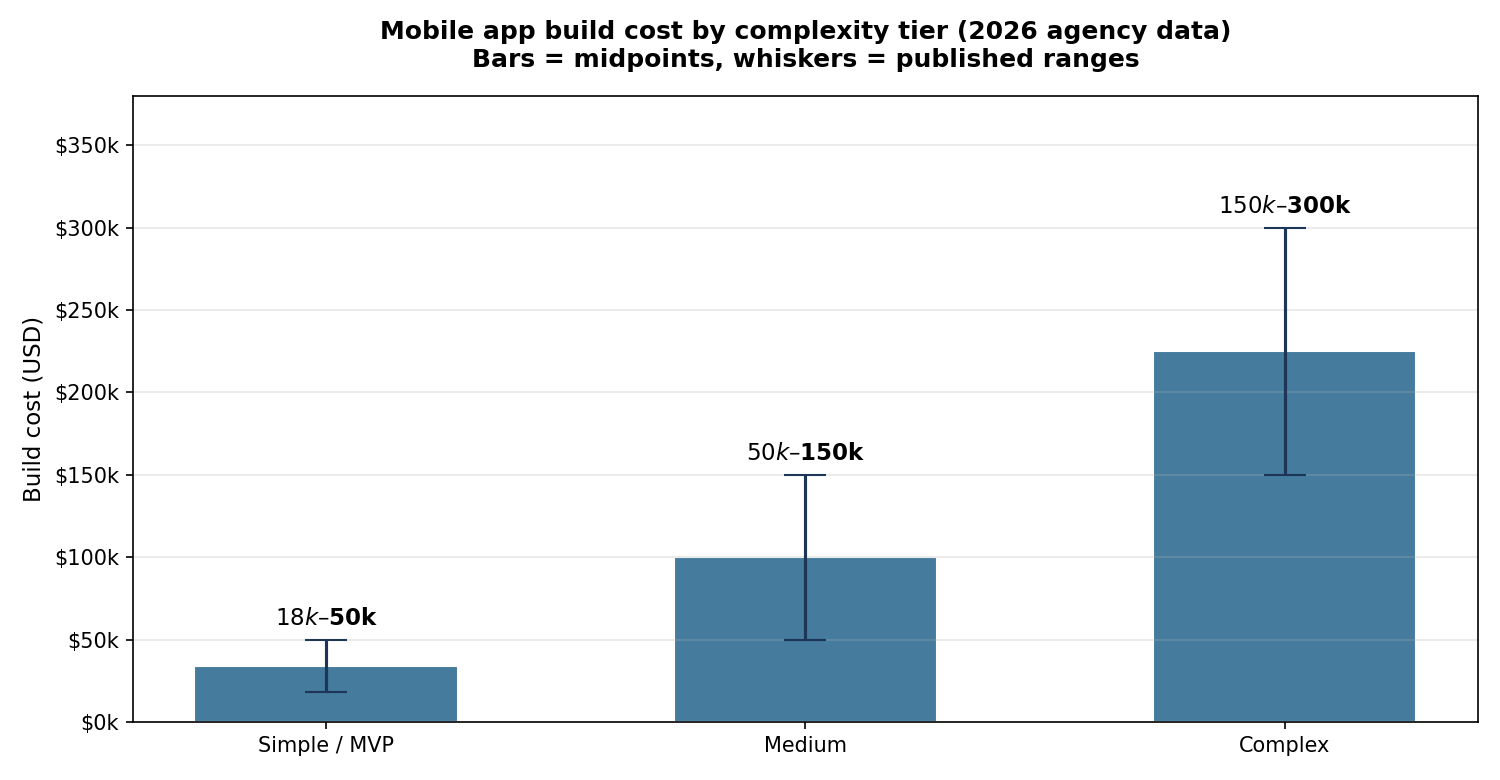
- Simple MVP: $18,000–$50,000
- Medium business app: $50,000–$150,000
- Complex platform: $150,000–$300,000+
- Enterprise / AI-heavy app: $300,000–$500,000+
These ranges come from agencies reporting on their own shipped work. Boolean Inc, which analyzed 100+ apps built from its Austin and Houston offices, puts the typical 2026 brackets at $18k–$50k for a simple MVP, $50k–$150k for medium, and $150k–$300k+ for complex builds. Clutch’s 2026 pricing survey puts the average agency-built app at $90,780, with the most common price bracket landing between $10,000 and $49,999. Netguru’s 2026 mobile app development cost guide frames it similarly: $15,000 for simple apps up to $500,000+ for complex ones, with a production-ready MVP through a mid-market agency typically running $40,000–$100,000.
What the data says: cost by app type
Aggregating the published 2026 surveys — including DianApps’ real project cost data drawn from GoodFirms and Clutch figures — here is where real projects land:
| App type | Typical cost (2026) | Timeline | Examples |
|---|---|---|---|
| Simple / MVP | $18,000–$50,000 | 2–4 months | Booking app, internal tool, single-purpose utility |
| Medium business app | $50,000–$150,000 | 4–7 months | Marketplace, fitness app with payments, client portal |
| Complex platform | $150,000–$300,000+ | 7–12+ months | Fintech, telehealth, multi-vendor platform |
| Enterprise / AI app | $300,000–$500,000+ | 9–18 months | Compliance-heavy systems, AI-driven products |
If someone quotes you $5,000 for a full custom app, they are selling you a template with your logo on it. If someone quotes $400,000 for a booking app, walk away. Everything honest sits between those extremes — and the 2026 app cost breakdown from Boolean Inc is a good reality check for whichever tier you are shopping in.

The 6 factors that actually move the price
1. Complexity and features
This is the dominant factor. Every feature you add — chat, video, AI recommendations, payments — adds design, development, and testing time. Published add-on estimates give a sense of scale: real-time chat typically adds $30,000–$50,000, payment integration $5,000–$20,000, GPS tracking $15,000–$40,000, and AI features $50,000 or more. A to-do app and a ride-hailing app are fundamentally different projects; the feature list is the budget.
2. Platform: iOS, Android, or both
Building natively for one platform costs roughly the same whether you pick iOS or Android (iOS apps typically run $30,000–$250,000, Android $35,000–$280,000 per Netguru’s guide), but building for both natively can nearly double the figure. Cross-platform frameworks like React Native or Flutter deliver both platforms for roughly 1.3–1.5× the cost of a single native build instead of 2× — a 30–45% saving most startups should take.
3. UI/UX design
Expect design to take 15–20% of the total budget. A clean, standard design system costs far less than fully custom animations and brand-specific interactions. The pragmatic move: ship the MVP with clean standard design and save the custom polish for version two.
4. Backend infrastructure
APIs, databases, authentication, and third-party integrations are where projects quietly go over budget. A “simple” app with login, user profiles, and an admin panel is really a medium app — proper authentication alone (OAuth, session management, password recovery) can add $5,000–$15,000.
5. Where the team is located
Hourly rates vary enormously by region, and this is the single biggest lever on the total:
| Region | Typical hourly rate |
|---|---|
| North America | $100–$200 |
| Western Europe | $80–$150 |
| Eastern Europe | $40–$80 |
| South Asia | $20–$50 |
Offshore teams in South Asia or Eastern Europe typically run 40–60% lower than North American agencies — a real trade-off involving communication overhead and quality control, but a legitimate way to stretch a startup budget.
6. Maintenance and hidden costs
The quote is not the total cost of ownership. Annual maintenance runs 15–20% of the original build cost — covering OS updates, SDK migrations every 12–18 months, bug fixes, and minor features. On a $100,000 app, budget $15,000–$20,000 a year just to keep it alive. Compliance-heavy work (HIPAA, PCI) can add another 15–25% to the scope up front.
iOS vs Android vs cross-platform: the cost math
| Approach | Relative cost | Best for |
|---|---|---|
| Native iOS only | 1× | US/EU consumer apps where iPhone dominates |
| Native Android only | ~1× (10–15% more QA) | Emerging markets, Android-first audiences |
| Cross-platform (Flutter / React Native) | ~1.3–1.5× for both platforms | Most startups — 30–45% cheaper than two native builds |
| Two native builds | ~2× | AR-heavy, graphics-intensive, hardware-specific apps |
The one caveat: skip cross-platform for AR-heavy, graphics-intensive, or hardware-specific apps, where native still wins. For everything else, one codebase for both stores is the budget-friendly default — and running the numbers through an app cost calculator with your feature list will show you exactly how the platform choice moves your quote.

How to cut the cost without cutting corners
You cannot negotiate physics — features take hours, hours cost money. But you can spend dramatically less by spending smarter:
- Build an MVP first. An MVP targets one core flow with minimum polish and runs 30–50% of full product cost. Most founders underestimate the full number by 2–3×, so prove demand before you fund the polish.
- Go cross-platform from day one. React Native or Flutter saves 30–40% versus separate iOS and Android builds with no meaningful quality loss for most business apps.
- Use standard UI. Clean, platform-standard design for the MVP; custom design systems come in version two, funded by revenue.
- Defer expensive features. Real-time chat, AI recommendations, and video are the budget killers. Launch without them, add the ones users actually ask for.
- Consider whether you need an app at all. Honest question: if your goal is selling products, a storefront on an existing platform may validate the business for nearly nothing — see our guide on how to start an online store with no money — and our Shopify vs Etsy comparison if you are weighing marketplaces. Build the app when the business model is proven, not before.

Fixed-price or time-and-materials?
How you pay matters almost as much as what you build. Fixed-price contracts give you budget certainty but require a locked scope — every change becomes a change order, and agencies pad the quote for risk. Time-and-materials billing is more flexible and usually cheaper for a well-managed project, but the meter keeps running if priorities drift. For a first build with a defined MVP, fixed-price protects you; for ongoing development after launch, time-and-materials with a monthly cap is the saner arrangement. Whichever you choose, get at least three quotes and make sure each one covers the same feature list — otherwise you are comparing different projects.
Frequently asked questions
How much does it cost to build a mobile app for a startup?
Most startup MVPs land between $18,000 and $100,000 in 2026, depending on complexity and team location. A lean single-platform MVP starts around $18,000–$40,000; a production-ready MVP through a mid-market agency typically runs $40,000–$100,000. Offshore teams can cut 40–60% off those figures.
How long does it take to build a mobile app?
Plan on 2–4 months for an MVP, 4–6 months for a standard app, 6–9 months for an app with a serious backend, and 9–18 months for enterprise builds. Agency-style production builds often cluster around 11 months when discovery, design, development, QA, and launch run in sequence.
Is it cheaper to build for iOS or Android?
Development hours are nearly identical. iOS gets a slight edge in QA because there are far fewer device variants to test against — Android fragmentation adds roughly 10–15% to QA. If you only ship one platform, pick by where your users are, not by cost.
How much does app maintenance cost per year?
Budget 15–20% of the original build cost annually. That covers iOS and Android OS updates, SDK migrations, bug fixes, and minor features — typically $10,000–$80,000 per year depending on complexity.
What is the cheapest way to build an app?
The cheapest legitimate route is a cross-platform MVP built by an offshore or Eastern European team, with standard UI and a minimal feature set — often $15,000–$30,000. Below that you are looking at no-code builders or templates, which are fine for validation but not for a real product.
Do I need a backend for my app?
If your app has user accounts, stores data in the cloud, sends push notifications, or processes payments, yes — and the backend is often where budgets break. Serverless backends can keep a simple app’s costs down, but anything with real user data needs proper API and database work.
The bottom line
How much does it cost to build a mobile app? In 2026: $18,000–$50,000 for a focused MVP, $50,000–$150,000 for a solid business app, $150,000–$300,000+ for a complex platform, and $300,000–$500,000+ at the enterprise end — with Clutch’s survey average of $90,780 sitting right in the middle of the market. The price is set by screens, integrations, platforms, and team location, not by magic. Define the smallest version that proves your idea, build it cross-platform, budget 15–20% a year for maintenance, and you will spend exactly what the app is worth — no more.



