
If you are about to open your first online shop, the shopify vs etsy debate probably feels like choosing between two good doors. Behind one is your own branded storefront and total control; behind the other, millions of ready-made shoppers browsing on day one. Here is what nobody tells beginners upfront: the right answer has almost nothing to do with branding and almost everything to do with math. Depending on how much you sell each month, one of these platforms quietly costs you twice as much as the other — and the point where the cheaper option flips is lower than most people expect.
I pulled both companies’ current fee pages for this comparison in October 2026, ran the numbers at four sales levels, and built a chart so you can see exactly where you land. This shopify vs etsy breakdown covers fees, traffic, branding, and the exact sales level where the cheaper option flips. Let’s get into it.
Shopify vs Etsy at a Glance: The Head-to-Head Table
Before we go deep, here is the side-by-side snapshot most beginners actually need. The fees below are verified against Shopify’s official pricing page and Etsy’s official fees policy as of October 17, 2026.
| Shopify (Basic plan) | Etsy (standard shop) | |
|---|---|---|
| Monthly subscription | $39/month billed monthly, or $29/month billed yearly | $0 — no monthly fee for a standard shop |
| Transaction fee (platform cut) | None with Shopify Payments — you only pay the card processing rate of 2.9% + 30¢ per online order. A 2% extra fee applies only if you use a third-party gateway instead | 6.5% of the item price plus shipping and gift wrap you charge |
| Listing fees | $0 — unlimited products on every plan | $0.20 per listing, renewed every 4 months or each time a multi-quantity item sells |
| Payment processing | Included in the 2.9% + 30¢ card rate | 3% + 25¢ per order on top of the transaction fee (US rate; varies by country) |
| Real cost per sale | Roughly 3.5% on a $50 order | Roughly 10–11% on a $50 order (before any ad fees) |
| Audience / traffic | You bring your own — no built-in marketplace traffic | Built-in: Etsy reported massive buyer traffic; shoppers actively browse the marketplace |
| Customization | Full control: your domain, theme, checkout, apps, email list | Limited: your shop lives inside Etsy’s look and rules; you don’t own the customer list |
| New-shop setup fee | $0 — free 3-day trial, then $1/month for the first 3 months | One-time set-up fee for new shops (Etsy shows the amount during onboarding) |
| Best for | Brands that want their own store and plan to drive their own traffic | Handmade, vintage, and craft sellers who want sales without building an audience first |
The headline takeaway: Etsy’s per-sale bite (about 10–11% all-in) is roughly triple Shopify’s (~3.5% per sale), but Shopify charges you $29–39 every single month whether you sell one mug or one hundred. That trade-off is the entire decision, so let’s make it visual.
The Real Cost of Shopify vs Etsy in 2026

To make the comparison honest, I modeled a typical beginner shop with a $35 average order and no ad spend, using the verified fees above. Shopify is on the Basic plan at the annual $29/month rate; Etsy pays the standard stack (listing + transaction + processing), excluding the optional Offsite Ads program and the one-time setup fee.
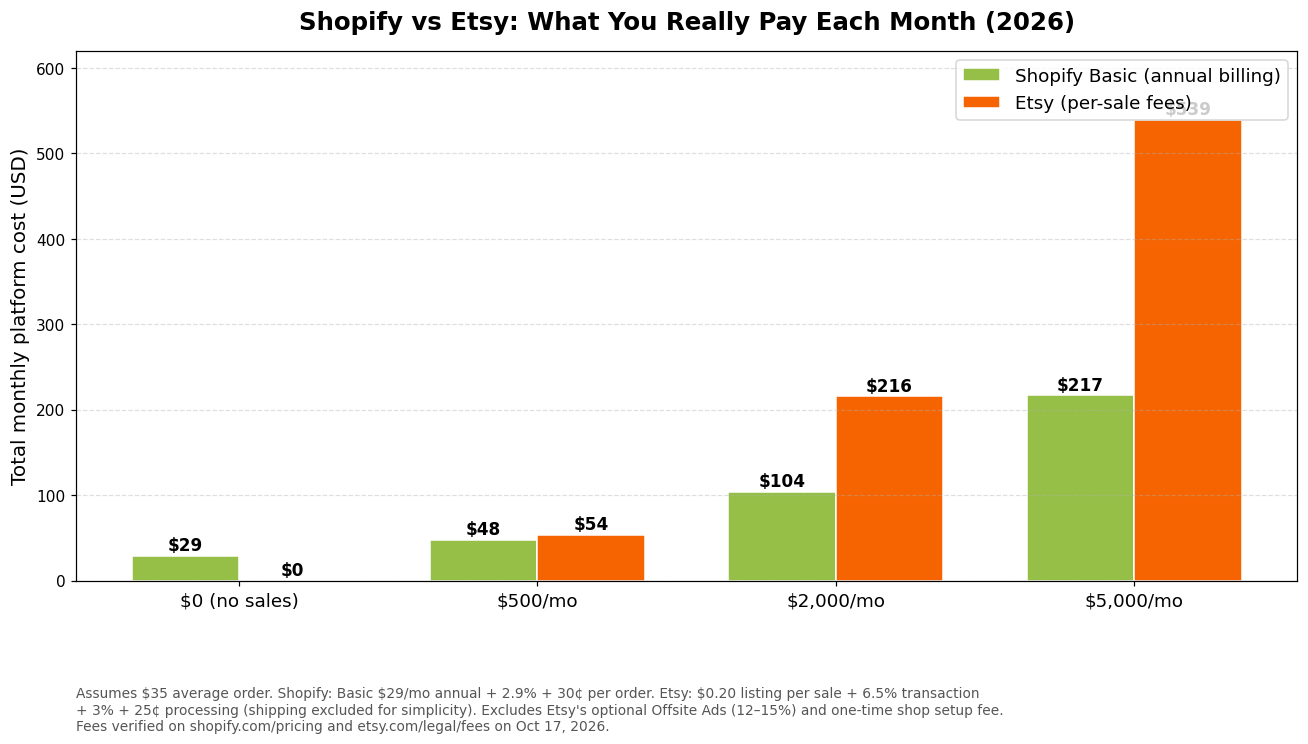
The chart tells a clear story. At $500 in monthly sales, Shopify costs about $48 while Etsy costs about $54 — already close. By $2,000 in sales, Shopify is roughly $104 versus Etsy’s $216. And at $5,000 a month, the difference is stark: about $217 on Shopify versus $539 on Etsy. The break-even point sits somewhere around $400 in monthly sales. Below that, Etsy’s zero monthly fee wins. Above it, Shopify’s flat subscription starts paying for itself — and every extra dollar of growth costs you less on Shopify than on Etsy.
Two gotchas deserve a mention. First, Etsy’s Offsite Ads program can add 12–15% to any sale that comes from an ad Etsy runs for you, and sellers over $10,000 in annual sales cannot opt out. If several of your orders each month are attributed to offsite ads, your effective fee climbs toward 22–25% on those sales, according to this worked example of what Etsy takes from a $50 sale. Second, Shopify’s true monthly bill can creep past the subscription if you stack paid apps, so keep your app installs lean at the start — see this independent Shopify pricing breakdown for the full picture.
Traffic: Built-In Shoppers vs Bringing Your Own

Fees are only half the story. The other half is traffic, and this is where Etsy genuinely shines for beginners. In any shopify vs etsy comparison, traffic is where the two platforms differ most. Etsy is a marketplace: tens of millions of buyers arrive with their wallets open, searching for handmade goods, vintage finds, and craft supplies. If you sell the kind of product Etsy’s audience already wants — ceramics, jewelry, printables, wedding decor — you can realistically make your first sales without spending a cent on ads. That built-in demand is Etsy’s real product, and it’s why so many sellers tolerate the 10% fee stack.
Shopify gives you nothing here. Your beautiful new store is an empty room on a street nobody walks down. You have to bring every visitor yourself through social media, SEO, influencers, or paid ads — and if you’re starting an online store with no money, that means months of organic hustle before the first sale. The upside is that every customer is yours: you collect their email addresses, you control the relationship, and you never compete with a cheaper seller two clicks away in the same search results.
There is also a subtler cost to Etsy’s traffic: you sell inside Etsy’s house, under Etsy’s rules. Etsy can change its search algorithm, raise fees (it did, repeatedly), or suspend shops with little warning. On Shopify, nobody can delist your storefront — but nobody will find it either until you earn that attention.
Branding and Control: A Storefront vs a Market Stall
Think of Etsy as renting a stall in a busy craft market, and Shopify as leasing your own shop on the high street. The stall gets foot traffic for free, but every stall looks the same and customers remember the market, not you. That trade-off is the heart of the shopify vs etsy branding debate.
On Shopify, you choose your domain, design your theme, customize checkout, install apps for reviews, upsells, and loyalty programs, and build an email list you actually own. That matters enormously as you grow: email and SMS marketing routinely drive 20–30% of revenue for established stores, and you simply cannot build that asset on Etsy the same way. When you write a business plan for a brand you intend to scale, that ownership is usually the deciding factor.
Etsy, meanwhile, keeps things deliberately simple. You get a shop page, listing photos, and a checkout — but the branding is Etsy’s, the customer data stays with Etsy, and your shop can look strikingly similar to a competitor’s. For a side hustle selling digital planners or handmade soaps, that simplicity is a feature: you list products in an afternoon and you’re in business. For a brand with ambitions beyond the marketplace, it’s a ceiling.
Shopify vs Etsy: Which Is Better for Beginners?
If “beginner” means you’ve never sold anything online and you want your first sale this month with minimal setup, Etsy wins. Listing a product takes minutes, there’s no monthly bill while you learn, and the built-in search traffic does the hardest job — finding buyers — for you. It’s the lowest-risk way to test whether anyone actually wants what you make.
If “beginner” means you’re serious about building a brand and you’re willing to learn marketing, Shopify wins. The $39 monthly fee forces a useful discipline: you either sell enough to cover it or you learn fast why you aren’t. And as the cost chart above shows, the moment you’re doing a few hundred dollars a month in sales, Shopify is already cheaper.
The practical beginner test is this: can you name ten people who would buy your product, or describe exactly where your first hundred customers will come from? If yes, Shopify. If that question makes you nervous, start on Etsy, prove the product, and migrate later. Many successful brands did exactly that.
Can You Use Etsy and Shopify at the Same Time?

Yes — and for a lot of sellers, this is the best answer. The shopify vs etsy decision doesn’t have to be either-or. There’s no rule against running both, and the two platforms complement each other neatly: Etsy acts as a discovery engine where new customers find you, while Shopify becomes your branded home base where repeat customers buy directly (at lower fees) and join your email list.
The smart way to combine them is to treat Etsy as your fishing net and Shopify as your aquarium. Use Etsy’s traffic to get discovered, then include a thank-you card or packaging insert that invites buyers to your own store for their next order — check Etsy’s current policies on off-platform marketing first, since the rules around this have tightened over the years. Even without aggressive cross-promotion, many sellers find that Etsy drives first-time buyers while Shopify captures the higher-margin repeat business.
Watch the workload, though. Two storefronts mean two inventories to sync, two sets of fees to track, and two customer inboxes to answer. If you’re budgeting on a low income and doing this solo, master one platform before adding the second.
The Honest Verdict: Which One Should You Start With?
Here’s my straight answer after running the numbers. After this full shopify vs etsy breakdown, my recommendation is simple: if you sell handmade, vintage, or craft products and you’re starting from zero audience, start on Etsy. You’ll pay more per sale, but you’ll get sales — and early sales teach you more than any course. Expect to keep roughly 89–90% of each order after standard fees, and treat Etsy as your paid-for customer acquisition channel.
If you’re launching a brand — your own products, your own name, your own domain — or you already have an audience on TikTok, Instagram, or an email list, start on Shopify. Once you pass roughly $400–500 in monthly sales, it’s cheaper than Etsy, and the gap only grows. The subscription stings at first, but it’s the price of owning your business instead of renting space in someone else’s.
And if you’re still torn, remember the hybrid route: prove demand on Etsy, then build the brand on Shopify. Plenty of small business ideas have grown up exactly this way. The worst choice isn’t picking the “wrong” platform — it’s spending six months researching instead of listing your first product.
Shopify vs Etsy: Frequently Asked Questions
Which is cheaper, Etsy or Shopify?
It depends on your sales volume. With no sales, Etsy is cheaper because there’s no monthly fee, while Shopify Basic costs $29–39/month. Around $400–500 in monthly sales is the break-even point: above that, Shopify becomes cheaper because its per-sale fees (~3.5%) are roughly a third of Etsy’s (~10–11% all-in). At $5,000/month in sales, Shopify costs about $217 versus roughly $539 on Etsy.
Can I use both Etsy and Shopify at the same time?
Yes. Many sellers use Etsy for discovery (its built-in buyer traffic) and Shopify as their branded home base for repeat customers and email marketing. Just be aware of the extra workload of managing two inventories and inboxes, and check Etsy’s current policies before directing Etsy buyers to your own site.
Which platform is better for beginners?
For absolute beginners who want their first sale quickly with minimal setup, Etsy is better: listing is fast, there’s no monthly fee, and marketplace traffic brings buyers to you. For beginners who are serious about building a brand and willing to learn marketing, Shopify is better long-term because fees are lower at scale and you own your customer relationships.
Is Etsy still worth it in 2026?
For handmade, vintage, and craft sellers, yes — Etsy’s buyer traffic remains its killer feature, and the fee structure (verified October 2026: $0.20 listings, 6.5% transaction fee, ~3% + 25¢ processing) hasn’t fundamentally changed. It’s less attractive if your products don’t fit Etsy’s categories or if you’re doing high volume, where the per-sale fees add up fast. Watch out for the Offsite Ads fee (12–15%), which can significantly raise your effective rate on attributed sales.
How much does Shopify actually cost per month for a beginner?
The Basic plan is $39/month billed monthly or $29/month billed annually, with a 3-day free trial followed by $1/month for the first three months. On top of that, expect about 2.9% + 30¢ per online order in card fees. A beginner doing $500/month in sales pays roughly $48/month total. Paid apps and premium themes can add more, so keep your setup lean at the start.
Conclusion
The shopify vs etsy question looks like a branding debate, but it’s really a math problem with a marketing problem attached. Run your expected monthly sales through the break-even logic: under ~$400/month, Etsy’s zero subscription makes it the cheaper, lower-risk start; over it, Shopify’s flat fee and lower per-sale costs win by a widening margin. Then ask the marketing question honestly: do you have a way to bring your own customers, or do you need Etsy’s marketplace to find them for you? Answer those two questions and the platform picks itself. Either way, the fee you should fear most is the one you pay for waiting — list your first product this week, and let real sales data make the next decision for you.