
October 22, 2026. Chinese AI startup DeepSeek is wrapping up one of the largest private funding rounds in tech history — about 100 billion yuan, or roughly $14.98 billion, raised from existing and new investors, according to Reuters reporting out of Hong Kong. Battery giant CATL and WeChat operator Tencent are among the biggest backers in the DeepSeek 15 billion funding round. If it closes as reported, the round would instantly make DeepSeek one of the best-capitalized AI labs on the planet — and it is a second massive raise in a single year.
Here is what is confirmed so far, who is writing the checks, why the round doubled in size, and what it changes about the contest between Chinese and American AI labs. Read on for the full breakdown of the DeepSeek 15 billion funding round.
What We Know About the DeepSeek 15 Billion Funding Round
The core facts come from a Reuters report by Kane Wu, published October 22, 2026, citing two people with knowledge of the matter who declined to be named because the information was confidential:
- Amount: about 100 billion yuan ($14.98 billion at the reported rate of 6.6749 yuan to the dollar).
- Investors: a mix of existing and new backers, with Contemporary Amperex Technology (CATL) and Tencent Holdings among the largest.
- Status: the fundraising is set to be complete in the coming days — but Reuters stresses the financial details are not ironclad and could still change.
Bloomberg first broke the news on Thursday, October 22, reporting that DeepSeek had raised $15 billion with CATL and Tencent as its main backers, as recapped by Runtime Wire. The round is DeepSeek’s second external raise of 2026: an earlier round of roughly $7.4 billion, at a valuation above $50 billion, closed around June, according to an October 8 funding timeline. Before this year, the company famously ran on its founders’ own money. Two external rounds in four months is a pace almost unheard of in AI — and it tells you how fast the company is spending.
Who Is Backing the Round — and Why the Names Matter
The two headliner investors say a lot about where DeepSeek is going. CATL is the world’s largest EV battery maker — an industrial giant, not a typical venture investor — while Tencent operates WeChat and is one of China’s most powerful tech platforms. Their presence suggests the round is as much about strategic alignment as capital: compute-hungry AI labs need energy infrastructure and distribution, and both backers can supply one or the other.
It also signals confidence from inside China’s tech establishment. DeepSeek gained global attention in 2025 by developing competitive AI models at remarkably low cost — an event that triggered a broad sell-off across technology stocks as investors repriced what AI development should cost. This raise is the next chapter of that story: the low-cost lab is now spending like a frontier lab.

From 50 Billion to 100 Billion Yuan: How the Target Doubled
One of the most telling details in the Reuters reporting is the round’s moving target. DeepSeek originally set out to raise 50 billion yuan. It then lifted the target to 80 billion yuan — and ultimately reached 100 billion yuan, doubling the initial goal, as El Fondo’s coverage also notes. When investors keep saying yes as the number climbs, it usually means demand for allocation exceeded supply — a strong signal about how the market values the company right now.
That said, a note of caution is warranted, and Reuters includes it: the round is wrapping up, not signed and closed, and the details could still shift before the money lands. Treat the $15 billion figure as the reported target-in-progress rather than a done deal. Investors watching the DeepSeek 15 billion funding round should treat every figure as provisional until the round formally closes.
What It Means for the AI Race
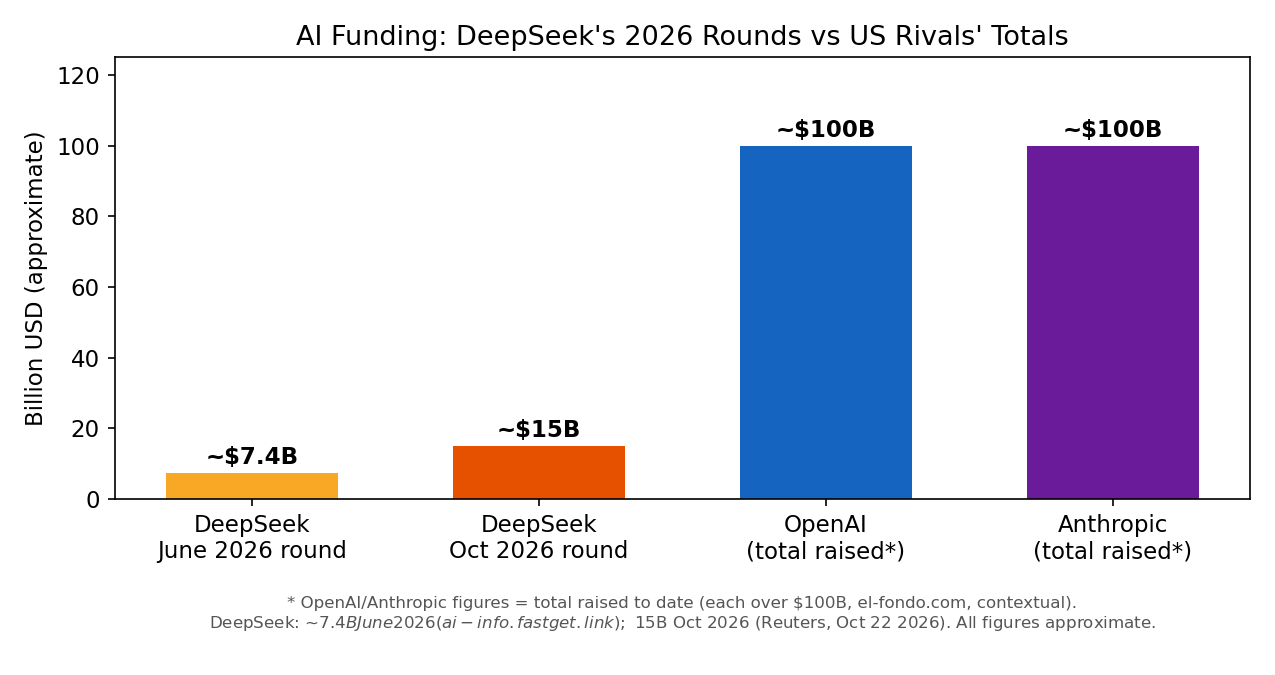
The strategic significance is the narrowing resource gap. According to El Fondo, the fresh capital brings DeepSeek closer to US rivals OpenAI and Anthropic, which have each raised more than $100 billion in total. DeepSeek is still far behind on cumulative funding — the chart below puts the numbers in perspective — but $15 billion buys an enormous amount of compute, talent, and time.
And the company is already spending it. DeepSeek has been expanding its data-center footprint and open-source model releases, and the October 8 funding timeline reports it is building out infrastructure including a planned 160,000-processor Huawei Ascend inference cluster in Inner Mongolia — while also developing its own inference silicon. On the product side, the company released DeepSeek-V4.1-Flash in September 2026, described as designed for greater capability, faster inference, and higher throughput, scaling to larger models. Capital, chips, and models are all moving in the same direction: scale. Few raises illustrate that pivot better than the DeepSeek 15 billion funding round.
There is an irony in the numbers worth pausing on. DeepSeek became famous in 2025 for proving that globally competitive AI models could be built at remarkably low cost — a revelation that triggered a sell-off across technology stocks as investors repriced what AI development should cost. Now the low-cost lab is raising about $15 billion and planning a 160,000-processor inference cluster in Inner Mongolia. The lesson is not that the efficiency story was a myth; it is that efficiency compounds. A lab that builds cheaply and then gets $15 billion can scale further and faster than a lab that was expensive from the start — and that is the dynamic OpenAI and Anthropic are now pricing in. Separately, CNBC reported on October 21 that OpenAI will distribute models via Google Cloud — a different deal, but another sign of how fluid AI partnerships have become this week.
For the broader industry, the raise lands in a week already crowded with AI money news — from Big Tech earnings to infrastructure bets — reinforcing that the AI buildout is accelerating, not cooling. If you are tracking how AI investment is reshaping markets, our AI stock market rebound coverage has the investor-side view, while the Muse Spark story shows how fast new models are reaching the public.

What Comes Next: A STAR Market IPO?
The fundraising also looks like a stepping stone to public markets. In September 2026, Reuters reported that DeepSeek hired CITIC Securities to prepare for a potential IPO on Shanghai’s STAR Market — China’s Nasdaq-style board for tech companies. The funding timeline adds that the company has told investors it plans an IPO restructuring targeting early 2027. Read together, the sequence is clear: raise private capital at scale now, reorganize, then list.
A STAR Market listing would be a landmark moment — arguably the most significant Chinese tech IPO since the regulatory tightening of the early 2020s — and it would give global investors their first direct way to bet on (or against) the low-cost AI lab that rattled markets in 2025. For investors, the sequencing matters: a private round closing in late October 2026, an IPO restructuring targeted for early 2027, and a STAR Market listing to follow would make DeepSeek’s public debut one of the most watched of the decade. Until the round formally closes, though, the only figures that count are the reported ones — and Reuters’ caution that the details are not ironclad is worth keeping in mind with every number in this article. Expect the IPO chatter to intensify the moment the round is confirmed complete.
Frequently Asked Questions
How much did DeepSeek raise in October 2026?
Reuters reported on October 22, 2026 that DeepSeek is wrapping up a round of about 100 billion yuan — roughly $14.98 billion — from existing and new investors. Bloomberg first reported the $15 billion figure the same day. The round is not yet formally closed and details could change.
Who invested in DeepSeek’s funding round?
Battery maker Contemporary Amperex Technology (CATL) and WeChat operator Tencent Holdings were among the biggest investors, according to Reuters’ sources. The full investor list has not been disclosed.
Is the DeepSeek funding round closed?
Not formally. Reuters reported the fundraising is set to be complete in the coming days but cautioned that the financial details are not ironclad and could still change.
What is DeepSeek’s valuation after this round?
No valuation figure for this round has been reported by the cited sources. Its earlier June 2026 round of roughly $7.4 billion was done at a valuation above $50 billion, but that does not establish the current round’s terms.
What does this mean for OpenAI and Anthropic?
It narrows — but does not close — the resource gap. OpenAI and Anthropic have each raised more than $100 billion in total, per El Fondo’s reporting. DeepSeek’s advantage remains efficiency: it built globally competitive models at low cost in 2025, and is now scaling that playbook with serious capital.
Is DeepSeek going public?
It is moving in that direction. Reuters reported in September 2026 that the company hired CITIC Securities to prepare for a potential STAR Market IPO, and the company has told investors it is targeting an IPO restructuring in early 2027.
Conclusion
DeepSeek’s ~$15 billion raise, reported October 22, 2026, is more than a big number — it is a statement of intent. A lab that once ran on its founders’ money has now raised twice in four months, doubled its own target along the way, pulled in two of China’s most strategic corporate investors, and is openly marching toward a public listing. The details are still being finalized, so treat the headline figure with the usual caution — but the direction is unmistakable. The AI race just got more expensive for everyone, and the low-cost disruptor of 2025 is now playing the scale game too. For the industry, the DeepSeek 15 billion funding round is the clearest signal yet that the AI race is entering a scale era.