

On October 15, 2026, Meta did something the AI world had been waiting months for: it released Muse Spark Open, an 816-billion-parameter open-weight AI model that anyone can download and build on. In a week packed with AI announcements — Google opened up Gemini 4 Argon to paying customers, and Microsoft published details of its 2.8-trillion-parameter MAI-Base-2 — the Muse Spark Open release stands out for one reason: it puts frontier-scale AI weights directly into developers’ hands. Here is what the model actually is, what it takes to run, and whether it matters for anyone who is not an AI researcher.
What Is Muse Spark Open?
Muse Spark Open is a natively multimodal mixture-of-experts (MoE) model. The headline numbers, reported by MacRumors from Meta’s announcement, are 816 billion total parameters with about 42 billion active for each token, plus a one-million-token context window. If those numbers mean little to you, here is the plain version: the model is enormous, but thanks to its mixture-of-experts design, only a small fraction of it “wakes up” for any given word it processes — like a hospital where triage sends each patient to a few specialists rather than the entire staff.
Meta built the model for coding and agentic work: long-running tasks, multi-step reasoning, and software engineering. In its demos, Meta showed the model driving its Muse Code agent to fix bugs and add features in a real open-source iOS app, and even controlling DaVinci Resolve to scrub through video footage and crop clips. It accepts text, images, video, and audio as input, though its outputs are primarily text.
The company calls it the most capable open-weight model yet released by a US lab — a claim worth treating as marketing until independent benchmarks land, since every performance number published so far comes from Meta or its launch partners.
The Real Story: It Runs on a Desktop
The most striking part of the announcement is not the parameter count; it is where the model can run. Meta worked directly with Apple to squeeze Muse Spark Open onto two Apple M5 Ultra Mac Studios linked through Apple’s MLX framework. Together, the two machines provide roughly a terabyte of unified memory — enough to hold the entire model — with 1.2 TB/s of memory bandwidth to feed it. Apple’s CEO John Ternus publicly congratulated the Meta team on the achievement.
There is a catch, and it is a big one: the 512GB Mac Studio configuration the demo used is not on sale yet. Apple is expected to ship it later this month, and it will not be cheap — the 256GB Mac Studio already costs over $10,000. Realistically, a two-machine setup lands well above $20,000 before you have generated a single token. As one widely shared analysis put it, this is an 816-billion-parameter model you can download today but probably cannot run.

How to Actually Use It (Three Routes)
If you want to try Muse Spark Open, there are three practical routes, and only one makes sense for most people:
1. Hosted APIs — the sensible default
Seven inference providers launched with day-one support: Baseten, Fireworks AI, Groq, Modal, Nebius, OpenRouter, and Together AI. You sign up, grab an API key, and you are generating text within minutes, paying per token. For developers who want to build on the model rather than run it, this is the obvious choice.
2. Download the weights — for researchers and the stubborn
The weights are published on Hugging Face in BF16 (about 1.6TB) and NVFP4 (about 530GB) formats, and are also mirrored on Amazon SageMaker AI, Google Cloud Model Garden, and Microsoft Foundry Models. Downloading 1.6 terabytes is a project in itself, and then you still need somewhere to run it. This route suits research labs and companies with serious GPU clusters.
3. Local Mac Studio setup — for the well-funded enthusiast
Two paired 512GB M5 Ultra Mac Studios via Apple’s MLX framework. Elegant, quiet, and entirely yours — once the hardware exists and you have recovered from the invoice. The upside is real: no per-token fees, no data leaving your desk, and a machine that doubles as a very expensive general-purpose computer.
Whichever route you take, note the license. Muse Spark Open does not ship under a permissive open-source license like Apache 2.0. It uses Meta’s custom Muse Model License: free for most users, including commercial use, but with strings attached. Any product built on it must display “Built with Muse Spark Open,” and companies with over $20 million in annual revenue that sell API access to the model must sign a separate agreement with Meta first. Using it inside your own product or for internal work is not affected by that clause.
The Bigger Picture: AI Models Keep Getting Larger — and Pricier to Run
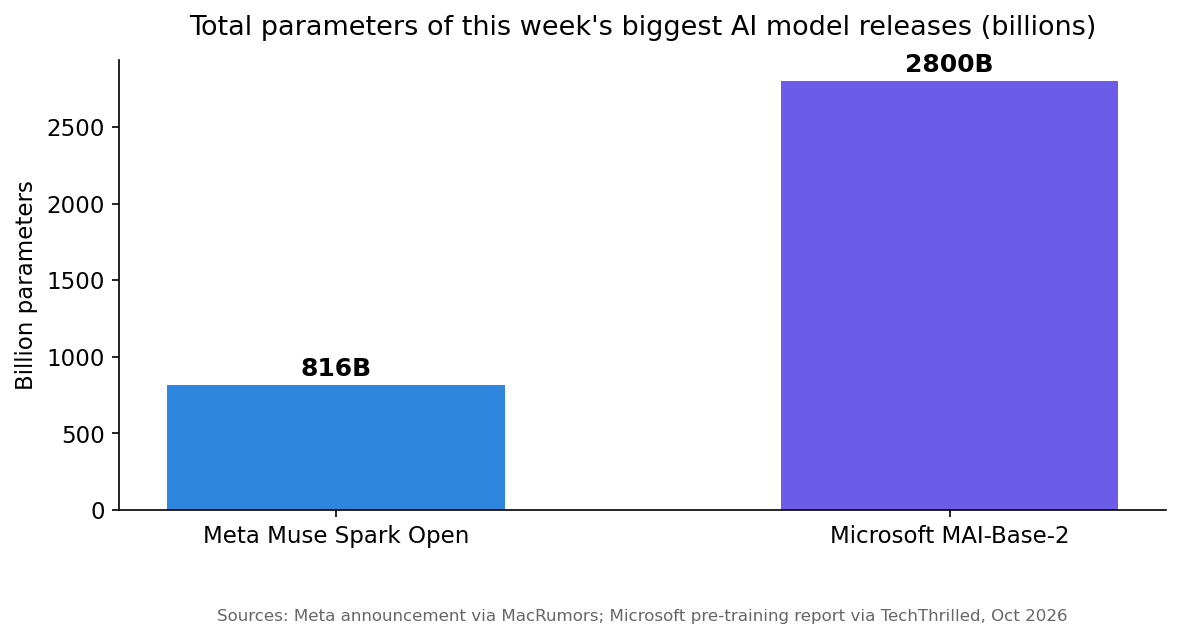
Muse Spark Open did not arrive in a vacuum. The same week, Microsoft published a pre-training report for MAI-Base-2, a 2.8-trillion-parameter mixture-of-experts model — more than three times the size of Muse Spark Open — as part of its push into custom AI infrastructure. Google, meanwhile, opened Gemini 4 Argon to paying Gemini and API customers, though with a sting: API rates are scheduled to double on December 1.
The pattern is hard to miss. Models are getting bigger, the hardware to run them is getting more exotic, and the bills are getting larger. Gartner now forecasts that inference costs per agentic AI workflow could rise more than fivefold by 2028, even as raw token prices fall — because businesses are chaining models into ever more elaborate multi-step workflows. As TechRepublic’s weekly roundup noted, the industry is pushing AI into larger models, custom chips, and connected everything, while security risks and infrastructure costs mount in parallel.
That tension — open weights in one hand, $20,000 desktops and doubling API prices in the other — is the real story of October 2026 in AI. The frontier is technically open. Affording a ticket is another matter.
Should You Care?
For most readers, Muse Spark Open is interesting the way a concept car is interesting: impressive engineering you will probably experience through someone else’s product. If you build software, the hosted APIs are worth a look — a 1-million-token context window and strong agentic behavior at open-model prices is a genuinely useful combination. If you are choosing AI tools for everyday work, this release changes little today; the models inside the apps you already use matter more than the weights on Hugging Face.
What is worth watching is the direction of travel. Meta releasing frontier-scale weights openly — even with license strings attached — keeps pressure on the entire market, and the Mac Studio partnership hints at a future where serious AI runs on desks, not just in data centers. Just do not remortgage the house for the hardware yet. And while you are thinking about the machine you already own, it is worth knowing how to speed up a slow laptop before assuming you need a new one — plus, as AI tools multiply, a quick refresher on how to spot a phishing email is cheap insurance, since AI-generated scams are getting harder to detect. Finally, if your phone is where you do most of your AI chatting, make sure you know how to back up your phone before trusting it with anything important.
Frequently Asked Questions
Is Muse Spark Open really free?
The weights are free to download, and the license allows limited commercial use. But “free” comes with conditions: mandatory attribution (“Built with Muse Spark Open”), and companies earning over $20 million a year that resell API access need a separate deal with Meta. And of course, the hardware or API bills to actually run it are very real.
Can I run Muse Spark Open on my laptop?
No. The full model needs roughly a terabyte of memory — Meta’s reference setup is two 512GB M5 Ultra Mac Studios. A typical laptop has 16–32GB. Your realistic options are a hosted API or a heavily quantized version, if and when the community produces one small enough.
How does Muse Spark Open compare to GPT or Claude?
It is too early for a fair answer. Meta’s own benchmarks are strong on agentic coding tasks, and one independent analysis put related Spark models roughly level with GPT-5.6 and Claude Opus 5 — but those are vendor-adjacent numbers, and head-to-head independent testing of the open weights had not landed as of mid-October 2026.
What does “open-weight” mean, exactly?
It means Meta published the trained model weights — the billions of numbers that make the model behave the way it does — so anyone can download, inspect, fine-tune, and run them. It does not mean open-source in the full sense: the training data and training code remain private, and the license has commercial restrictions.
When was Muse Spark Open released?
Meta announced and released Muse Spark Open on October 15, 2026, alongside the Mac Studio partnership with Apple.
What is the cheapest way to try it?
A hosted API endpoint through one of the seven launch partners (Together AI, Fireworks AI, Groq, OpenRouter, Baseten, Modal, or Nebius). You pay per token, need no special hardware, and can start in minutes.
Conclusion
Muse Spark Open is the most significant open-weight AI release of 2026 so far: 816 billion parameters, a million-token context, and a genuine path to running on a desktop — if your desktop costs as much as a car. For developers, the hosted APIs make it immediately useful. For everyone else, it is a signpost: the most powerful AI models are slowly migrating from distant data centers toward hardware you can own, even if the price of admission is still steep. As of October 2026, the open frontier is real — just bring a very large hard drive.



