FDA Approves First Immunotherapy for Locally Advanced Rectal Cancer: What Patients Should Know
On October 19, 2026, the U.S. Food and Drug Administration made history for colorectal cancer patients: the fda dostarlimab rectal cancer approval granted dostarlimab (brand name Jemperli, from GSK) accelerated approval for adults with Stage II or III locally advanced rectal cancer — the first immunotherapy ever approved for this diagnosis. For a subset of patients whose tumors carry specific molecular features, the news opens a door that simply did not exist before: a real chance of treating rectal cancer without surgery, chemotherapy, or radiation.
This is an exciting headline, and it deserves careful explanation. Here is what the approval actually means, who qualifies, what the trial data really showed, and what questions to bring to your oncologist.
What the fda dostarlimab rectal cancer approval means
The FDA granted dostarlimab accelerated approval for adults with locally advanced (Stage II/III) rectal cancer whose tumors are MSI-H (microsatellite instability-high) or dMMR (mismatch repair-deficient), as confirmed by an FDA-authorized test. Accelerated approval is a regulatory pathway that lets the FDA approve drugs for serious conditions based on early evidence of benefit — in this case, tumor responses — while the drugmaker confirms longer-term outcomes in follow-up studies. The approval came with three special designations — Fast Track, Breakthrough Therapy, and Priority Review — which the FDA reserves for drugs it considers substantial improvements for serious diseases. You can read the FDA’s accelerated approval announcement for the full regulatory details.
Why does this matter so much? Because the standard treatment for locally advanced rectal cancer is brutal: weeks of combined chemotherapy and radiation, followed by major surgery that can leave patients with a permanent colostomy bag or lasting bowel, bladder, and sexual problems. The idea that some patients might skip all of that — while still getting a complete response — is genuinely paradigm-shifting.
Who is eligible: MSI-H and dMMR, explained in plain language
The approval is not for everyone with rectal cancer. It covers patients whose tumors test positive for one of two closely related markers:
- MSI-H (microsatellite instability-high): The tumor’s DNA repair system makes lots of copying errors, creating many mutations.
- dMMR (mismatch repair-deficient): The tumor is missing one or more of the proteins that normally fix DNA mistakes — essentially the same problem described from a different angle.
Here is why that matters for immunotherapy. All those DNA errors make the tumor look “foreign” to the immune system, like a stranger covered in red flags. Dostarlimab is a PD-1 blocker — it releases a brake the tumor uses to hide from immune cells. In MSI-H/dMMR tumors, the immune system is already primed to attack; the drug simply lets it. This same biology explains why MSI-H tumors respond to immunotherapy across several cancer types.
Roughly 5–10% of rectal cancers are dMMR/MSI-H, so this approval affects a meaningful minority of the roughly 45,000 Americans diagnosed with rectal cancer each year. Eligibility must be confirmed with an FDA-authorized test — ask your oncologist whether your tumor has been tested, because not every pathology lab runs these markers routinely. The Oncology Nursing Society’s breakdown of the approval is a helpful patient-friendly summary to bring to your appointment.

The AZUR-1 trial results, explained simply
The approval rests on the AZUR-1 trial (clinicaltrials.gov identifier NCT05723562), a multicenter, single-arm, open-label study in which 154 previously untreated patients with MSI-H/dMMR locally advanced rectal cancer received dostarlimab 500 mg by IV every three weeks for nine cycles. The fda dostarlimab rectal cancer approval was based on these verified results:
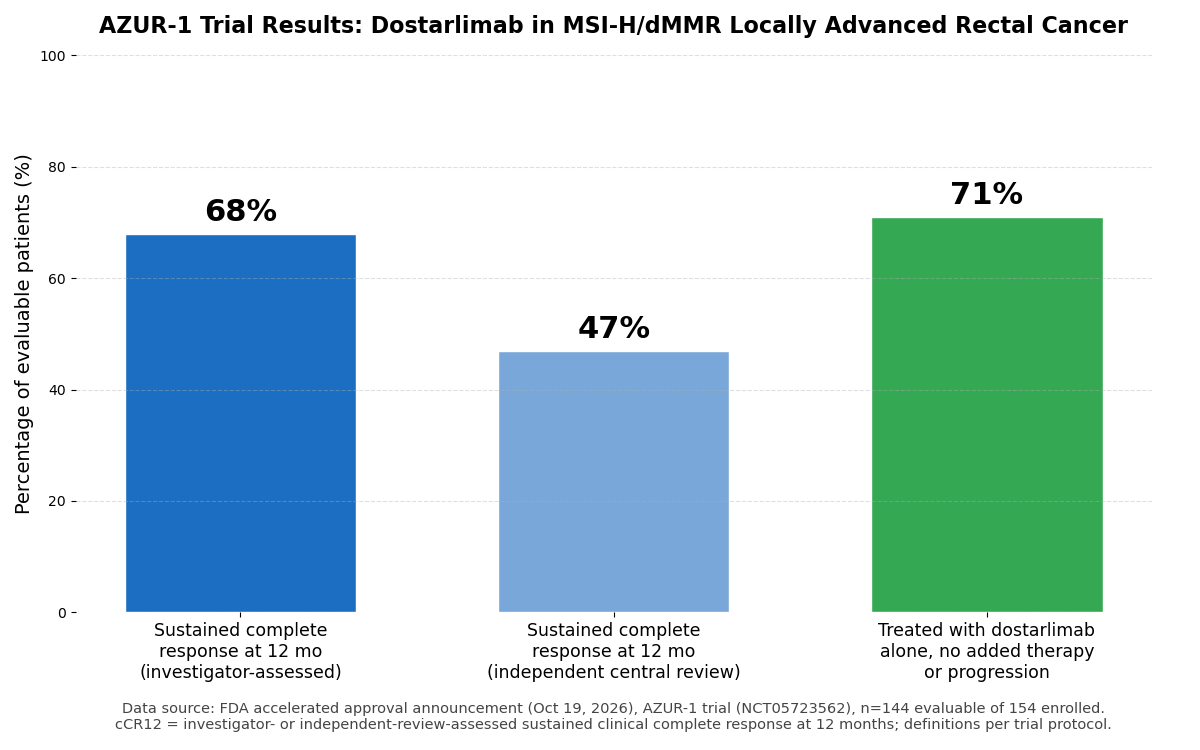
- 68% achieved a sustained clinical complete response at 12 months (98 of 144 evaluable patients; 95% confidence interval 60–76%). “Clinical complete response” means the tumor could no longer be detected by physical exam, imaging, or endoscopy.
- In the group evaluated by an independent central review committee, the 12-month sustained complete response rate was 47% (95% CI 27–56%).
- 71% of evaluable patients (110 of 144) received dostarlimab alone — no additional treatment and no disease progression during the assessment period.
- Among responders, no disease recurrences were reported after a median follow-up of more than two years.
The gap between the investigator-assessed 68% and the independent-review 47% is worth understanding, not hiding: investigator assessments tend to run more optimistic than blinded central review, and the chart below shows both. Even at the more conservative 47% figure, nearly half of patients saw their tumors vanish and stay gone — without an operation — is an outcome the old standard of care could not reliably deliver.
These results did not come out of nowhere. They build on pioneering work from Memorial Sloan Kettering by Drs. Luis Diaz Jr. and Andrea Cercek, whose landmark 2022 New England Journal of Medicine study found that all 12 of 12 patients with dMMR rectal cancer had a complete clinical response with dostarlimab alone. The full AZUR-1 dataset is scheduled for presentation at the ESMO Congress 2026 in Madrid on October 25, 2026, where oncologists worldwide will scrutinize the details.
What “non-operative management” means for patients
Patients in AZUR-1 who achieved a complete response entered non-operative management: instead of scheduled surgery, they were followed closely with serial monitoring — regular exams, imaging, and endoscopy — to confirm the cancer stayed gone. This is often called a “watch-and-wait” approach.
For patients, the practical difference is enormous. Rectal surgery can mean a temporary or permanent ostomy, months of recovery, and long-term changes to bowel function. Avoiding that while the cancer remains undetectable is the outcome this approval was designed to enable. It does mean committing to a strict surveillance schedule — the cancer must be caught immediately if it returns, and monitoring is frequent and ongoing. This is something to discuss in detail with your care team, because watch-and-wait only works when surveillance is rigorous.

Side effects and safety: immunotherapy versus chemotherapy
Immunotherapy side effects are fundamentally different from chemotherapy’s. Chemo attacks all rapidly dividing cells, which is why it causes hair loss, nausea, and low blood counts. Dostarlimab, as a PD-1 inhibitor, works by unleashing the immune system — and the main safety concern is that the immune system can attack healthy tissue, causing immune-related side effects such as inflammation of the colon, lungs, liver, thyroid, or skin. These are generally manageable when caught early but can become serious if ignored.
No invented specifics here: the drug’s prescribing information and the FDA review carry the full safety profile, and patients should review it with their oncologist before starting. What can be said in general — and is well established across the PD-1 inhibitor class — is that immunotherapy avoids the hallmark toxicities of traditional chemo (no hair loss, far less nausea) while introducing its own distinct immune-related risks that require prompt reporting of new symptoms. This trade-off is exactly what makes the FDA-authorized test requirement and careful patient selection so important: the benefit is concentrated in MSI-H/dMMR tumors.
As with the fast-moving field of cancer detection — remember the recent multi-cancer blood test that earned FDA breakthrough status — oncology is shifting toward matching the right therapy to the right tumor biology rather than treating every patient the same way. Dostarlimab is the latest example of that precision approach.
What happens next: ESMO data and confirmatory trials
Because this is an accelerated approval, the story is not finished. The FDA requires confirmatory evidence that the early benefit translates into durable, long-term outcomes — the standard bargain of the accelerated pathway. Two milestones to watch:
- October 25, 2026 — ESMO Congress, Madrid: the full AZUR-1 data will be presented, giving oncologists the detailed efficacy and safety numbers behind the headline percentages.
- Confirmatory trials: ongoing and future studies will need to confirm that sustained complete responses hold up over longer follow-up and clarify which patients benefit most. If confirmatory data disappoint, the FDA can withdraw an accelerated approval — so this step genuinely matters.
The fda dostarlimab rectal cancer approval also sets up a broader question researchers are already asking: if immunotherapy can eliminate MSI-H/dMMR rectal tumors before surgery, could similar strategies work for other early-stage MSI-H cancers? Expect the research community to move fast on that.
How to talk to your oncologist
If you or a loved one has been diagnosed with Stage II or III rectal cancer, this approval gives you concrete questions to bring to your next appointment:
- Has my tumor been tested for MSI-H or dMMR? If not, can it be?
- Am I a candidate for dostarlimab based on my stage and test results?
- If I respond completely, would non-operative management be an option — and what would surveillance involve?
- What immune-related side effects should I watch for, and how do I report them quickly?
- Are there clinical trials at this center that could give me access to related approaches?
Bring a notebook, bring a second set of ears, and don’t rush the decision. Standard chemoradiation plus surgery remains a proven, curative approach — this approval adds an option for a defined subgroup, not a replacement for everyone.

FAQs
Is dostarlimab a cure for rectal cancer?
Not exactly. The trial showed that a majority of eligible patients had no detectable tumor at 12 months and none of the responders had recurred after more than two years of follow-up — but this is still early data, and longer follow-up is needed. Think of it as a highly effective treatment option for a specific subgroup, not a universal cure.
How is dostarlimab given?
In the AZUR-1 trial, patients received 500 mg by intravenous infusion every three weeks for nine cycles. Your oncologist will determine the actual regimen; always follow your prescribed treatment plan.
Does the fda dostarlimab rectal cancer approval mean I can skip surgery?
Only for patients who achieve a complete clinical response — and only under close surveillance. In the trial, complete responders entered non-operative management with serial monitoring. Patients who did not fully respond still needed additional treatment. This is a decision made with your oncology team, never alone.
What if my tumor is not MSI-H or dMMR?
This approval does not apply. The standard treatment — typically chemoradiation followed by surgery — remains the proven path, and your oncologist can discuss whether any clinical trials fit your tumor’s profile.
Will insurance cover it?
FDA approval is the first step toward coverage, but insurance policies vary. Accelerated approvals are usually covered for the labeled indication, though prior authorization is common. Your care team’s financial counselors can help navigate this.
Where can I read the official information?
Start with the FDA’s approval announcement and the Oncology Nursing Society’s summary, and discuss everything with your own doctor.
The bottom line
The October 19, 2026 decision is a genuine milestone: the first time immunotherapy has been approved for locally advanced rectal cancer, with trial data showing the majority of eligible patients achieving a complete response without surgery. The fda dostarlimab rectal cancer approval won’t change treatment for every rectal cancer patient — eligibility is narrow, follow-up is still maturing, and confirmatory evidence is required — but for the MSI-H/dMMR subgroup, it rewrites what a diagnosis can mean. Watch the ESMO presentation on October 25 for the full picture.
Disclaimer: This article is for informational purposes only and is not medical advice. Cancer treatment decisions are highly individual — always consult your oncologist or qualified healthcare provider about your own situation.
Sources: U.S. Food and Drug Administration approval announcement (October 19, 2026); Oncology Nursing Society news coverage; AZUR-1 trial (NCT05723562). Broader health context: see our coverage of the ultraprocessed foods brain damage study for how lifestyle research and medical breakthroughs fit together in modern health reporting.