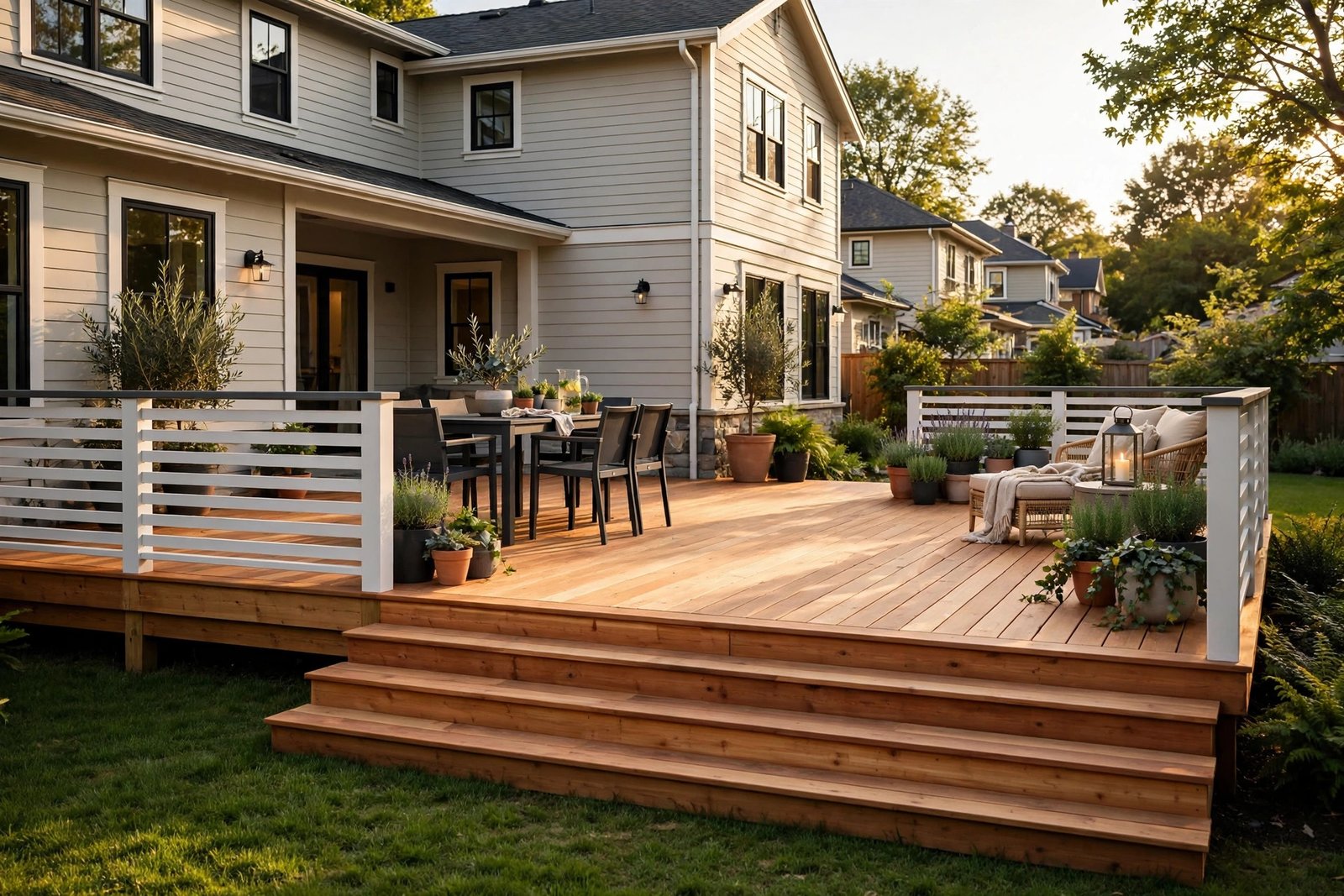

A new deck is one of those upgrades that transforms how you actually live in your home — suddenly summer evenings stretch longer, the grill gets a permanent home, and your backyard stops being “the yard” and starts being a room. But before you start picking out deck boards, there’s one question to answer: how much does it cost to build a deck? The honest answer is that it varies wildly, from a few thousand dollars for a simple ground-level platform to $25,000 or more for a multi-level composite showpiece. This guide breaks down real published cost data so you can budget with confidence.
The National Average Cost to Build a Deck
Let’s start with the number everyone wants first. Angi’s 2026 deck cost guide, based on 20,403 verified projects, puts the national average at $8,321, with most homeowners spending between $4,338 and $12,653. HomeAdvisor’s data tells essentially the same story: an average of $8,265 and a typical range of $4,340 to $12,600.
Other cost trackers skew higher because they include bigger, pricier builds. Fixr’s deck cost data puts the national average closer to $14,000, with most projects landing between $9,000 and $20,000. Why the gap? Angi’s numbers are weighted toward common mid-size projects, while Fixr’s include larger premium builds with composite decking, railings, and stairs. The practical takeaway: a straightforward deck runs roughly $8,000, but once you add size, premium materials, or extras, $14,000-plus is realistic.
Size is the single biggest lever on your final bill, and the industry’s own surveys show the typical new deck is around 278 square feet (per the 2025 Builder Practices Survey cited by Eye on Housing). But averages only tell you so much — here’s what size and material actually do to the price.
How Much Does It Cost to Build a Deck by Size?
The chart below shows installed cost ranges for common deck sizes in the two most popular materials, using national 2026 data from RemodelCalculators’ deck cost breakdown. The full table behind that chart is below:
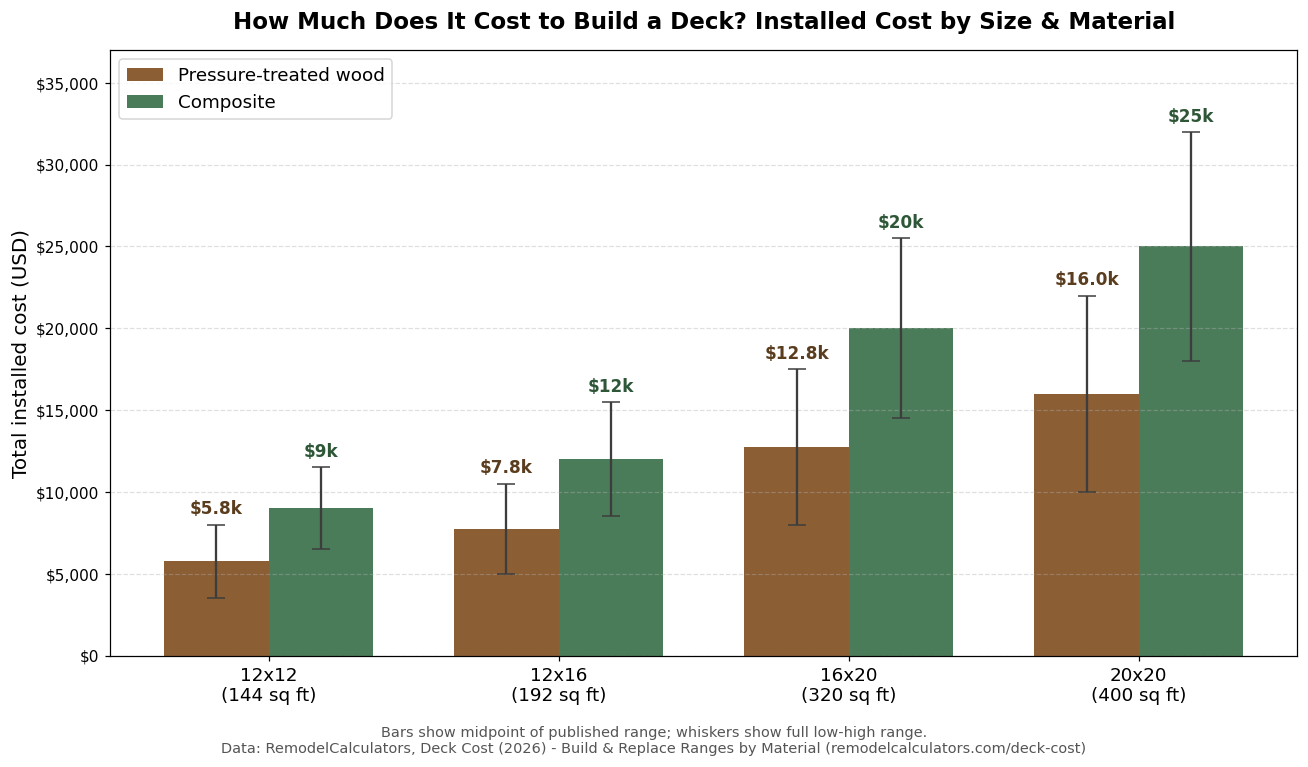
A compact 12×12 deck (144 sq ft) runs about $3,500–$8,000 in pressure-treated wood or $6,500–$11,500 in composite. Step up to a 12×16 (192 sq ft) and you’re looking at $5,000–$10,500 wood or $8,500–$15,500 composite. The popular 16×20 size (320 sq ft) costs $8,000–$17,500 in wood or $14,500–$25,500 in composite. And a spacious 20×20 (400 sq ft) deck runs $10,000–$22,000 in wood or $18,000–$32,000 in composite.
Notice the pattern: doubling your deck area doesn’t quite double the cost, because fixed costs like permits, footings, and mobilization get spread over more square feet. That’s also why smaller decks can feel expensive per square foot — the contractor still has to haul tools, dig footings, and pull a permit whether the deck is 100 square feet or 400.
Deck Cost Per Square Foot
Per-square-foot pricing is how contractors estimate and how you should sanity-check bids. Nationally, installed deck costs run about $25 to $80 per square foot, depending on material and design complexity. Fixr’s deck cost data puts most decks between $15 and $55 per square foot installed, with pressure-treated wood at $15–$25 and composite at $28–$40, while the Deck Cost Guide’s wood-vs-composite comparison pegs cedar or redwood at $30 to $60 installed.
Design complexity moves you along that scale. A floating (freestanding) deck runs about $20 to $60 per square foot, per Angi, while elevated, multi-level, or rooftop designs push past $50 per square foot easily. The cheapest deck per square foot is a plain ground-level rectangle on flat ground — no stairs, minimal railings, pressure-treated everything.
Cost by Material: Wood vs Composite vs PVC
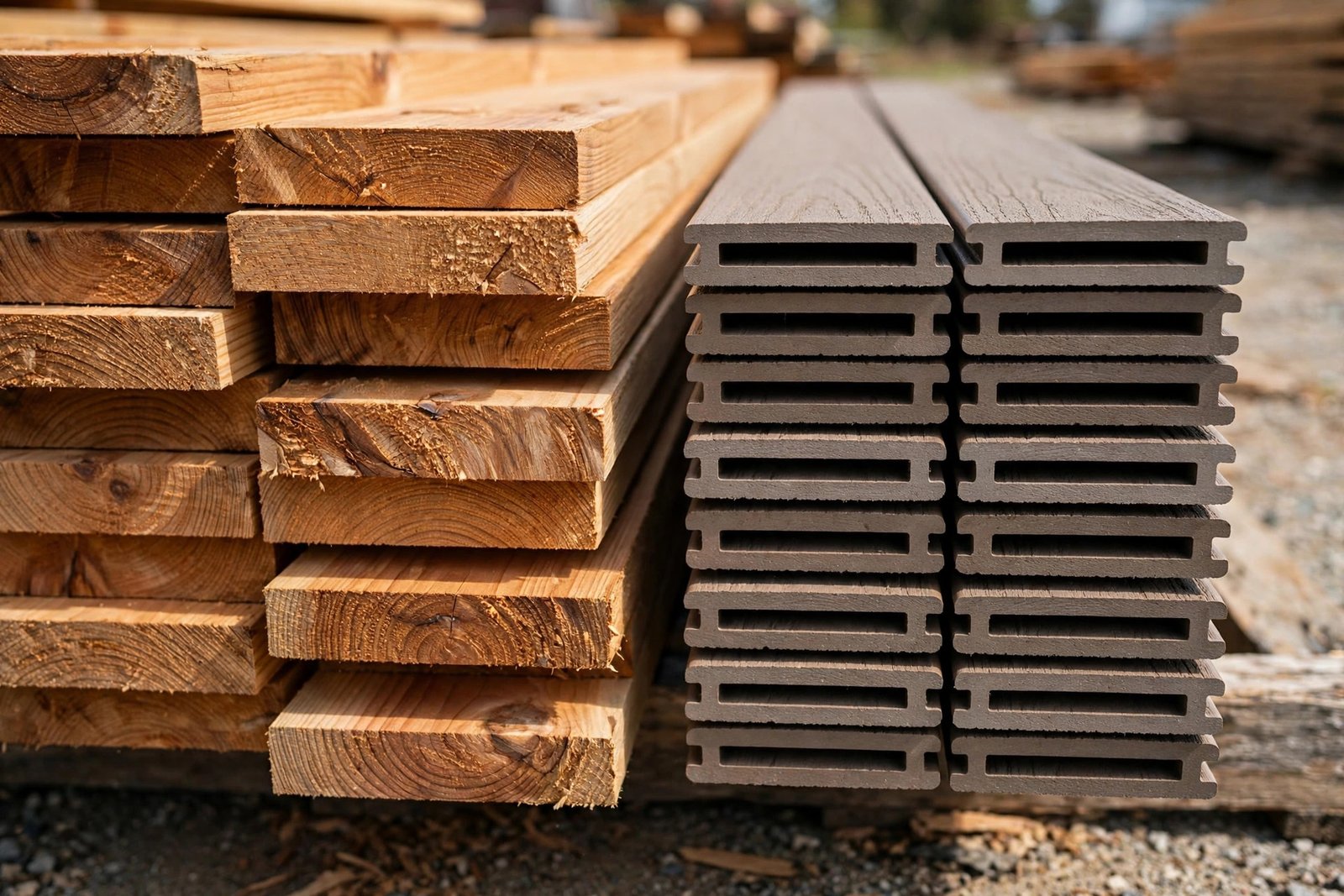
Material choice is the second-biggest cost driver after size. Here’s how the options stack up, with both materials-only and installed pricing where published.
Pressure-treated wood: $15–$50 per sq ft installed
Pressure-treated pine is the classic budget option and still the cheapest way to build a deck. Materials run roughly $2 to $5 per square foot, according to Angi, and the installed price lands between $15 and $50 per square foot depending on your market and design. The trade-off is maintenance: you’ll need to stain or seal it every two to three years, which adds both money and weekend labor over the deck’s 15-to-20-year life. Lumber prices have also been volatile — TradeCalc notes pressure-treated lumber is down about 22% from its 2021 peak but still 35% above 2019 levels, with a 12-foot 2×6 board running around $14 in 2026.
Cedar and redwood: $30–$60 per sq ft installed
Cedar and redwood sit in the middle: materials cost about $3 to $7 per square foot for cedar and $5 to $35 for redwood (wide range, since grades vary hugely). Installed, expect $30 to $60 per square foot. Both woods naturally resist insects and rot better than pine, and they look warmer and richer without stain. They still need periodic sealing to hold their color, but they last longer and age more gracefully than pressure-treated lumber.
Composite decking: $30–$80 per sq ft installed
Composite (Trex, TimberTech and the like) is the fastest-growing segment, and for good reason: no staining, no splinters, and a 25-to-50-year lifespan. Materials run $12 to $22 per square foot, with an installed composite deck typically $25 to $54 per square foot, per Angi. Expect to pay two to three times more upfront than pressure-treated wood — but over 15-plus years, the math gets interesting, because a wood deck needs staining every few years ($350 a pop each time, per TradeCalc’s estimates, plus your weekends).
PVC and premium hardwoods
PVC decking is the premium low-maintenance play at $50 to $110 per square foot installed, fully waterproof and fade-resistant. Tropical hardwoods like ipe run $10 to $20 per square foot for materials alone (installed prices land far higher) and deliver a 40-plus-year lifespan — but they’re harder to work with, which inflates labor. These make sense for forever homes where you never want to think about the deck again.
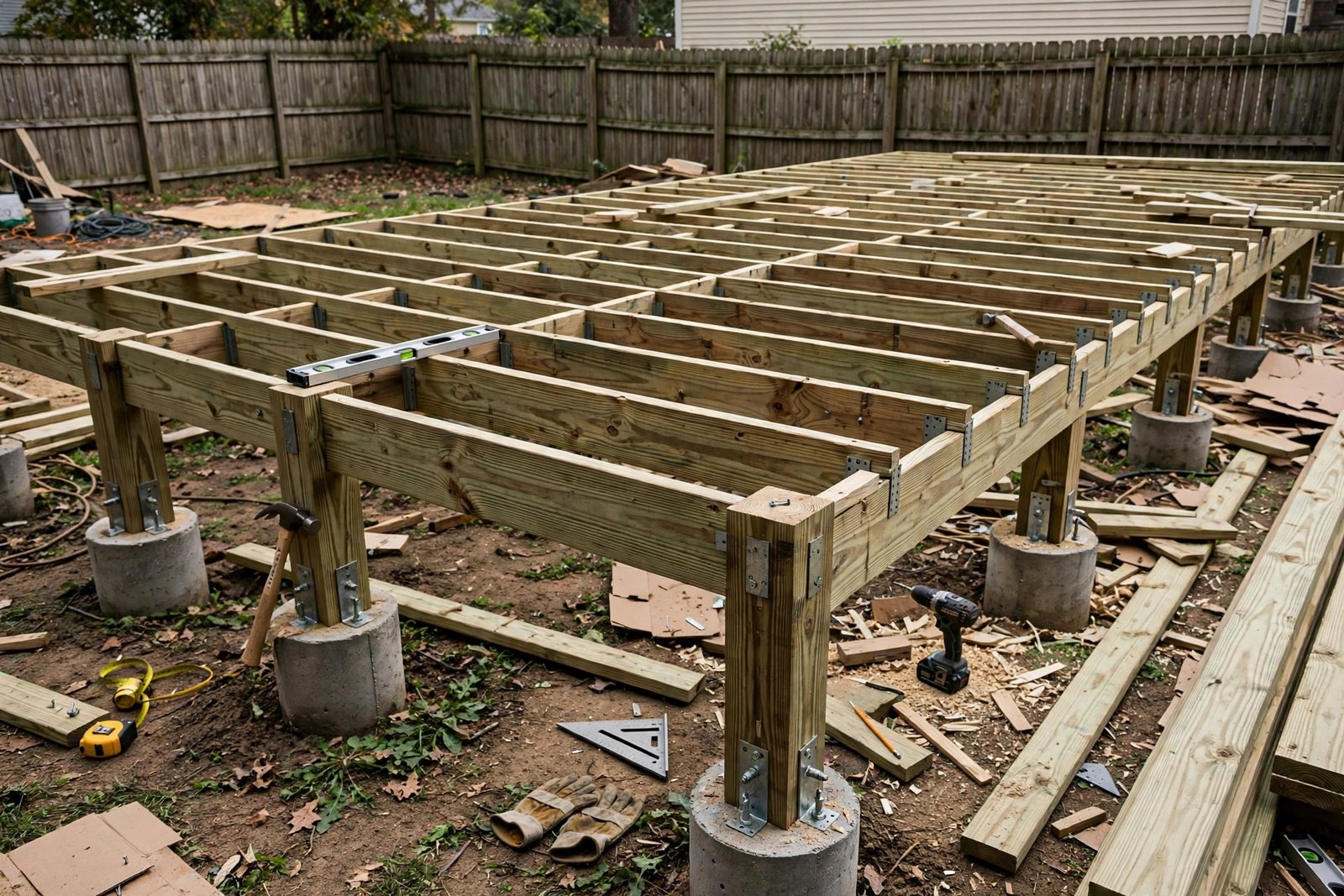
One thing to remember: nearly all decks, including composite ones, sit on a pressure-treated lumber frame. So the structure costs roughly the same either way — the price gap between wood and composite is almost entirely the decking boards and railing.
Labor vs DIY: What Does a Deck Builder Charge?
Labor is typically 45 to 60 percent of the total deck cost, which is why contractor-built decks cost so much more than DIY builds. HomeAdvisor reports deck labor at roughly $15 to $35 per square foot (framing adds another $9 to $12 when broken out), and easier materials like pine keep labor down while premium materials and complex designs push it up.
Doing it yourself can roughly halve the bill. TradeCalc’s cost calculator estimates a 192 sq ft pressure-treated deck at about $2,900 in materials alone versus around $7,000 with a contractor — a saving of 50 to 60 percent. Some budget builders report spending as little as $1,500 on materials for a 16×16 pressure-treated deck.
But DIY has real costs of its own: expect 40 to 60 hours of work for a first-timer, plus $500 to $1,000 in tools if you don’t own them. And this is not the project to wing — a badly built deck is a safety hazard. If you’ve never done framing or concrete work, hire a pro for the structure and do the decking boards yourself. And check permit rules first: most jurisdictions require a permit for any deck attached to the house or elevated more than about 30 inches, with fees running $230 to $500, per Angi.
Extra Features That Raise the Cost of Building a Deck
The deck itself is only the start. These add-ons push budgets up fast, and most of them show up in real quotes:
Railings. Any elevated deck needs them, and railing runs $25 to $45 per linear foot for wood, $85 to $140 for aluminum pickets, and $120 to $200-plus for glass — which can easily add thousands to a large deck.
Stairs. Ground-level stairs run $1,000 to $3,000; stairs for a raised deck can hit $3,000 to $8,000 or more depending on width and railings.
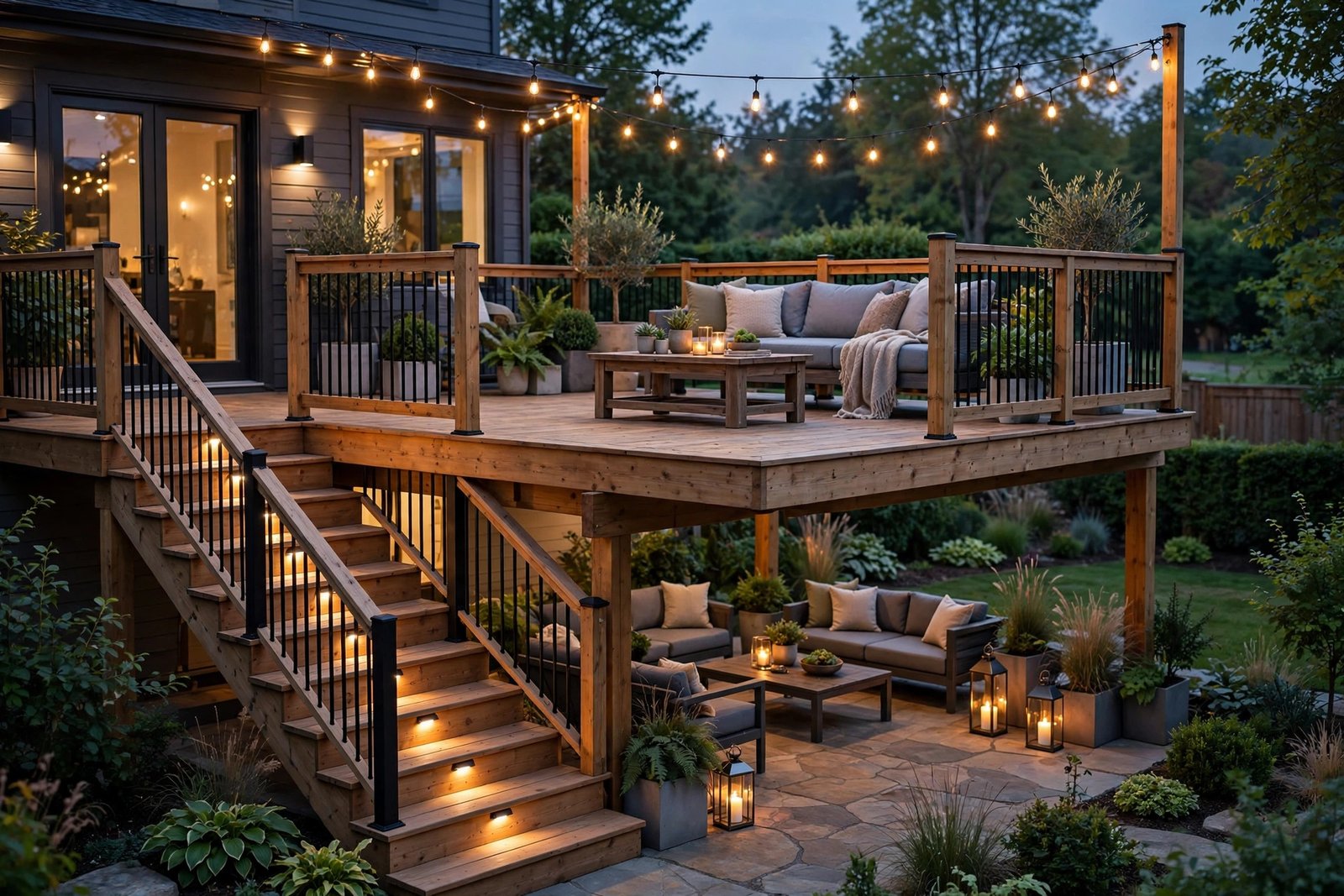
Multi-level designs. Second levels, wraparound shapes, and built-in benches add framing complexity — large multi-level decks with railings, stairs, and lighting can reach $25,000 to $50,000 or more.
Lighting and electrical. Built-in step lights, post-cap lights, and outdoor outlets add material cost plus an electrician’s time. An outdoor-rated ceiling fan for a covered section adds comfort too — see our guide on how to install a ceiling fan if you’re planning that yourself.
Permits and old-deck removal. Budget $230 to $500 for the building permit. If you’re replacing an old deck, demolition and disposal adds about $5 to $8 per square foot on top of the rebuild — roughly $1,000 to $1,500 for a 192 sq ft deck.
Site conditions. Sloped yards, poor soil, and tight access all add labor. Second-story decks need taller posts, more bracing, and often structural engineering sign-off.
How to Save Money on Your Deck (Without Cutting Corners)
A deck is one of the easier projects to value-engineer without regretting it later. Here’s what actually works:
Keep the shape simple. A rectangle costs less than curves, angles, and multi-level platforms because it uses standard lumber lengths with minimal waste. Every design flourish adds labor hours.
Choose pressure-treated wood strategically. It’s the cheapest decking material by a wide margin. If the budget is tight, build the whole deck in pressure-treated pine now — or build a composite deck surface over a pressure-treated frame later. Either way, the structure is the expensive part you only want to build once.
DIY the non-structural parts. Staining, sealing, installing railing pickets, and even laying decking boards are approachable weekend tasks even if the framing is done by a pro. Splitting the project like this is the sweet spot between cost and safety.
Get three itemized bids. Deck quotes vary enormously between contractors — same size, same materials, thousands apart. Get at least three written, itemized bids, and check that each one includes the permit, footings, stairs, and railings (missing line items are how “cheap” quotes turn expensive).
Build in the off-season. Contractors are busiest in spring and summer. Booking for fall or winter can mean better availability and sometimes better pricing — and your deck will be ready by the first warm weekend.
Phase the extras. Build the deck now, add the lighting, built-in seating, and pergola next year. Your wallet recovers, and you’ll make better decisions about what you actually use. If you’re building a home project budget on a tight income, phasing is the difference between done and deferred.
Is Building a Deck Worth It? The ROI Question
Few home projects return as much of their cost as a deck. The Zonda 2025 Cost vs. Value Report found that a wood deck addition costing $18,263 adds back $17,323 in resale value, a 94.9% cost recoup. A composite deck ($25,096 job cost) returns $22,199, or 88.5%.
That puts both deck types in the top ten nationally for ROI — eight of the top ten are exterior upgrades. A deck is also one of the few projects buyers genuinely care about in listings — and it can make your home more attractive than a comparable house without one. Even the cost of a roof replacement returns a lower percentage at resale.
That said, build the deck for yourself, not for the spreadsheet. You’ll enjoy it for years before you sell, and the resale return is the bonus — not the reason.
Frequently Asked Questions
How much does it cost to build a deck per square foot?
Most installed decks run $25 to $80 per square foot nationally, per RemodelCalculators. The realistic planning range is $15 to $55 per square foot: pressure-treated wood at $15 to $25, cedar or redwood at $30 to $60, and composite at $30 to $80. Elevated or complex designs push past $50 per square foot.
What is the cheapest way to build a deck?
A ground-level rectangular deck in pressure-treated wood, built DIY, is the cheapest route — materials alone can run as little as $1,500 for a 16×16 deck. With a contractor, the same style of deck still comes in cheapest, around $3,500 to $5,300 for a 12×16, since labor and simple geometry are the same. Keeping the shape simple and skipping extras is where the real savings are.
Is it cheaper to build a deck yourself?
Yes — DIY saves roughly 50 to 60 percent, because labor is about half the total cost. A 192 sq ft pressure-treated deck costs around $2,900 in materials versus $7,000 installed by a contractor. But budget 40 to 60 hours of work and $500 to $1,000 in tools if you don’t own them, and hire a pro for structural framing if you’re not experienced.
Does a deck add value to your home?
Yes. The Zonda 2025 Cost vs. Value Report shows a wood deck recouping 94.9% of its cost at resale ($17,323 back on an $18,263 project) and a composite deck recouping 88.5% — both in the top ten home projects for ROI. Beyond dollars, outdoor living space is a strong selling feature in most markets.
Do I need a permit to build a deck?
In most jurisdictions, yes — especially if the deck is attached to the house or more than about 30 inches off the ground. Permit fees typically run $230 to $500. Skipping the permit can cause problems at resale and may affect insurance coverage, so have your contractor pull it or pull it yourself as the homeowner.
How long does a deck last?
Pressure-treated wood lasts about 15 to 20 years with regular staining and sealing; cedar and redwood run 20-plus years. Composite decking lasts 25 to 50 years with minimal maintenance, PVC decking can last 50 years, and tropical hardwoods like ipe can exceed 40. The frame (usually pressure-treated lumber) typically needs attention before premium decking boards wear out.
Conclusion
So, how much does it cost to build a deck? For most homeowners in 2026, the answer is roughly $8,000 to $14,000 for a standard wood deck, or $14,000 to $25,000 for composite — with simple DIY builds starting near $1,500 and large multi-level premium decks exceeding $40,000. Size and material drive about 80% of the price; everything else is details you can control.
The smartest move is to decide your budget first, then let it choose your size and material — not the other way around. Get three itemized bids, keep the design simple, and don’t skip the permit. Do that, and you’ll end up with a deck you love at a price that doesn’t haunt you — and one of the best resale returns in home improvement when the day comes to sell. And if a deck is just one item on your home-upgrade list, even simple wins like painting a room can refresh a space while you save for the bigger projects.