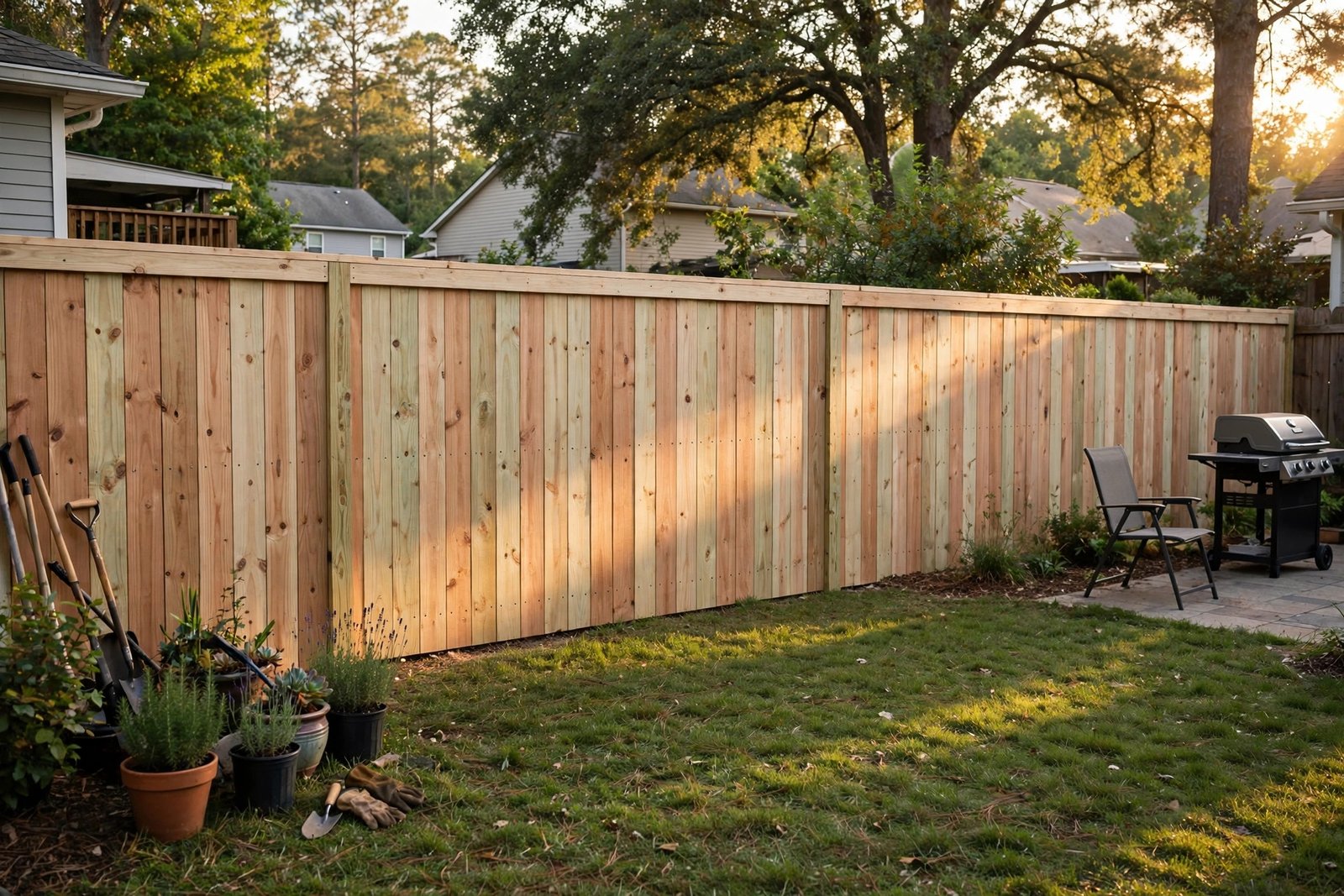

How Much Does It Cost to Build a Fence? The 2026 Breakdown
Table of Contents
You have measured the yard, picked a style, and now comes the question every homeowner asks first: how much does it cost to build a fence? The honest answer is that it depends on the material, the length, the height, and whether you hire a crew or do it yourself — but the range is wide enough to matter. This guide breaks down the real 2026 numbers, material by material, so you can budget with confidence and spot a bad quote when you see one.
The headline figures set the scene. According to HomeAdvisor’s 2026 data, most fence projects land between $1,860 and $4,843, with a typical project costing around $3,276 and most homeowners paying about $23 per linear foot installed. HomeGuide’s 2026 guide puts the installed range for wood and vinyl at $20 to $60 per linear foot, or $4,000 to $12,000 for a 200-foot fence. Fixr’s national data, updated in January 2025, puts the average at $4,500 for 200 linear feet of 4-foot cedar picket fence with a gate.
How Much Does It Cost to Build a Fence? The Short Answer
For a typical suburban backyard — roughly 150 linear feet of fencing on three sides — expect to pay about $1,250 to $4,250 for a 4-foot chain-link fence, $2,250 to $6,750 for a 6-foot pressure-treated wood privacy fence, and $3,750 to $9,000 for a 6-foot vinyl privacy fence, materials and labor included. Those figures come from reconciled 2026 national data, and they are the numbers to hold in your head before you start collecting quotes.
The single most important number is the cost per linear foot, installed. It bundles materials, posts, rails, concrete, and labor into one comparable figure, and every other estimate in this guide is built from it. Multiply the per-foot rate by your fence length and you have the cost of the fence run itself — then add gates, old-fence removal, and permits on top.
Fence Cost Per Linear Foot by Material
Material is the biggest single driver of cost, and the differences are large. The table below shows installed prices per linear foot from HomeGuide’s 2026 guide, with lifespans to help you weigh price against longevity.
| Material (6 ft unless noted) | Installed cost per linear foot | Typical lifespan | Upkeep |
|---|---|---|---|
| Chain-link (4 ft, galvanized) | $9–$30 | 15–25 years | Almost none |
| Wood (pressure-treated pine) | $20–$50 | 10–25 years | Stain or seal every 2–3 years |
| Vinyl / PVC privacy | $30–$60 | 20–30 years | Wash only |
| Aluminum | $25–$75 | 20–30 years | Almost none |
| Composite | $20–$85 | 25–30 years | Wash only |
| Wrought iron | $50–$85 | 50+ years | Repaint to prevent rust |
| Split rail (wood) | $15–$35 | 10–15 years | Minimal |
A note on the vinyl range: published guides disagree at the edges. HomeGuide lists $40 to $60 for a 6-foot vinyl privacy fence, while Angi lists $25 to $40, so the honest band is $25 to $60 — and your local bids are the numbers that count. The same is true of chain-link, where Fixr quotes $9 to $25 per foot and Bob Vila quotes $15 to $30. Treat national figures as a starting point, not a quote.
Wood is the most popular choice for a reason: it is the cheapest way to get full privacy, it looks natural in almost any yard, and a single damaged board can be replaced without touching the rest of the fence. Vinyl costs roughly twice as much up front but asks almost nothing of you afterward, which is why it often wins on lifetime cost. The Remodel Calculators fence cost guide reconciles the HomeGuide, Angi, and Fixr figures into one set of ranges, and it is a useful second source for checking the material prices against your local quotes.
How Much Does It Cost to Build a Fence by Length?
Length is the second big driver, and it is the one you control most directly. Fencing only the backyard costs far less than enclosing the whole lot, and most homeowners fence three sides of a backyard rather than the full perimeter. The table below shows what different lengths cost in the three most common materials, using HomeGuide’s 2026 figures for wood and vinyl and Fixr’s figures for chain-link.
| Fence length | Chain-link (4 ft) | Wood privacy (6 ft) | Vinyl privacy (6 ft) |
|---|---|---|---|
| 100 linear feet | $900–$3,000 | $2,000–$5,000 | $3,000–$6,000 |
| 150 linear feet | $1,250–$4,250 | $2,250–$6,750 | $3,750–$9,000 |
| 200 linear feet | $1,800–$6,000 | $4,000–$10,000 | $6,000–$12,000 |
| 300 linear feet | $2,700–$9,000 | $6,000–$15,000 | $9,000–$18,000 |
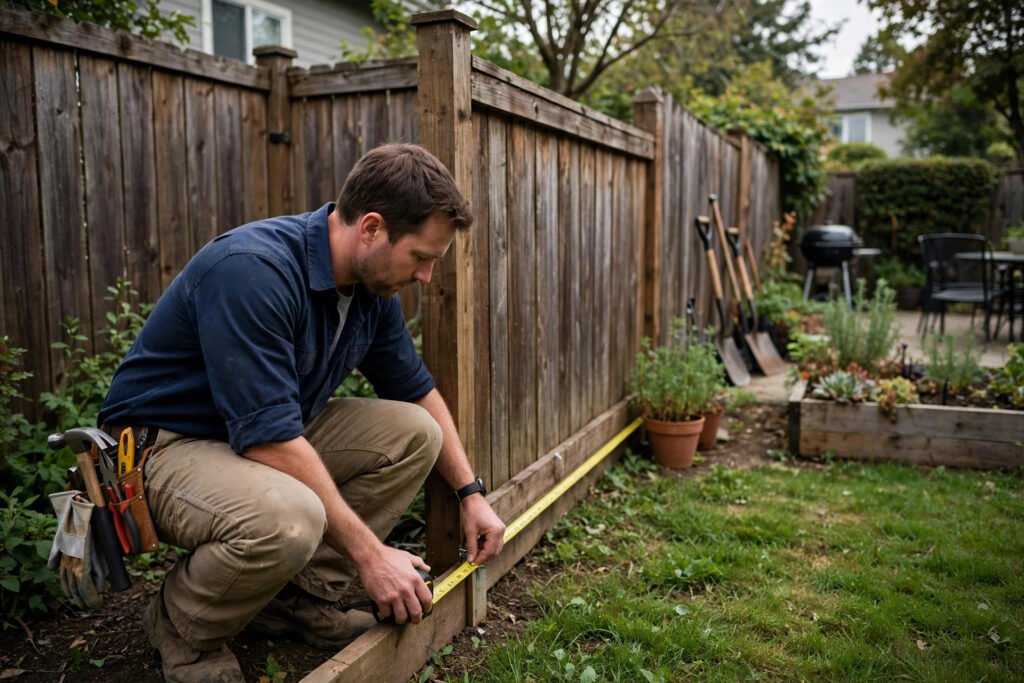
Measure your fence line before you call anyone. Walk the boundary with a measuring wheel or a long tape, and mark where gates will go. Contractors price by the linear foot, so a measurement that is off by 20 feet can move your quote by $500 to $1,000.
DIY vs Hiring a Professional: What You Actually Save
Labor is typically 40% to 60% of a fence project, so doing it yourself can cut the bill nearly in half. Fixr’s January 2025 data puts labor at $5 to $20 per linear foot for most fence types: wood $10 to $20, chain-link $6.75 to $15, vinyl and aluminum $5 to $10, and composite $13 to $15. A 2026 contractor pricing guide from Zarla puts field labor slightly higher, at $10 to $35 a foot depending on the material. On a 150-foot wood privacy fence, that is $1,500 to $3,000 of labor you would keep by doing the work yourself — against materials-only costs of roughly $5 to $15 per linear foot for wood.
But DIY fencing is real work, and it is worth being honest about it. A 150-foot fence means digging roughly 20 post holes, setting each post in concrete, keeping the line straight and level, and hanging panels or pickets one by one. For two reasonably fit people with a rented auger, that is a full weekend at minimum, and often two. Mistakes are expensive too: posts set too shallow or out of plumb will lean within a season, and a fence that leans is harder to fix than it is to build right the first time.
The middle path is common and sensible: hire a crew for the posts — the part that determines whether the fence lasts — and do the panels or pickets yourself. Get at least three quotes either way, and make sure each one itemizes materials, labor, gates, removal, and permits separately. A quote that lumps everything into one number is a quote you cannot compare. If you are weighing DIY against hiring out on other home projects too, our guide to how much it costs to replace a water heater shows the same labor-versus-materials split for an indoor job.
What Else Adds to the Cost? Gates, Removal, Permits, and Terrain
The fence run itself is only part of the bill. The extras below are where budgets most often go wrong, because they are easy to forget until the quote arrives.
Gates. A standard walk-through gate adds roughly $150 to $500 installed, while a wide double gate for a driveway can run $500 to $1,500 or more, especially with hardware and automation.
Old fence removal. Taking down and hauling away an existing fence typically costs $3 to $10 per linear foot, depending on the material and whether concrete footings need to come out. For a 150-foot run, budget $450 to $1,500. Some contractors include removal in their quote and some do not, so ask explicitly.
Permits and surveys. Many cities and counties require a fence permit, usually $50 to $200, and homeowners associations often require approval as well. A boundary survey, if you need one, can cost $300 to $700. Skipping the permit can mean a fine and an order to take the fence down, which is the most expensive outcome of all.
Terrain and access. A flat, open yard is the cheapest fence to build. Slopes, rocky soil, tree roots, and tight access for equipment all add labor hours. If your yard slopes, ask each bidder how they handle it — stepped panels or racked panels — because the answer affects both the look and the price.
Height. A 4-foot fence costs substantially less than a 6-foot one, and an 8-foot fence costs more again: HomeGuide puts 6-foot privacy fencing at $25 to $60 per foot and 8-foot fencing at $50 to $85.
How to Save Money on a Fence Without Regretting It
There are good ways to cut the cost and bad ways. The good ways start with timing and scope: fence in the off-season, when contractors are quieter and more willing to negotiate; choose a 4-foot fence where privacy is not the point, since height is one of the biggest cost levers.
Sharing the cost with a neighbor is the single biggest saving available to many homeowners. A boundary fence benefits both properties, and in many areas the cost is legally shared. A polite conversation before you build can halve your bill — and it avoids the awkwardness of a fence that one neighbor resents. Put any agreement in writing, including who pays for what and who maintains it.
Material choices matter too. Pressure-treated pine is the cheapest wood that still looks good, and it lasts 10 to 15 years with basic care. Cedar costs more — typically $30 to $50 per foot installed — but resists rot and insects naturally and can last 15 to 30 years. Buying materials yourself from a lumber yard rather than through a contractor’s markup can save 10% to 20%, if your contractor allows it. And if you are comfortable with a simpler design, a picket fence at $20 to $50 per foot costs less than a full privacy fence in the same material.
The bad ways to save are the ones that show up later. Skipping concrete footings, setting posts too shallow, or using untreated wood below grade will all cost more in repairs than they save up front. A fence is a 15- to 30-year purchase, and the cheapest fence is rarely the cheapest over its life — a point the Home Exterior Lab fence cost guide makes with its lifetime cost comparisons.

How Long Does a Fence Last?
Lifespan is the other half of the cost question, because a fence that costs twice as much but lasts twice as long is not really more expensive. Chain-link lasts 15 to 25 years with almost no maintenance. Pressure-treated wood lasts 10 to 15 years, western red cedar 15 to 30 years. Vinyl lasts 20 to 30 years or more, composite 25 to 30 years, aluminum 20 to 30 years, and wrought iron 50 years or longer if it is repainted to prevent rust.
Maintenance is what separates the materials in practice. Wood needs staining or sealing every two to three years, and individual boards will warp, crack, or rot and need replacing. Vinyl needs an occasional wash with a hose. Aluminum and wrought iron need rust checks, especially at ground level.
Getting Quotes: What to Ask Before You Sign
A good fence quote is specific. It should state the material and brand, the height and style, the exact linear footage, the number and size of gates, the post spacing and depth, the type of concrete, the removal cost for any old fence, the permit cost, and the warranty — both on materials and on workmanship. If any of those are missing, ask for them before you sign.
Ask how deep the posts will go. A common standard is one-third of the post length below ground, or at least 24 inches for a 6-foot fence, deeper in frost-prone areas. Ask about the warranty: reputable installers typically offer at least a one-year workmanship warranty, and vinyl and composite manufacturers often offer 20-year or lifetime material warranties.
Finally, check the contractor. Verify licensing and insurance, read recent reviews, and ask for two or three nearby jobs you can drive past. A fence is a visible, long-lived part of your property — the cheapest bidder is not always the best value, and the most expensive is not always the best work. Three detailed, itemized quotes will tell you more than any national average can.
Frequently Asked Questions
How much does it cost to build a fence in 2026?
Most projects cost $1,860 to $4,843, according to HomeAdvisor’s 2026 data, with most homeowners paying about $23 per linear foot installed. A 150-foot wood privacy fence typically costs $2,250 to $6,750, while the same length in vinyl runs $3,750 to $9,000.
What is the cheapest fence to build?
Chain-link is the cheapest installed fence, at roughly $9 to $30 per linear foot for a 4-foot galvanized fence. Split rail is similarly cheap at $15 to $35 per foot, but it provides no privacy. For a cheap privacy fence, pressure-treated wood at $20 to $50 per foot is the usual choice.
How much does a 200-foot fence cost?
For 200 linear feet, expect roughly $1,800 to $6,000 in chain-link, $4,000 to $10,000 in wood privacy, and $6,000 to $12,000 in vinyl privacy, installed. Fixr’s national average is $4,500 for 200 feet of 4-foot cedar picket fence with a gate.
Is it cheaper to build a fence yourself?
Yes — labor is typically 40% to 60% of the job, so DIY can save $1,500 to $3,000 on a 150-foot wood fence. But it is hard physical work, and poorly set posts will cost more to fix than the labor saved. Many homeowners hire a crew for the posts and do the panels themselves.
Do I need a permit to build a fence?
Often yes. Many cities and counties require a fence permit, usually $50 to $200, and homeowners associations usually require approval. Check local rules on height and placement before you build — front-yard fences are often capped at 3 or 4 feet.
How long does a wood fence last compared to vinyl?
Pressure-treated wood lasts 10 to 15 years and cedar 15 to 30 years, with staining every two to three years. Vinyl lasts 20 to 30 years or more with almost no maintenance. Over its full life, vinyl often costs less per year despite the higher upfront price.
Conclusion
So, how much does it cost to build a fence? For most homeowners in 2026, a realistic budget is $2,000 to $7,000 for a typical backyard, with the material you choose mattering more than anything else. Chain-link is the budget option, wood is the best value for privacy, and vinyl is the low-maintenance choice that often wins on lifetime cost.
The smartest move is not to chase the lowest national average but to get three itemized local quotes, measure your fence line carefully, and decide on the material with its full lifespan in mind. A fence is one of the few home improvements you see every single day — it is worth the extra afternoon of research to get it right. For a broader sense of what outdoor projects cost in 2026, our breakdown of how much it costs to build a deck uses the same per-foot thinking.