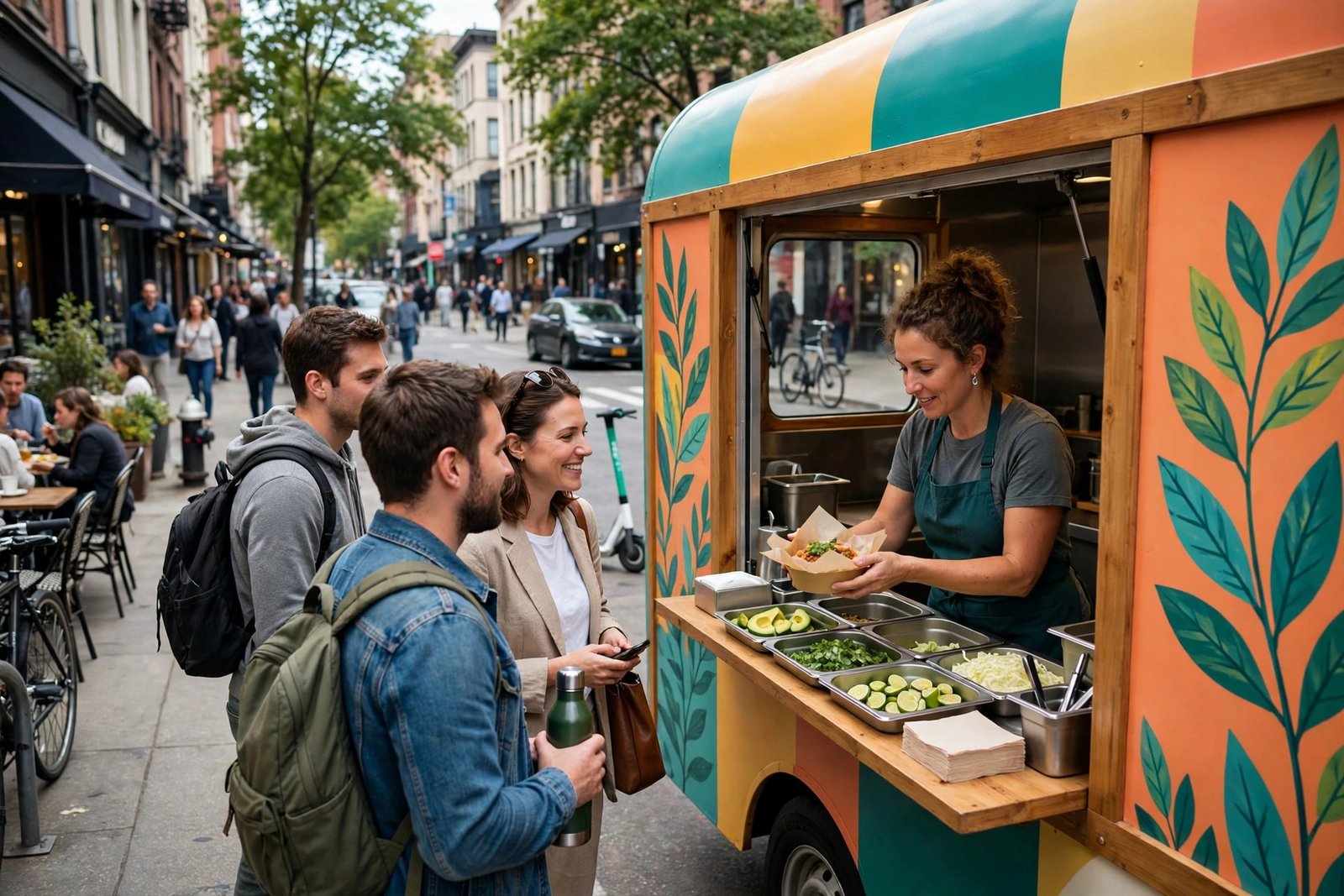

How Much Does It Cost to Start a Food Truck? The Real 2026 Breakdown
If you’ve ever dreamed of trading your desk for a rolling kitchen, you’ve probably asked the question every aspiring operator asks first: how much does it cost to start a food truck? The honest answer is that it costs somewhere between $50,000 and $250,000, with most properly funded launches landing between $100,000 and $150,000 all in. That’s far cheaper than opening a brick-and-mortar restaurant — but it’s real money, and underestimating it is the single fastest way to fail in this business.
In this guide, I’ll walk you through every line item of a food truck startup budget, from the vehicle itself to the permits, commissary fees, and the working-capital buffer almost nobody plans for. Every figure below comes from 2025–2026 industry data, and I’ll flag exactly where costs swing the most — because a truck in Wichita and a truck in New York City are barely the same business.
The Short Answer: How Much Does It Cost to Start a Food Truck?
Industry guides agree on the same rough territory. Square’s food truck research puts startup costs between $46,700 and $187,440, depending on whether you rent, buy used, or buy new. Eat App’s 2026 breakdown of food truck startup costs puts most launches at $100,000–$150,000 when done properly, and food truck statistics for 2026 put the full range at $50,000 to $250,000. A lean, used-truck launch can squeeze in near $50,000; a brand-new custom build in a major city can push past $200,000 before you sell your first taco.
Here’s the summary table before we dig into each category. All ranges reflect 2025–2026 market rates reported by industry sources.
| Cost category | Budget / used range | New / custom range |
|---|---|---|
| The truck (or trailer) | $30,000 – $100,000 | $75,000 – $200,000 |
| Kitchen equipment & outfitting | $10,000 – $20,000 | $25,000 – $50,000 |
| Permits & licenses (first year) | $1,000 – $5,000 | $3,000 – $30,000+ |
| Commissary (annual) | $2,400 – $9,600 | $6,000 – $24,000 |
| Initial inventory & supplies | $1,000 – $5,000 | $2,000 – $5,000 |
| Insurance (annual) | $2,000 – $5,000 | $2,500 – $6,000 |
| Branding, wrap & POS | $3,500 – $10,000 | $5,000 – $12,000 |
| Working capital buffer | $5,000 – $15,000 | $15,000 – $30,000 |
| Typical total | $50,000 – $130,000 | $100,000 – $250,000+ |
1. The Vehicle: $30,000–$200,000
The truck is your biggest line item, and the single decision that moves your total the most. There are three paths, and each has a very different price tag.
Buying new or custom-built ($75,000–$200,000). A custom fabricator builds the kitchen to your exact layout and menu, and the equipment is brand new. The downside, besides price, is lead time: custom builds can take several months, and you’re paying for depreciation the moment you drive away.
Buying used ($30,000–$100,000). This is the most common route. A serviceable used truck typically sells for $30,000 to $80,000, though you’ll often need $10,000 or more in repairs and upgrades to bring it up to your local health code. Always get a used truck professionally inspected before buying — a bad transmission on a step van can erase your savings in one repair bill.
Buying a trailer ($15,000–$50,000). Food trailers are the budget champion. You get a full kitchen at a fraction of the cost, but you need a tow vehicle, and trailers are less mobile for hopping between lunch spots.
Renting ($2,000–$3,000/month). If you’re testing a concept, renting gets you rolling fastest. But after two years of rent you’ve spent $48,000–$72,000 and own nothing, so this is a trial strategy, not a long-term plan.
2. Kitchen Equipment & Outfitting: $10,000–$50,000
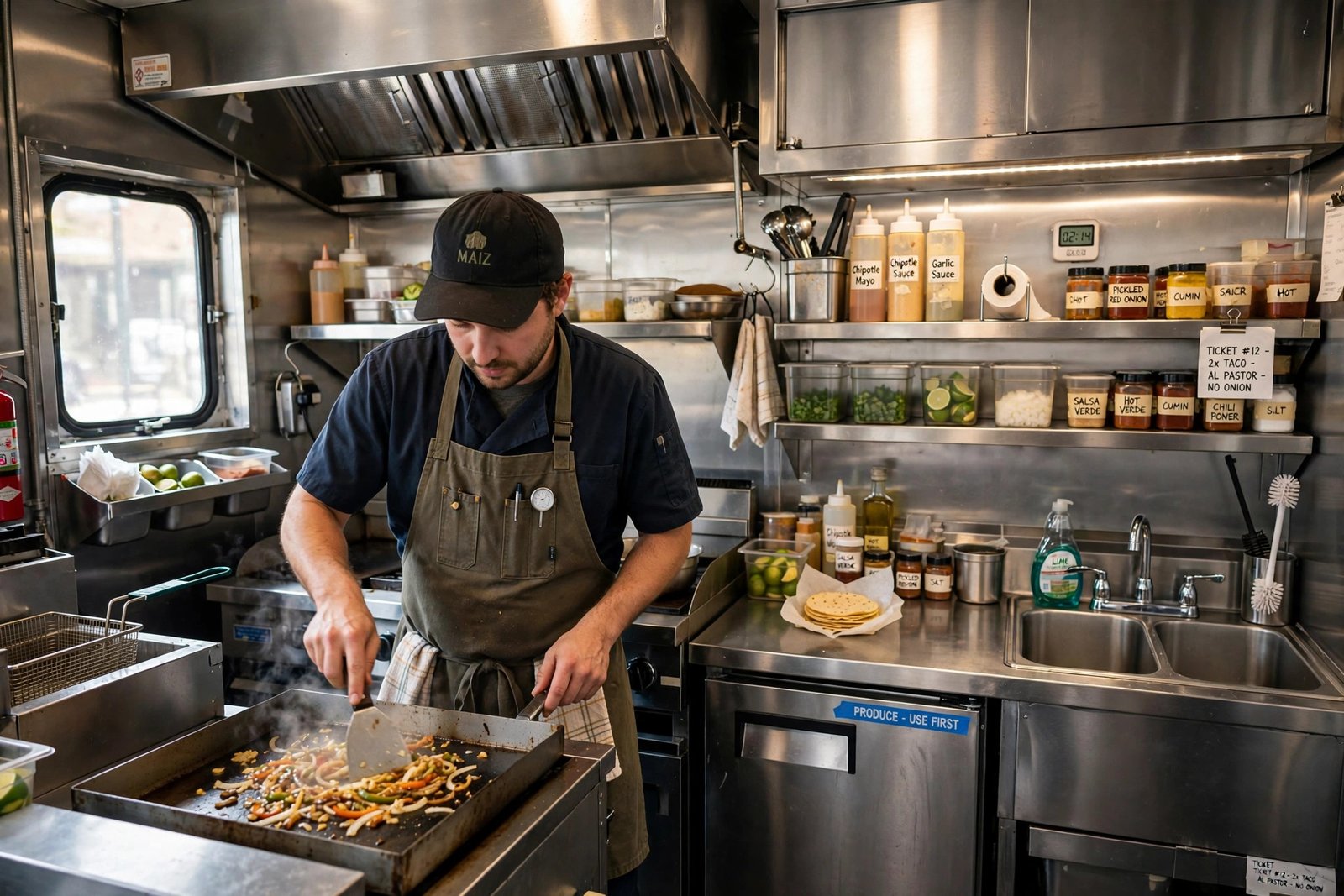
If you buy a bare or half-finished truck, the kitchen buildout is your second-biggest expense. Your menu decides the bill: a simple griddle-and-fryer operation can be outfitted for $10,000–$20,000, while a full-service kitchen with multiple cooking stations runs $25,000–$45,000 or more, according to Homebase’s guide to food truck startup costs.
The core list most trucks need: refrigeration and cold storage, a flat-top griddle or grill, fryers, a prep table, a three-compartment sink plus a separate hand-wash sink, fresh and grey water tanks, and — the expensive surprise — a commercial exhaust hood with a fire-suppression system. Ventilation and Ansul-style suppression alone run $8,000–$16,000, and they’re non-negotiable: health and fire inspectors check them first. Then add the generator: a quiet commercial unit in the 7–12 kW range costs $6,500–$15,000, and skimping here means running loud, failing equipment that will get you kicked out of events.
3. Permits & Licenses: $1,000–$30,000+
This is the most location-sensitive category in the entire budget, and the one that blindsides newcomers. In an affordable city, first-year permits might total $800–$2,500. In a major market, compliance costs can reach $15,000–$30,000+, per the U.S. Chamber of Commerce Foundation’s Food Truck Nation study.
The standard paperwork stack includes: business registration or LLC filing ($50–$500 depending on state), a federal EIN (free), a mobile food vendor license ($100–$1,000), a health department permit ($200–$500), a fire safety permit ($100–$500), food handler certifications for every worker, and parking or vending permits that vary block by block. When you’re choosing between an S corp vs LLC for your food truck, remember that the filing fee is the cheapest part — permits are where the money goes.
The extreme example is New York City, where the official license fees are only a few hundred dollars — but the city stopped issuing enough new mobile food vendor licenses years ago, so operators buy existing ones on the secondary market for $15,000–$25,000. Research your specific city before budgeting; national averages are meaningless for this line item.
4. Commissary: $2,400–$24,000 per Year
Most cities require food trucks to operate out of a licensed commissary kitchen — a commercial facility where you store inventory overnight, do heavy prep, clean equipment, and dump grey water. You cannot simply park the truck at home and call it done; health inspectors will ask for your commissary agreement.
Costs run $200–$2,000 per month depending on the city, which means $2,400–$9,600 a year in affordable markets and up to $24,000 a year in expensive metros. A shared commissary with cold storage, prep space, and ice service is usually enough when you’re starting out. Some operators split commissary time with another truck to halve the cost — worth asking about before you sign anything.
5. Initial Inventory & Supplies: $1,000–$5,000
Your opening food order, disposable packaging, napkins, utensils, cleaning supplies, and smallwares typically cost $1,000–$5,000, depending on menu complexity. A burger truck with a five-item menu can open lean; a truck doing made-from-scratch cuisine across twelve menu items needs a bigger opening order.
Keep the opening menu tight — five to eight items — until you know what sells. Food waste runs 4–10% of inventory for most operators, so a sprawling menu you can’t turn over fast is just expensive garbage. You can also save real money by bulk-buying staples with other trucks; some operators coordinate on oil, napkins, and takeout containers.
6. Insurance: $2,000–$6,000 per Year
You need more insurance than most first-timers expect: commercial auto for the vehicle, general liability, product liability (in case someone gets sick), and workers’ comp once you hire. Industry figures put the first year at $2,000–$5,500, with broader coverage pushing toward $6,000 in high-cost states.
Context helps justify the spend: the average general liability claim in this industry cost $6,438 in 2025, according to 2026 food truck statistics. One accident without coverage ends the business. Get quotes from insurers that actually write food truck policies — a standard commercial auto quote often misses the mobile-food exposures — and confirm exactly what your commissary and event organizers require, since many demand to be named as additional insured.
7. Branding, Wrap & POS: $3,500–$12,000
Your truck’s exterior is a rolling billboard, and a full professional vinyl wrap costs $2,500–$8,000. A menu board, signage, and basic brand design (logo, social profiles, printed menus) add another $500–$2,000. Don’t skip this: food trucks live or die on visibility and Instagram, and a clean, memorable wrap pays for itself in free marketing.
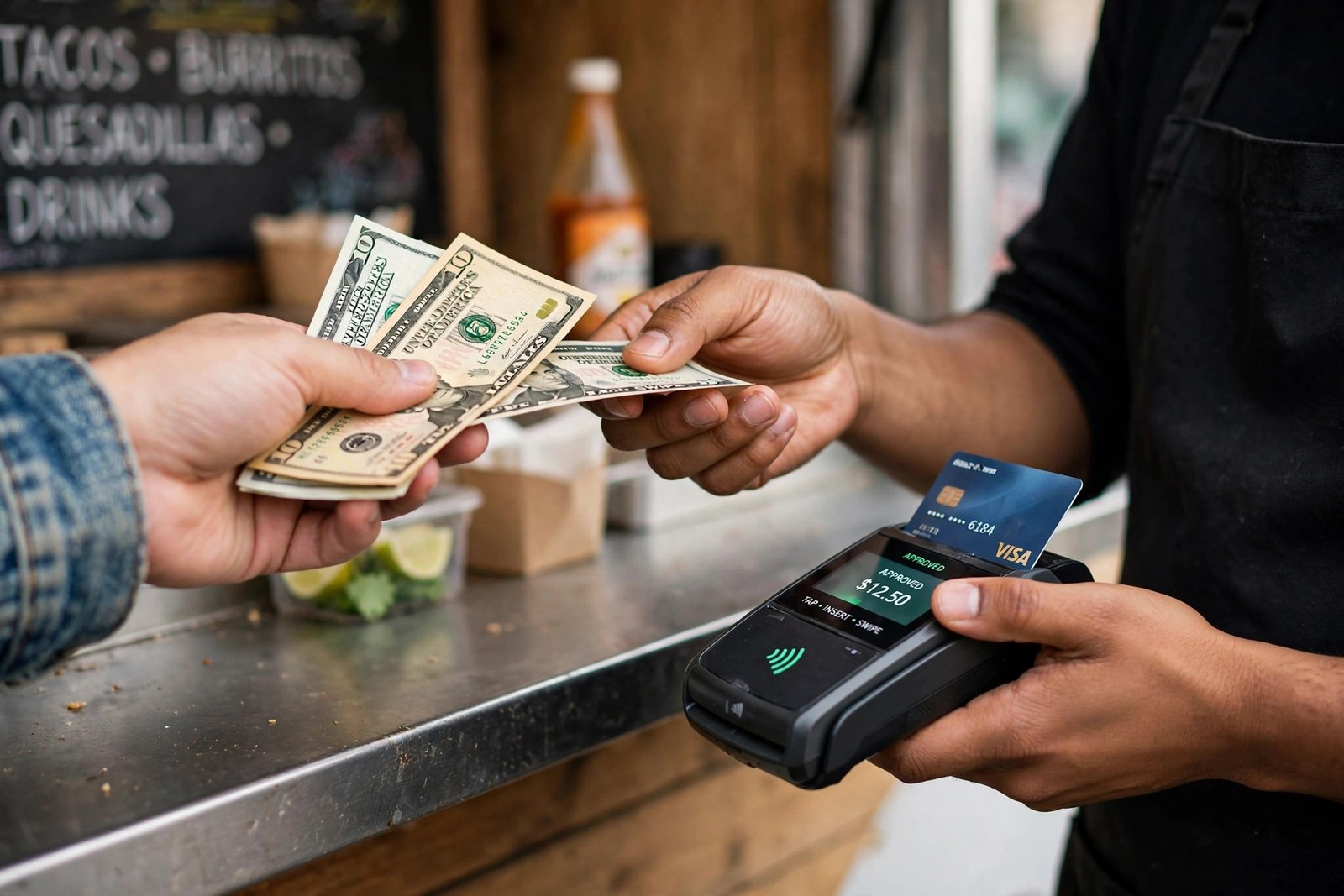
A modern point-of-sale system runs $500–$2,000 for the hardware and reader setup. Go cashless-friendly from day one — card processing fees run 2.6–2.9% of sales, but cash-only trucks measurably lose impulse buyers. For the back-office side, invoicing tools that get you paid faster matter more than you’d think once catering gigs and private events become part of your revenue — and they will.
8. The Operating Runway: $15,000–$30,000 in Working Capital
Here’s the line item that kills more food trucks than any other: the cash to survive until the business feeds itself. Most trucks take 12–24 months to reach consistent profitability. Plan for three to six months of operating expenses sitting in the bank on day one — roughly $15,000–$30,000 for a full-time operation.
A realistic full-time truck burns $13,000–$26,000 a month: $6,000–$12,000 in food costs, $4,000–$8,000 in labor, $800–$1,500 in fuel, $1,000–$2,000 in commissary fees, plus insurance, maintenance, and marketing. That means you need $400–$600 a day just to break even, and $800–$1,500 a day to run profitably.
Build a 20% contingency buffer on top of your whole budget. Emergency vehicle repairs run $3,000–$12,000, winter revenue can drop 30–60%, and one rained-out festival weekend means lost perishable inventory with zero revenue. The TruckerWiki food truck financing calculator is a useful sanity check here: compare loan structures before you commit, because the SBA 7(a) program’s longer amortization can materially lower your monthly payment and preserve that runway. Many successful launches are funded with a mix of personal savings, SBA microloans, and equipment financing.
New vs. Used: Two Realistic Budget Scenarios
To make this concrete, here are two full-budget scenarios built from the figures above — a lean launch and a turnkey launch.
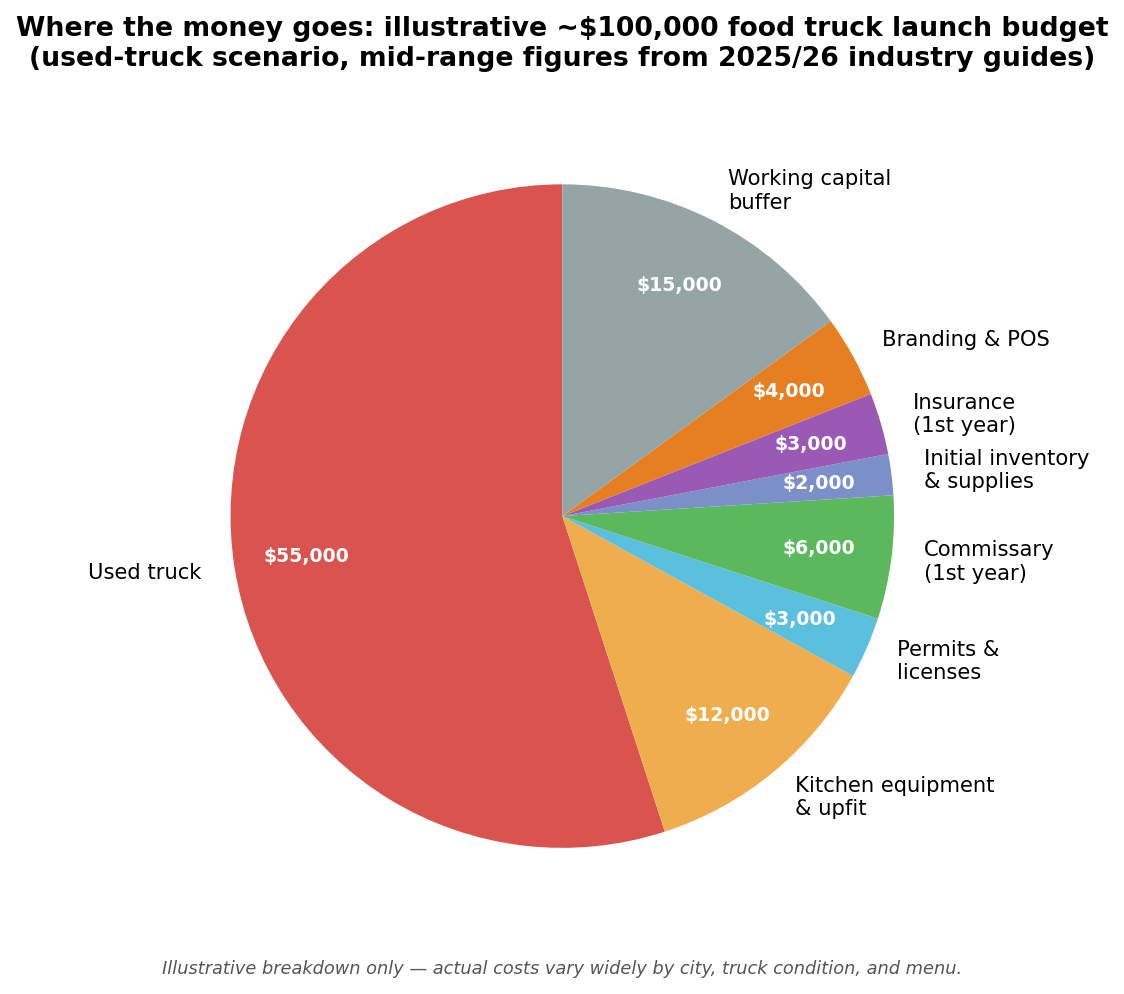
Lean launch (~$97,500): $60,000 used truck, $10,000 equipment upgrades, $3,000 permits, $6,000 first-year commissary, $2,000 opening inventory, $3,000 first-year insurance, $4,000 wrap and POS, and a $15,000 working-capital reserve. Then roughly $13,900 a month in operating costs. That’s about $167,000 in total first-year expenses — but at $300,000 in revenue (realistic for a well-run truck), the math works.
Turnkey launch (~$200,000+): $120,000 new custom truck, $30,000 full equipment buildout, $8,000 permits in a competitive city, $12,000 commissary, $4,000 inventory, $5,000 insurance, $8,000 premium wrap and tech, and a $25,000 runway. The equipment is new, the truck is exactly your layout — but you’re financing depreciation, and the monthly loan payment eats margin from day one.
Frequently Asked Questions
Can I start a food truck with $50,000?
Yes, but only at the lean end: a used truck or trailer, a simple five-to-eight-item menu, and you working the window solo. Budget around $50,000–$75,000 this way, and keep a smaller but real cash buffer. Most operators who try to launch for less end up stalled on repairs or permits they didn’t budget for.
How much does it cost to start a food truck in a big city vs. a small town?
The truck and equipment cost roughly the same everywhere, but permits and commissary don’t. First-year compliance can be under $1,000 in an affordable market and $15,000–$30,000+ in a major city — and in places like New York, a scarce vendor license alone can cost $15,000–$25,000 on the secondary market. Always research your specific city before finalizing a budget.
Is it cheaper to rent a food truck or buy one?
Renting ($2,000–$3,000/month) is cheapest up front and the fastest way to test a concept. Buying a used truck ($30,000–$100,000) wins long-term: after two years of rent you’ve spent up to $72,000 and own nothing. Rent to validate, buy to build.
How long until a food truck becomes profitable?
Most food trucks break even in 12–24 months, with strong concepts in high-traffic areas doing it in 6–12 months. The U.S. food truck market hit about $2.8 billion in 2025 with average annual revenue around $346,000 per truck and 6–9% profit margins — but year one is almost always about building the customer base, not banking profit.
What are the biggest hidden costs of running a food truck?
Emergency vehicle repairs ($3,000–$12,000), seasonal revenue drops of 30–60% in winter, credit card processing fees (2.6–2.9% of sales), equipment breakdowns ($500–$6,000), and food waste (4–10% of inventory). Add a 20% contingency buffer to whatever budget you land on.
Do I need a commissary kitchen?
In most cities, yes — health departments require a licensed commissary agreement for storage, prep, cleaning, and grey-water disposal before they’ll permit your truck. Budget $200–$2,000 a month depending on your market.
The Bottom Line
So, how much does it cost to start a food truck in 2026? Plan on $50,000 at the absolute floor, $100,000–$150,000 for a realistic used-truck launch, and $200,000+ for a new custom build in a competitive market. The vehicle dominates the budget, permits are the wildcard, and the working-capital runway is the line item that separates the trucks that survive year one from the ones that don’t.
The food truck is still one of the most accessible doors into the restaurant business — a fraction of a brick-and-mortar build-out, with per-truck margins that beat traditional restaurants. But “accessible” is not “cheap.” Do the research on your city, get the used truck inspected, keep the menu tight, and keep three to six months of expenses in the bank. Get those four things right, and the math genuinely works.