

How Much Does It Cost to Trademark a Business Name? (2026 Breakdown)
You finally found the perfect business name. The domain is yours, the logo looks sharp, and you are already picturing it on packaging, invoices, and a storefront. But here is the nightmare scenario: six months after launch, a competitor starts using the same name — and there is nothing you can do about it, because they filed a trademark and you did not. If that thought makes your stomach drop, take a breath. Understanding how much it costs to trademark a business name in 2026 is simpler than most founders expect, and the price of protection is far lower than the price of a forced rebrand.
The short version: file it yourself with the U.S. Patent and Trademark Office and you will pay $350 per class of goods or services. Use an online filing service or hire a trademark attorney, and the all-in total typically lands somewhere between $1,000 and $2,500. Below, I will walk through every fee on the 2026 schedule, the surcharges that quietly inflate the bill, the maintenance costs most articles skip, and the exact moves that keep your total as close to that $350 floor as possible. In other words, how much does it cost to trademark a business name comes down to how you file.

How Much Does It Cost to Trademark a Business Name? The 2026 Short Answer
For a single business name filed in a single class, here is what the math looks like in 2026:
- DIY filing: $350 in USPTO fees, full stop — as long as you use pre-approved wording for your goods and services.
- Online filing service: roughly $500–$800+ total for the service plus government fees (an estimate; packages vary widely).
- Trademark attorney: typically $1,000–$2,500 all-in for a straightforward application, according to legal industry pricing data.
Those numbers assume one mark in one class. The single biggest cost driver is not who files for you — it is how many classes your business touches. Trademark fees are charged per class of goods or services (there are 45 in total), so a clothing brand that also runs a retail store files in two classes and pays the base fee twice. Before we get into strategy, let us look at the official fee schedule line by line.
The 2026 USPTO Trademark Fee Schedule, Line by Line
In January 2025, the USPTO scrapped its old two-tier system (TEAS Plus at $250 and TEAS Standard at $350) and replaced it with one base application fee plus surcharges. The USPTO’s official 2025 fee changes summary confirms the structure that is still in force in 2026:
- Base application fee: $350 per class. This is the electronic filing fee for applications under Trademark Act Sections 1 and 44. Most applicants pay only this.
- Insufficient information surcharge: +$100 per class. Triggered when your application is missing basic required details and forces the examining attorney to ask for them.
- Free-form identification surcharge: +$200 per class. If you type your own description of goods or services instead of picking a pre-approved entry from the USPTO’s Trademark ID Manual, you pay this.
- Long description surcharge: +$200 per class for each additional 1,000 characters. A wordy custom description stacks this charge on top of the free-form surcharge.
- Statement of Use: $150 per class. If you file on an intent-to-use basis (more on that below), you pay this when you later show the mark in actual commerce.
Put plainly: a clean, single-class application with pre-approved wording costs $350. The same application with a custom, 1,500-character description and a missing detail could cost $350 + $200 + $200 + $100 = $850. The fee structure is designed to reward complete, by-the-book applications — which, conveniently, is also the fastest way to get approved. For a second opinion on the current numbers, this 2026 USPTO trademark cost guide walks the schedule line by line against the January 2025 fee rule.

DIY vs. Filing Service vs. Attorney: What Each Route Really Costs
There are three ways to get your application filed, and the price spread is dramatic. The chart below puts them side by side for one mark in one class.
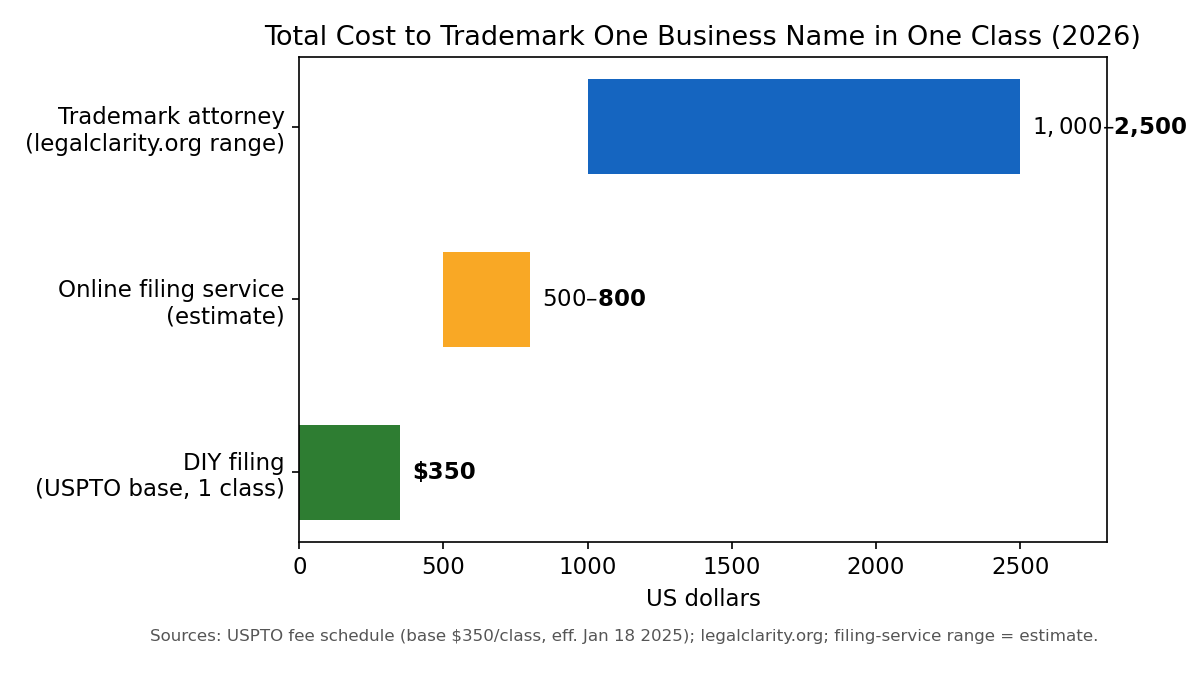
1. Do it yourself ($350). You run your own knockout search in the USPTO database (free), draft the application in the USPTO’s Trademark Center, and file. This is genuinely viable for simple word marks in one class — thousands of small businesses do it every year. The risk is entirely in the details: a sloppy goods description or a missed conflicting mark can lead to an office action or a refusal, and the $350 filing fee is nonrefundable either way. A detailed trademark fee breakdown notes that DIY filers who stick to the ID Manual’s pre-approved descriptions avoid every surcharge.
2. Online filing service (roughly $500–$800+ total, estimate). Companies like LegalZoom package the search, class selection, and filing into a flat-rate product. For reference, LegalZoom’s trademark registration is advertised at $899 plus federal fees and includes a federal and common-law search, attorney-selected classes, and attorney filing — which puts a single-class total around $1,250 with that particular provider. Mid-tier providers land lower, hence the estimate range in the chart. The appeal is convenience: someone else handles the paperwork, and you get a professional search before you spend the government fee.
3. Trademark attorney ($1,000–$2,500 all-in for routine filings). A dedicated trademark lawyer typically charges a flat fee covering a clearance opinion, application drafting, and filing, plus the $350 USPTO fee. For complex situations — a similar mark already exists in a related class, you are about to spend serious money on packaging and a launch campaign, or you plan to file internationally — this is money well spent. One comparison of providers notes that dedicated trademark law practices average close to $2,850 plus USPTO fees, which is why the top of the range stretches past $2,500 for complicated matters.
Which should you choose? If your name is distinctive, your search comes back clean, and you are filing in one class, DIY is perfectly reasonable. If any of those three is not true, pay for help — a refused application costs you the $350 fee plus months of delay, which is usually more expensive than the attorney would have been. For most founders, the question of how much does it cost to trademark a business name is really a question of risk tolerance.
The Costs People Forget: Statement of Use and Maintenance
The filing fee is only the first chapter. Two later costs catch founders off guard:
The Statement of Use ($150 per class). You can file before you actually use the name in commerce — this is called an “intent-to-use” application, and it is how startups lock in a name while still building. But once the USPTO approves the mark, you must file a Statement of Use proving real commercial use, at $150 per class. If you need more time, extensions of time to file are $200 each. File on a “use in commerce” basis from day one (because you are already selling under the name) and you skip this entirely.
Maintenance filings. A federal trademark lasts as long as you keep using it and keep up the paperwork. Between years five and six after registration, you must file a Section 8 declaration of continued use ($325 per class). Between years nine and ten, you file for renewal under Section 9 ($325 per class, or $650 combined with Section 8) — and then every ten years after that. Miss the Section 8 window and your registration gets cancelled. Calendar these dates the day your mark registers; plenty of owners lose protection over a forgotten deadline, not a legal dispute.
All in, a DIY trademark held for its first full ten-year term costs roughly $350 (filing) + $325 (Section 8) + $650 (combined renewal) = about $1,325 in government fees per class, spread over a decade. That is the real long-term number to budget for. That is the full ten-year answer to how much does it cost to trademark a business name when you file it yourself.

5 Ways to Keep Your Trademark Costs Down
1. Pick your description from the ID Manual. This single move avoids the $200 free-form surcharge and the $200-per-1,000-characters charge, and it speeds up examination. Most goods and services are already listed.
2. File only in the classes you actually need. Every extra class is another $350 (plus surcharges and attorney time). A local bakery does not need to file in the software class “just in case.” You can always file in more classes later as the business expands.
3. Run a serious clearance search before you file. The USPTO database search is free, and a few hours of digging — including common-law uses on Google and social media — can save you a $350 nonrefundable fee on a name that was never available. This is also the step where a solid business plan pays off: founders who have already researched competitors tend to spot naming conflicts early.
4. File “use in commerce” if you are already trading under the name. It skips the $150-per-class Statement of Use and the extension fees entirely.
5. Docket your maintenance deadlines yourself. If you use an attorney, ask them to calendar the Section 8 and Section 9 dates — or set your own reminders. Paying the government fees directly beats paying a provider’s markup plus the fees later.
Mistakes That Quietly Double Your Trademark Bill
Filing before searching. The most expensive trademark application is the one that gets refused. The fee is nonrefundable, so a $350 gamble on an uncleared name is the worst deal in the process.
Choosing the wrong class. File in the wrong class and your registration does not protect what you actually sell — you will end up filing again. When you are still deciding on choosing between an LLC and sole proprietorship or weighing S corp vs LLC, remember that your entity choice and your trademark class are separate decisions; get the class right regardless of structure.
Writing a novel in the goods description. Free-form text triggers the $200 surcharge, and every extra 1,000 characters adds another $200. Pre-approved wording is shorter, cheaper, and examined faster.
Ignoring office actions. If the examining attorney raises an issue, you generally have a set window to respond. Miss it and the application goes abandoned — and re-filing means paying the $350 again.
Frequently Asked Questions
How much does it cost to trademark a business name with the USPTO?
The base electronic filing fee is $350 per class of goods or services. Surcharges of $100–$200 per class can apply for incomplete applications or custom goods descriptions, and an intent-to-use filing adds a $150-per-class Statement of Use later. Most single-class DIY filings total exactly $350.
Do I need an attorney to trademark my business name?
No — anyone can file directly with the USPTO. An attorney is worth it when your clearance search turns up a similar mark, you are investing heavily in branding before launch, or you are filing in multiple countries. Note that applicants based outside the United States are required to use a US-licensed attorney.
How long does a trademark last?
Indefinitely, as long as you keep using the mark and file maintenance paperwork: a Section 8 declaration between years 5 and 6, and a Section 9 renewal between years 9 and 10, then every 10 years. Government maintenance fees run about $325–$650 per class per filing.
Can I trademark a name I am not using yet?
Yes, through an intent-to-use application. You lock in your filing date now and prove actual use later with a Statement of Use ($150 per class). If you need more time to launch, extensions are available at $200 each.
What is the difference between a trademark, a copyright, and an LLC?
A trademark protects brand identifiers (names, logos, slogans) in commerce. A copyright protects original creative works like text and artwork. An LLC is a business structure that limits your personal liability — forming one does not give you any trademark rights in your business name. Many founders do both: form the entity, then federally register the brand.
Does a trademark protect my business name nationwide?
A federal USPTO registration does — it gives you presumptive nationwide rights and lets you use the ® symbol. A state trademark registration or a DBA filing only covers you in that state and offers far weaker enforcement options.
Conclusion
So, how much does it cost to trademark a business name in 2026? For most small businesses, the honest answer is $350 — one clean, single-class application with pre-approved wording, filed yourself. Add professional help and the realistic range becomes $1,000 to $2,500 all-in; add extra classes, custom descriptions, or missed deadlines and the number climbs from there. The cheapest trademark is the one filed carefully the first time: search before you file, pick your classes deliberately, use the ID Manual’s wording, and calendar your maintenance dates. Do that, and your brand is protected for roughly the cost of a nice dinner — instead of the five-figure rebrand that awaits founders who skip it.