

If you’re wondering how to start running when you’re out of shape, here’s the truth most running advice skips: you don’t start by running. You start by walking, with short bursts of jogging mixed in — and you let those jogging bursts grow a little each week. It’s called the run-walk method, and it’s how millions of people have gone from couch to 5K without injury, misery, or quitting in week two.
Being winded after ninety seconds doesn’t mean you’re hopeless. It means your heart and lungs are untrained, which is a temporary condition with a very reliable fix. This guide gives you an 8-week plan built for true beginners: three short sessions a week, rest days between them, and a progression gentle enough that your joints and tendons keep up with your enthusiasm.
A quick note before we lace up: this article is general information, not medical advice. If you have a heart condition, high blood pressure, diabetes, are pregnant, or simply haven’t exercised in years, check with a healthcare professional before starting — the Mayo Clinic Health System gives the same advice to anyone with a chronic condition.
Why “just go for a run” fails (and what works instead)
Almost every failed running attempt follows the same script. You feel motivated, head out the door, run as far as you can — usually about three blocks — then stop, gasping, legs burning, convinced running “isn’t for you.” The problem isn’t your fitness. It’s the strategy.
Running is a high-impact activity. Your cardiovascular system actually adapts to it fairly quickly — within a few weeks your breathing feels easier. But your bones, tendons, and ligaments adapt much more slowly, on a cycle of weeks rather than days. Hammering them with continuous running before they’re ready is how shin splints and sore knees happen.
The run-walk method solves this elegantly: short jogging intervals give your heart and lungs the stimulus they need, while the walking breaks keep the total impact low enough for your connective tissue to adapt safely. As Runner’s World’s run-walk guide explains, knowing a walk break is coming also makes the whole session mentally easier — which is half the battle for beginners.
So forget distance, forget pace, forget what the person sprinting past you is doing. For the next eight weeks, the only thing that matters is time on your feet. That single principle is the foundation of how to start running when you’re out of shape.
Before week 1: your honest starter checklist
You need far less gear than the running industry wants you to believe. Here’s the short list that actually matters when you’re learning how to start running when you’re out of shape:
Shoes, not sneakers. Your one worthwhile purchase is a pair of genuine running shoes — not fashion trainers, not the old gym shoes from 2019. They don’t need to be expensive; they need to fit well with a thumb’s width of room in front of your longest toe. If you can, visit a running shop for a basic gait check. And plan to replace them after a few hundred miles of use, when the cushioning wears out.
Clothes you can sweat in. Moisture-wicking fabrics beat cotton, which holds sweat and causes chafing. Dress as if it’s about 10 degrees warmer than it is — you’ll heat up fast.
A timing method. You’ll be alternating jogging and walking by the clock, so bring your phone and use its timer, or grab one of the many free interval-timer apps. Don’t try to count in your head; you’ll lose track by the second interval.
A flat, forgiving route. A park path, a quiet neighborhood loop, or a treadmill — somewhere without hills and without traffic to dodge. Save the scenic hill route for month three.

How to start running when you’re out of shape: the 8-week walk/run plan
Here it is — the full answer to how to start running when you’re out of shape. Three sessions per week, with at least one rest day between sessions (Monday–Wednesday–Friday works beautifully). Every session starts with a 5-minute brisk walk to warm up and ends with a 5-minute easy walk to cool down; the table below shows the main workout in between.
The plan is inspired by the classic walk-run format popularized by programs like the NHS Couch to 5K programme — a free 9-week plan that takes absolute beginners from 1-minute runs to 30 minutes of continuous running — condensed here into eight weeks and described in full below so you can follow it from this page alone. If a week feels too hard, repeat it. There is no penalty for taking nine or ten weeks; the only failure is stopping.
| Week | Main workout (after 5-min warm-up walk) | Sessions |
|---|---|---|
| 1 | Alternate 1 min easy jogging / 90 sec walking, for 20 minutes | 3 |
| 2 | Alternate 90 sec jogging / 2 min walking, for 20 minutes | 3 |
| 3 | 90 sec jog, 90 sec walk, 3 min jog, 3 min walk — repeat the sequence twice (about 21 min) | 3 |
| 4 | 3 min jog, 90 sec walk, 5 min jog, 2½ min walk, 3 min jog, 90 sec walk, 5 min jog | 3 |
| 5 | Session 1: 5 min jog, 3 min walk, 5 min jog, 3 min walk, 5 min jog · Session 2: 8 min jog, 5 min walk, 8 min jog · Session 3: 20 min continuous jogging, no walking | 3 |
| 6 | Session 1: 5 min jog, 3 min walk, 8 min jog, 3 min walk, 5 min jog · Session 2: 10 min jog, 3 min walk, 10 min jog · Session 3: 25 min continuous jogging | 3 |
| 7 | 25 minutes of continuous easy jogging | 3 |
| 8 | 28–30 minutes of continuous easy jogging — your graduation run, roughly 5K at a beginner’s pace | 3 |
Notice the pattern: the jogging intervals grow while the walking breaks shrink, until walking breaks disappear entirely in week 5’s final session. Week 5 is the famous sticking point — jumping to 20 continuous minutes feels like a leap. Trust the four weeks behind you; your body is more ready than your brain believes.
Your 8 weeks, visualized: from walk-breaks to 30 minutes straight
Sometimes it helps to see the arc of the whole plan at once. This chart shows the jogging vs. walking minutes in the longest session of each week — watch the walking bars shrink to nothing as the jogging bars take over. If you’re a visual learner, this chart is how to start running when you’re out of shape in one image:
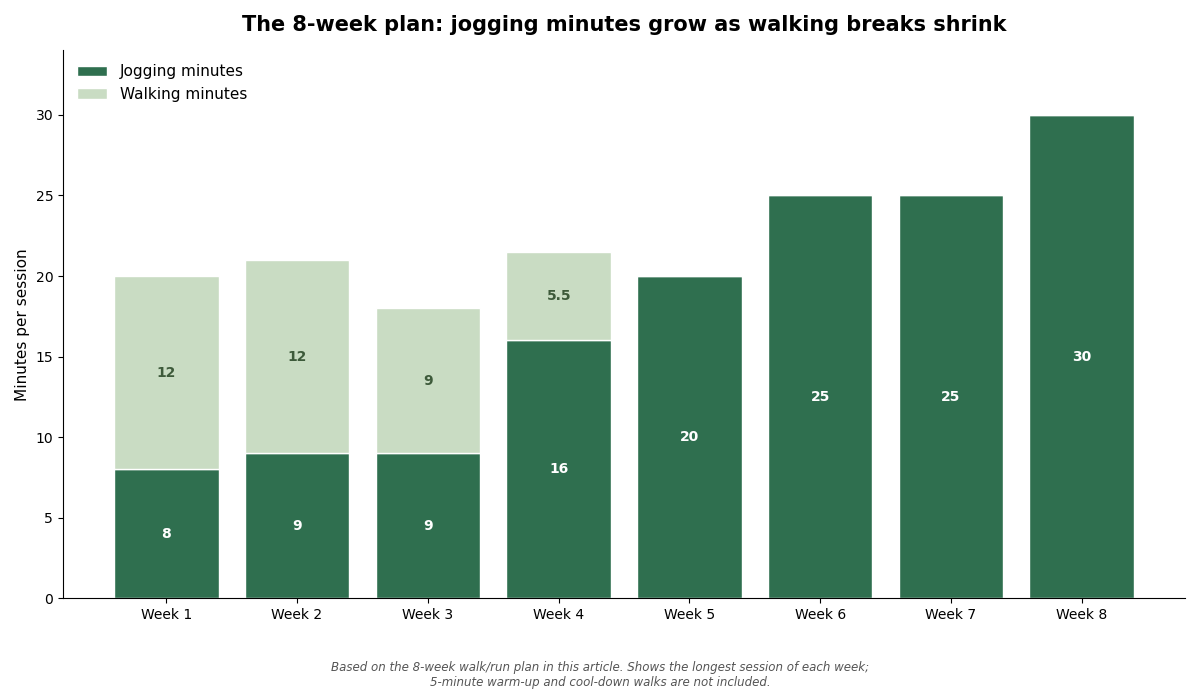
That crossover — where jogging minutes finally exceed walking minutes — happens around week 4. From there, you’re not really a “walker who jogs” anymore. You’re a runner who takes walk breaks, and then, a few weeks later, a runner, full stop.

8 rules that keep beginners running past week 3
The plan handles the physical progression. These are the eight rules that make how to start running when you’re out of shape actually stick — the stuff that determines whether you’re still running in December.
1. Run slower than you think you should
The number one beginner mistake is running too fast. Your jogging pace should feel almost embarrassingly easy — a shuffle is fine. Use the talk test: you should be able to hold a conversation in short sentences. As the Mayo Clinic puts it, moderate intensity means you can talk but not sing. If you’re gasping, you’re racing, not training.
2. Take real rest days
Do not run on consecutive days, especially in the first month. Your tendons and bones strengthen during rest, not during the run — adaptation happens in the 48 hours after the stimulus. Walking, gentle cycling, or yoga on rest days is great; another run is not. Three sessions a week is the sweet spot, and it’s exactly what the NHS program prescribes too. Rest is what makes how to start running when you’re out of shape sustainable.
3. Repeat weeks without guilt
Couldn’t finish week 4’s session? Congratulations, you just discovered what week 4 is for: repeat it next week. The plan is a ladder, not a deadline. Repeating a week consolidates fitness and confidence; skipping ahead when you’re not ready is how injuries happen. Remember, learning how to start running when you’re out of shape is a skill — and skills take the time they take.
4. Warm up every single time
That 5-minute brisk walk isn’t optional padding — it raises your core temperature, loosens your joints, and eases your heart rate up gradually instead of shocking it. Cold-starting into a jog is the fastest route to a pulled calf. Same logic in reverse for the cool-down walk. Skipping it is the most avoidable error when learning how to start running when you’re out of shape.
5. Fuel simply and hydrate
You don’t need gels or sports drinks for 30-minute sessions — water before and after is plenty. Eat a light snack (a banana, toast, or yogurt) 30–60 minutes before you head out if you’re hungry, and avoid running on a completely full stomach. As running becomes a habit, getting your everyday eating right matters more than any pre-run ritual; our guide to meal prep for beginners makes the nutrition side effortless.
6. Protect your sleep
Fitness is built during recovery, and sleep is when most of that recovery happens. Running will actually help you fall asleep faster — physical tiredness is a wonderful sedative — but guard your bedtime as training discipline. If your sleep is already shaky, read our guide on how to sleep better naturally; better sleep means better runs, and better runs mean better sleep. Recovery is part of how to start running when you’re out of shape, not an optional extra.
7. Track it in writing
Check off each session on a calendar, in a notes app, or in a journal. Eight weeks is long enough that motivation will dip around week 5 or 6, and nothing rescues motivation like seeing four straight weeks of checkmarks you’d hate to break. A simple training log also helps you spot patterns — like runs always feeling harder after late nights. If you don’t journal yet, starting a journaling habit pairs perfectly with a new running routine.
8. Remember why your heart will thank you
On the mornings you’d rather stay in bed, remember the payoff isn’t just fitness — it’s health. Regular running strengthens the heart and circulation, helps maintain a healthy weight, and research reviewed by Mayo Clinic physicians found that even modest weekly running is linked to meaningful longevity benefits. It can also help lower blood pressure naturally over time as your cardiovascular system gets more efficient.
5 mistakes that derail beginners
Starting too fast. Covered above, but it bears repeating because almost everyone does it. Your first-week jog should feel too easy. If it doesn’t, slow down. Mastering an easy pace is the first real skill in how to start running when you’re out of shape.
Running through sharp pain. Muscle tiredness and heavy breathing are normal; sharp, localized, or one-sided pain is not. Pain that changes how you move is your body asking for rest — or a professional opinion. Dull aches that fade as you warm up are usually fine; anything that gets worse during the run means stop.
Skipping the warm-up. See rule 4. Five minutes. Every time. No exceptions in the first two months.
Wearing the wrong shoes. Old, flat, unsupportive shoes are behind a remarkable share of beginner shin splints and knee complaints. This is the one place spending a little money pays for itself many times over.
Comparing your chapter 1 to someone else’s chapter 20. The runner gliding past you effortlessly has years of base fitness. You are building yours right now, one 90-second interval at a time. The only person you’re racing is last week’s version of you — and you’re already beating them.

Frequently asked questions
How do I start running if I’m totally out of shape?
Start with walking, then add short jogging intervals — the run-walk method. Begin with something like 1 minute of easy jogging alternated with 90 seconds of walking, three times a week, and extend the jogging portions gradually over 8–9 weeks. Programs like the free NHS Couch to 5K are built exactly for this, and the 8-week plan in this article follows the same proven format. That is how to start running when you’re out of shape in one paragraph: walk first, jog a little, and let the jogging grow.
Should beginners run every day?
No. Three sessions a week with rest days between them is the proven beginner formula. Your muscles, tendons, and bones need roughly 48 hours to adapt to a new running stimulus; running daily as a beginner is one of the fastest routes to shin splints, burnout, or both. You can add a fourth day much later, once 30 continuous minutes feels comfortable. That patience is the core of how to start running when you’re out of shape.
What is the best beginner plan — Couch to 5K?
For most absolute beginners, yes. The NHS Couch to 5K is free, has guided audio coaching, takes nine weeks, and was designed specifically for people starting from zero — its creator built it to get his own mother off the couch. The classic 9-week Couch to 5K schedule alternates walking and running in the same way as this article’s 8-week plan; either will get you to 30 minutes of continuous running if you follow it consistently.
How fast should I run as a beginner?
Slower than your ego wants. Aim for a “conversational” pace — you should be able to speak in short sentences while jogging. If you can only gasp out single words, ease off. Pace doesn’t matter at all for the first two months; time on your feet is the only metric that counts.
What if I can’t run for even one minute?
Then start smaller — there’s no minimum entry requirement. Try 30-second jogging intervals with 2-minute walks, or spend the first week or two doing brisk 20–30 minute walks to build a base, exactly as Runner’s World’s beginner run-walk programme suggests for true beginners. The Mayo Clinic’s jogging guidance makes the same point: start slowly, even with a 10-minute walk, and build from there. Week 1 of any plan can be your week 3 — the plan waits for you.
Your first run is this week
Here’s your only assignment: within the next three days, put on shoes, walk briskly for five minutes, then alternate one minute of easy jogging with 90 seconds of walking for twenty minutes, and walk five minutes to cool down. That’s week 1, session 1. It will feel harder than it looks and easier than you feared — and when you finish, you’ll have done the hardest part of the entire eight weeks, which is starting.
Eight weeks from now, you’ll jog for thirty minutes without stopping. That is the whole secret of how to start running when you’re out of shape: a plan gentle enough to follow and consistent enough to work. Not because you found hidden willpower, but because you followed a plan that was designed for exactly where you are right now. See you out there.



