
How to Brine a Turkey: Wet vs Dry Brine, Step by Step (2026)
Every November, the same question lands in kitchens across the country: is brining a turkey worth the trouble? If you have ever carved into a Thanksgiving bird that looked gorgeous and tasted like dry cardboard, you know why people ask. Learning how to brine a turkey is the most reliable way to fix that before it starts — and it is far simpler than the internet makes it sound. You need salt, time, and a refrigerator.
This guide covers both methods side by side, with exact salt ratios for every turkey weight, the food-safety rules that matter, and the air-dry step for crisp skin. Thanksgiving falls on Thursday, November 26, 2026, so plan your brine for Tuesday or Wednesday, not Thursday morning.
One thing first: brining starts with a fully thawed turkey — a frozen bird cannot absorb salt. If yours is still frozen, see our guide on how to thaw a turkey safely — the refrigerator method takes about 24 hours for every 4 to 5 pounds, so a 16-pound turkey needs four full days.
What Brining Actually Does (and What It Doesn’t)
A brine is salt, applied in advance. In a wet brine it is dissolved in water with sugar and aromatics; in a dry brine it is rubbed directly onto the bird. Either way, the salt does three jobs: it seasons the meat all the way through, it helps the muscle proteins hold on to more moisture during roasting, and it draws surface moisture out of the skin — which is what you want for crispy skin.
What brining does not do is inject flavor deep into the meat — the herbs and citrus mostly season the surface and the drippings; the salt is the ingredient that travels. Keep your brine simple. It also does not forgive overcooking: a brined turkey roasted to 185°F in the breast will still be dry. The USDA recommends 165°F in the thickest part of the breast and the inner thigh, measured with a thermometer.
Wet Brine vs Dry Brine: The Honest Head-to-Head
Both produce a juicy, well-seasoned turkey. They differ in effort, fridge space, skin, and timing.
| Wet Brine | Dry Brine | |
|---|---|---|
| What it is | Turkey submerged in salt water | Salt rubbed onto the bird |
| Time needed | 12 to 24 hours | 24 to 72 hours |
| Salt ratio | 1 tablespoon kosher salt per quart of water | ½ to ¾ teaspoon kosher salt per pound |
| Fridge space | A lot — stockpot, bucket, or cooler | Almost none — one sheet pan |
| Skin result | Juicy meat, softer skin | Noticeably crisper skin |
| Best for | First-timers, fast results | Crispiest skin, least fuss |
Pick a dry brine if your fridge is crowded or crispy skin matters to you. Pick a wet brine if you are short on time — it works in as little as 12 hours. Food Network’s wet vs dry brine guide reaches the same conclusion: dry brining is easier for most home cooks, while wet brining works faster. Both share one rule: bird and brine stay at 40°F or below the entire time.
Which Turkeys Should Never Be Brined
Check the label first: some birds are already salted, and brining one will leave meat that tastes like a salt lick.
Never brine a kosher turkey. Kosher turkeys are already salted as part of the koshering process — a brine on top is double-salting, and there is no way to undo it.
Never brine a pre-brined, enhanced, or self-basting turkey. These birds are injected with a salt solution at the plant — the label will say “contains up to 8% of a solution” or “enhanced with broth.” That is the brine, already done for you. When in doubt, skip the brine and season lightly instead.
Never brine a frozen turkey. Salt cannot penetrate frozen meat. Thaw first, brine second. Always.
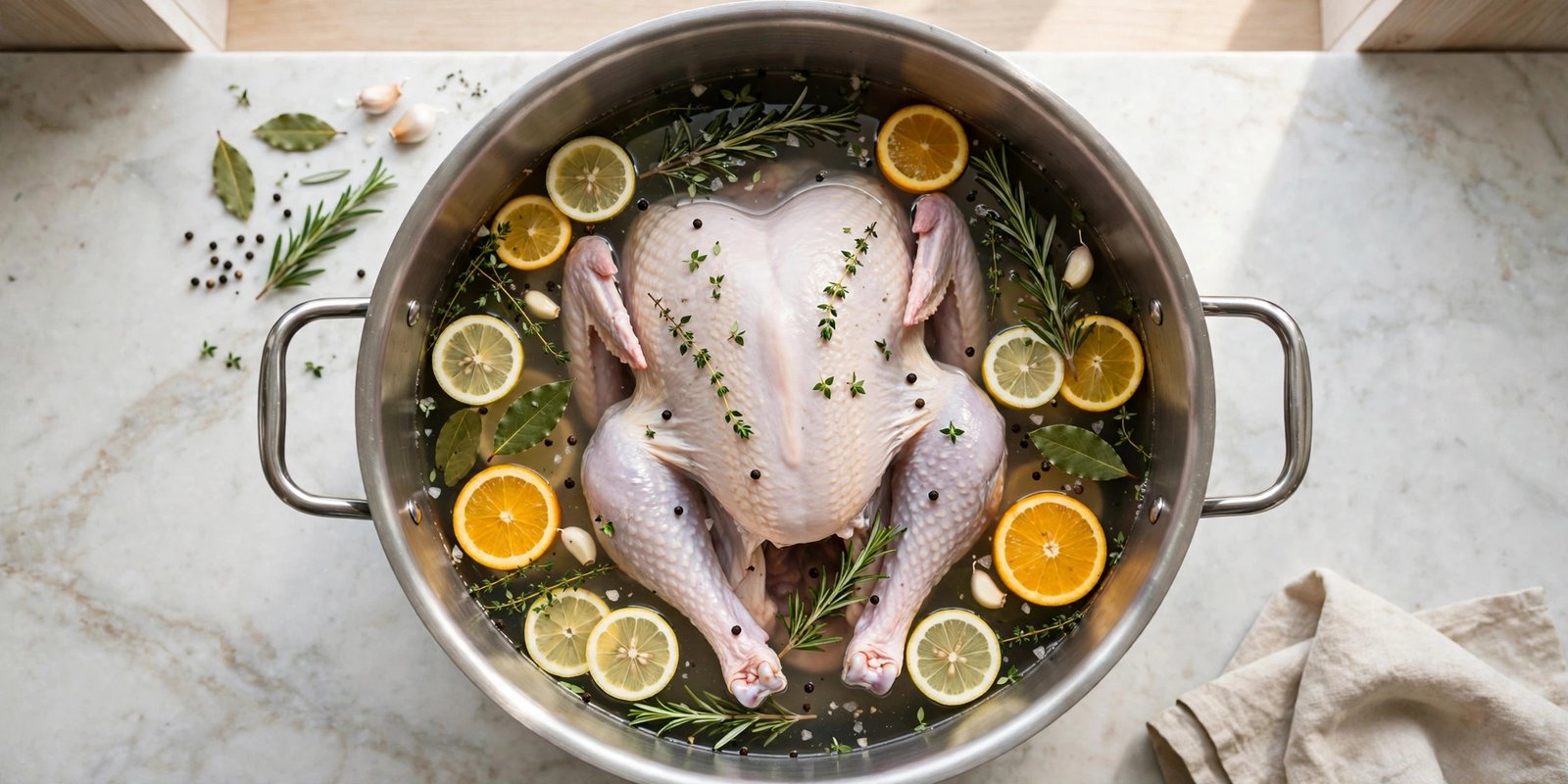
How to Brine a Turkey: The Wet Brine Method, Step by Step
Wet brining is the classic method: the turkey takes a long, cold bath in salted water.
Step 1: Get your container ready. You need something big enough to hold the turkey fully submerged — a large stockpot, a clean food-grade bucket, or a brining bag inside a cooler. Measure first: cover the turkey with water and note how much it took. Clear a fridge shelf, or plan on a cooler with ice.
Step 2: Mix the brine. The standard ratio is 1 tablespoon of kosher salt per quart of water — ¼ cup per gallon. For a typical 14- to 16-pound turkey, you will need roughly 2 gallons of brine, so that is ½ cup of kosher salt. Add ¼ cup of sugar per gallon for a touch of sweetness and better browning — optional. Stir in aromatics if you like: bay leaves, peppercorns, thyme, rosemary, garlic, citrus peel. Heat a quart of the water with the salt and sugar until dissolved, then add the rest cold. Never put a turkey into warm brine. Cool it to 40°F or below first — stir in ice and check with a thermometer.
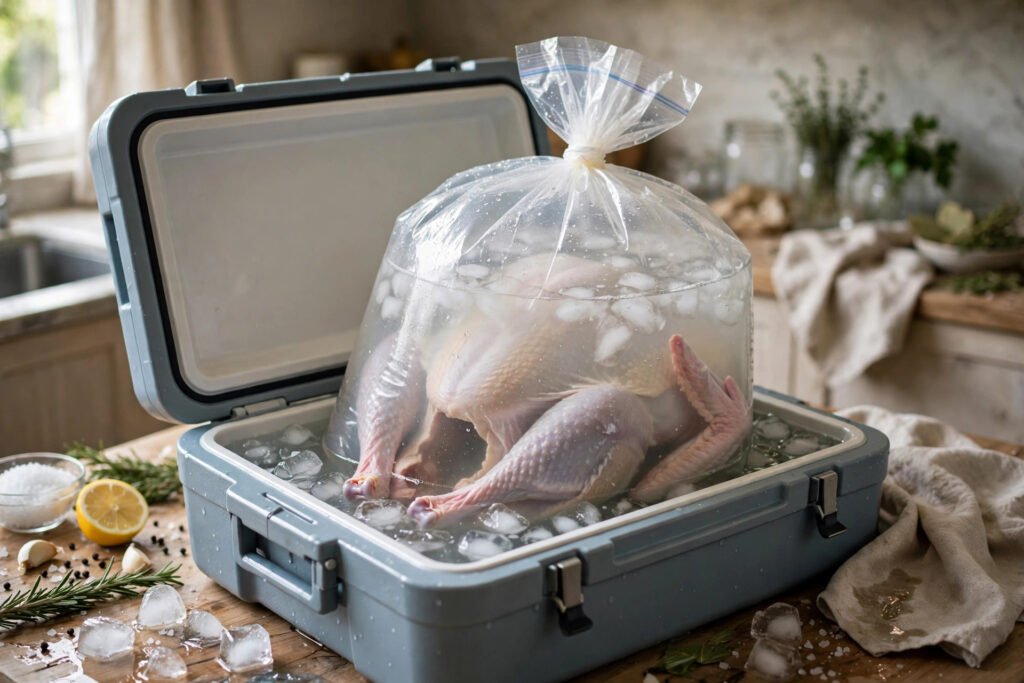
Step 3: Submerge the turkey. Remove the neck and giblets and save them — they make excellent gravy from scratch. Lower the turkey in, breast-side down, fully covered; weigh it down with a plate if it floats. Seal the bag or cover the container, and get it into the refrigerator or a cooler packed with ice.
Step 4: Wait 12 to 24 hours. Twelve hours is the minimum; 24 is the sweet spot. Do not go past 24 hours — beyond that, the meat can turn spongy and too salty. If you are using a cooler, check the ice every few hours so the brine stays at or below 40°F. FoodSafety.gov is clear: a brining turkey is still a raw turkey, and it needs to stay cold.
Step 5: Rinse, pat dry, and air-dry. Lift the turkey out and discard the brine — never reuse it. Rinse briefly under cold water, then pat thoroughly dry with paper towels, inside and out. Then the step that separates good from great: set the turkey on a rack over a sheet pan, uncovered, in the fridge for at least a few hours, ideally overnight. The dry fridge air pulls moisture from the skin — and that dry skin crisps in the oven.
How to Dry Brine a Turkey, Step by Step
Dry brining sounds too simple to work: rub salt on a turkey, put it in the fridge, and walk away. But the chemistry is sound and the results are consistently excellent — if you are still deciding how to brine a turkey for the first time, this is the method most test kitchens would recommend.
Step 1: Pat the turkey dry. Take the thawed turkey out of its packaging, remove the neck and giblets, and pat the whole bird dry with paper towels, inside and out — salt will not stick to a wet bird.
Step 2: Mix the salt rub. For every pound of turkey, use ½ to ¾ teaspoon of kosher salt, plus ¼ teaspoon of baking powder per pound for extra-crispy skin. Mix in dried herbs if you like: thyme, sage, rosemary, garlic powder, and black pepper. Use kosher salt, not table salt — table salt is denser, so the same volume contains more salt. If you only have table salt, use about half the volume.
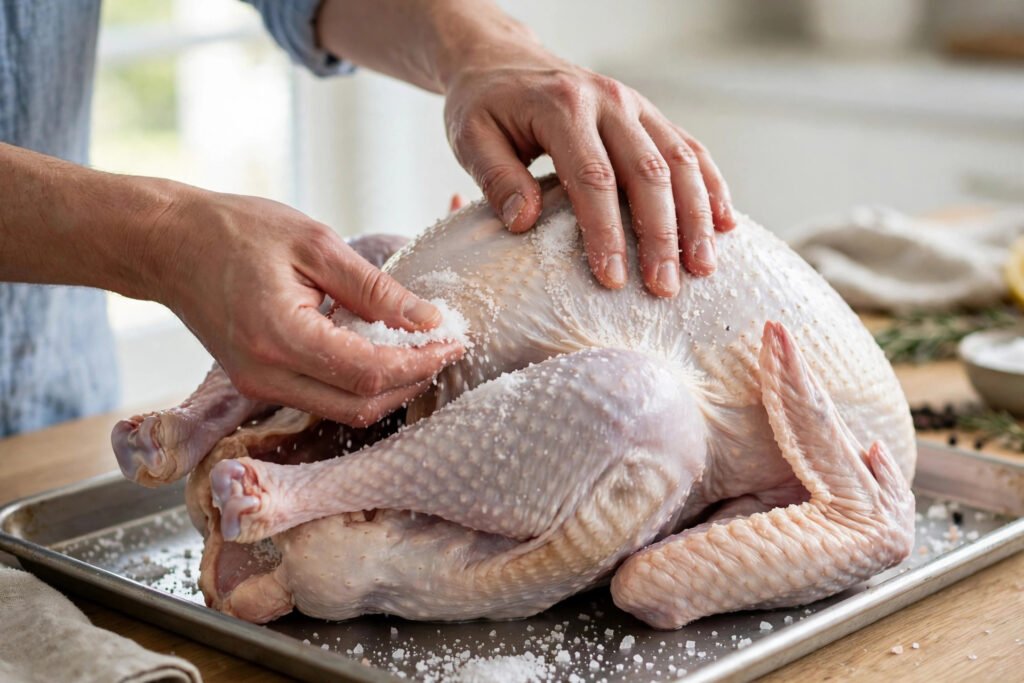
Step 3: Rub it on, everywhere. Sprinkle the salt mixture all over the turkey — breast, legs, wings, back, cavity. Get it under the breast skin if you can; that is where the thickest meat is.
Step 4: Refrigerate uncovered for 24 to 72 hours. Set the turkey on a wire rack over a rimmed sheet pan and slide it into the fridge, uncovered. The salt first draws moisture out, then that moisture dissolves the salt and gets reabsorbed, carrying seasoning deep into the muscle, while the fridge air dries the skin. Twenty-four hours is the minimum; 48 is the sweet spot; 72 is the upper limit. Serious Eats’ Food Lab testing has long championed this approach: seasoning penetrates deeply, and the skin dries while it works.
Step 5: Roast — no rinsing needed. Take the turkey out and roast it as you normally would. Do not rinse the salt off — it has done its job, and rinsing would undo the skin-drying you just spent two days achieving. Brush the skin with melted butter or oil first. No bucket, no gallons of water, no mess.
Salt Ratios by Turkey Weight
The most common brining mistake is guessing the salt. Too little and nothing happens; too much and the bird is inedible. Measure with spoons or a scale, not by eye.
Dry Brine: Kosher Salt per Turkey Weight
| Turkey weight | Kosher salt (½ tsp/lb) | Kosher salt (¾ tsp/lb) | Baking powder (¼ tsp/lb) |
|---|---|---|---|
| 12 pounds | 2 tablespoons | 3 tablespoons | 1 tablespoon |
| 14 pounds | 2 tbsp + 1 tsp | 3½ tablespoons | 1 tbsp + ½ tsp |
| 16 pounds | 2 tbsp + 2 tsp | 4 tablespoons (¼ cup) | 1 tbsp + 1 tsp |
Start at the lower end if you are brining the full 72 hours, and the higher end for larger birds or shorter brines. Diamond Crystal and Morton kosher salts differ in density — Morton is denser, so stick to the lower end with Morton.
Wet Brine: Salt and Water per Turkey Weight
| Turkey weight | Water needed (approx.) | Kosher salt (1 tbsp/quart) | Sugar (optional) |
|---|---|---|---|
| 10–12 pounds | 1½ gallons (6 quarts) | 6 tablespoons | 6 tablespoons |
| 14–16 pounds | 2 gallons (8 quarts) | ½ cup | ½ cup |
These volumes are estimates — measure the water you actually use to cover the bird, then add 1 tablespoon of salt per quart. The Kitchn’s brining guides use the same ratio.
The Air-Dry Step: How to Get Crispy Skin From a Brined Bird
Wet brining’s biggest weakness is soggy skin — the bird spends a day soaking in water. The fix costs nothing: air-dry it. After rinsing and patting the turkey dry, set it on a rack over a sheet pan, uncovered, in the refrigerator for at least 8 hours, ideally overnight. The cold, dry air pulls moisture from the skin; you will know it is working when the skin looks taut and almost papery.
Dry-brined turkeys get this step free, since they spend their whole brine uncovered in the fridge. Two more tips: roast at around 425°F for the first 30 minutes to set the skin, then drop to 325°F; and resist constant basting, which drops the oven temperature and steams the skin.
Food Safety Rules You Can’t Skip
Brining involves raw poultry sitting around for a day or more, so the safety rules are not optional.
Keep everything at 40°F or below. The USDA’s cold-storage rule is 40°F or below for raw turkey, brine included. If your fridge is full, use a cooler with plenty of ice and a thermometer — a cooler drifting to 50°F is where bacteria multiply fastest. The USDA’s food-safety guidance is unambiguous, and Thanksgiving is the worst day to test it.
Do not rinse raw poultry if you can avoid it. The USDA advises against rinsing raw poultry — splashing spreads bacteria around the sink. For a wet brine, a brief rinse is the one accepted exception; keep the water gentle and clean the sink after. For a dry brine, do not rinse at all.
Discard wet brine after use. It has been in contact with raw poultry for a full day — it is not a marinade you can save, and it is not stock. Pour it out. Cook to 165°F. The turkey is done when a thermometer in the thickest part of the breast and the inner thigh reads 165°F; rest it 20 to 30 minutes before carving. For a faster method after brining, our guide to cooking a turkey in an air fryer covers timing and temperatures for smaller birds.
What to Do With the Drippings and Leftovers
A brined turkey produces fantastic pan drippings — the foundation of great gravy. Save the neck and giblets, simmer them while the turkey roasts, and use the drippings for your gravy. One caution: brined drippings are saltier than usual, so taste before adding any extra salt.
Go lighter on the salt in the stuffing and mashed potatoes — the bird is already carrying plenty. The cranberry sauce from scratch on the table is a natural partner: its sharp acidity cuts through the richness of a brined bird. Leftovers hold up better than unbrined ones, since the meat starts out juicier. Refrigerate carved meat within two hours of serving, and use it within three to four days.

Frequently Asked Questions
How long should I brine a turkey?
Wet brine: 12 to 24 hours, with 24 the sweet spot for a full-size bird. Dry brine: 24 to 72 hours, with 48 ideal. Never wet-brine longer than 24 hours, or dry-brine longer than 72.
Can I brine a turkey in a cooler instead of the fridge?
Yes, if you keep the brine at or below 40°F. Use plenty of ice, check with a thermometer every few hours, and top up as needed. A cooler works when the fridge is full.
Do I need to rinse a dry-brined turkey before roasting?
No. The salt is absorbed into the meat, and rinsing would wash away surface seasoning and re-wet the skin you spent days drying. Roast it as-is, brushing with butter or oil if you like.
Can I brine a turkey breast instead of a whole bird?
Absolutely — same ratios, shorter time: 8 to 12 hours wet, 12 to 24 hours dry. A great option for a smaller Thanksgiving that fits in the fridge without a fight.
Will brining make my turkey taste salty?
Not if you follow the ratios and the timing — a correctly brined turkey tastes well-seasoned, not salty. It tastes salty when the brine was too strong, the time was too long, or the turkey was already salted. Measure your salt, set a timer, check the label.
Can I add wine, beer, or juice to a wet brine?
You can, but it does little. The salt is what penetrates the meat; other liquids mostly flavor the surface and the drippings. Keep the salt ratio the same.
Conclusion
Knowing how to brine a turkey pays off every Thanksgiving from now on. The method matters less than the basics: a fully thawed, unenhanced bird; the right amount of salt; enough time; and a fridge that stays at 40°F or below. Dry brine for the crispiest skin and least mess; wet brine for the fastest result. Either way, finish with the air-dry step, roast to 165°F, and rest the bird before carving.
Thanksgiving is Thursday, November 26, 2026. Work backward: thaw starting the weekend before, brine Tuesday or Wednesday, roast Thursday with confidence. Your future self — carving a juicy, golden bird while everyone asks what you did differently — will be glad you planned it.



