

Learning how to build credit from scratch can feel like a riddle: you need credit history to get approved for credit, but you can’t get history without being approved. The good news is that this loop is very breakable. Millions of people start with a blank file every year — young adults, recent immigrants, anyone who has simply always paid cash — and lenders have entire products designed exactly for them. This guide gives you the exact six-month path: which starter product to pick, what to do each month, and the two habits that do nearly all of the work.
One honest note before we start: nobody can promise you a specific score by a specific date. Timelines in this guide use “typically” language for a reason — your results depend on the product you choose, the lender’s reporting, and your behavior. What follows is a realistic, proven process, not a magic trick.
Why “No Credit” Is a Starting Line, Not a Dead End
Having no credit score is very different from having a bad one. A bad score tells lenders you mishandled credit before; a blank file just tells them they have nothing to judge yet. That makes you a much better bet than your anxiety suggests. Starter products exist precisely because lenders know there is a large, responsible market of people with thin or empty files.
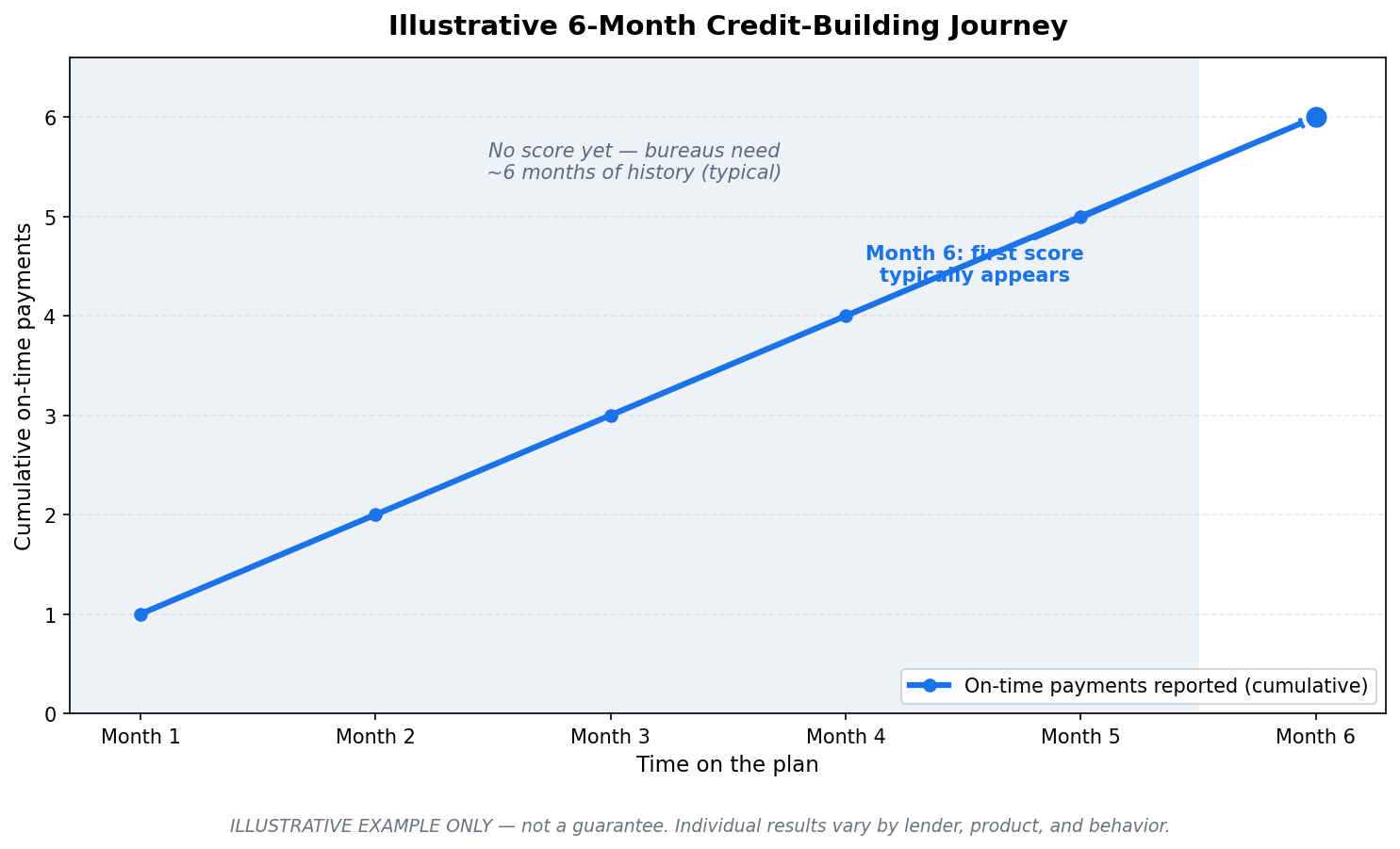
Here’s the mechanic that matters most: a FICO score typically requires at least one account that has been open and reported for about six months. That single fact shapes this entire plan. Everything you do in months one through five is about getting a reporting account open and feeding it a flawless payment record, so that around month six, a real score can appear. Patience in the first half is the strategy, not a delay.
It also helps to understand how credit scores are calculated at a high level. Payment history carries the most weight in the major scoring models, followed by how much of your available credit you’re using. Those two factors are the entire game for a beginner — which is convenient, because both are fully within your control from day one.
How to Build Credit From Scratch: The 3 Paths Compared
There are three legitimate on-ramps. All of them work; they just suit different situations. Here’s how they stack up before we dig into each one.
| Feature | Secured Credit Card | Credit-Builder Loan | Authorized User |
|---|---|---|---|
| How it works | You put down a refundable deposit that becomes your credit limit; you spend and repay normally | The lender holds a small “loan” in a locked account while you make payments; you get the money at the end | A trusted person adds you to their existing card; their history can appear on your file |
| Upfront cost | Refundable deposit (often $200–$500, varies by card) | No deposit, but you pay installments before receiving funds | Usually $0 |
| Best for | People who want a real card in their wallet and full control | People who want forced savings plus a payment record | People with a family member who has a long, clean card history |
| Builds which factor | Payment history + utilization (revolving credit) | Payment history (installment credit) | Age of accounts + utilization (piggybacked) |
| Watch out for | Annual fees on some starter cards; confirm it reports to all three bureaus | Some programs charge fees or interest — read the terms | You inherit their behavior: their missed payments or high balances can hurt you too |
Path 1: The Secured Credit Card
This is the most popular route, and for most beginners it’s the right one. A secured card looks and works like a normal credit card, except your credit limit is backed by a refundable deposit you provide upfront. Buy groceries, pay the bill, get the deposit back when you upgrade or close the account in good standing.
The critical shopping question is not the interest rate — it’s whether the card reports your payments to all three major credit bureaus. A card that doesn’t report is just an expensive debit card. Check the card’s terms or ask the issuer directly before you apply. Many secured cards also offer a path to “graduate” to an unsecured card after a stretch of on-time payments, which is exactly the upgrade you want in month seven or eight.

Path 2: The Credit-Builder Loan
Credit-builder loans flip the normal loan around: instead of receiving money and repaying it, you make monthly payments first and receive the lump sum at the end. The lender reports each payment to the bureaus, so you build an installment-account history without needing to qualify for a traditional loan.
This path suits people who don’t trust themselves with a card yet, or who want to build a small emergency cushion at the same time — the payout at the end can become starter savings. Just read the fine print: some programs carry administrative fees or interest that eat into what you get back. A low-fee program from a credit union or community bank is typically the best value here.
Path 3: The Authorized-User Shortcut
If a parent, spouse, or trusted relative has a credit card with a long, clean payment history and low balances, they can add you as an authorized user. Their account’s history may then appear on your credit file, which can give your file a head start — sometimes a dramatic one.
The caveat is real, though: you inherit their behavior, good and bad. A missed payment or a maxed-out card on their side can damage the file you’re trying to build. Only take this route with someone whose habits you’d bet your own score on — because you are. And note that not every issuer reports authorized-user activity to the bureaus, so confirm that detail too.
Your 6-Month Plan, Month by Month
Pick one primary path (most beginners should pick the secured card) and run this timeline to build credit from scratch. If you combine paths — say, a secured card plus authorized-user status — the same monthly habits apply.
- Month 1: Open your starter account. Apply for one secured card (or enroll in one credit-builder program). One application is enough — multiple applications in a short window can look risky. Set up autopay for at least the minimum payment the day the account opens.
- Month 2: Make the card boring. Use it for one small, recurring purchase — a streaming subscription, a tank of gas — and let autopay handle the rest. Boring is the goal. You’re building a record of reliability, not a lifestyle.
- Month 3: Check that reporting is working. Pull your free credit reports and confirm the new account appears. If it doesn’t, contact the issuer — an account that isn’t reported isn’t building anything.
- Month 4: Keep utilization tiny. Utilization means the percentage of your limit you’re using when the statement closes. Keep it low — many advisors suggest staying well under 30%, and single digits is even better for scoring purposes. Paying the balance in full each month handles this automatically.
- Month 5: Don’t apply for anything new. Let the account age. This is the month beginners most often sabotage by chasing a second card or a store offer. Your file is five months old; one more month of quiet gets you to the milestone.
- Month 6: Check for your first score. Around now, a first score can typically be generated. Check it through your card issuer’s free score tool or a reputable free service, and review what goes into a FICO score so you understand what moved and what to keep doing.
Notice what isn’t on this list: spending a lot, carrying a balance “to build credit faster” (a persistent myth — carrying a balance costs you interest and doesn’t help your score), or opening multiple accounts. The plan is deliberately minimal because minimal works.
The Two Rules That Do Most of the Work
If the month-by-month plan feels like a lot to remember, compress it into two rules. These two habits account for the majority of what scoring models reward in a young file.
Rule 1: Never miss a payment. Payment history is the single biggest factor in the major scoring models, and on a thin file, one missed payment does outsized damage because there’s no long track record to cushion it. Autopay for at least the minimum is the beginner’s seatbelt — set it on day one and leave it on forever. You can always pay more manually; autopay is just the floor that keeps you safe.
Rule 2: Keep reported balances low. You don’t need to obsess over the exact day your issuer reports, but it helps to know the statement balance is typically what gets reported. Paying your card down before the statement closes — or simply paying in full each month — keeps utilization low without any calendar gymnastics. Small, regular spending plus full payment is the whole technique.
There’s a nice side effect here: both rules are really just budgeting habits in disguise. If money is tight, getting your spending plan under control first makes everything else easier — our guide to budgeting on a tight income walks through a realistic framework for that. And once your credit is established and your budget is stable, that same discipline is what lets you start investing with little money instead of watching fees and interest eat your paycheck.
Mistakes That Stall Beginners
- Closing the starter account too early. That first account is the oldest item on your file, and age of accounts matters. When you qualify for a better card, keep the starter open (use it once in a while) or upgrade it with the same issuer rather than closing it.
- Applying for five cards “to build faster.” Each application can create a hard inquiry, and several in a short period can signal risk. One well-chosen starter account, aged patiently, beats a handful of young ones.
- Paying only the minimum while spending freely. The minimum keeps you “on time,” but rising balances push utilization up and interest piles on. Minimums are a safety net, not a strategy.
- Ignoring the reports. Errors on credit files are more common than people think, and on a thin file a single error looms large. Checking your free reports a few times a year and disputing anything wrong is free protection.
- Co-signing for someone else. As a beginner, your file is fragile. Co-signing makes you fully responsible for someone else’s debt — one missed payment of theirs lands on your record. Build your own foundation first.

Frequently Asked Questions
How long does it take to get a credit score from scratch?
Typically around six months. The major scoring models generally need at least one account that has been open and reported for about six months before they can calculate a score. Open your starter account, keep it in perfect standing, and check around the six-month mark — but treat that as a typical timeline, not a promise.
Can I build credit without a credit card?
Yes. Credit-builder loans are designed for exactly this, and authorized-user status can help too. Some rent-reporting and subscription-reporting services also exist, though their impact varies by scoring model. A secured card is usually the simplest path, but it’s not the only one.
How much money do I need to start?
Often just the refundable deposit for a secured card — commonly a few hundred dollars, depending on the card — or nothing upfront for authorized-user status. Credit-builder loans typically require no deposit since you pay into them over time. This is genuinely one of the cheapest financial foundations you can build.
Will checking my own score hurt it?
No. Checking your own score or reports is a “soft” inquiry and never affects your score. Only applications for new credit create “hard” inquiries, which is why the plan above keeps applications to a minimum.
What credit score will I have after six months?
There’s no honest way to promise a number — it depends on the product, the lender’s reporting, and your behavior. What you can expect is a real, scorable file with a clean six-month payment history, which is the foundation every future score builds on. Keep the two rules going and the trajectory takes care of itself.
Conclusion
Learning how to build credit from scratch is one of the rare financial tasks where the instructions are short and the payoff is long. Open one starter account that reports to all three bureaus. Pay on time, every time — autopay is your insurance. Keep balances low. Then give it six quiet months. That’s the whole plan, and it works because scoring models reward exactly the boring reliability you’re demonstrating.
Start this week: compare one secured card and one credit-builder program, confirm bureau reporting, and open the one that fits your situation. Six months from now, you’ll have something most people take years to build by accident — a clean foundation, on purpose.




[…] protecting it is part of budgeting. If building or rebuilding credit is on your list, our guide on how to build credit from scratch walks through it without requiring existing credit. And if a collector is calling, you have rights […]