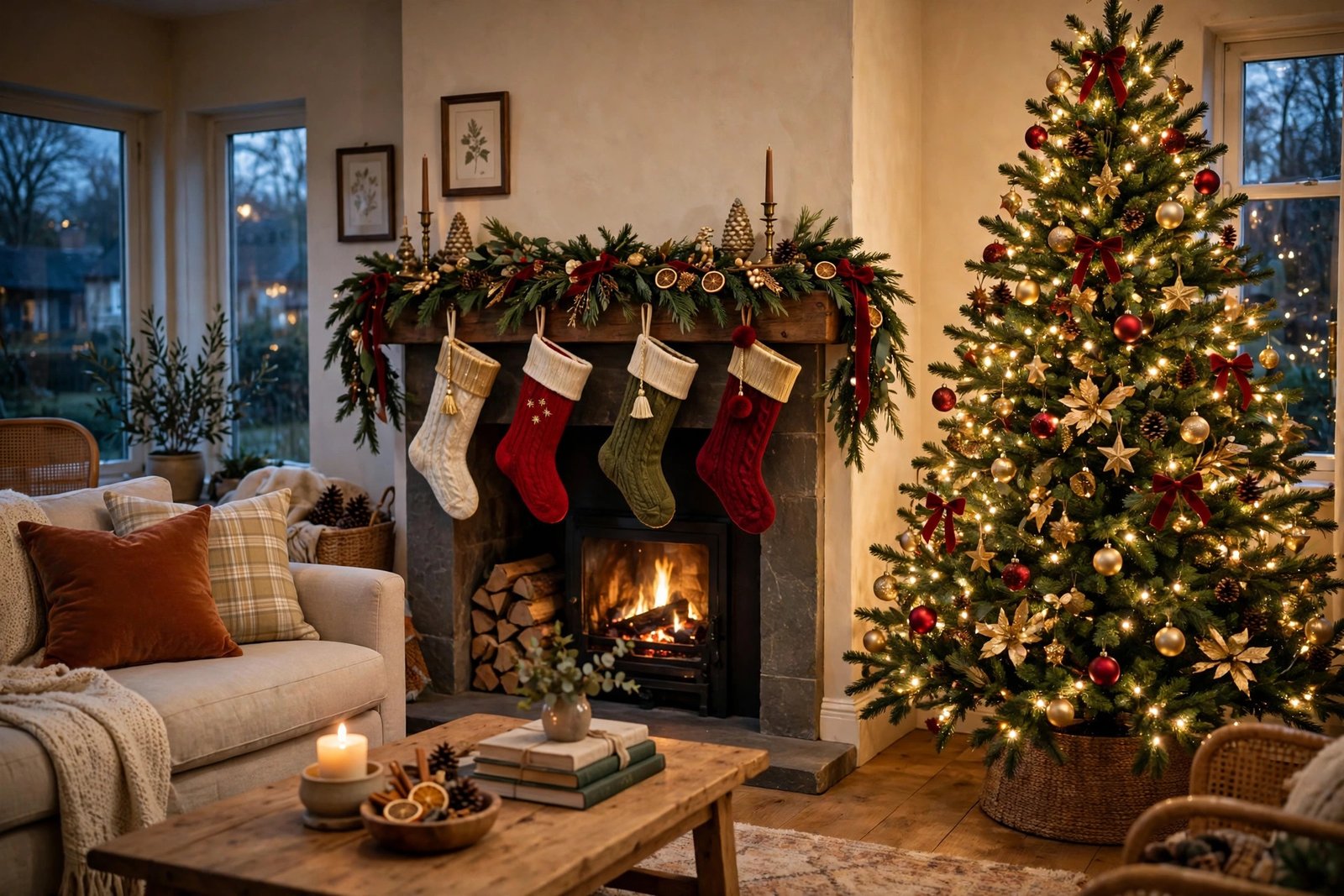

How to Decorate Your Home for Christmas (Room by Room)
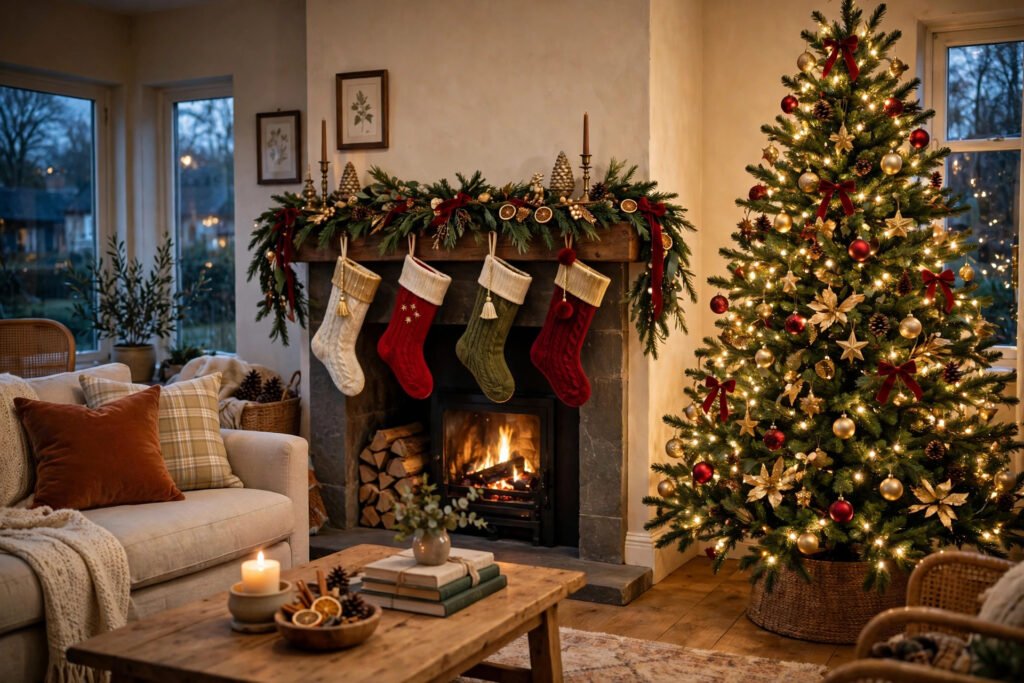
Christmas decorating feels overwhelming because most of us start by buying things: we come home with armfuls of ornaments, put them up wherever there’s space, and end up with a house that looks busy rather than beautiful. Learning how to decorate your home for Christmas isn’t about buying more — it’s about having a plan: a colour scheme, a room-by-room order, and a budget you decided before you walked into the shop.
Done well, decorating is the best part of the season: the house smells of pine, the lights go on at dusk, and every room feels like it belongs to December. This guide gives you the whole plan — the theme system that makes everything look intentional, a room-by-room walkthrough, a realistic budget split, the safety rules that matter, and a timing plan that gets the bulk of the work done in November so December stays calm.
Start With a Theme, Not a Shopping Trip
Every home that looks professionally decorated for Christmas has one thing in common: restraint. Pick two or three colours and repeat them in every room. Classic red and gold. Deep green and warm white. Silver and icy blue. Navy, white, and natural wood. Once you’ve chosen, those colours are your filter — if it doesn’t match the palette, it doesn’t come home.
Before you buy anything new, take stock of what you already own. Pull every box out, lay it all on the dining table, and sort it: keep, donate, throw away. Most homes already own enough decorations for two Christmases — they’re just buried in boxes from three moves ago. Buying duplicates of things you own is the fastest way to blow a decorating budget.
How to Decorate Your Home for Christmas Room by Room
The secret to how to decorate your home for Christmas without losing a weekend to it is order. Work from the most important room outward, and finish each room before you start the next. Here’s the order that works: tree first, then mantel, then stairs and entry, then dining, then the outdoors.
The Christmas tree: the anchor of the whole house
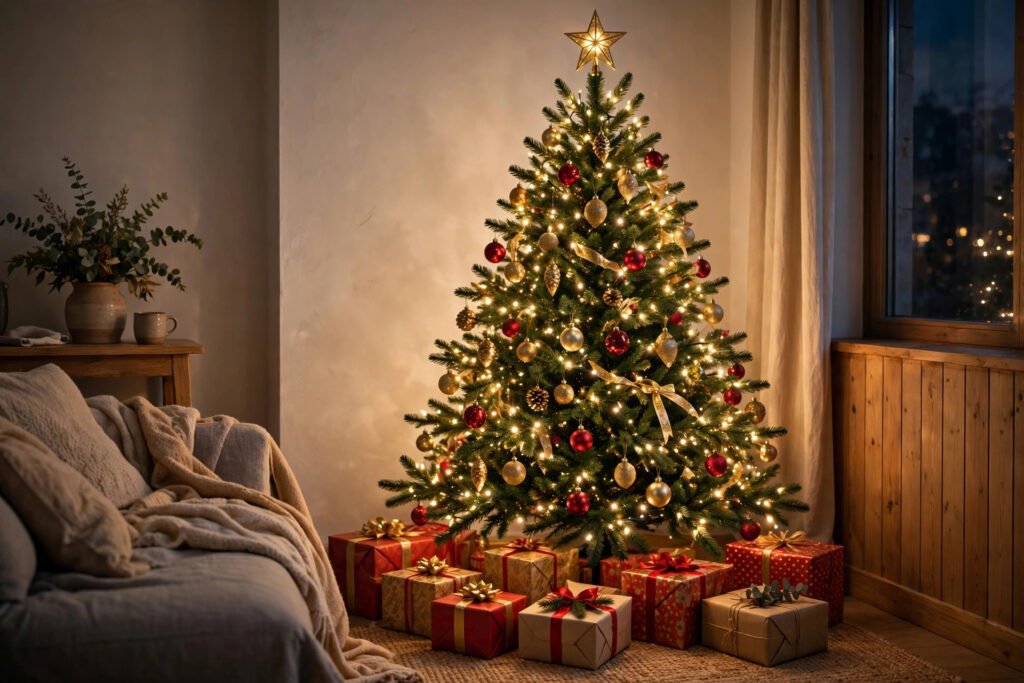
The tree is the centrepiece, so it gets the most attention. Place it where it can be seen from the main seating and, if possible, from a window — a tree glowing in a window is the best decoration a house has. Leave at least a foot of space from walls and heat sources: radiators and fireplaces dry a real tree out fast, and a dry tree is a fire risk. If your tree is real, water it every day — a fresh-cut tree can drink a litre or more a day. Our guide to keeping a Christmas tree fresh longer covers the routine, and if you’re still deciding between real and fake, our real vs artificial Christmas tree comparison will help you choose.
Decorate in layers: lights first, working from the inside of the branches outward so the glow comes from within the tree; then ribbon or garland in loose swags; then large ornaments, spaced evenly and pushed slightly into the branches; then small ornaments to fill the gaps; and the topper last. Step back after each layer — that’s the distance everyone else sees it from.
The mantel: the fireplace is the living room’s stage
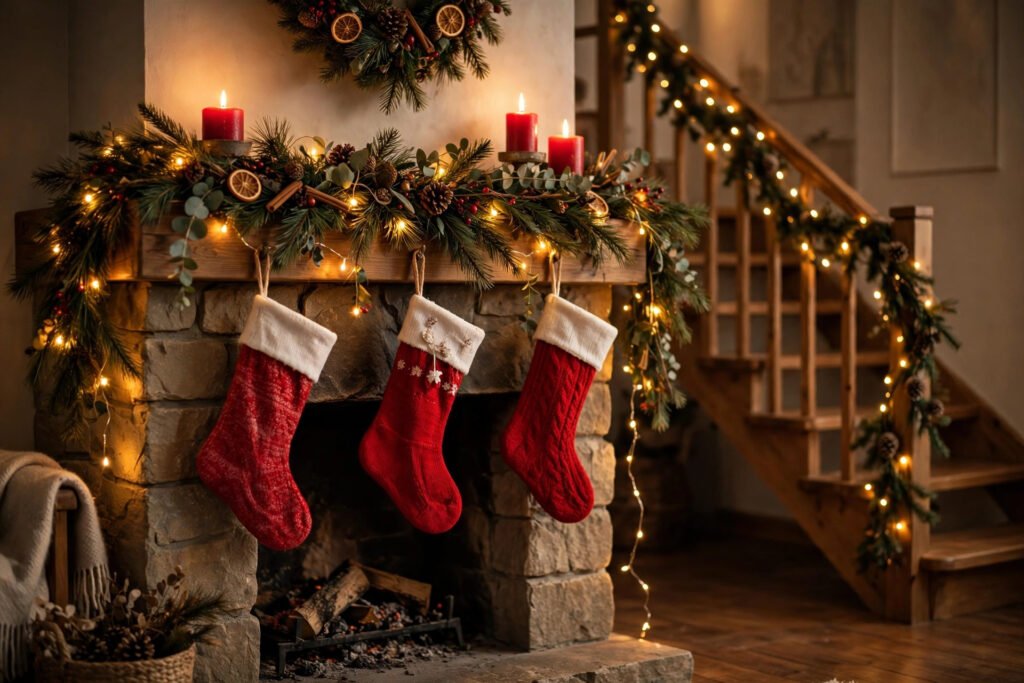
If you have a fireplace, the mantel is the second most photographed spot in the house after the tree. Start with a garland along the top — real pine if you can, good-quality faux if you can’t — and let it drape slightly over the ends. Weave fairy lights through it, then add your theme colours: ribbon bows, baubles tucked into the greenery, dried orange slices, pinecones.
Hang stockings with proper stocking holders, not tape — stockings full of small gifts are heavier than they look. Keep candles in stable holders and never leave them burning unattended, and never hang anything flammable above a working fire. Without a fireplace, the same treatment works on a console table or sideboard.
The stairs and hallway: the journey through the house
Stairs are the most underused decorating surface in most homes, and the easiest to get right. Run a garland along the banister, securing it with ribbon or reusable ties at every second or third spindle — never with nails or staples, which damage the wood and can nick light wires. Weave lights through it and add a bow or a cluster of baubles at each tie point.
The hallway sets the tone the moment someone walks in. A wreath on the inside of the front door, a small garland on the console table, and a bowl of baubles or pinecones make the entry feel like Christmas. Keep it clear of clutter — guests stand in it while they take their coats off.
The dining room: where Christmas dinner happens
The dining table deserves its own moment, because it’s where the family gathers on the day itself. A simple centrepiece beats a complicated one: a low garland or a row of candles down the centre, a few baubles scattered between them, and a linen runner in one of your theme colours. Keep it low — guests need to see each other across it.
Extend the theme to the place settings: a sprig of pine or rosemary tied to each napkin, a name card, a single bauble on each plate.
The bedrooms and bathrooms: small touches, big effect
You don’t need to decorate every bedroom like a show home: a small wreath on the door, fairy lights on the headboard, and a festive cushion on the bed are enough. In children’s rooms, let them decorate a small tree of their own. Bathrooms need only a festive hand towel and a sprig of pine on the windowsill.
The outdoors: the first impression
Outdoor decorating is the most visible part of the project — the only part the neighbours see. Start at the front door: a wreath, a pair of lanterns or small potted evergreens flanking the steps, and a doormat that can handle wet boots. Then the lights: warm white strings along the roofline, clipped on with proper light clips, never nailed or stapled through the wire.
Keep it simple and symmetrical: a single well-lit tree or a clean roofline looks better than a yard full of competing inflatables. If you want more, add one focal piece — a lit wreath in an upstairs window, or a small lit tree in the front garden — and stop there. Use only lights and extension cords rated for outdoor use, plugged into a GFCI-protected outlet. Our guide to hanging Christmas lights safely walks through the full setup, step by step.

How Much to Spend: A Realistic Budget Split
Christmas decorating doesn’t have to be expensive, but it does need a number — without one, you’ll spend twice what you meant to. A useful rule of thumb is that decorations account for roughly 20% of total holiday spending, the rest going on gifts, food, and travel. Set a firm decorating budget before you shop.
| Budget area | Share of budget | What it covers | Money-saving tip |
|---|---|---|---|
| The tree and its lights | 30–40% | Tree, lights, topper, tree skirt | See our best artificial Christmas tree 2026 picks |
| Ornaments and garlands | 25–30% | Baubles, ribbon, garlands, stockings | Reuse last year’s; buy in the January sales |
| Mantel and table | 15–20% | Candles, holders, centrepiece, runner | Free greenery from the garden |
| Outdoor lights and wreath | 15–20% | Outdoor lights, clips, wreath, lanterns | LEDs cost less to run |
The cheapest decorations are the ones you make or gather. A bowl of pinecones from the garden, dried orange slices from the kitchen, cinnamon sticks tied with ribbon, and fresh greenery cut from a hedge all look expensive and cost almost nothing. The most expensive decorations are the ones you buy twice because you didn’t check what you already owned. Buy the big things — the tree, the lights, the garland — first, and the small things last.
Christmas Decorating Safety: The Rules That Actually Matter
Christmas is the most fire-prone season of the year — which is why safety belongs in any plan for how to decorate your home for christmas. The National Fire Protection Association reports that, on average between 2020 and 2024, US fire departments responded to about 143 home fires a year that started with Christmas trees, causing an estimated seven deaths, 13 injuries, and $15 million in property damage. Decoration fires added roughly 835 more a year, and nearly half happened because decorations were too close to a heat source.
Nearly all of it is preventable. Water a real tree daily and keep it away from heat sources. Keep decorations, especially anything flammable, away from candles, fireplaces, and radiators. Turn lights off when you leave the house or go to bed — a short circuit in an unattended string is how most light fires start.
Check every string of lights before you use it, old or new: look for broken or cracked sockets, frayed or bare wires, and loose connections, and throw out any damaged set rather than repairing it. The CPSC’s holiday decoration safety guidance adds two rules most people miss: use no more than three standard-size sets of lights per single extension cord, and never use electric lights on a metallic tree, which can become electrically charged. Only use lights tested by a recognised laboratory such as UL or ETL, and only plug outdoor lights into GFCI-protected circuits.
LED lights are the safest and cheapest choice for most of the house. ENERGY STAR certified LED holiday lights use about 70% less energy than incandescent strings, last up to ten times longer, and stay cool to the touch. The NFPA reports nearly one in four Christmas tree fires was started by lamps or bulbs.
Candles deserve their own rule: never leave one burning unattended, never place one on or near a tree or evergreen, and keep them away from curtains and furniture. Candle fires peak in December, and Christmas Day is the peak day of the year for them. Battery candles give you the glow without the risk.
When to Decorate: Do the Bulk in November
When you plan how to decorate your home for christmas, do the bulk of the work in November, so December stays calm. Today is Saturday, November 28, 2026 — the day after Black Friday — and if you haven’t started yet, this weekend is ideal: the shops are full, the sales are on, and you still have nearly a month before Christmas Day.
A sensible schedule: early November, pull out the boxes, sort what you own, and buy the big items — tree, lights, garland. Mid to late November, decorate the main rooms — tree, mantel, stairs, entry. Early December, add the dining table, bedrooms, and outdoors, and buy fresh greenery and the real tree last so they’re at their best on Christmas Day. The week before Christmas is for enjoying the house, not still hanging things.
If you have a real tree, buy it as late as you can stand it — one bought in the first week of December looks far better on Christmas Day than one bought in mid-November. Keep it watered from the day it comes home. And plan the takedown now: decide the date, pack ornaments in tissue, coil lights around cardboard so they don’t tangle, and label every box by room.
Small Spaces and Rentals: Christmas Without the Clutter
Not every home has a fireplace, a staircase, and a front garden, and the same approach to how to decorate your home for christmas works in flats and rented homes too — just at a smaller scale. In a small flat, one well-decorated corner beats a thin scattering across every surface: a small tree on a side table, a garland on a shelf, and fairy lights on a window. If you can’t have a full tree, a tabletop tree or a large branch in a vase with a few baubles works beautifully.
Renters should avoid anything that damages walls or woodwork: use removable hooks, ribbon ties, and freestanding decorations rather than nails or staples. And check your lease — some buildings restrict outdoor lights or real trees.
Frequently Asked Questions
When should I start decorating my home for Christmas?
Most people start in late November, and the bulk of decorating is best done then so December stays relaxed. If you have a real tree, buy it in early December so it stays fresh through Christmas Day. There’s no wrong date — start when it makes you happy, and finish at least a week before Christmas.
How do I decorate my home for Christmas on a budget?
Start by using what you already own, then set a firm budget — decorations are roughly 20% of total holiday spending. Buy the tree and lights first, then ornaments, and use free natural materials like pinecones and dried oranges to fill the gaps. Buy next year’s decorations in the January sales.
How many lights do I need for a Christmas tree?
About 100 lights per foot of tree height — so a six-foot tree needs around 600 lights. LED strings are the better choice: they use about 70% less energy than incandescent lights, stay cool to the touch, and last far longer. Work the lights from the inside of the branches outward.
How do I keep my Christmas decorations safe?
Water a real tree daily and keep it away from heat sources. Check every light string for damage before use, use no more than three standard-size sets per extension cord, and plug outdoor lights into GFCI-protected outlets. Turn all lights off when you leave the house or go to bed.
What colours should I use to decorate for Christmas?
Pick two or three colours and repeat them in every room: classic red and gold, deep green and warm white, silver and icy blue, or navy with natural wood. Choose one metal and one natural texture, and repeat them everywhere.
How do I decorate a small home for Christmas?
Focus on one well-decorated corner rather than spreading decorations thinly: a tabletop tree, a garland on a shelf, and fairy lights on a window are enough. Use removable hooks if you rent, and keep pathways clear so the flat still feels liveable.
Conclusion
Learning how to decorate your home for Christmas comes down to three decisions: a colour palette you repeat everywhere, a room-by-room order that starts with the tree, and a budget you set before you shop. Do the bulk of the work in November, water the tree daily, check your lights, and turn them off when you leave the house.
Start this weekend — today, Saturday, November 28, is the perfect moment, with Black Friday behind you and nearly a month of December ahead. Pull out the boxes, pick your two or three colours, and begin with the tree.



