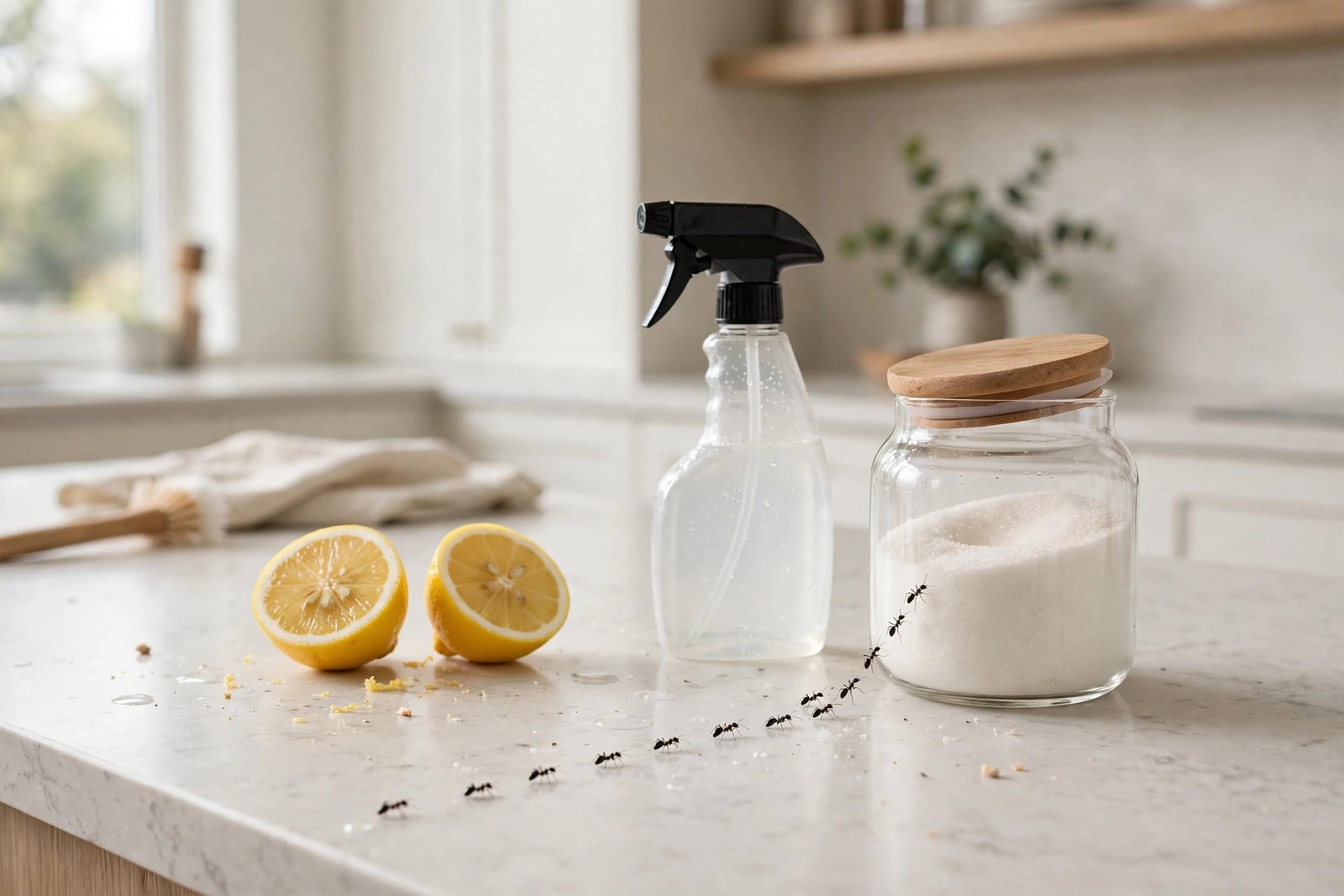

One ant on the counter is rarely just one ant. By the time you spot a neat little line marching toward the sugar bowl, a scout has already found food, laid down an invisible chemical trail, and invited the whole colony to dinner. It feels sudden, but it is a solvable problem — and you do not need a cloud of chemical spray in the room where you cook. Learning how to get rid of ants in the kitchen naturally is mostly about breaking that trail, removing the reward, and closing the doors they used to get in.
This guide walks through the methods in the order that actually works: first, find out why they came; then clean up the invitation; then use natural repellents and barriers; then, if a stubborn colony keeps returning, use a targeted bait. It also covers what not to do, how to keep children and pets safe around borax, and when it is time to stop experimenting and call a professional. Most kitchens improve within days, and lastingly within a week or two, provided the food sources and entry points are dealt with at the same time as the ants themselves.
How to Get Rid of Ants in the Kitchen Naturally Starts With Why They Come
Ants are not visiting because your kitchen is dirty in some moral sense. They are foragers, and kitchens are the most reliable food and water source in most homes. A few crumbs under the toaster, a sticky jam jar, a pet bowl left out overnight, a dripping tap, or a ripe banana on the counter can all be enough. Once a scout ant finds something sweet, greasy, or protein-rich, it carries a sample back to the nest and lays a pheromone trail on the way. Other ants follow that trail, reinforce it, and soon you have a highway.
Start by watching for ten minutes. Where is the line coming from? A window frame, a gap under the back door, a crack where the counter meets the wall, a pipe under the sink? Follow it backward if you can do so safely. Knowing the entry point will save you from spraying repellent in the wrong place and wondering why nothing changed.
Step 1: Remove the Food Sources (Do This First, Every Time)
Before you reach for vinegar or cinnamon, do a proper kitchen reset. Empty the bins, wipe down counters, sweep and mop the floor, and clean under appliances where crumbs collect. Pay special attention to the spots people forget: the top of the fridge, the inside of the microwave, the sugar and cereal cupboards, the honey jar lid, and the pet food area. For a kitchen that already has a fruit-fly problem, the same sugary residue often feeds both pests, so a deep clean helps on two fronts. If you want a companion routine for another common kitchen pest, see our guide on getting rid of fruit flies naturally — many of the same habits apply.
Then change how food is stored. Transfer sugar, flour, cereal, rice, biscuits, and pet food into airtight glass or hard plastic containers with sealing lids. Cardboard boxes and thin bags are no obstacle to ants; a determined ant can chew through paper and squeeze through gaps you would swear were sealed. Keep fruit in the fridge during an active invasion, rinse sticky bottles before putting them back, and do not leave pet food out all day — put the bowl down for meals, then wash it and store the remainder sealed.
Water matters as much as food. Fix dripping taps, wipe up puddles by the sink, empty the dish rack tray, and do not leave damp sponges sitting in a puddle. A kitchen that is dry, sealed, and crumb-free is a much less interesting destination, and it makes every later step — repellents, barriers, and baits — work far better. This step alone will not always end an established colony visit overnight, but skipping it guarantees the other steps will fail.

Step 2: Wipe Out the Pheromone Trails With Vinegar
Vinegar is the workhorse when learning how to get rid of ants in the kitchen naturally because it does two jobs at once: it cleans the surface and it disrupts the chemical trail ants use to navigate. Mix equal parts white vinegar and water in a spray bottle, spray it directly along the ant trail and around the entry point, and wipe it away with a clean cloth. Repeat daily for a few days, and spray again whenever you see a new line forming. The smell fades quickly for humans, but for ants the trail is gone.
Be careful where you spray. Undiluted vinegar can dull natural stone counters such as marble or granite, so test a small hidden spot first and use the diluted mix on stone. Do not spray it near the eyes of pets, and keep it away from houseplants. For a simple natural ant repellent spray variation that adds lemon, Apartment Therapy has a straightforward recipe worth trying — lemon adds scent and cleaning power, and the combination is pleasant in a kitchen.
Step 3: Use Citrus and D-Limonene Where Ants Travel
Ants dislike citrus oils, and d-limonene — the compound that gives orange and lemon peel their sharp scent — is a recognised natural repellent. You can use it simply: rub lemon peel along a windowsill, place lemon slices near an entry point, or wipe counters with a cloth dampened with lemon juice and water. Commercial citrus-based cleaners that list d-limonene as an ingredient can work in the same way, and they are a good option if you want something ready-made rather than a home mix.
Step 4: Lay Cinnamon and Clove Barriers at Entry Points
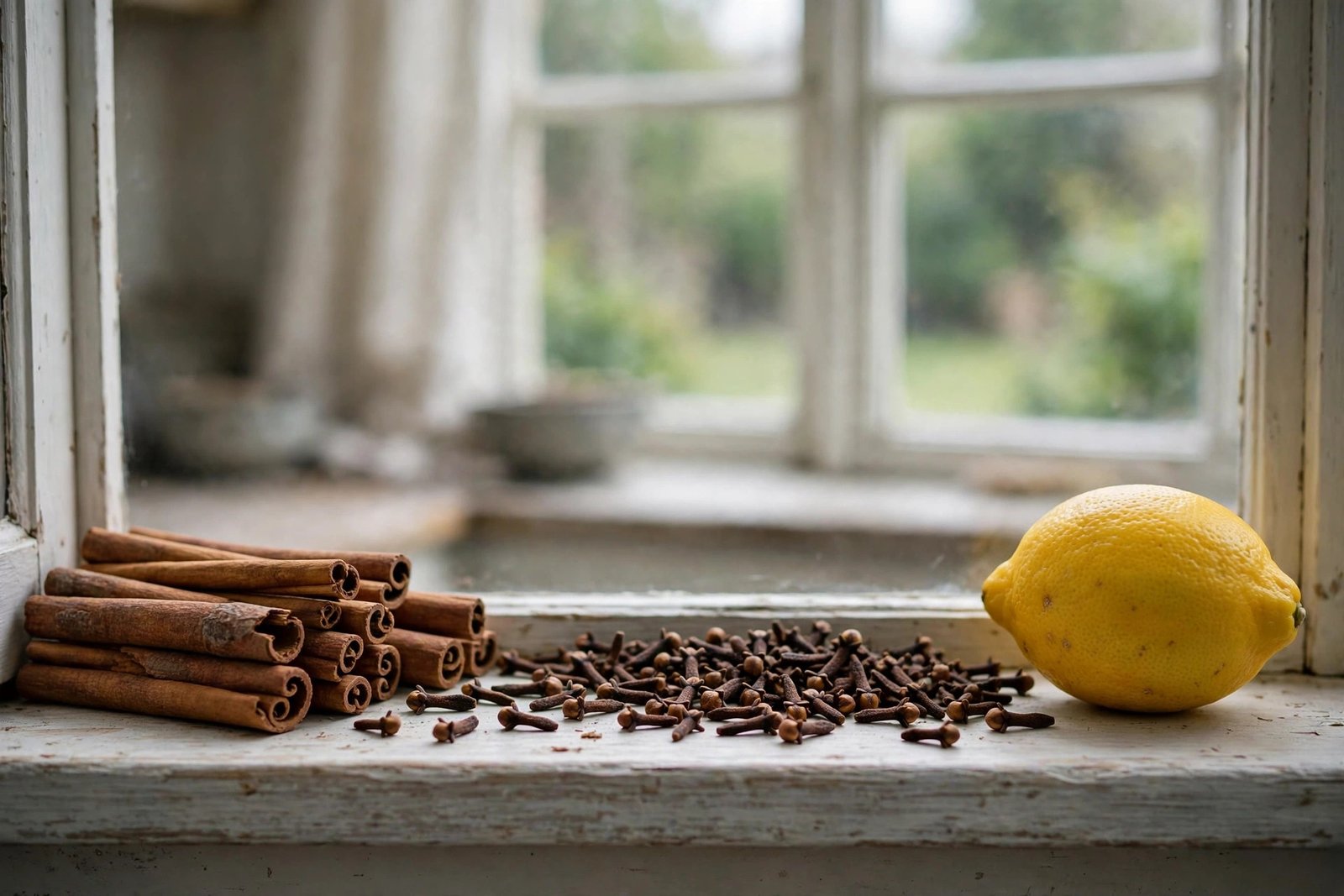
Cinnamon and clove are classic pantry repellents, and they work for a simple reason: ants avoid crossing strong, powdery, strongly scented lines. Sprinkle a thin line of ground cinnamon across a windowsill, along the back of a counter, or in front of a crack where ants enter. Whole cloves placed near entry points can have a similar effect. Some people prefer cinnamon essential oil on a cotton ball tucked near the entry, which lasts longer than loose powder and is less messy. For another take on pantry remedies, see this natural ant control guide.
Step 5: Diatomaceous Earth for Cracks, Crevices, and Dry Hiding Spots
Food-grade diatomaceous earth is a fine powder made from fossilised algae. To humans and pets it feels like chalk dust; to insects, its microscopic sharp edges damage their waxy outer coating and cause them to dry out. That makes it a useful tool for dry, hidden spots ants travel through: behind the fridge, along skirting boards, inside wall cavities you can access, and around the outside of a door frame. Apply a very thin, barely visible dusting — a thick pile actually deters ants from walking through it, which defeats the purpose.
Only use food-grade diatomaceous earth, never the pool-grade version, which is processed differently and is not safe for home use in this way. Keep it dry: it stops working when wet, so it is useless in a damp sink area until the leak is fixed. Wear a dust mask while applying it, keep it out of the reach of children, and do not puff it into the air. Vacuum it up and reapply after a week or after cleaning. It is slow — ants may take a few days to die after contact — but it is a genuine, low-chemical option for places you cannot seal immediately.
Step 6: Borax and Sugar Bait — Effective, But Only With Strict Safety Rules
When repellents and cleaning are not enough, a borax bait is a key step in how to get rid of ants in the kitchen naturally is the natural method most likely to reach the colony itself. The idea is counterintuitive: you do not kill the ants on the spot. You mix a small amount of borax with sugar water, place it where foragers will find it, and let them carry it back to the nest, where it is shared and eventually kills the colony, including the queen. A common home recipe is one part borax to three parts sugar dissolved in warm water, soaked onto cotton balls or placed in a shallow lid. Use only a small amount, and place it directly on the ant trail.
Safety comes first, without exception. Keep borax bait away from children and pets at all times. Borax is toxic if eaten in quantity, and a sweet bait is attractive to a curious child or a dog. Place baits inside a sealed bait station or a lidded container with small ant-sized holes, put them where children and pets cannot reach — behind a heavy appliance, inside a high cupboard, or outside near the entry point — and never leave open dishes of borax bait on a counter. Wash your hands after handling it, label the container clearly, and store the borax itself locked away. If a child or pet does ingest borax, contact your local poison control service or veterinarian immediately.
Be patient with bait. You may see more ants at first, because the bait attracts foragers — that is a sign it is working, not failing. Do not spray vinegar or repellent on the bait trail, or you will destroy the route the foragers need to carry the bait home. Replace the bait every few days until activity drops, then remove it entirely. If you are unsure about using borax in a home with small children or pets, skip this step and rely on cleaning, sealing, and diatomaceous earth, or ask a professional about pet-safe bait stations. For more on choosing between kitchen remedies, tiny ants in the kitchen naturally is a useful comparison of methods, including when bait is the right call and when it is not.
Step 7: Seal the Entry Points for Good
Repellents fade and baits run out, but a sealed gap stays sealed, which is why sealing is central to how to get rid of ants in the kitchen naturally. Once you know where ants are entering, close it properly. Use silicone caulk for cracks around window frames, skirting boards, and counter edges. Fit draught excluders or door sweeps on external doors. Seal gaps where pipes pass through walls under the sink with caulk or expanding foam, and check the seal around the back door and the kitchen window. This is the step that turns a one-week fix into a permanent one, and it is the step most people skip because it feels like DIY rather than pest control.
Work from the outside in if you can. Walk around the exterior of the kitchen wall and look for gaps in brickwork, damaged sealant, and holes where cables enter. Trim back plants and branches that touch the house, because they act as bridges for ants. Inside, check the less obvious routes: the gap behind the oven, the space where the worktop meets the wall, and the corners of the pantry. A tube of caulk and an afternoon of careful sealing will do more long-term good than a month of spraying.

When to Call a Professional
Most kitchen ant problems respond to the steps above, but some do not, and knowing the difference saves time and damage. Call a professional if ants keep returning after two to three weeks of consistent cleaning, baiting, and sealing; if you see large black ants and suspect carpenter ants, which nest in damp wood and can damage timber; if you find ants in electrical outlets, appliances, or wall cavities you cannot reach; or if the infestation is large, spreading to multiple rooms, or linked to a nest inside the structure of the house.
Frequently Asked Questions
How long does it take for natural ant remedies to work?
Repellents such as vinegar and cinnamon can scatter a visible trail within hours, but a lasting result usually takes one to two weeks. Bait takes longer because foragers must carry it back to the colony. If activity has not dropped after two to three weeks, recheck food sources and entry points, or consider professional help.
Is vinegar enough on its own?
Vinegar is excellent for erasing trails and cleaning, but on its own it rarely ends an invasion, because it does not reach the colony. Pair it with food storage, sealing, and, if needed, a bait for the best result.
Are cinnamon and clove safe around pets?
Ground cinnamon in small amounts on a windowsill is generally low risk, but essential oils are concentrated and should be kept where pets cannot lick them. Do not use loose powder where a pet might inhale or eat a large amount, and keep all repellents out of pet food bowls.
Can I use borax bait if I have a dog or a cat?
You can, but only in a sealed, inaccessible bait station, never as an open dish. If you cannot place a bait where pets absolutely cannot reach it, skip borax and use cleaning, sealing, and diatomaceous earth instead, or ask a professional about pet-safe options.
Why do ants keep coming back every summer?
Warm weather increases ant activity, and colonies expand their foraging range. If the same entry point and food source are available each year, the same colony — or a new one — will find them again. Annual sealing checks in spring, before the warm season, break that cycle.
Will killing the ants I see solve the problem?
Usually not. The ants you see are foragers, a small fraction of the colony. Killing them without erasing the trail, removing food, and sealing entry points leaves the colony intact and the route open. Target the trail, the food, and the nest, not just the visible line.
Conclusion
A kitchen free of ants is not about one miracle spray, and knowing how to get rid of ants in the kitchen naturally means following the sequence, not chasing one fix. It is about a sequence: remove the food, erase the trail, block the route, and, only if needed, bait the colony — all while keeping children and pets safe. Start today with the clean-up and a vinegar wipe, lay your citrus or cinnamon barrier at the main entry, and set aside an afternoon to seal the gaps properly. Most kitchens improve fast, and the habits that keep ants out — sealed containers, dry counters, and sealed gaps — make the whole kitchen cleaner and more pleasant to cook in. If the problem persists, or you suspect carpenter ants, do not keep guessing: get a professional identification and a targeted plan. Your kitchen should be a place for cooking, not a highway for a colony. Once ants are gone, see our guide to making your home smell good naturally.