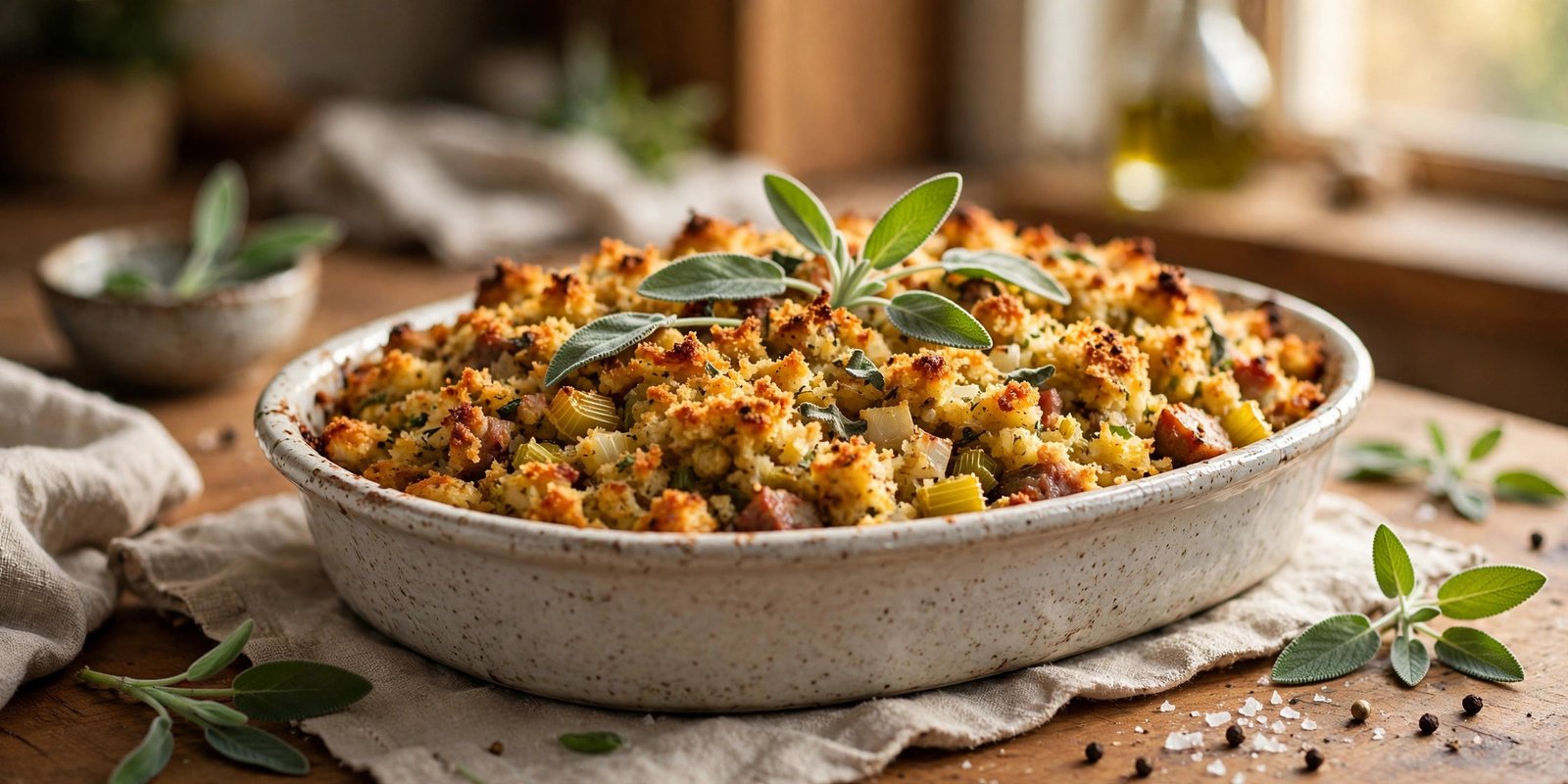

How to Make Stuffing From Scratch: The Classic Recipe (Plus 5 Variations)

There is a moment at every Thanksgiving table when someone takes a second helping of the stuffing before they have finished the first. If you want that dish on your table this year, learning how to make stuffing from scratch is the single best upgrade you can make to the holiday meal — and it is far easier than the boxed mix on the shelf makes it look. You need bread, butter, broth, and about an hour.
This guide starts with the classic sage-and-onion recipe, the one most families picture when they say the word “stuffing.” Then it gives you the exact bread, butter, broth, and egg ratios for 4, 8, or 12 servings, the food-safety rules that matter, five variations that cover nearly every guest at the table, and a make-ahead plan so you are not scrambling on Thanksgiving morning. Thanksgiving falls on Thursday, November 26, 2026, so you have time to practice once — and you should.
One note before you start: this recipe bakes the stuffing in a dish, not inside the bird. That is the safer method, and it is the one food-safety experts recommend — the stuffing still needs to reach 165°F in the center, and baking it separately means the turkey never has to overcook to get there.
What “From Scratch” Actually Means
From scratch does not mean baking your own bread, unless you want to. It means you are building the flavor yourself instead of opening a box of pre-seasoned crumbs. A box mix gives you dried bread cubes and a packet of salt, herbs, and flavorings. Homemade stuffing gives you real butter, real onion and celery cooked until sweet, fresh sage, and broth you chose. The difference shows up in the first bite.
The other advantage is control. You decide how much salt goes in, which matters because the turkey and the gravy are already salty. You can leave out the sausage for a vegetarian guest, swap the bread for a gluten-free loaf, or add oysters the way your grandmother did. A box cannot do any of that.
None of this requires special skill. If you can sauté an onion and tear bread into cubes, you can make stuffing. The rest is timing, and this guide covers that in detail.
The Three Building Blocks of Great Stuffing
Every good stuffing is a balance of three things: bread, liquid, and fat. Get the balance right and the result is moist inside, golden and crisp on top, and sliceable rather than soggy.
Bread is the structure. Use a sturdy, day-old loaf — white sandwich bread, sourdough, French bread, or a mix. Soft, fresh bread collapses into mush; bread that has sat out overnight, or spent 15 minutes in a low oven, holds its shape and soaks up broth without falling apart. Cut it into roughly one-inch cubes, not crumbs — cubes give you texture, crumbs give you paste.
Butter is the flavor. Butter carries the sage and onion through the whole dish, and it is what browns the top. Use real butter, not margarine, and do not skimp: the ratio table below calls for about one tablespoon of butter per cup of bread cubes. Serious Eats’ complete guide to Thanksgiving stuffing makes the same point — butter is doing real work here, not just adding richness.
Broth is the moisture. Chicken or turkey broth, preferably low-sodium so you control the salt. Add it gradually, a cup at a time, and stop when the bread is moist but not swimming. The cubes should look damp and clump together when squeezed, with no liquid pooling at the bottom of the bowl. Eggs bind it all together so the stuffing slices instead of crumbling.
Ingredient Ratios by Servings
Stuffing scales cleanly, which is why this table is worth keeping. The amounts below are for the classic sage-and-onion base. If you add sausage or oysters, keep the bread, butter, broth, and egg amounts the same and treat the add-in as extra.
| Ingredient | 4 servings | 8 servings | 12 servings |
|---|---|---|---|
| Bread cubes (day-old) | 4 cups | 8 cups | 12 cups |
| Butter | 4 tablespoons | 8 tablespoons (1 stick) | 12 tablespoons (1½ sticks) |
| Broth (low-sodium) | 1 to 1¼ cups | 2 to 2½ cups | 3 to 3¾ cups |
| Eggs, beaten | 1 | 2 | 3 |
| Onion, diced | ½ cup | 1 cup | 1½ cups |
| Celery, diced | ½ cup | 1 cup | 1½ cups |
| Fresh sage, chopped | 1 tablespoon | 2 tablespoons | 3 tablespoons |
| Salt and black pepper | ½ tsp each | 1 tsp each | 1½ tsp each |
The broth range is deliberate: start at the low end, mix, and add more only if the bread still looks dry. Different breads absorb differently — sourdough drinks more than white sandwich bread — so the right amount is a look and a feel, not a fixed number.
How to Make Stuffing From Scratch, Step by Step
This is the classic recipe for eight servings, using the middle column of the table above. It takes about 20 minutes of hands-on work and 45 to 50 minutes in the oven.
Step 1: Dry the bread. Cut a day-old loaf into one-inch cubes until you have about 8 cups. If the bread is fresh, spread the cubes on a sheet pan and bake at 250°F for 15 to 20 minutes, stirring once, until they feel dry on the outside but are not browned. Let them cool. This is the step people skip, and it is the step that separates stuffing from mush.
Step 2: Cook the vegetables. Melt 8 tablespoons of butter in a large skillet over medium heat. Add 1 cup of diced onion and 1 cup of diced celery with a pinch of salt. Cook for 8 to 10 minutes, stirring now and then, until the onion is soft and translucent and the celery has lost its raw crunch. Stir in 2 tablespoons of chopped fresh sage and a teaspoon of thyme leaves, and cook for one more minute until fragrant.
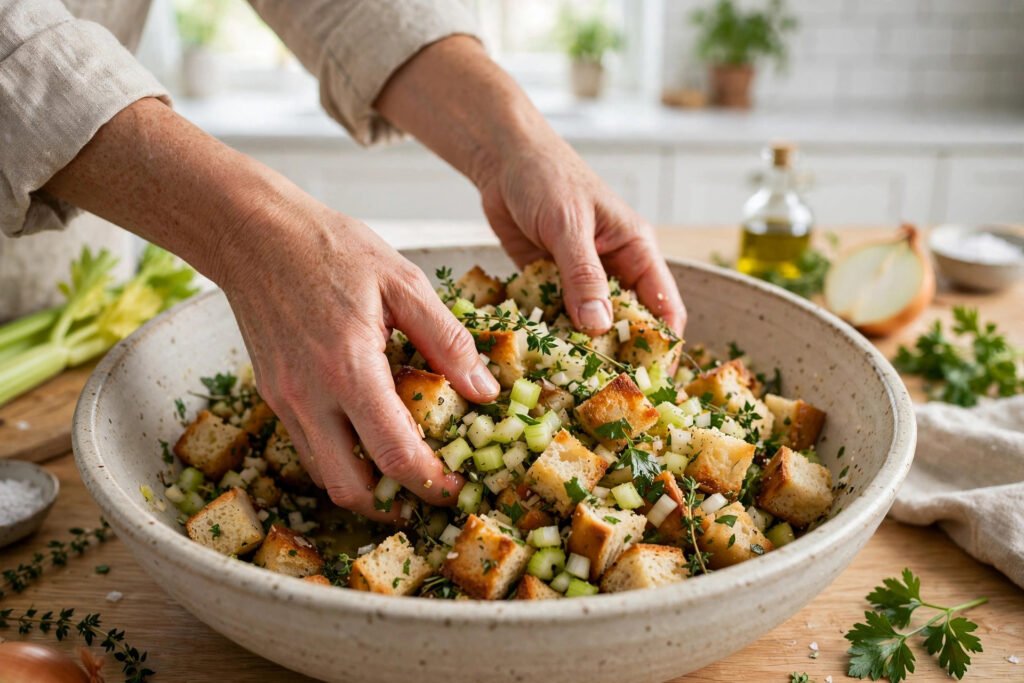
Step 3: Combine. Put the bread cubes in your largest bowl. Pour the hot butter and vegetable mixture over them, scraping the skillet clean. Toss gently so every cube gets coated, then let it sit for five minutes so the bread starts to absorb the butter.
Step 4: Add the broth, slowly. Pour in 2 cups of low-sodium chicken or turkey broth, a little at a time, tossing between pours. Stop and check: squeeze a handful of cubes. They should hold together and feel moist, with no broth pooling in the bottom of the bowl. Add up to another half cup only if the bread still looks dry.
Step 5: Beat in the eggs. Beat two eggs in a small bowl, then pour them over the mixture and toss until evenly distributed. Taste a cube and adjust the salt and pepper — this is your last chance to season.
Step 6: Bake. Butter a 9-by-13-inch baking dish and spread the stuffing in evenly, without packing it down. Dot the top with a few small pieces of butter for extra browning. Cover tightly with foil and bake at 350°F for 30 minutes. Then remove the foil and bake 15 to 20 minutes more, until the top is golden and crisp at the edges and a thermometer in the center reads 165°F.
Step 7: Rest and serve. Let the stuffing rest for 10 minutes before serving so it sets and slices cleanly. Serve it straight from the dish, family-style, with a big spoon. If you made it alongside a brined bird, check our guide on how to brine a turkey for the rest of the timing — the stuffing goes into the oven when the turkey comes out to rest.
Five Variations Worth Trying
Once you know how to make stuffing from scratch, the variations are easy — each one swaps or adds a single element and keeps everything else the same. Here are the five most requested, and they cover nearly every table.
1. Sausage Stuffing
The most popular variation for a reason. Brown one pound of bulk pork sausage in the same skillet before the vegetables, breaking it into small crumbles. Drain off most of the fat, then cook the onion and celery in the remaining drippings plus a little butter. Fold the sausage in with the eggs. Use a mild Italian sausage for flavor without heat, or a sage sausage to double down on the classic profile.
2. Cornbread Stuffing
Swap half the white bread for crumbled cornbread — Southern-style, made without sugar, if you can find or bake it. Cornbread absorbs more broth than white bread, so start at the high end of the broth range. The result is sweeter, denser, and more golden, with a crumb that holds together beautifully.
3. Oyster Stuffing
The old New England and Southern coastal classic. Add one pint of shucked oysters, drained and roughly chopped, along with a tablespoon of their liquor, when you add the eggs. The oysters bake into the stuffing and add a briny, savory depth that pairs perfectly with turkey. And do not skip the food-safety step: the stuffing still needs to reach 165°F in the center, oysters included.
4. Gluten-Free Stuffing
Use a sturdy gluten-free loaf, dried the same way, and keep everything else identical. The one difference: gluten-free bread absorbs broth faster and can go soggy sooner, so add the broth more slowly and stop at the low end of the range. Check the broth label too — some broths contain gluten.
5. Vegetarian Stuffing
The classic recipe is nearly vegetarian already: swap the chicken broth for a good vegetable broth and you are done. To make it richer, add a cup of sautéed mushrooms — cremini work well — with the onion and celery, and a handful of toasted pecans or walnuts at the end for crunch. Butterball’s holiday recipe collection includes vegetarian-friendly sides built on exactly this pattern.
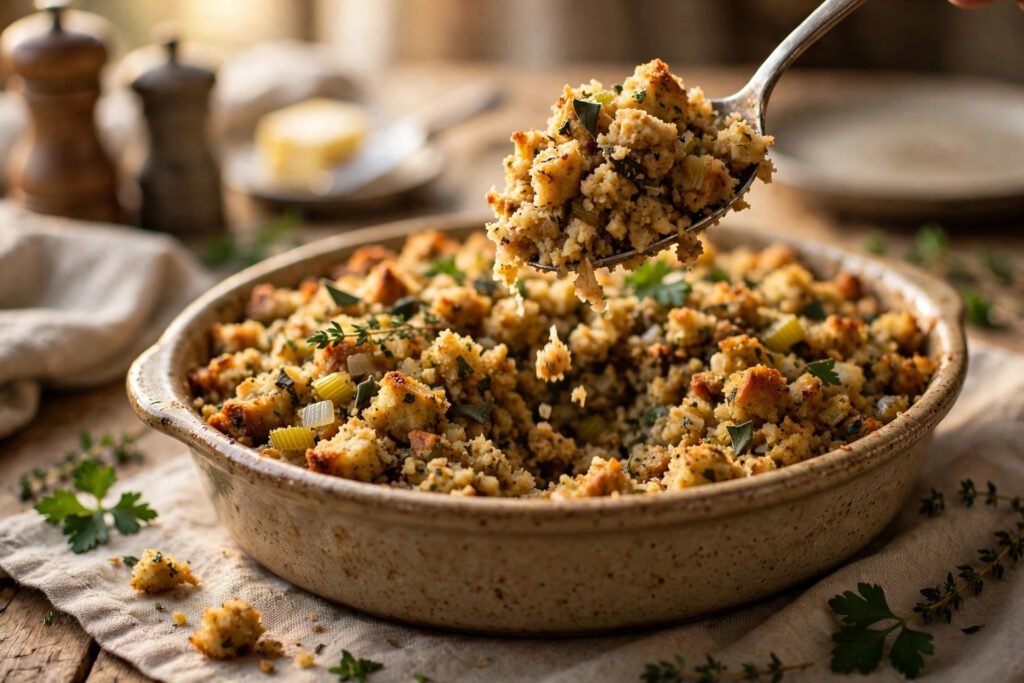
Food Safety: The 165°F Rule
Stuffing is a food-safety risk if it is handled carelessly, because warm, moist bread is an excellent place for bacteria to grow. The rules are simple and worth following exactly.
Cook it to 165°F. Whether you bake it in a dish or inside the bird, the center of the stuffing must reach 165°F. Use a thermometer — the top can look golden while the middle is still lukewarm. If you do stuff the turkey, pack it loosely, never the night before, and check the temperature of both the stuffing and the bird.
Never stuff the bird the night before. Raw turkey juices soak into the stuffing overnight, and bacteria multiply in that window. If you insist on stuffing the bird, do it right before it goes into the oven. The safer choice — the one this guide uses — is baking the stuffing separately in a dish.
Cool and store it fast. Leftovers should go into the refrigerator within two hours of serving, in shallow containers so they cool quickly. Eat them within three to four days, and reheat to 165°F. FoodSafety.gov is clear on both points, and Thanksgiving is the worst day of the year to test them.
Do not leave it on the counter. Stuffing sitting out on the buffet while everyone watches the game is the classic mistake. If it has been out for more than two hours, it goes in the trash, not back in the fridge.
Make-Ahead and Freezer Guide
Thanksgiving morning is crowded enough without stuffing prep. The good news is that nearly all of it can be done the day before.
The day before: dry the bread cubes and store them in a bag at room temperature. Cook the onion, celery, and herbs in butter, cool, and refrigerate. Brown any sausage and refrigerate it separately. Do not combine the wet and dry parts yet — mixed stuffing sitting overnight in the fridge turns soggy.
Thanksgiving morning: combine everything, add the broth and eggs, and bake as directed. The whole assembly takes about ten minutes. If your oven is busy with the turkey, the stuffing can wait: assemble it, cover it, and refrigerate for up to a few hours, then bake while the turkey rests.
Freezing: baked stuffing freezes well for up to a month. Cool it completely, portion it into freezer bags, and press out the air. Thaw overnight in the fridge, then reheat covered at 350°F until it reaches 165°F, uncovering for the last ten minutes to re-crisp the top.
If you are planning the whole meal, the timing connects to the rest of the table: the turkey needs thawing days in advance, and our guide to how to thaw a turkey safely covers the refrigerator math. The gravy from scratch uses the drippings, and the cranberry sauce from scratch can be made a week ahead — it is the one dish that actually improves with time.

Frequently Asked Questions
Can I make stuffing the day before Thanksgiving?
Yes, with one rule: prepare the parts separately and combine them on the day. Dry the bread, cook the vegetables, and brown the sausage the day before. Mix everything with the broth and eggs on Thanksgiving morning and bake.
How do I keep stuffing from getting soggy?
Three things: dry the bread cubes first, add the broth gradually and stop when the bread is moist but not swimming, and bake uncovered for the last 15 to 20 minutes so the top crisps.
Can I use fresh bread instead of day-old bread?
You can, but dry it first. Spread the cubes on a sheet pan and bake at 250°F for 15 to 20 minutes until they feel dry on the outside. Fresh, soft bread soaks up broth too fast and collapses into mush.
Should stuffing be cooked inside the turkey or separately?
Separately is safer and gives you better results. Stuffing cooked inside the bird must reach 165°F in the center, which usually means the turkey overcooks, and it can only be stuffed right before roasting — never the night before. A baking dish gives you a crisp top and full control over the temperature.
How long does leftover stuffing last?
Three to four days in the refrigerator, stored in shallow containers and cooled within two hours of serving. Reheat to 165°F. It also freezes well for up to a month.
What is the difference between stuffing and dressing?
Only where it is cooked. “Stuffing” is baked inside the bird; “dressing” is baked in a dish alongside it. In practice, most Americans use the words interchangeably, and the recipe is the same either way.
Conclusion
Learning how to make stuffing from scratch comes down to three habits: dry the bread, add the broth slowly, and cook it to 165°F. The classic sage-and-onion version in this guide is the one to master first, and the five variations are there for the years when you want something different. Make the parts the day before, assemble in the morning, and bake it while the turkey rests.



