

Uber vs Lyft: Which Is Cheaper and Faster in 2026?
You’re standing on a rainy curb at 11 p.m., bags at your feet, and both apps are flashing a number at you. Uber says $24. Lyft says $21. Or maybe it’s the other way around. If you’ve ever stared at those two prices wondering whether the uber vs lyft debate has a real answer — whether one app is genuinely cheaper, faster, or simply better — this guide is for you.
Here’s the short version: neither app is always cheaper. But that’s not the whole story. A landmark economics study audited 2,238 identical rides and found the two apps disagree on price by about 14% on average. A separate analysis of 263 million real New York City trips reveals exactly where, when, and for what kind of ride each app wins.
uber vs lyft prices: what 2,238 identical rides revealed
The cleanest price test ever run on rideshare comes from economists at Harvard, Johns Hopkins Carey, and Theia Insights. Their NBER working paper, “Leaving Money on the Dashboard,” audited 2,238 matched trips across New York City during one week in February 2025 — the same routes, at the same times, quoted on both apps.
The headline findings:
- The average absolute price gap was about $3.50 — roughly 14% of the average fare — for the exact same ride.
- The uber vs lyft price gap exceeded $1 about 75% of the time. Meaningful savings are the norm, not the exception.
- Neither app is consistently cheaper. The gap distribution is roughly symmetric — sometimes Uber wins, sometimes Lyft does.
- Only 16.1% of riders who open one app also open the other. The rest book blind — and researchers estimate this inflates the platforms’ New York City revenue by more than $300 million per year.
As the Johns Hopkins Carey Business School research summary puts it: small frictions — habit, perceived hassle, app design — weaken competition and raise what everyone pays. The highest-value habit in this article is also the simplest: open both apps before you book.
Where each app actually wins: the borough and distance patterns
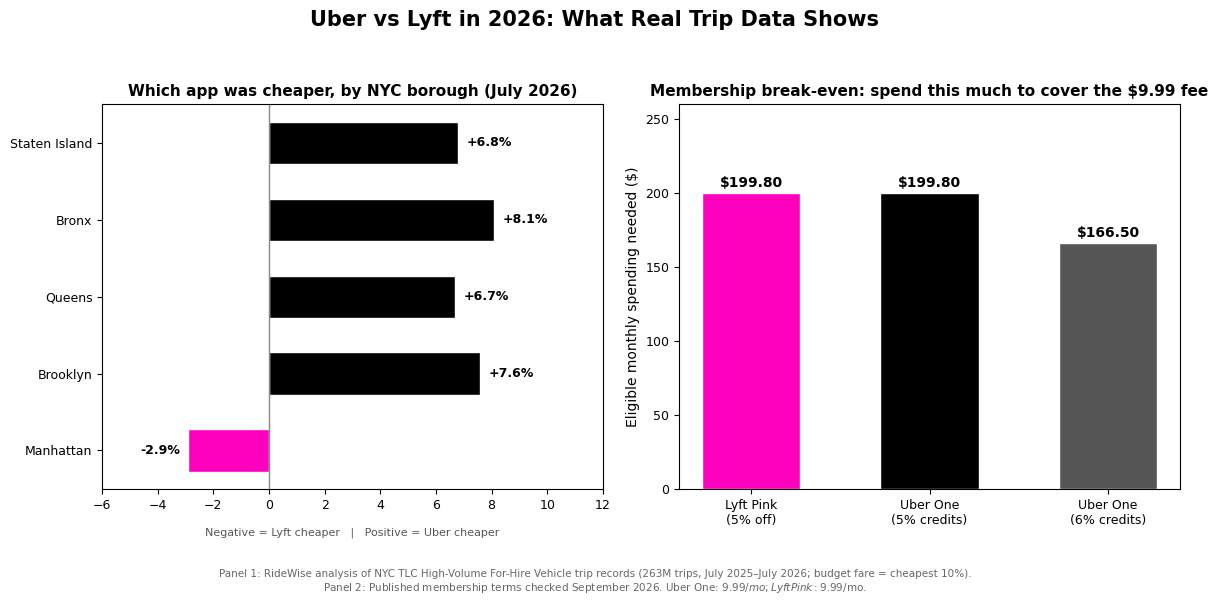
A second dataset goes even deeper. An independent 263-million-trip analysis of New York City’s public trip records (July 2025 through July 2026) compared what riders actually paid on the same routes at the same hours. The patterns are strikingly specific:
- Outside Manhattan, Uber’s cheapest rides now beat Lyft’s by 7–8%. This is the single biggest pattern in the data.
- In Midtown Manhattan, Lyft still wins — its cheapest fares run 13–17% below Uber’s around Midtown and Times Square.
- On rides under a mile, Lyft’s budget fare was 8.9% cheaper. Hopping a few blocks? Open Lyft first.
- On rides of 2 to 8 miles, Uber’s cheapest option wins by 11–18%. That covers a huge share of everyday trips.
- Longer rides are roughly a tie at the budget end — the apparent Lyft edge on long trips mostly reflects more Uber riders choosing XL or Black cars.
One more twist: the balance has shifted. A year ago, Lyft’s typical fare sat 6.2% below Uber’s on the same routes. Lyft’s typical fare has since risen 7.1% while Uber’s rose just 1.7%, and the two are now about even. Lyft’s old budget-app reputation is outdated — at least in New York.
The practical takeaway: in dense downtown cores and for very short hops, check Lyft first. For standard cross-town trips in the outer boroughs and suburbs, check Uber first. But always check both — the apps disagree by more than a dollar three rides out of four.
Wait times and availability
Price is half the equation. The same New York trip records track how long riders waited from tapping “request” to getting in the car — and this is the rare dataset that measures wait times from actual completed trips rather than surveys.
For a typical ride, Uber is slightly faster: the median Uber rider was picked up 4.3 minutes after requesting, versus 4.6 minutes on Lyft. On matching pickup areas and hours, Uber was faster 71% of the time. That edge comes from Uber’s larger driver network — it handles about 72% of New York City trips.
But the averages hide an important asymmetry. Uber also has more very long waits: 11% of Uber rides took more than 10 minutes, compared with 6% on Lyft. The two apps treat slow pickups differently, too — Uber riders who waited 10 to 15 minutes paid about 5% less than normal (riders trading time for a discount), while Lyft riders who waited that long paid about 7% more (busy periods with surge pricing).
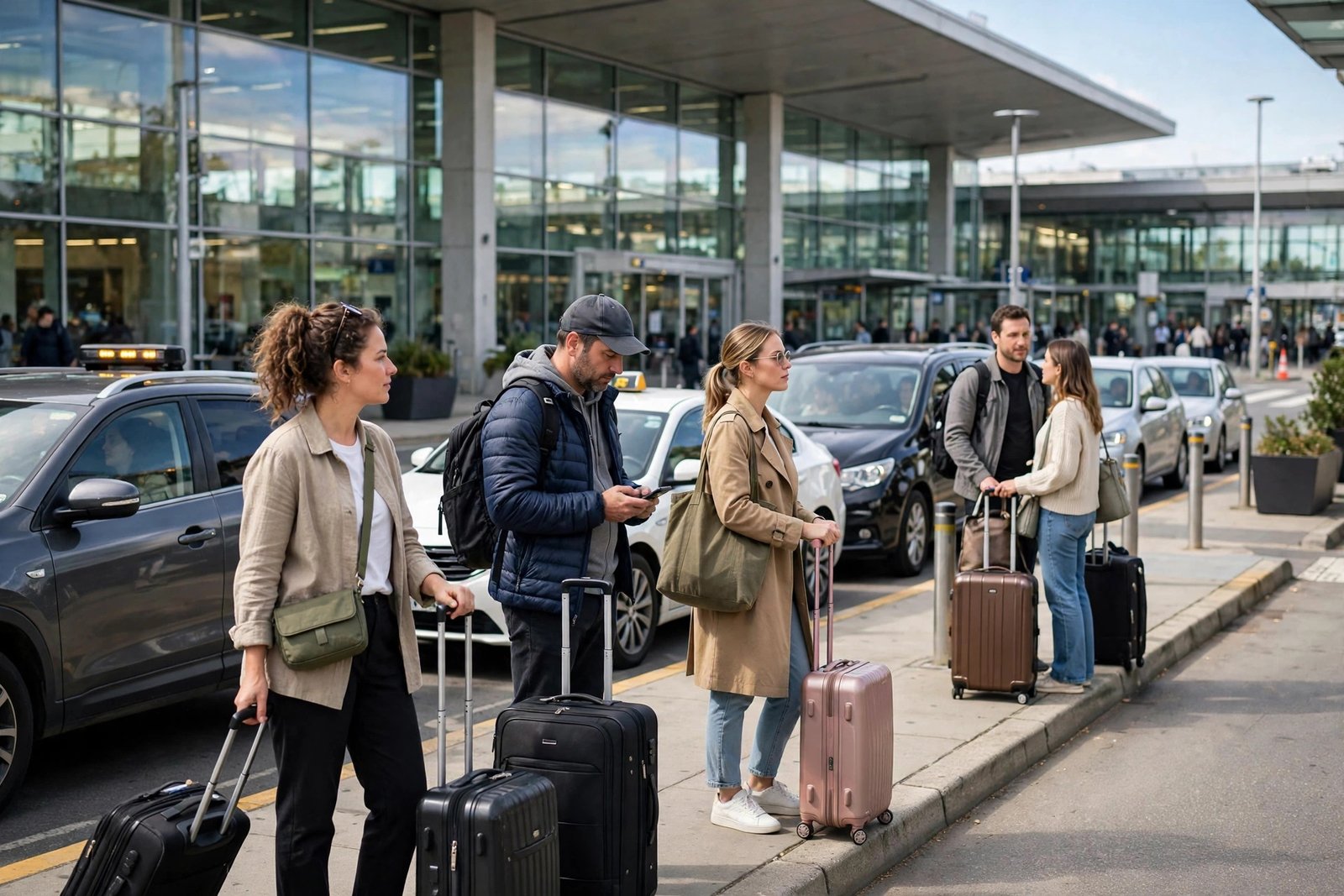
Airports deserve a special note, since that’s where many travelers make the call. At LaGuardia, Lyft was clearly faster — 5.6 minutes median against Uber’s 6.9 — while JFK was about even. And on airport routes like Midtown to JFK, Lyft’s typical all-in fare came in dramatically lower ($114.00 vs $141.38), though part of that gap reflects more Uber riders booking XL or Black cars. Packing light with the best carry-on luggage saves you checked-bag fees on the flight itself — and checking Lyft first at the curb may save you on the ride.
App experience and features
Both apps converged years ago on the same basic flow: set pickup, set destination, see an upfront price, track your driver on a live map. The differences now live in the details.
Uber’s edge is breadth. Beyond standard UberX, it offers scheduled rides, package delivery, and food and grocery ordering in the same app — plus Wait & Save, which cuts the fare during surge periods in exchange for a longer wait. The trip data suggests Uber’s version is doing real work: those discounted slow pickups show up clearly in the numbers.
Lyft’s edge is simplicity and rider-friendly touches. Its app is cleaner and less cluttered with upsells. Lyft’s own Wait & Save trades roughly a 20-minute wait for about $1–$5 off — ideal for an unhurried trip home.
Honestly, most riders will be happy with either app. If you order food delivery too, Uber’s combined ecosystem is the tiebreaker. If you just want a car with minimal fuss, Lyft’s cleaner interface wins on vibes.
Driver pay and experience
Where your fare goes matters — for the driver’s livelihood, and because pay shapes which drivers stick around. The New York data offers a rare transparent window:
- Uber drivers received 77% of the fare (before tolls, tips, taxes, and fees) in July 2026; Lyft drivers received 75%. A year earlier the split was 77% and 79% — so Lyft’s recent price increases did not flow to drivers.
- Lyft riders tip more often: 22% of Lyft rides included a tip versus 19% on Uber. Tips added 5.3% to Lyft fares overall, against 4.4% on Uber.
- Both apps operate under New York’s minimum driver pay rules, which rose 3.36% in March 2026 — and pay on the same trips actually grew faster at Uber (5.3%) than at Lyft (3.2%).
Driver experience also differs in tone. Lyft built its brand on friendliness, and its rating culture and in-app tipping prompts remain slightly more generous. Uber counters with scale: more ride requests per hour in most markets, plus delivery work through the same driver app — steadier earnings, and more drivers on the road for you.
Coverage: cities, airports, and small towns
In America’s major metro areas, both apps blanket every large city with plenty of drivers. The coverage gap opens up at the margins:
- Small cities and suburbs: Uber’s larger network usually means shorter waits and more consistent availability outside downtown cores. If you live 20 minutes from the city center, Uber is the safer default.
- Airports: both serve every major US airport, but pickup logistics differ by terminal — follow the app’s directions to the designated rideshare zone rather than the taxi line. At LaGuardia specifically, the data favors Lyft on both price and wait time.
- International travel: Uber operates in far more countries than Lyft, which is concentrated in the US and Canada. Landing abroad, Uber (or a local equivalent) is usually your only option of the two.
- Rural areas: neither app is reliable far from population centers — check both apps the night before a rural trip, and have a taxi company’s number as backup.
Subscriptions: Uber One vs Lyft Pink
Both companies sell a $9.99/month membership, and the uber vs lyft subscription math is refreshingly concrete. Prices below were verified against the companies’ published membership terms in September 2026.
Uber One — $9.99/month (discounted annual plan available). The ride benefit is 5–6% back in Uber One credits on eligible rides — credits, not an instant discount, and they expire 60 days after they’re issued. The membership’s real power is in delivery: $0 delivery fees on eligible Uber Eats orders. For rides alone, the fee breaks even at roughly $167–$200 of eligible monthly ride spending.
Lyft Pink — $9.99/month or $99/year, plus an All Access tier at $199/year. Pink gives an instant 5% off Standard, Extra Comfort, and XL rides (applied in the upfront price, not as future credit), free Priority Pickup upgrades, relaxed cancellations (fee credited up to 3 times a month when you rebook within 15 minutes), waived lost-and-found fees, and bike/scooter unlocks. All Access adds 10% off Black rides and unlimited 45-minute classic bike rides in cities like New York and Chicago. Per Lyft’s official Lyft Pink page, members save $23 per month on rides on average. Pink’s 5% discount covers the monthly fee at $199.80 of eligible spending.
The detailed Uber One vs Lyft Pink break-even math confirms both standard plans cost the same — so the decision comes down to mechanics: Lyft’s instant discount beats Uber’s expiring credits for pure ride savings, while Uber One wins if you also order delivery. One caution: a subscription never guarantees its app shows the cheapest fare. Keep comparing both apps per ride, membership or not.
Safety features
Both apps now ship essentially the same safety toolkit:
- In-app emergency assistance that can call local authorities and share your live location.
- Real-time trip sharing so a friend or family member can follow your route on a live map.
- Driver and vehicle verification — check the license plate, driver photo, and name before you get in, every time.
- PIN verification for matching with the correct car in crowded pickup zones like airports and stadiums.
- GPS trip tracking and support with trip records stored in your ride history.
The safety habits that matter most are yours, not the app’s: verify the plate, sit in the back seat, share your trip on late-night rides, and never get into a car that doesn’t match the app.
Verdict by use case
The right answer depends on your situation:
- Daily commuter in the outer boroughs or suburbs: Uber, and check Lyft as backup — Uber’s budget fares run 7–18% lower on typical mid-distance trips.
- Downtown core / Manhattan: Lyft first — 13–17% cheaper around Midtown, 8.9% cheaper on sub-mile hops.
- Airport runs: Lyft at LaGuardia (faster pickups, lower typical fares); compare both at JFK.
- Not in a hurry: whichever app’s Wait & Save discount is deeper right now.
- Frequent rider: Lyft Pink for instant ride discounts; Uber One if you also order food delivery.
- Traveling internationally: Uber — it’s the one that will be there.
- Everyone, every ride: open both apps and compare. You’ll find a meaningful price difference three times out of four.
And if you’re planning the trip around the ride, our guide to how to find cheap flights pairs well — savings on the flight and the airport transfer stack. Packing light with the right best travel backpack doesn’t hurt either when you’re sprinting to the rideshare pickup zone.
FAQs
Is Uber cheaper than Lyft in 2026?
Sometimes — but not consistently. A 263-million-trip analysis of New York City rides found Lyft’s cheapest fares ran 3.8% higher than Uber’s cheapest fares overall in July 2026, yet Lyft was 13–17% cheaper in Midtown Manhattan and 8.9% cheaper on rides under a mile. An NBER study of 2,238 identical rides found the two apps’ prices differ by about 14% on average with neither consistently cheaper. Compare both apps for each trip.
Why is Lyft sometimes more expensive than Uber?
Both apps use dynamic upfront pricing that moves with local driver supply and rider demand minute by minute. When Lyft has relatively fewer available drivers than Uber in your area at that moment, its algorithm quotes higher. Over the past year in New York, Lyft’s typical fare rose 7.1% while Uber’s rose 1.7% — erasing Lyft’s old discount reputation.
Which app has shorter wait times, Uber or Lyft?
Uber, slightly. Across New York City’s trip records, the median Uber pickup took 4.3 minutes versus 4.6 minutes on Lyft, and Uber was faster in 71% of matched pickup areas and hours. But Uber also produces more very long waits (11% over 10 minutes vs 6% on Lyft) — while Lyft was notably faster at LaGuardia airport.
Is Uber One or Lyft Pink worth it?
It depends on volume. Both cost $9.99/month. Lyft Pink’s instant 5% ride discount pays for itself at about $200/month in eligible rides, plus Priority Pickup upgrades and relaxed cancellations. Uber One gives 5–6% back as credits (expiring in 60 days) on rides, but its strongest value is $0 delivery fees on Uber Eats. Heavy delivery users should pick Uber One; pure frequent riders get cleaner value from Lyft Pink.
Do Uber and Lyft show the same price to everyone?
No. Both use personalized dynamic pricing — the quote depends on your exact pickup point, destination, time, local demand, and even small differences like walking a block or waiting five minutes. That’s exactly why the uber vs lyft comparison has to happen per ride, in the moment, with both apps open.
Can I use Uber or Lyft outside the US?
Uber operates in far more countries worldwide, making it the default choice abroad. Lyft is concentrated in the United States and Canada. If you’re cruising out of a US port, our first-time cruise mistakes guide covers the port-transfer timing that catches many travelers off guard.
The bottom line
So in the uber vs lyft matchup of 2026, the data tells a clear story: the cheaper app changes with your neighborhood, your trip distance, and the hour — and the gap between them averages 14%, which is real money. Uber brings the bigger network, slightly faster typical pickups, and better suburban coverage. Lyft brings downtown discounts, faster airport pickups at places like LaGuardia, and the cleaner subscription for pure riders.
But the single most valuable finding in all of this research isn’t about either company. It’s that only 16% of riders bother to open both apps — leaving an estimated $300 million a year on the table in one city alone. Open both, compare, and let the data pick your ride.